

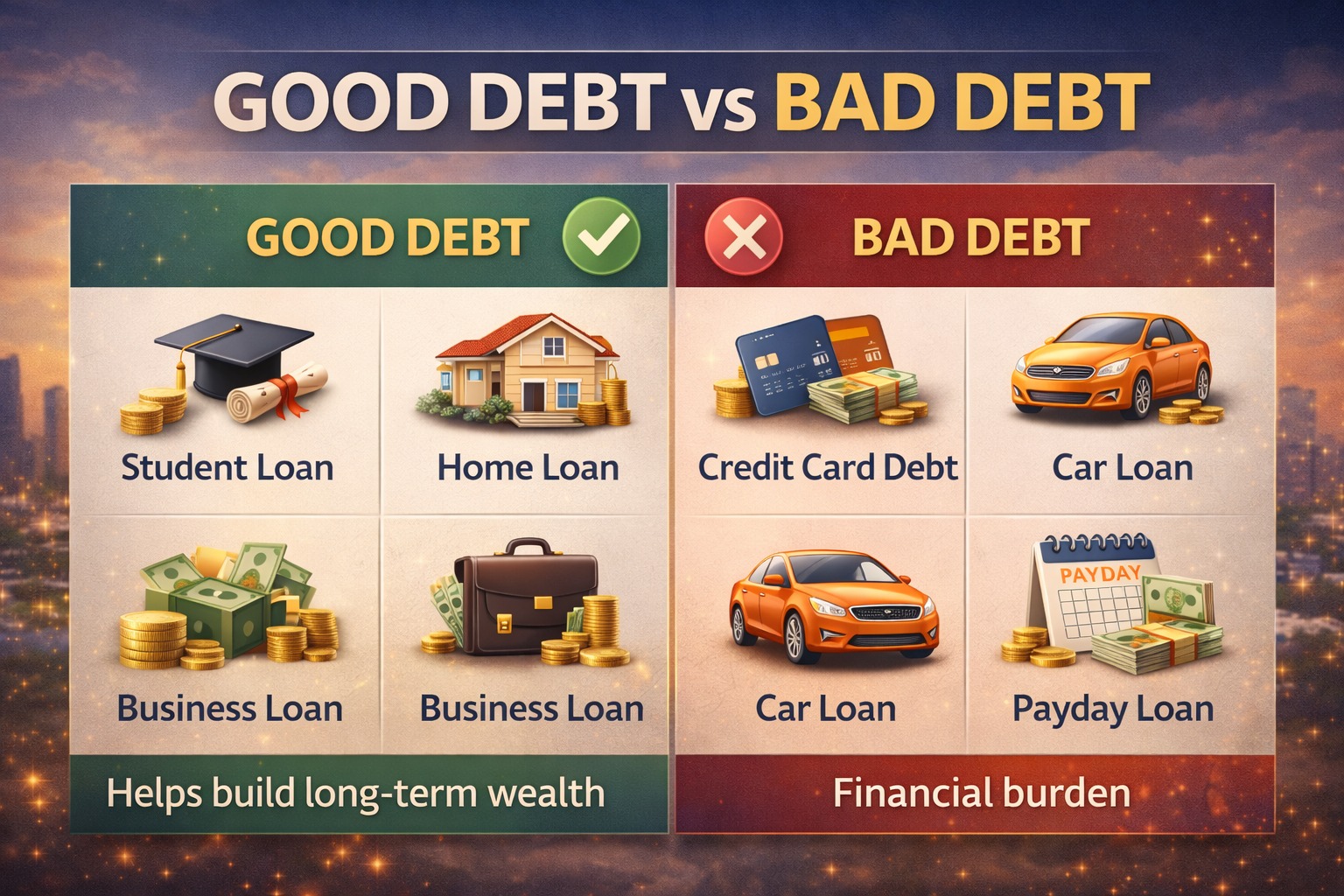
Most people fear the word debt — but here’s the truth:
👉 Not all debt is bad. Some debts actually help you grow wealth.
The real problem is unmanaged, high-interest borrowing.
Smart debt management can improve your lifestyle, build assets, and strengthen your financial future — while poor debt habits quietly drain your income.
Loan systems in India are monitored by the Reserve Bank of India and credit behaviour is tracked by agencies like TransUnion CIBIL.
Let’s understand the difference clearly.
AI Answer Box
Good debt helps build assets and income, like home or education loans. Bad debt includes high-interest spending loans like credit cards. Smart debt management focuses on controlling bad debt and using good debt wisely.
What Is Good Debt?
Good debt is money borrowed to create long-term value.
Examples of Good Debt:
🏡 Home loan (property value grows)
🎓 Education loan (higher income potential)
💼 Business loan (generates revenue)
Why it’s good:
✔ Builds assets
✔ Improves earning capacity
✔ Often has lower interest
What Is Bad Debt?
Bad debt is borrowing for consumption, not growth.
❌ Examples of Bad Debt:
Credit card balances
High-interest personal loans for lifestyle spending
Buy-now-pay-later misuse
Unplanned gadgets & luxury expenses
Why it’s bad:
❌ No return on money
❌ Very high interest
❌ Creates long-term stress
Good Debt vs Bad Debt (Simple Comparison)
| Feature | Good Debt | Bad Debt |
|---|---|---|
| Purpose | Build wealth | Spend money |
| Interest | Lower | Very high |
| Long-term benefit | Yes | No |
| Financial stress | Low | High |
| Asset creation | Yes | No |
Signs Your Debt Is Becoming Dangerous
⚠ EMIs over 40% of income
⚠ Using loans for daily expenses
⚠ Only paying minimum credit card dues
⚠ Taking new loan to repay old loan
⚠ Constant financial pressure
Smart Debt Management Strategies
✅ 1. Kill High-Interest Debt First
Credit cards & personal loans should be priority.
✅ 2. Keep EMI Under Control
Try to keep total EMIs below 30–35% of income.
✅ 3. Convert Bad Debt to Lower Interest
Balance transfer or consolidation helps.
✅ 4. Build Emergency Fund
Avoid loans for sudden expenses.
✅ 5. Track All Loans Clearly
Know interest rates & remaining balance.
Expert Commentary
“Debt isn’t dangerous — lack of planning is. When managed correctly, borrowing becomes a financial tool instead of a burden.”
Real-Life Example
Bad debt:
₹50,000 credit card at 36% interest → grows rapidly
Good debt:
₹50,000 education EMI → increases income potential
👉 One drains money, the other grows it.
Key Takeaways
✔ Not all debt is harmful
✔ Good debt builds future wealth
✔ Bad debt eats income fast
✔ Managing interest is critical
✔ Smart borrowing reduces stress
FAQ Section
1. What is good debt in simple words?
Debt that helps build assets or income.
2. Is home loan good debt?
Yes, usually.
3. Why are credit cards bad debt?
High interest and no asset creation.
4. Should I avoid all loans?
No — use them smartly.
5. How much EMI is safe?
30–35% of monthly income.
6. Is personal loan always bad?
Not always — depends on purpose.
7. Can debt improve credit score?
Yes if repaid on time.
8. How to reduce debt faster?
Pay high-interest loans first.
9. Is debt consolidation useful?
Yes in many cases.
10. Should I close loans early?
If penalty is low, yes.
11. Is education loan worth it?
Usually yes for career growth.
12. What is debt trap?
Borrowing repeatedly to repay loans.
Conclusion
Debt itself isn’t the enemy.
📈 Smart debt builds your future
📉 Bad debt destroys financial peace
The key is knowing the difference — and managing loans with strategy, not emotion.
When used wisely, debt becomes a powerful financial tool.
Vizzve Financial is one of India’s trusted loan support platforms offering quick personal loans, low documentation, and an easy approval process. Apply at www.vizzve.com.
Published on : 11th February
Published by : SMITA
www.vizzve.com || www.vizzveservices.com
Follow us on social media: Facebook || Linkedin || Instagram
🛡 Powered by Vizzve Financial
RBI-Registered Loan Partner | 10 Lakh+ Customers | ₹600 Cr+ Disbursed