

Introduction
When a borrower misses loan payments, the lender may begin a debt recovery process to collect overdue amounts. Recovery can involve reminders, customer-service communication, restructuring or settlement discussions where appropriate, and in some cases formal legal or enforcement procedures.
Debt recovery is an important part of the lending system, but it must be carried out fairly and lawfully.
For borrowers, the process can sometimes feel confusing or stressful. Understanding what recovery agents can do, what they cannot do, how to respond to overdue payments, and where to raise a complaint can make the situation easier to manage.
The Reserve Bank of India (RBI) has issued guidelines concerning recovery agents and prohibits regulated entities and their agents from using intimidation or harassment in debt collection. RBI guidance also places responsibility on regulated entities for the conduct of their outsourced recovery agents.
This guide explains the debt recovery process in India, borrower rights, recovery-agent responsibilities, repayment strategies, and practical steps for handling overdue loans.
AI Answer Box: What Is Debt Recovery?
Debt recovery is the process through which a lender attempts to collect money that a borrower has not paid according to the agreed repayment schedule.
The process may include:
- Payment reminders
- Calls or written communication
- Follow-up regarding overdue EMIs
- Engagement of authorized recovery agents
- Repayment or resolution discussions
- Formal notices where applicable
- Legal recovery proceedings or enforcement measures, depending on the loan and applicable law
Short Answer
If you have an overdue loan, the best approach is usually to communicate with the lender, verify the outstanding amount, understand your repayment options, keep records of communications, and raise a formal complaint if recovery conduct violates applicable rules.
What Is Debt Recovery?
Debt recovery refers to efforts made to collect an outstanding debt after a borrower has failed to make payment when due.
It can apply to different types of borrowing, including:
- Personal loans
- Home loans
- Vehicle loans
- Business loans
- Credit-card dues
- Consumer loans
- Other forms of credit
The recovery process depends on the loan agreement, type of lender, type of security involved, applicable RBI directions, and relevant Indian laws.
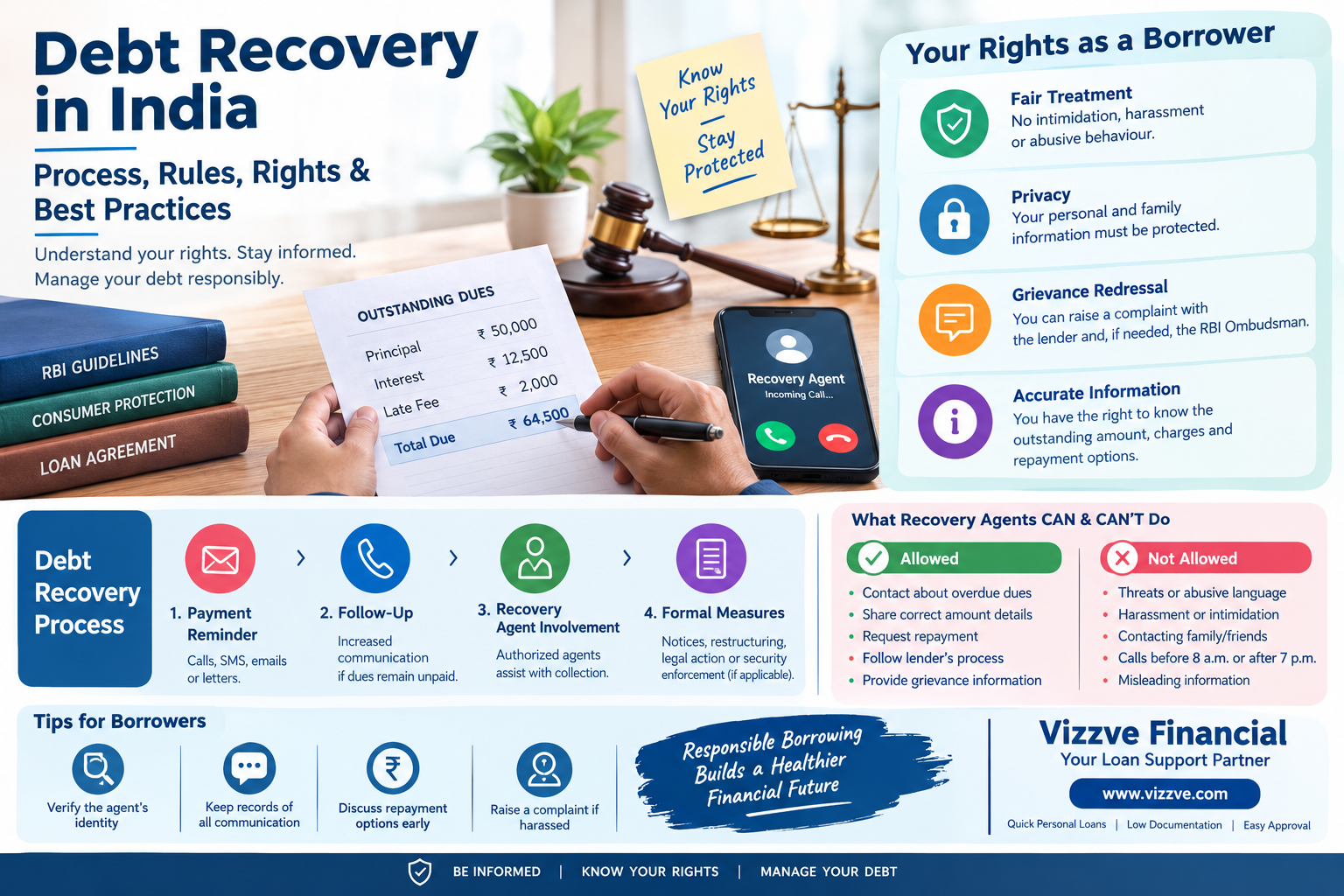
How Does the Debt Recovery Process Work in India?
There is no single recovery procedure for every loan. However, the process commonly develops through several stages.
Stage 1: Payment Reminder
The lender may first contact the borrower regarding an overdue EMI.
Communication may occur through:
- Phone
- SMS
- App notifications
- Letters
- Other authorized channels
At this stage, borrowers should check whether the payment is genuinely overdue and confirm the amount payable.
Stage 2: Follow-Up and Recovery Communication
If the overdue amount remains unpaid, the lender may increase follow-up efforts.
The objective should be to obtain repayment or reach an appropriate resolution rather than using intimidation.
RBI specifically states that regulated entities and their recovery agents should not resort to intimidation or harassment, including threatening calls, inappropriate messages, public humiliation, or persistent calls at prohibited times.
Stage 3: Recovery Agent Involvement
A lender may appoint a recovery agency to assist with collection.
However, outsourcing does not remove the lender's responsibility. RBI's 2022 instructions state that the regulated entity remains responsible for the actions of its recovery agents.
Stage 4: Formal Recovery Measures
If the debt remains unresolved, further action may depend on the circumstances.
This can potentially include:
- Formal notices
- Negotiated repayment arrangements
- Restructuring, where applicable
- Legal proceedings
- Enforcement of security, where applicable
The exact process varies by loan category and legal framework.
What Are Debt Recovery Agents?
A recovery agent is generally an individual or agency engaged by a regulated financial institution to recover outstanding dues.
Recovery agents can communicate with borrowers and seek payment, but their activities are subject to applicable rules and the lender's responsibilities.
RBI requires regulated entities to have appropriate mechanisms concerning recovery agents, including due diligence and conduct requirements.
What Are Recovery Agents Allowed to Do?
A legitimate recovery process can involve activities such as:
- Contacting a borrower regarding overdue dues
- Communicating the outstanding amount
- Requesting repayment
- Explaining available repayment procedures
- Following the lender's authorized recovery process
- Visiting a borrower where permitted under the applicable framework
- Providing information about grievance channels
The precise scope depends on the lender, loan agreement and applicable regulations.
What Recovery Agents Cannot Do
Debt recovery does not give an agent unlimited authority.
RBI guidelines prohibit intimidation and harassment in recovery activities. Examples identified by RBI include:
- Threatening or abusive language
- Physical intimidation
- Public humiliation
- Harassing family members, friends or colleagues
- Threatening violence
- Misleading representations
- Persistent calls
- Inappropriate messages
- Calls during prohibited hours
For many regulated entities, RBI's instructions specifically prohibit recovery calls before 8:00 a.m. and after 7:00 p.m.
Some RBI directions applicable to particular regulated entities may prescribe different calling-hour limits, so borrowers should consider the rules applicable to their lender and loan type.
Debt Recovery vs Debt Collection
The terms are often used interchangeably, but they can describe slightly different stages or activities.
| Debt Collection | Debt Recovery |
|---|---|
| Broad process of collecting outstanding payments | Often refers to efforts to recover overdue debt |
| Can begin with payment reminders | May involve stronger recovery measures |
| May involve customer-service teams | May involve specialized recovery agents |
| Can occur before serious default | Commonly associated with overdue accounts |
| May be informal | Can eventually involve formal or legal measures |
The terminology used by lenders can vary.
Borrower Rights During Debt Recovery
Borrowers have responsibilities, but they also have protections.
1. Right to Fair Treatment
A borrower should not be subjected to intimidation or harassment merely because an EMI is overdue.
RBI's recovery-agent instructions explicitly prohibit such conduct.
2. Right to Privacy
Recovery efforts should not unnecessarily intrude into the privacy of the borrower or their family members.
RBI guidance specifically addresses privacy and prohibits practices such as public humiliation and inappropriate contact with family members, friends or referees.
3. Right to Grievance Redressal
Regulated entities are expected to maintain mechanisms for handling recovery-related grievances.
4. Right to Accurate Information
Borrowers should be able to understand:
- Amount overdue
- Applicable charges
- Outstanding balance
- Repayment requirements
- Relevant loan terms
If an amount appears incorrect, request a written statement or clarification from the lender.
What Should You Do If a Recovery Agent Harasses You?
If you believe recovery conduct is inappropriate, avoid responding with threats or confrontation.
Instead:
Step 1: Stay Calm
Keep communication professional.
Step 2: Ask for Identification
Request the agent's:
- Name
- Agency
- Lender they represent
- Official contact information
Step 3: Verify With the Lender
Contact the lender through its official customer-service channel and confirm whether the person or agency is authorized.
Step 4: Keep Evidence
Save:
- SMS messages
- Emails
- Call records
- Letters
- Payment receipts
- Relevant screenshots
- Other communications
Step 5: Submit a Formal Complaint
Raise the issue through the lender's official grievance mechanism.
If the complaint is not resolved satisfactorily, eligible complaints against covered regulated entities may be taken to the RBI's Ombudsman framework. RBI's Integrated Ombudsman Scheme, 2026 is the current framework effective from July 1, 2026.
RBI – Integrated Ombudsman information
How to Deal With Debt Recovery Agents Professionally
If you genuinely have an outstanding loan, avoiding every communication may not solve the underlying debt.
A better approach is:
- Confirm the debt.
- Check the outstanding amount.
- Request written details.
- Explain your repayment situation.
- Ask the lender about available options.
- Pay through official channels.
- Keep payment proof.
- Document inappropriate recovery behaviour.
- Escalate genuine complaints through the official grievance process.
What Happens If You Cannot Pay Your Loan?
Financial difficulty can happen because of:
- Loss of income
- Unexpected expenses
- Business slowdown
- Emergency costs
- Temporary cash-flow problems
- Other financial commitments
If you cannot make an EMI, contact the lender as early as possible.
Depending on the loan and lender, possible options may include:
- Revised repayment arrangements
- Restructuring, if eligible
- Payment plans
- Settlement discussions
- Other lender-approved solutions
These options are not automatically available to every borrower.
Debt Settlement vs Full Repayment
A borrower may sometimes hear the terms "settlement" and "closure" during discussions about overdue debt.
They are not necessarily the same.
| Full Repayment/Closure | Settlement |
|---|---|
| Outstanding amount is paid according to agreed terms | Lender accepts a negotiated amount under settlement terms |
| Account may be closed after required payment | Credit reporting can have consequences depending on reporting/status |
| Generally preferable when financially possible | May be considered when repayment in full is not feasible |
| Requires understanding final account status | Borrower should obtain written settlement terms |
Before agreeing to a settlement, understand the financial and credit-reporting implications.
Debt Recovery for Secured Loans
Debt recovery can work differently when a loan is secured by an asset.
Examples include:
- Home loans
- Vehicle loans
- Certain business loans
- Other secured lending
If the borrower defaults, the lender may have contractual and statutory remedies concerning the security.
For example, RBI guidance for NBFC vehicle financing has addressed repossession procedures, including contractual provisions concerning notice, possession and sale/auction procedures.
Important: Repossession or enforcement is not something borrowers should assume can happen without following the applicable agreement and legal process.
Debt Recovery for Unsecured Loans
Personal loans and many other consumer loans may be unsecured.
This means there is generally no specific asset pledged as collateral.
However, unsecured does not mean unenforceable.
If a borrower defaults, the lender may still pursue appropriate recovery mechanisms available under the loan agreement and applicable law.
Debt Recovery: Pros and Cons
Pros of a Proper Recovery Process
- Encourages repayment discipline
- Helps lenders manage unpaid accounts
- Gives borrowers an opportunity to resolve overdue amounts
- Can provide structured repayment discussions
- Supports the functioning of the formal credit system
Cons of Poor Debt Recovery Practices
- Borrower stress
- Privacy concerns
- Harassment
- Fraudulent recovery-agent impersonation
- Damage to customer relationships
- Potential regulatory complaints
A professional recovery process should balance legitimate debt collection with fair treatment of borrowers.
Common Debt Recovery Scams to Watch Out For
Not every person claiming to be a recovery agent is genuine.
Be cautious if someone:
- Demands payment to an unknown personal account
- Refuses to identify the lender
- Threatens immediate arrest without explaining a legitimate legal basis
- Demands sensitive information unnecessarily
- Sends suspicious payment links
- Uses unofficial phone numbers while claiming to represent a lender
- Pressures you to pay immediately without verification
Safer Approach
Verify the debt and payment instructions directly through the lender's official communication channels.
Never make a payment solely because someone threatens or pressures you.
Step-by-Step Debt Repayment Strategy
If you are struggling with multiple debts, create a clear repayment plan.
Step 1: List All Debts
Record:
- Lender
- Outstanding balance
- EMI
- Interest rate
- Due date
- Overdue amount
Step 2: Prioritize Payments
Prioritize obligations based on your financial situation, interest costs, contractual consequences and essential expenses.
Step 3: Stop Taking Unnecessary New Debt
Using a new loan to cover an old loan can create a debt cycle if the underlying cash-flow problem remains unresolved.
Step 4: Contact Your Lenders
Ask whether any formal repayment assistance or restructuring options are available.
Step 5: Create a Monthly Budget
Separate:
Income − essential expenses − debt payments = available balance
Use realistic numbers rather than optimistic estimates.
Step 6: Keep Records
Maintain:
- Loan agreements
- Statements
- Receipts
- Settlement letters
- Closure documents
- Complaint references
Debt Recovery Process: Quick Comparison
| Situation | Possible Next Step |
|---|---|
| One EMI recently missed | Contact lender and arrange payment |
| Multiple EMIs overdue | Request account statement and discuss repayment options |
| Recovery agent contacts you | Verify authorization and outstanding dues |
| Amount appears incorrect | Request written clarification |
| Harassment occurs | Document evidence and complain |
| Settlement is offered | Review written terms before accepting |
| Secured loan is in default | Understand contractual and legal enforcement procedures |
| Recovery complaint unresolved | Escalate through the applicable grievance mechanism |
Expert Commentary: Responsible Debt Recovery
Expert perspective: Debt recovery works best when both sides understand their responsibilities. Borrowers should not ignore genuine debt, while lenders and recovery agents should follow applicable conduct, privacy and grievance-redressal requirements.
RBI's framework makes an important distinction: the existence of overdue debt does not justify intimidation or harassment. Regulated entities remain responsible for the conduct of recovery agents they engage.
Real-World Experience Points for Borrowers
In practical situations, borrowers often make the problem more difficult by ignoring communications completely.
A more constructive approach is to:
- Respond through official channels.
- Request the outstanding statement.
- Keep communication in writing where possible.
- Avoid emotional arguments.
- Don't promise a payment date you cannot meet.
- Ask what formal options are available.
- Obtain written confirmation after making agreed payments.
- Keep evidence if inappropriate behaviour occurs.
This approach creates a documented trail and keeps the focus on resolving the outstanding obligation.
What Should You Check Before Taking a Loan?
Good debt recovery starts with responsible borrowing.
Before taking a loan, check:
- Interest rate
- Annualized cost where disclosed
- Processing fees
- EMI
- Tenure
- Late-payment charges
- Prepayment conditions
- Default consequences
- Grievance mechanism
- Lender identity
- Loan agreement
RBI has also issued Fair Practices Code guidance addressing transparency in lending and interest-related practices.
Key Takeaways
- Debt recovery is the process of collecting overdue debt.
- Recovery agents may be appointed by lenders, but lenders retain responsibility for their agents' conduct.
- Borrowers should not be subjected to intimidation or harassment.
- Keep records of recovery communications and payments.
- Verify recovery agents before sharing information or making payments.
- Contact the lender early if you cannot meet an EMI.
- Ask for written information about outstanding dues.
- Understand settlement terms before accepting them.
- Secured and unsecured loans can have different recovery mechanisms.
- Use the lender's grievance process when problems occur.
- Eligible unresolved complaints can be escalated through the RBI Ombudsman framework.
Frequently Asked Questions
1. What is debt recovery in India?
Debt recovery is the process used by lenders to collect outstanding amounts from borrowers whose payments are overdue.
2. What is a debt recovery agent?
A debt recovery agent is an individual or agency authorized by a lender to assist with recovering outstanding dues.
3. Can a recovery agent threaten a borrower?
Recovery agents should not use intimidation, abusive language, threats of violence or other prohibited harassment practices. RBI has specifically addressed such conduct.
4. Can recovery agents contact family members?
RBI guidelines prohibit harassment of relatives, friends and other persons connected to the borrower as part of debt recovery.
5. Can a recovery agent call at night?
For many RBI-regulated lending contexts, recovery calls before 8:00 a.m. and after 7:00 p.m. are prohibited. Borrowers should also check the specific rules applicable to their lender and loan category.
6. What should I do if I cannot pay my EMI?
Contact the lender as early as possible, explain the situation and ask about available repayment assistance or other options.
7. Can an unsecured personal loan be recovered?
Yes. Unsecured means that a specific asset is generally not pledged as collateral; it does not mean the debt disappears when a borrower defaults.
8. What happens after a loan default?
The lender may begin reminders and recovery communication. Further action depends on the loan, agreement, lender and applicable legal framework.
9. How can I complain about a recovery agent?
Start by submitting a complaint through the lender's official grievance mechanism. If the matter remains unresolved and falls within the applicable RBI framework, an eligible complaint can be escalated through the RBI Ombudsman system.
10. Can a recovery agent visit my home?
Depending on the circumstances and applicable rules, recovery agents may conduct permitted field visits. Such activity must still comply with applicable conduct, privacy and harassment restrictions.
11. Is debt settlement the same as loan closure?
Not necessarily. Settlement generally involves an agreed resolution of outstanding dues, while closure following full repayment is a different situation. Borrowers should review the lender's written documentation and understand the resulting account status.
12. Should I ignore recovery calls if I cannot pay?
Ignoring genuine communication generally does not resolve the underlying debt. A better approach is to communicate through official channels and discuss realistic repayment options.
13. Can a lender appoint a recovery agency?
Lenders may engage recovery agents subject to applicable RBI requirements and other laws. Regulated entities remain responsible for the conduct of their outsourced agents.
14. What evidence should I keep if I face recovery harassment?
Keep relevant messages, emails, letters, call details, payment records and complaint references. Avoid altering or deleting potentially important evidence.
15. What is the RBI Ombudsman?
The RBI Ombudsman mechanism provides an alternative grievance-redressal route for eligible complaints involving deficiency in service by covered regulated entities. The Reserve Bank – Integrated Ombudsman Scheme, 2026 took effect on July 1, 2026.
Conclusion
Debt recovery is a normal part of the lending system when a borrower fails to repay an outstanding obligation. However, recovery should be conducted fairly, responsibly and in accordance with applicable rules.
If you have an overdue loan, don't make the situation harder by ignoring every communication. Verify the outstanding amount, communicate with the lender, understand your repayment options and keep proper records.
At the same time, borrowers should know that debt collection does not give recovery agents permission to use intimidation, threats, public humiliation or harassment. RBI has established specific expectations for regulated entities and recovery agents, including protections concerning borrower privacy and conduct.
If a genuine grievance cannot be resolved through the lender's internal process, eligible customers can use the RBI's current Ombudsman framework.
For borrowers exploring personal-loan support, Vizzve Financial can help you explore available options.
Explore your loan options today with Vizzve Financial: www.vizzve.com