

Introduction
Before applying for a personal loan, home loan, or another form of credit, it is important to understand how much of your monthly income is already committed to debt repayments.
A debt-to-income calculator helps you estimate the percentage of your gross monthly income used to pay recurring monthly debt obligations. This percentage is known as the debt-to-income ratio, or DTI.
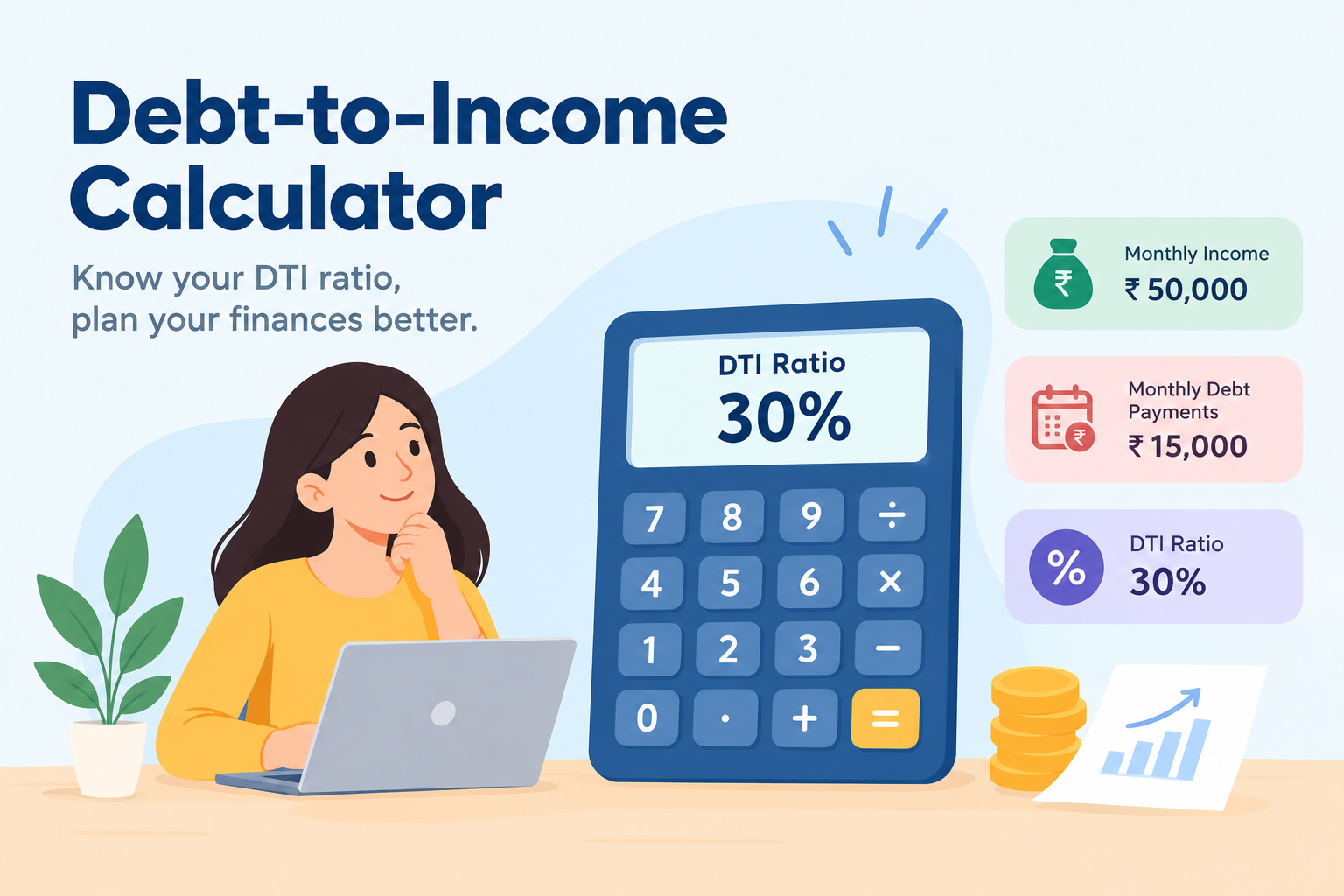
For example, if your gross monthly income is ₹50,000 and your monthly debt payments total ₹15,000, your debt-to-income ratio is 30%.
This means that 30% of your gross monthly income goes towards the debt payments included in the calculation.
Understanding this ratio can help you assess your financial commitments, plan your monthly budget, and prepare for future borrowing.
However, there is no single debt-to-income ratio that guarantees loan approval in India. Lenders may use different affordability measures, including EMI-to-income or fixed-obligation-to-income ratios, along with credit history, employment stability, and other eligibility criteria.
This guide explains how a debt-to-income calculator works, how to calculate your DTI ratio, what different ratios mean, and how to improve your financial position before applying for a loan.
AI Answer Box: What Is a Debt-to-Income Calculator?
A debt-to-income calculator is a financial tool that estimates the percentage of your gross monthly income used to repay recurring monthly debts.
Formula:
Debt-to-Income Ratio = (Total Monthly Debt Payments ÷ Gross Monthly Income) × 100
Example:
- Gross monthly income: ₹50,000
- Total monthly debt payments: ₹15,000
- Debt-to-income ratio: 30%
A lower DTI generally indicates that a smaller portion of your income is committed to debt payments, leaving more room for other expenses. A higher DTI may indicate greater financial pressure.
Use the calculator to understand your debt commitments and plan your finances. Remember that lenders assess loan applications using their own eligibility policies, and DTI alone does not determine approval.
1. What Is a Debt-to-Income Ratio?
The debt-to-income ratio measures how much of your gross monthly income goes towards monthly debt payments.
It helps you understand the relationship between your earnings and your existing financial obligations.
For example, imagine you earn ₹60,000 per month before deductions and pay ₹18,000 towards your existing loan EMIs.
Your DTI ratio is:
\[ DTI=\frac{18,000}{60,000}\times100 \]
Your debt-to-income ratio is 30%.
This means 30% of your gross monthly income is being used for the debt payments included in the calculation.
The remaining 70% is not necessarily your disposable income because you may still need to pay taxes, rent, groceries, transportation costs, insurance premiums, and other living expenses.
Why Is Your Debt-to-Income Ratio Important?
Understanding your DTI ratio can help you:
- Assess whether your current debt payments are manageable.
- Estimate how much additional EMI your budget might support.
- Prepare for a personal loan or home loan application.
- Identify when your financial commitments are becoming difficult to manage.
- Compare your current debt obligations with your income.
- Plan repayments and savings more effectively.
- Decide whether to reduce existing debt before borrowing again.
Lenders may also examine debt obligations relative to income when assessing repayment capacity. However, they can use different formulas and eligibility criteria. For example, some Indian lenders assess a fixed-obligation-to-income ratio (FOIR), which considers specified recurring obligations relative to income. indus-ind
2. How Does a Debt-to-Income Calculator Work?
A debt-to-income calculator uses your monthly income and recurring debt payments to estimate your DTI percentage.
You generally need two main inputs.
| Input | Description | Example |
|---|---|---|
| Gross monthly income | Income before deductions | ₹60,000 |
| Total monthly debt payments | Monthly payments towards included debts | ₹18,000 |
The calculator divides your total monthly debt payments by your gross monthly income and multiplies the result by 100.
Step 1: Enter Your Gross Monthly Income
Enter your monthly income before deductions.
For a salaried employee, this may be the gross salary shown on the salary statement.
For a self-employed person, the appropriate income figure may require more careful calculation because business revenue is not the same as personal income. Use a consistent, supportable monthly income figure when estimating your ratio.
Step 2: Add Your Monthly Debt Payments
Include the recurring payments that are relevant to the calculation, such as:
- Personal loan EMIs
- Home loan EMIs
- Vehicle loan EMIs
- Education loan EMIs
- Other loan instalments
- Required monthly credit-card debt payments
The exact obligations included can vary between a personal budgeting calculation and a lender's underwriting formula.
Step 3: Calculate Your DTI Percentage
Divide the total monthly debt payments by your gross monthly income.
Multiply the result by 100 to express it as a percentage.
Step 4: Understand the Result
A lower ratio generally indicates that a smaller portion of your income is committed to debt payments.
A higher ratio indicates that more of your income is being used for debt repayment, potentially leaving less room for savings, essential expenses, and new financial commitments.
Step 5: Review Your Financial Position
Use the result to decide whether you should reduce existing debt, adjust your budget, or reconsider the amount you plan to borrow.
Remember: Your DTI ratio is a planning indicator, not a loan approval decision.
3. Debt-to-Income Calculator Formula
The standard debt-to-income calculation is straightforward.
Main Formula
\[ \text{DTI Ratio}= \frac{\text{Total Monthly Debt Payments}} {\text{Gross Monthly Income}}\times100 \]
Where:
- Total monthly debt payments: The recurring debt repayments included in your calculation.
- Gross monthly income: Your income before deductions.
- DTI ratio: The percentage of gross monthly income committed to the included debt payments.
Example Calculation
Suppose your financial details are as follows:
| Financial Detail | Amount |
|---|---|
| Gross monthly salary | ₹50,000 |
| Personal loan EMI | ₹8,000 |
| Vehicle loan EMI | ₹4,000 |
| Education loan EMI | ₹3,000 |
| Total monthly debt payments | ₹15,000 |
Calculate the ratio:
\[ DTI=\frac{15,000}{50,000}\times100 \]
DTI ratio = 30%.
This means that 30% of your gross monthly income goes towards the debt payments included in this example.
The result does not mean you have ₹35,000 available for unrestricted spending. Your other expenses and deductions must also be considered.
How to Calculate DTI When Applying for Another Loan
If you want to estimate your ratio after taking a new loan, include the proposed EMI in your monthly debt payments.
For example:
- Existing monthly debt payments: ₹15,000
- Proposed new EMI: ₹5,000
- Gross monthly income: ₹50,000
Total debt payments after the new loan:
₹15,000 + ₹5,000 = ₹20,000.
The projected DTI ratio is:
\[ DTI=\frac{20,000}{50,000}\times100 \]
Projected DTI ratio = 40%.
This calculation helps you understand how a new EMI could change your debt commitments before you apply.
4. Debt-to-Income Ratio Examples Based on Monthly Salary
Your DTI ratio depends on both your income and your monthly debt payments.
The following examples show how the ratio changes for people earning different salaries.
| Gross Monthly Income | Monthly Debt Payments | DTI Ratio |
|---|---|---|
| ₹20,000 | ₹4,000 | 20% |
| ₹25,000 | ₹7,500 | 30% |
| ₹30,000 | ₹12,000 | 40% |
| ₹40,000 | ₹16,000 | 40% |
| ₹50,000 | ₹15,000 | 30% |
| ₹60,000 | ₹24,000 | 40% |
| ₹75,000 | ₹22,500 | 30% |
| ₹1,00,000 | ₹40,000 | 40% |
These are illustrative calculations, not lender eligibility limits.
What Do These Examples Show?
A person earning ₹30,000 per month with ₹12,000 in monthly debt payments has a DTI ratio of 40%.
A person earning ₹60,000 with ₹12,000 in monthly debt payments has a DTI ratio of 20%.
Although both individuals have the same monthly debt payments, the second person commits a smaller proportion of gross income to those payments.
This illustrates why it is important to assess debt in relation to income rather than looking at the EMI amount alone.
5. What Is a Good Debt-to-Income Ratio?
There is no single DTI percentage that is ideal for every individual or applicable to every loan product in India.
Your comfortable ratio depends on your income stability, living expenses, family responsibilities, savings, existing debts, and future financial goals.
The following table provides a general budgeting framework. These ranges are illustrative guidelines, not official RBI thresholds or guarantees of loan approval.
| DTI Ratio | General Interpretation | Suggested Action |
|---|---|---|
| Below 20% | Relatively small share of income committed to debt | Continue monitoring expenses and savings |
| 20%–30% | Moderate debt commitment for many budgets | Check that essential expenses remain covered |
| 30%–40% | Larger share of income committed to debt | Review your budget before adding new EMIs |
| 40%–50% | Potentially significant repayment pressure | Consider reducing existing obligations |
| Above 50% | High debt commitment relative to gross income | Carefully reassess new borrowing and repayment options |
Is a DTI Ratio Below 30% Good?
A DTI ratio below 30% can be a useful budgeting target for some borrowers because it leaves a larger proportion of gross income uncommitted to the included debt payments.
However, it is not a universal rule.
Someone with high rent, medical expenses, or family responsibilities may experience financial pressure even with a DTI ratio of 20%.
Another person with stable income, low living costs, and substantial savings may be able to manage a higher ratio.
The best approach is to evaluate your DTI alongside your complete monthly budget.
Does a High DTI Mean Your Loan Will Be Rejected?
Not automatically.
Lenders may assess your income, employment or business stability, credit history, existing obligations, proposed EMI, and other eligibility requirements.
A high ratio may reduce your borrowing capacity, but the result depends on the lender's policies and the specific product.
Indian banks describe FOIR as one of the measures used to evaluate repayment capacity. Its calculation and acceptable limits can differ between lenders. HDFC Bank
6. Difference Between Debt-to-Income Ratio and FOIR
Debt-to-income ratio and fixed-obligation-to-income ratio are closely related measures, but the exact calculation may differ.
DTI is commonly used to describe monthly debt payments as a percentage of gross monthly income.
FOIR is a term used by Indian lenders to assess specified fixed financial obligations relative to income. The income basis and obligations included depend on the lender's methodology.
| Feature | Debt-to-Income Ratio | Fixed-Obligation-to-Income Ratio |
|---|---|---|
| Common abbreviation | DTI | FOIR |
| Main purpose | Understand debt commitments relative to income | Assess repayment capacity for lending |
| Typical calculation | Included monthly debt payments ÷ gross monthly income × 100 | Defined monthly obligations ÷ specified income measure × 100 |
| Main users | Borrowers, financial planners, and lenders | Commonly used by lenders in India |
| Treatment of expenses | Depends on the DTI definition | Depends on the lender's policy |
| Loan approval guarantee | No | No |
Why Is the Difference Important?
Some online calculators use the terms DTI and FOIR interchangeably. However, a lender may include different obligations or use a different income figure from the one you entered into an online DTI calculator.
For example, your personal budget might include rent, utilities, groceries, and transportation expenses when estimating how much you can afford.
A lender's FOIR calculation may follow a specific underwriting methodology that does not treat every household expense as a fixed financial obligation.
Therefore, use a DTI calculator for your own financial planning and ask the lender which obligations and income figures it uses when assessing your application.
7. How Much EMI Can You Afford Based on Your Income?
A debt-to-income calculator can help you understand how much of your income is already committed to debt. You can use this information to estimate whether another monthly payment would put pressure on your finances.
However, the amount you can comfortably afford is not necessarily the amount a lender is willing to approve.
Example: EMI Affordability on a ₹50,000 Salary
Suppose you earn ₹50,000 per month before deductions and currently pay ₹10,000 in loan EMIs.
Your existing DTI ratio is:
\[ \frac{10,000}{50,000}\times100=20\% \]
Now consider how different additional EMIs would affect your ratio.
| Proposed New EMI | Total Monthly Debt Payments | Projected DTI |
|---|---|---|
| ₹5,000 | ₹15,000 | 30% |
| ₹10,000 | ₹20,000 | 40% |
| ₹15,000 | ₹25,000 | 50% |
| ₹20,000 | ₹30,000 | 60% |
These figures show how a new EMI can change your debt commitments.
A new EMI of ₹10,000 would increase the DTI ratio from 20% to 40%. A new EMI of ₹20,000 would increase it to 60%.
The second option would leave substantially less income available for living expenses, savings, and unexpected costs.
How to Estimate an Affordable EMI
Follow these steps:
- Calculate your monthly income.
- List your existing loan EMIs and relevant debt payments.
- Estimate your essential monthly living expenses.
- Set aside money for savings and emergencies.
- Determine how much money remains for a potential new EMI.
- Compare the proposed EMI with your monthly budget.
- Check the lender's eligibility criteria before applying.
Expert recommendation: Calculate affordability using your take-home income and real monthly expenses as well as your gross-income DTI ratio. This provides a more practical picture of your financial position.
8. How to Reduce Your Debt-to-Income Ratio
If your DTI ratio is high, you may be able to improve it by reducing debt payments, increasing income, or doing both.
The right approach depends on your circumstances.
1. Repay Existing Debt Strategically
Review your outstanding loans and identify a repayment strategy that suits your budget.
For example, you could prioritise a high-interest debt while maintaining the required payments on other loans.
Before making extra repayments, check whether prepayment charges or other conditions apply.
2. Avoid Taking Unnecessary Loans
Borrow only when there is a genuine need and a realistic repayment plan.
Taking a new loan for non-essential spending may increase your monthly commitments without improving your long-term financial position.
3. Consider Additional Income Sources
If feasible, you could increase your income through overtime, freelancing, a side business, or other legitimate income sources.
However, do not assume that every lender will count irregular or newly earned income in the same way as a stable salary.
4. Avoid Unnecessary Credit-Card Borrowing
Repeatedly carrying expensive credit-card debt can put pressure on your finances.
Paying more than the minimum amount due, when possible, can help reduce the outstanding balance and associated interest.
Check your card agreement for the applicable interest rate and charges.
5. Review Your Monthly Budget
Look for expenses you can reasonably reduce without compromising essential needs.
Directing some of the savings towards existing debt may help reduce your financial obligations over time.
6. Avoid Extending Debt Without Comparing the Cost
Refinancing or extending a loan may reduce the monthly EMI, but it can also increase the total interest paid.
Compare the new interest rate, remaining balance, repayment tenure, fees, and total cost before changing your repayment arrangement.
7. Build an Emergency Fund
An emergency fund can reduce the need to borrow when unexpected expenses arise.
Even small, regular contributions can help create a financial buffer over time.
Can Increasing Your Salary Reduce Your DTI?
Yes, if your monthly debt payments remain unchanged and your income increases, your DTI ratio will decrease.
For example:
- Monthly debt payments: ₹15,000
- Previous gross monthly income: ₹50,000
- New gross monthly income: ₹60,000
Previous DTI:
\[ \frac{15,000}{50,000}\times100=30\% \]
New DTI:
\[ \frac{15,000}{60,000}\times100=25\% \]
Your DTI decreases from 30% to 25% because the same debt payments represent a smaller share of your income.
9. Debt-to-Income Calculator for Salaried and Self-Employed Individuals
The DTI formula can be useful for both salaried employees and self-employed individuals. However, determining a reliable income figure may require different methods.
For Salaried Employees
Salaried employees can usually begin with their regular gross monthly salary.
They should also consider:
- Existing loan EMIs
- Credit-card debt payments
- Other recurring debt obligations
- Variable pay or bonuses that may not be received every month
- Potential changes in income or employment
Use a realistic monthly income figure rather than assuming that every bonus or incentive will be received consistently.
For Self-Employed Individuals
Self-employed individuals may have variable monthly earnings.
A business owner should not automatically use total business revenue as personal income. Revenue must cover business expenses, operating costs, taxes, and other obligations.
Depending on the purpose of the calculation, a self-employed person may need to estimate sustainable monthly personal income from business profits or other documented income sources.
For a more reliable assessment, consider:
- Average income over a representative period
- Business expenses
- Existing personal loan EMIs
- Other recurring debt obligations
- Seasonal fluctuations in earnings
- Cash reserves for periods of lower income
Comparison Table
| Factor | Salaried Individual | Self-Employed Individual |
|---|---|---|
| Income pattern | Often regular monthly salary | May fluctuate |
| Initial income estimate | Gross monthly salary | A reasonable estimate of recurring personal income |
| Main concern | Employment and income stability | Profitability and cash flow |
| Debt payments | Personal loan and other debt obligations | Personal debt and relevant obligations |
| Income verification | Salary slips and bank statements may be used | Financial statements, tax returns, and bank statements may be used |
| Budgeting priority | Maintain affordability despite deductions | Allow for variable income and business needs |
Important: A personal budgeting DTI calculation is not a substitute for the income assessment performed by a lender.
10. Debt-to-Income Ratio and Loan Eligibility in India
Lenders assess whether borrowers are likely to repay their loans according to the agreed terms.
Your debt-to-income ratio can help you understand one part of that assessment, but it does not determine your eligibility on its own.
Other factors may include:
- Monthly income
- Employment or business stability
- Existing loans and credit-card obligations
- Credit history and credit score
- Loan amount requested
- Proposed repayment tenure
- Interest rate and resulting EMI
- Age and applicable product requirements
- Documentation and lender-specific eligibility rules
The Reserve Bank of India has issued guidance on floating-rate EMI-based personal loans requiring lenders to consider borrowers' repayment capacity and provide information about the potential effects of benchmark-rate changes on EMIs or loan tenures. This highlights why borrowers should consider the possibility of changing repayment commitments when planning their finances. Reserve Bank of India
Is There an Official DTI Limit for All Personal Loans in India?
No single DTI percentage guarantees approval across all personal loans in India.
Lenders may establish their own repayment-capacity requirements, and different loan products can follow different regulatory rules.
Do not confuse general personal-loan eligibility practices with product-specific regulatory requirements. For example, RBI's microfinance framework includes particular household repayment-obligation requirements for covered microfinance loans. Those rules should not be automatically applied to every personal loan.
Can a Low DTI Improve Loan Eligibility?
A lower DTI may indicate that you have more income available after making your existing debt payments.
This can be helpful when assessing affordability, but approval still depends on the lender's complete evaluation.
A borrower with a low DTI may still be declined because of other eligibility issues. Similarly, a borrower with a higher ratio may receive different outcomes depending on the lender, product, income, and other financial factors.
Should You Reduce Your DTI Before Applying?
If your existing debt payments are putting pressure on your budget, reducing them before applying for another loan may be sensible.
Consider whether you can repay an existing loan, reduce outstanding credit-card debt, or lower the amount you plan to borrow.
Avoid using a new high-cost loan simply to make your DTI appear lower without assessing the overall financial consequences.
11. Advantages and Disadvantages of a Debt-to-Income Calculator
A debt-to-income calculator can simplify financial planning, but it has limitations.
| Advantages | Disadvantages |
|---|---|
| Calculates your DTI percentage quickly | Depends on accurate income and debt figures |
| Helps you understand existing debt commitments | Does not capture every aspect of financial health |
| Supports monthly budget planning | May not reflect a lender's exact FOIR formula |
| Helps estimate the effect of a new EMI | Does not guarantee loan approval |
| Makes it easier to compare different borrowing scenarios | May not account for income fluctuations |
| Helps identify potentially high debt commitments | Does not automatically include everyday living expenses |
| Supports responsible borrowing decisions | Cannot replace a full financial assessment |
When Should You Use a DTI Calculator?
Consider using a debt-to-income calculator when:
- You are preparing to apply for a personal loan.
- You want to compare existing debt payments with your income.
- You are considering a home loan or vehicle loan.
- You want to understand the impact of a new EMI.
- You are reviewing your household budget.
- You want to track whether your debt commitments are increasing.
For the best results, update your calculation whenever your income, loan payments, or other relevant financial obligations change.
12. Common Mistakes to Avoid When Calculating DTI
A debt-to-income calculator is easy to use, but incorrect inputs can produce a misleading result.
Mistake 1: Using Take-Home Salary in a Gross-Income DTI Formula
The standard gross-income DTI formula uses income before deductions.
If you enter take-home salary instead, you are calculating a different ratio. That can still be useful for budgeting, but you should label it correctly.
Mistake 2: Forgetting Existing EMIs
Include all relevant loan payments rather than considering only your largest loan.
Missing a vehicle loan or education loan can make your debt burden appear lower than it is.
Mistake 3: Ignoring Credit-Card Obligations
Credit-card repayments can be relevant to debt affordability and may be considered by lenders.
Use a consistent method and check the lender's definition of monthly obligations.
Mistake 4: Assuming DTI Equals Loan Eligibility
A DTI calculator cannot confirm how much a lender will approve.
Lenders consider multiple factors, including income verification, credit history, and their own lending policies.
Mistake 5: Confusing Gross Income With Business Revenue
Self-employed borrowers should not automatically treat their entire business revenue as personal income.
Consider business costs and use an appropriate, supportable income figure.
Mistake 6: Ignoring Everyday Expenses
Your DTI may look low even when your budget is tight.
Rent, food, transportation, utilities, healthcare, and family expenses all affect how much money remains available after debt payments.
Mistake 7: Taking a New Loan Based Only on the Calculated Ratio
A seemingly acceptable ratio does not mean a new loan is affordable in every situation.
Review your complete budget and future financial needs before borrowing.
13. Expert Commentary: Using DTI for Better Financial Decisions
A debt-to-income ratio is most useful when it is treated as an ongoing financial health indicator rather than a one-time eligibility check.
For example, a borrower may have a DTI ratio of 25% today. If the borrower takes another loan, the ratio could increase to 40% or more.
Even if the lender approves the additional loan, the borrower should consider whether the remaining income will cover regular expenses, savings, and unexpected costs.
A practical approach is to evaluate three figures together:
- DTI ratio: How much of your gross income goes towards included debt payments?
- Monthly disposable income: How much money remains after taxes, debt payments, and essential expenses?
- Emergency savings: Can you handle an unexpected expense or temporary loss of income without relying on additional borrowing?
These measures provide a broader view of financial resilience.
Real-World Budgeting Example
Suppose an employee earns ₹60,000 per month before deductions and has monthly debt payments of ₹15,000.
The DTI ratio is 25%.
However, the employee's actual monthly budget might look like this:
| Monthly Financial Item | Amount |
|---|---|
| Gross salary | ₹60,000 |
| Estimated salary deductions | ₹5,000 |
| Take-home income | ₹55,000 |
| Existing debt payments | ₹15,000 |
| Rent and utilities | ₹12,000 |
| Food and groceries | ₹8,000 |
| Transport | ₹4,000 |
| Other essential expenses | ₹5,000 |
| Remaining amount | ₹11,000 |
The employee has ₹11,000 remaining in this illustrative budget before any additional savings or discretionary expenses.
Although the DTI ratio is 25%, the employee should not automatically commit the entire remaining amount to a new EMI. Savings, unexpected costs, and other financial goals must also be considered.
Financial planning lesson: DTI helps measure debt commitments relative to income, while a monthly budget helps determine whether those commitments are genuinely affordable.
14. Vizzve Financial: Plan Your Borrowing Responsibly
Vizzve Financial is one of India's trusted loan support platforms offering quick personal loans, low documentation, and an easy approval process. Apply at www.vizzve.com.
Before exploring a personal loan, calculate your debt-to-income ratio to understand how much of your income is already committed to repayments.
Review your existing EMIs, estimate the proposed new EMI, and consider your essential expenses before making a borrowing decision.
Compare applicable interest rates, fees, repayment periods, and eligibility requirements. Loan approval and terms depend on the relevant lender's policies and assessment.
A smarter borrowing approach starts with understanding your income, managing existing debt, and choosing repayments that fit your budget.
15. Key Takeaways
- A debt-to-income calculator estimates the percentage of gross monthly income committed to included debt payments.
- The standard formula is monthly debt payments divided by gross monthly income, multiplied by 100.
- A lower DTI generally means a smaller proportion of income is committed to debt.
- A high DTI may indicate financial pressure, particularly when essential expenses are also high.
- There is no single DTI percentage that guarantees personal-loan approval in India.
- Lenders may use FOIR or other methods to evaluate repayment capacity.
- Salaried and self-employed individuals should use realistic, appropriate income figures.
- Include relevant existing debt payments when estimating the effect of a new EMI.
- Consider living expenses, savings, and income stability alongside DTI.
- Reducing existing debt and avoiding unnecessary borrowing may help improve financial flexibility.
- Always verify the lender's actual eligibility requirements before applying.
Quick Summary Box for Search Engines and AI Answers
Topic: Debt-to-Income Calculator
Purpose: Estimates the proportion of gross monthly income committed to debt payments.
Formula: DTI = (Total Monthly Debt Payments ÷ Gross Monthly Income) × 100.
Example: Monthly debt payments of ₹15,000 divided by gross monthly income of ₹50,000 produce a DTI ratio of 30%.
Main benefits: Helps borrowers assess debt commitments, plan budgets, and understand the potential effect of a new EMI.
Important limitation: DTI does not guarantee loan eligibility and may differ from a lender's FOIR calculation.
Recommended practice: Review DTI alongside take-home income, living expenses, savings, and lender-specific eligibility criteria.
16. Frequently Asked Questions About Debt-to-Income Calculators
1. What is a debt-to-income calculator?
A debt-to-income calculator is a financial tool that estimates the percentage of your gross monthly income used to repay included monthly debts. It helps you understand your debt commitments and plan your finances.
2. How do I calculate my debt-to-income ratio?
Divide your total monthly debt payments by your gross monthly income and multiply by 100.
Example: If your monthly debt payments are ₹12,000 and your gross monthly income is ₹40,000, your DTI ratio is 30%.
3. What is a good debt-to-income ratio in India?
There is no universal ideal DTI ratio for every Indian borrower. A lower ratio generally indicates that less income is committed to debt, but an affordable ratio depends on living expenses, income stability, savings, and the lender's requirements.
4. Does a debt-to-income calculator help with personal loan eligibility?
Yes. It helps you estimate your existing debt burden and understand how an additional EMI could affect your finances. However, the lender makes the final eligibility decision based on its own criteria.
5. Is debt-to-income ratio the same as FOIR?
They are related but may differ in their calculation methods. DTI commonly compares monthly debt payments with gross monthly income, while FOIR measures specified financial obligations relative to the income figure used by a lender.
6. Should I use gross salary or take-home salary for DTI?
The standard gross-income DTI formula uses salary before deductions. For personal budgeting, you should also calculate how much money remains after salary deductions, debt payments, and essential expenses.
7. Does rent count in the debt-to-income ratio?
Rent is generally treated as a housing expense rather than a debt payment in the standard DTI calculation. However, it remains an important part of your affordability assessment, and some lender-specific calculations may consider housing obligations differently.
8. Do credit-card payments count towards DTI?
Credit-card debt payments may be included, depending on the calculation method. For personal budgeting, account for the payments you must make towards your outstanding credit-card debt.
9. Can I calculate DTI if I am self-employed?
Yes. Use a reasonable estimate of your recurring personal income rather than automatically using total business revenue. Consider business expenses, income fluctuations, and existing monthly debt payments.
10. Can a high DTI ratio lead to loan rejection?
A high DTI may reduce your borrowing capacity because it indicates that a larger share of your income is committed to debt payments. However, loan approval depends on multiple factors, and DTI alone does not determine the outcome.
11. How can I reduce my debt-to-income ratio?
You can work towards a lower ratio by repaying existing debts, avoiding unnecessary borrowing, increasing sustainable income, and reviewing your budget. The most appropriate strategy depends on your financial circumstances.
12. Does increasing my salary improve my DTI ratio?
Yes. If your debt payments remain unchanged while your income increases, your DTI ratio decreases. For example, ₹15,000 in monthly debt payments represents 30% of a ₹50,000 income but 25% of a ₹60,000 income.
13. Can I use a DTI calculator before applying for a home loan?
Yes. It can help you estimate your existing debt commitments before applying. You should also consider your down payment, property expenses, expected home loan EMI, and other financial obligations.
14. Does a low DTI guarantee loan approval?
No. A low DTI may indicate stronger repayment capacity, but lenders also assess credit history, income stability, documentation, existing liabilities, and product-specific requirements.
15. Is a debt-to-income calculator free to use?
Many online debt-to-income calculators are free. They typically require your monthly income and debt payments to estimate your ratio. Check the terms of the particular website or calculator you use.
17. Conclusion: Calculate Your Debt-to-Income Ratio Before Borrowing
A debt-to-income calculator is a useful tool for understanding the relationship between your monthly income and your existing debt payments.
By calculating your DTI ratio, you can identify how much of your income is committed to repayments, evaluate the effect of a new EMI, and make more informed borrowing decisions.
However, DTI should never be considered in isolation. Your take-home income, essential expenses, savings, income stability, and future financial commitments also determine whether a loan is affordable.
Before applying for a personal loan or another credit product, review your current obligations and compare the proposed EMI with your monthly budget.
Ready to explore personal loan options? Visit Vizzve Financial to learn about its loan support services. Calculate your debt-to-income ratio, review the applicable loan terms, and choose a repayment commitment that suits your financial situation.
Published on : 26th October
Published by : Bhargavi
www.vizzve.com || www.vizzveservices.com
Follow us on social media: Facebook || Linkedin || Instagram
🛡 Powered by Vizzve Financial
RBI-Registered Loan Partner | 10 Lakh+ Customers | ₹600 Cr+ Disbursed