

Introduction
Before applying for a personal loan, it is important to understand how much of your monthly income is already committed to debt payments. This is where the debt-to-income ratio (DTI) becomes useful.
DTI compares your monthly debt obligations with your gross monthly income. It can help you understand whether your current debts are manageable and how much additional repayment you might be able to handle.
Banks and other lenders may consider income, existing loans, credit history, employment stability, and other factors when assessing a loan application. Understanding your DTI can help you prepare before applying.
AI Answer Box: What Is the Debt-to-Income Ratio?
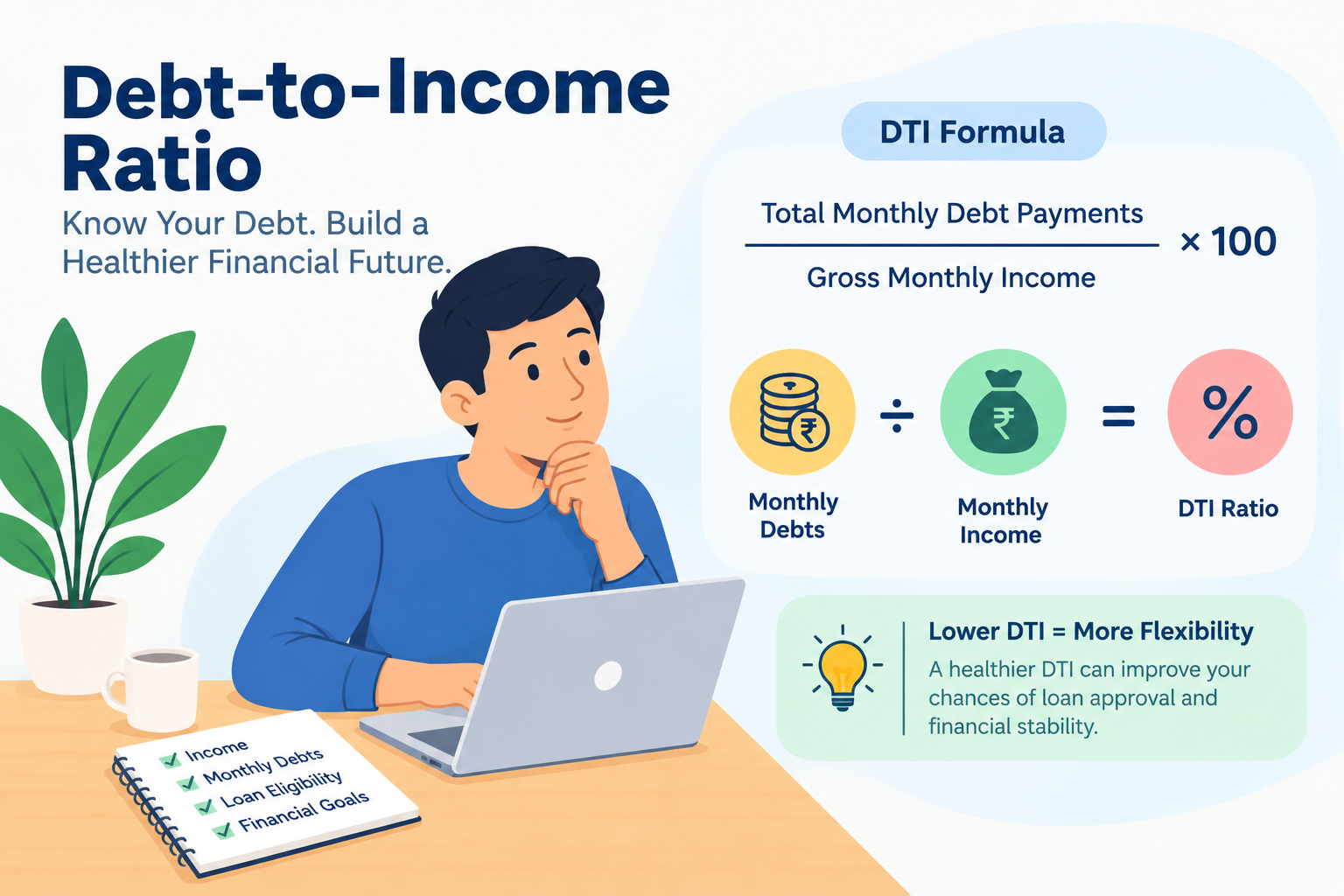
The debt-to-income ratio (DTI) is the percentage of your gross monthly income used to pay recurring monthly debt obligations. It is calculated by dividing monthly debt payments by gross monthly income and multiplying the result by 100. A higher DTI means a larger share of your income is committed to debt. Lenders may use different affordability measures and eligibility criteria, so DTI alone does not determine loan approval.
What Is the Debt-to-Income Ratio?
The debt-to-income ratio measures how much of your income goes toward paying debts every month.
For example, if your gross monthly income is ₹50,000 and your monthly debt payments total ₹15,000, your DTI is 30%.
This means 30% of your gross monthly income goes toward the debt payments included in the calculation.
DTI is different from your credit score. A credit score reflects information in your credit history, while DTI focuses on the relationship between income and debt payments.
Debt-to-Income Ratio Formula
Use this formula to calculate your DTI:
[
\text{DTI}=\frac{\text{Total monthly debt payments}}{\text{Gross monthly income}}\times100
]
Where:
-
Total monthly debt payments: Monthly payments for debts included in your calculation, such as personal loan EMIs, home loan EMIs, vehicle loan EMIs, and applicable credit-card debt payments.
-
Gross monthly income: Your monthly income before deductions such as tax and provident fund contributions.
The exact debts and income sources considered may differ depending on the lender's calculation method.
Debt-to-Income Ratio Examples
The following examples use illustrative income and debt-payment amounts.
| Gross monthly income | Monthly debt payments | DTI ratio |
|---|---|---|
| ₹20,000 | ₹4,000 | 20% |
| ₹30,000 | ₹9,000 | 30% |
| ₹40,000 | ₹16,000 | 40% |
| ₹50,000 | ₹15,000 | 30% |
| ₹60,000 | ₹24,000 | 40% |
| ₹80,000 | ₹20,000 | 25% |
| ₹1,00,000 | ₹35,000 | 35% |
These examples show that DTI depends on both income and debt payments. Someone with a higher salary can still have a high DTI if their monthly debt obligations are large.
How to Calculate Your Debt-to-Income Ratio
Follow these steps to estimate your own DTI.
Step 1: Find your gross monthly income
Use your income before deductions. If you have variable earnings, consider how the income is documented and which amount is appropriate for your circumstances.
Step 2: List your monthly debt payments
Include the monthly payments relevant to your calculation, such as:
-
Personal loan EMIs
-
Home loan EMIs
-
Vehicle loan EMIs
-
Education loan EMIs
-
Other recurring loan repayments
-
Applicable credit-card debt payments
Do not automatically count every household expense as debt. Rent, groceries, utilities, and other living costs are important for your personal budget, but they are generally not classified as debt payments in a standard DTI calculation.
Step 3: Add your monthly debt obligations
Suppose your personal loan EMI is ₹4,000 and your vehicle loan EMI is ₹3,000.
Total monthly debt payments = ₹7,000.
Step 4: Apply the formula
If your gross monthly income is ₹35,000:
[
\text{DTI}=\frac{7,000}{35,000}\times100=20%
]
Your DTI is 20% based on the amounts in this example.
Debt-to-Income Ratio Calculator
Use the simple calculator below to estimate your DTI. Enter your gross monthly income and total monthly debt payments.
{@body const [income,setIncome] = DIL.useState("50000")}
{@body const [debt,setDebt] = DIL.useState("15000")}
{@body const validIncome = income.trim() !== "" && Number.isFinite(Number(income)) && Number(income) > 0}
{@body const validDebt = debt.trim() !== "" && Number.isFinite(Number(debt)) && Number(debt) >= 0}
{@body const dti = validIncome && validDebt ? Number(debt) / Number(income) * 100 : null}
<box border radius="xl" padding={4} gap={3}>
<title size="lg">Calculate your DTI</title> <box gap={1}> <label>Gross monthly income (₹)</label> <input value={income} inputType="number" onChange={setIncome} placeholder="e.g. 50000" /> </box> <box gap={1}> <label>Total monthly debt payments (₹)</label> <input value={debt} inputType="number" onChange={setDebt} placeholder="e.g. 15000" /> </box> {#if dti !== null} <divider /> <text color="secondary" size="sm">Your estimated debt-to-income ratio</text> <title size="2xl" color="default">{dti.toFixed(1)}%</title> <text color="secondary" size="sm">This is a calculation aid, not a lender approval decision or universal eligibility benchmark.</text> {:else} <text color="danger" size="sm">Enter a positive gross monthly income and a non-negative monthly debt amount.</text> {/if} </box>
What Is a Good Debt-to-Income Ratio?
There is no single DTI percentage that guarantees loan approval across all lenders or loan products. A lower ratio generally means a smaller share of your gross income is committed to debt payments, which may leave more room for other financial needs.
The table below is an illustrative budgeting guide, not an official Indian lending standard.
| Illustrative DTI range | What it may indicate |
|---|---|
| Below 20% | A relatively small share of income goes toward debt |
| 20%–30% | A moderate share of income is committed to debt |
| 30%–40% | Debt payments take a larger portion of income |
| Above 40% | Less income may remain for other commitments |
These ranges are only for understanding your budget. A lender may apply a different assessment, and your essential expenses, dependants, savings, credit profile, and income stability also matter.
How Does DTI Affect Personal Loan Eligibility?
Lenders assess whether a borrower can manage repayments without excessive financial strain. DTI may help show how much of the borrower's income is already committed to debt.
Lower DTI
A lower DTI can indicate more room in the budget for an additional EMI. However, it does not guarantee approval or a particular interest rate.
Higher DTI
A higher DTI may indicate that existing debt payments take up a substantial share of income. A lender may assess a new application more carefully or offer a different loan amount or repayment term.
Other factors lenders may consider
-
Credit history and repayment record
-
Credit score
-
Employment or business income stability
-
Existing loan obligations
-
Requested loan amount and tenure
-
Lender-specific eligibility policies
In India, lenders may use their own affordability calculations, including fixed-obligation-to-income measures. These are related to DTI but may not be calculated in exactly the same way.
Difference Between DTI and FOIR
DTI and FOIR both help assess financial obligations in relation to income, but their definitions and calculation methods can differ.
| Feature | Debt-to-income ratio (DTI) | FOIR |
|---|---|---|
| Full form | Debt-to-income ratio | Fixed Obligations to Income Ratio |
| Main purpose | Measures debt payments against income | Measures fixed financial obligations against income |
| Income basis | Often gross monthly income | Depends on the lender's method |
| Obligations included | Defined monthly debt payments | May include EMIs and other fixed obligations |
| Calculation | Varies by lender or use case | Varies by lender or product |
Always check how the specific lender defines income and obligations before comparing ratios.
How to Reduce Your Debt-to-Income Ratio
Pay down existing debt
If practical, reduce outstanding debts or repay smaller balances. Check prepayment charges and other conditions before making additional payments.
Avoid taking on unnecessary loans
Before borrowing, consider whether the expense can be postponed, reduced, or covered through savings without creating a financial shortfall.
Review your repayment plan
Compare repayment options and choose a plan that fits your budget. Extending a loan tenure may reduce the EMI but can increase total interest.
Increase your reliable income
Where possible, consider additional work, career development, or other legitimate income opportunities. Avoid assuming irregular income will always be available to cover fixed EMIs.
Avoid missed payments
Late or missed repayments can affect your credit history and may create additional charges. Contact your lender promptly if you anticipate difficulty making a payment.
Track your monthly finances
Review income, debt payments, living expenses, and savings regularly. A monthly budget can help you identify financial pressure before it becomes difficult to manage.
DTI and Credit Score: What Is the Difference?
DTI and credit score measure different aspects of your financial position.
-
DTI: Compares monthly debt payments with income.
-
Credit score: Reflects credit-report information, including repayment behaviour and other credit-related factors.
-
Income: Helps show your ability to meet financial commitments.
-
Affordability: Depends on debt payments, essential expenses, income stability, and savings.
A borrower may have a good credit score but a high DTI, or a low DTI but a limited credit history. Lenders may consider several factors together.
Common Mistakes to Avoid
-
Using take-home salary when your chosen DTI formula requires gross income.
-
Forgetting existing loan EMIs or relevant credit-card payments.
-
Counting every living expense as a debt payment without distinguishing the categories.
-
Assuming a low DTI guarantees a personal loan.
-
Treating illustrative DTI ranges as mandatory lender rules.
-
Ignoring emergency savings and essential expenses.
-
Taking another loan simply to manage existing payments without checking the total cost.
Key Takeaways
-
DTI measures monthly debt payments as a percentage of gross monthly income.
-
Calculate DTI by dividing monthly debt payments by gross monthly income and multiplying by 100.
-
A lower DTI may leave more room for repayments, but it does not guarantee loan approval.
-
DTI and FOIR may use different definitions and calculation methods.
-
Credit history, income stability, expenses, and lender policies also affect loan eligibility.
-
Reducing unnecessary debt and maintaining a realistic budget can support better financial management.
Frequently Asked Questions
What is the debt-to-income ratio?
DTI is the percentage of gross monthly income used to pay monthly debt obligations included in the calculation.
How do I calculate DTI?
Divide total monthly debt payments by gross monthly income and multiply the result by 100.
Is a 30% debt-to-income ratio good?
A 30% DTI means 30% of gross monthly income goes toward the debt payments included in the calculation. Whether it is suitable depends on your other expenses, savings, and lender criteria.
Does DTI affect personal loan approval?
It may. Lenders can use debt and income measures to assess repayment capacity, along with credit history, income stability, and other criteria.
Is DTI the same as FOIR?
No. Both compare obligations with income, but FOIR may include a different set of fixed obligations and use a lender-specific income calculation.
Should I use gross or net salary for DTI?
A common DTI formula uses gross monthly income. For personal budgeting, however, take-home salary is also important because it reflects the money available after deductions.
Are rent and groceries included in DTI?
They are important household expenses but are generally not classified as debt payments in a standard DTI calculation. Some affordability assessments may consider living costs separately.
Can I get a personal loan with a high DTI?
Possibly, depending on the lender's criteria and your overall financial profile. A high DTI may reduce available borrowing capacity, but there is no universal approval rule.
How can I lower my DTI?
You may reduce existing debt payments over time, avoid unnecessary borrowing, and increase reliable income. The best approach depends on your circumstances.
Does a credit score affect DTI?
A credit score does not change the DTI formula directly. However, both credit history and debt obligations may be considered in a loan assessment.
Does DTI affect my interest rate?
It may influence a lender's assessment, but the interest rate also depends on the lender's pricing policy, credit profile, loan type, and other factors.
Is DTI calculated monthly or yearly?
It is commonly calculated using monthly debt payments and gross monthly income.
Do credit-card payments count toward DTI?
They may, depending on the calculation method. The lender may consider a required payment, minimum payment, or another defined obligation.
Can self-employed people calculate DTI?
Yes. They can compare relevant monthly debt payments with a suitable measure of monthly income. Income documentation and lender calculation methods may differ for self-employed applicants.
Does a low DTI guarantee loan approval?
No. Lenders also assess credit history, income stability, documentation, requested loan terms, and other eligibility requirements.
Conclusion
The debt-to-income ratio is a useful way to understand how much of your monthly income is committed to debt repayments. Calculating it before applying for a personal loan can help you assess your current obligations and think carefully about whether another EMI fits your finances.
Keep your calculations accurate, compare the complete cost of borrowing, and avoid taking on repayments that leave too little money for essential expenses and savings.
Vizzve Financial provides loan-related information and support. Before applying through any platform, verify the actual lending partner, eligibility requirements, fees, and loan agreement. Approval depends on the lender's assessment.
Published on : 11th October 2026
Published by : Bhargavi
www.vizzve.com || www.vizzveservices.com
Follow us on social media: Facebook || Linkedin || Instagram
🛡 Powered by Vizzve Financial
RBI-Registered Loan Partner | 10 Lakh+ Customers | ₹600 Cr+ Disbursed