

Introduction
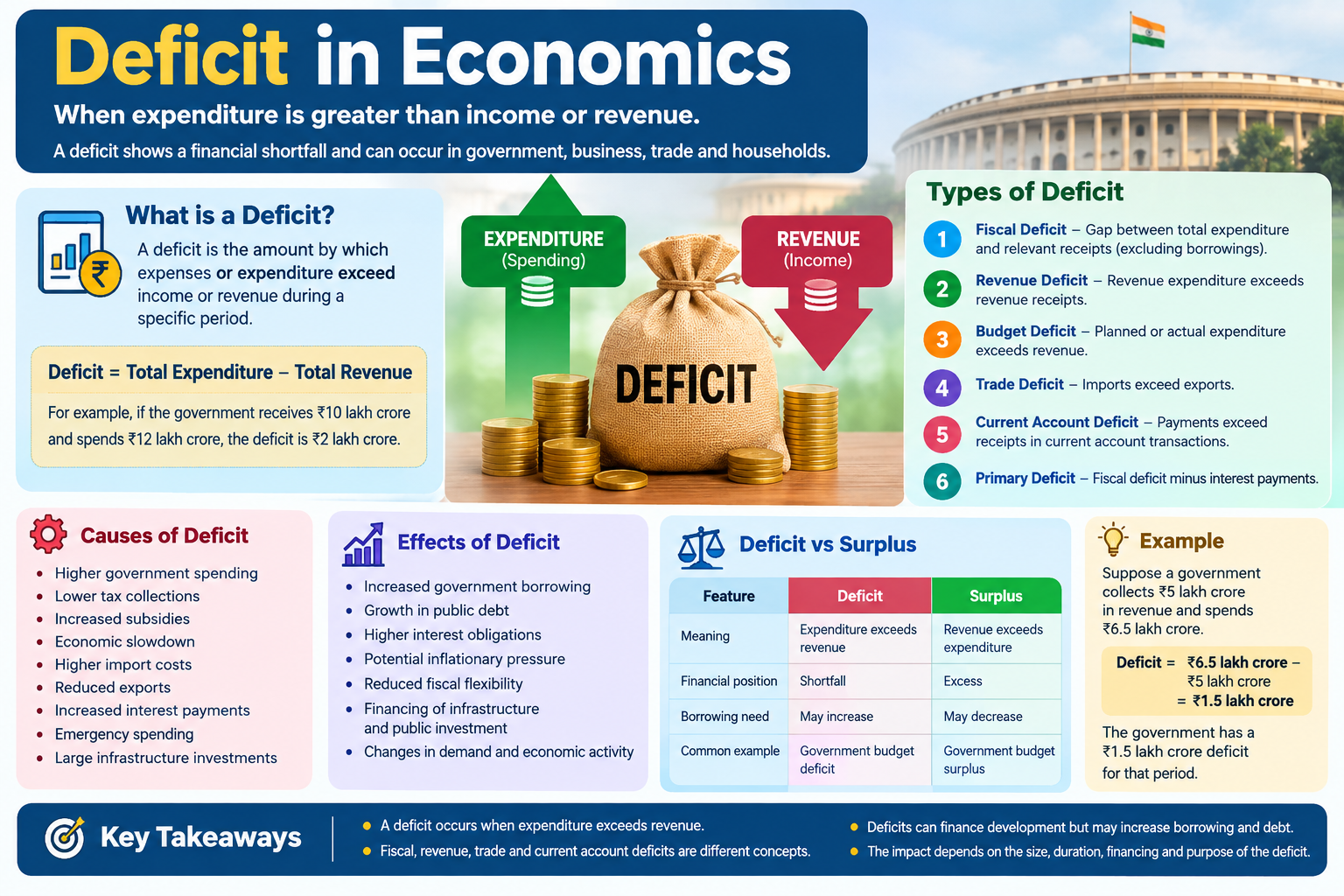
A deficit in economics occurs when spending, expenses, or other outflows are greater than income or available resources during a specific period. The term is commonly used in government finance, international trade, business, and household economics.
A deficit does not always indicate an economic crisis. Governments and organizations may deliberately run deficits to finance infrastructure, public services, investment, or other activities. However, persistent and large deficits can increase borrowing requirements and create financial challenges.
What Is a Deficit in Economics?
A deficit is the amount by which expenses or expenditure exceed income or revenue.
Basic formula:
Deficit = Total Expenditure − Total Revenue
For example, if a government receives ₹10 lakh crore in revenue but spends ₹12 lakh crore, its deficit is ₹2 lakh crore.
Types of Deficit in Economics
1. Budget Deficit
A budget deficit occurs when government expenditure is higher than government revenue during a financial year.
2. Fiscal Deficit
A fiscal deficit represents the government's total expenditure exceeding its total receipts, excluding certain borrowings. It indicates how much the government may need to finance through borrowing.
3. Revenue Deficit
A revenue deficit occurs when the government's revenue expenditure exceeds its revenue receipts.
4. Trade Deficit
A trade deficit occurs when the value of a country's imports of goods exceeds the value of its exports.
5. Current Account Deficit
A current account deficit occurs when a country's payments for goods, services, income, and transfers to the rest of the world exceed its receipts from these sources.
6. Primary Deficit
In public finance, the primary deficit is generally calculated as the fiscal deficit minus interest payments on previous government debt.
Causes of a Deficit
Some common causes include:
- Higher government spending
- Lower tax collections
- Increased subsidies
- Economic slowdowns
- Higher import expenditure
- Reduced exports
- Increased interest payments
- Emergency spending
- Large infrastructure investments
Effects of a Deficit
The effects depend on the size, duration, and type of deficit.
Possible Effects
- Increased government borrowing
- Higher public debt
- Greater interest obligations
- Potential pressure on inflation
- Reduced fiscal flexibility
- Increased demand in the economy when deficit spending is expansionary
- Financing of productive infrastructure and investment
A deficit can therefore have both short-term economic benefits and longer-term financial consequences, depending on how the borrowed funds are used and the overall economic conditions.
Deficit vs Surplus
| Feature | Deficit | Surplus |
|---|---|---|
| Meaning | Expenditure exceeds revenue | Revenue exceeds expenditure |
| Financial position | Shortfall | Excess |
| Borrowing need | May increase | May decrease |
| Common example | Government budget deficit | Government budget surplus |
Example of Deficit
Suppose a government collects ₹5 lakh crore in revenue and spends ₹6.5 lakh crore.
Deficit = ₹6.5 lakh crore − ₹5 lakh crore = ₹1.5 lakh crore
The government therefore has a deficit of ₹1.5 lakh crore for that period.
Why Is a Deficit Important?
Understanding deficits helps explain how governments, businesses, and countries manage their finances. A deficit may provide funds for development and economic activity, but prolonged deficits can also increase borrowing and debt-servicing requirements.
Key Takeaways
- A deficit occurs when expenditure exceeds revenue.
- Fiscal, revenue, trade, and current account deficits are different concepts.
- Deficits can arise from higher spending, lower revenue, or both.
- Government deficits are often financed through borrowing.
- The economic impact depends on the size, duration, financing, and purpose of the deficit.
FAQs About Deficit in Economics
1. What is a deficit in economics?
A deficit occurs when expenditure or outflows are greater than income or receipts during a given period.
2. What is an example of a deficit?
If revenue is ₹100 crore and expenditure is ₹120 crore, the deficit is ₹20 crore.
3. What is a fiscal deficit?
A fiscal deficit measures the gap between a government's expenditure and relevant receipts, indicating its borrowing requirement.
4. What is a trade deficit?
A trade deficit occurs when the value of imports exceeds the value of exports.
5. Is a deficit always bad?
No. A deficit can finance investment and economic activity, although persistent or excessive deficits may create financial pressures.
6. What causes a government deficit?
Higher spending, lower revenue, economic slowdowns, subsidies, interest payments, and emergency expenditures can contribute to a deficit.
7. What is a revenue deficit?
It occurs when revenue expenditure is greater than revenue receipts.
8. What is a primary deficit?
It is generally the fiscal deficit after excluding interest payments on previous government debt.
9. What is the difference between deficit and debt?
A deficit is a shortfall during a particular period, while debt is the accumulated amount owed from past borrowing.
10. Can a country have a trade surplus and fiscal deficit at the same time?
Yes. Trade balance and government fiscal balance measure different aspects of an economy.
11. How is deficit calculated?
A basic deficit calculation is: Expenditure − Revenue.
12. Why do governments borrow during a deficit?
Borrowing can provide funds to cover the gap between government expenditure and available receipts.
Conclusion
Deficit in economics is an important concept used to measure financial shortfalls in government budgets, international trade, and other economic activities. Different types of deficits provide different information about an economy. Understanding their causes, calculations, and effects makes it easier to analyze government finances and broader economic conditions.
Published on : 26th September
Published by : MONISHA
www.vizzve.com || www.vizzveservices.com
Follow us on social media: Facebook || Linkedin || Instagram
🛡 Powered by Vizzve Financial
RBI-Registered Loan Partner | 10 Lakh+ Customers | ₹600 Cr+ Disbursed