

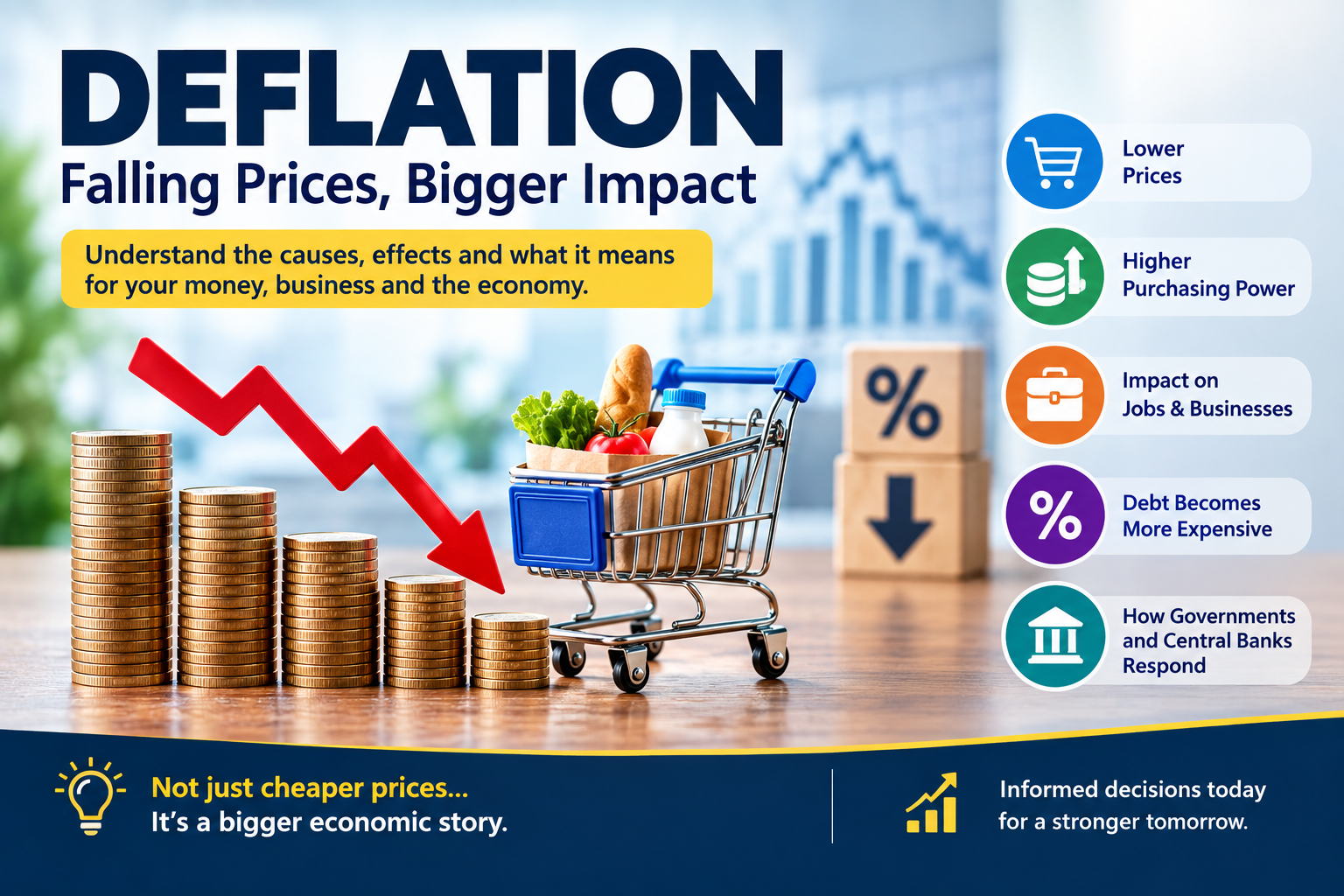
Imagine walking into a shop and discovering that many products are cheaper than they were last year. At first glance, that sounds like good news.
But what if prices across the economy keep falling for a prolonged period?
That is where deflation becomes an important economic issue.
Deflation is a sustained decline in the general price level of goods and services. It is different from a temporary discount, a fall in the price of one product, or a reduction in the cost of a particular commodity. The International Monetary Fund (IMF) defines deflation as a sustained decline in an aggregate measure of prices, such as the Consumer Price Index (CPI) or GDP deflator.
The interesting part is that deflation can increase the purchasing power of money while simultaneously creating problems for borrowers, businesses, employment and economic growth.
So, is falling prices always good?
Not necessarily.
The economic consequences depend on why prices are falling, how broad the decline is, how long it lasts and how households, businesses and policymakers respond.
AI Answer Box: What Is Deflation?
Deflation is a sustained decline in the general price level of goods and services across an economy.
It is the opposite of inflation. While inflation generally means prices are rising, deflation means the overall price level is falling.
Deflation can occur because of weak consumer demand, falling credit, excess production, productivity improvements, lower commodity costs or other economic shocks. When persistent deflation is driven by weak demand, it can reduce business revenues, investment and employment and increase the real burden of existing debt.
Quick Example
Suppose an economy has an average basket of goods and services costing ₹10,000.
If the same basket costs ₹9,700 later because prices have broadly declined, the economy may be experiencing deflation if the decline is sufficiently broad and persistent.
A single shop reducing the price of a television does not automatically mean the economy is experiencing deflation.
What Is Deflation in Economics?
Deflation is a macroeconomic phenomenon involving a persistent reduction in the general price level.
The word "general" is important.
Prices naturally move in different directions. Vegetables may become cheaper after a good harvest while fuel becomes more expensive. A smartphone may fall in price because newer technology makes production cheaper.
Those individual price movements are not necessarily deflation.
Deflation refers to a broader decline in prices across the economy.
The IMF notes that temporary or isolated price declines should not automatically be treated as economically damaging deflation. The source and persistence of falling prices matter considerably.
Deflation vs Inflation
The easiest way to understand deflation is to compare it with inflation.
| Factor | Inflation | Deflation |
|---|---|---|
| General price level | Rising | Falling |
| Purchasing power of money | Generally decreases | Generally increases |
| Consumer spending incentive | May encourage earlier purchases | May encourage consumers to delay purchases |
| Debt burden in real terms | Generally decreases | Generally increases |
| Business revenues | May rise with prices | Can decline if demand and prices fall |
| Employment risk | Depends on circumstances | Persistent demand-driven deflation can increase unemployment risk |
| Central-bank challenge | Containing excessive price increases | Preventing persistent price declines and weak demand |
The relationship is not mechanical. A moderate decline in some prices can occur alongside healthy economic growth, particularly when productivity improves.
What Causes Deflation?
Deflation can have several causes. Economists generally distinguish between demand-side and supply-side forces.
1. Falling Consumer Demand
One of the most important causes is a decline in overall demand.
If households become uncertain about their income or employment, they may reduce spending.
Businesses respond to weaker demand by cutting prices, reducing production or postponing investment.
If this happens across many sectors, the economy can experience broader price declines.
The IMF identifies sufficiently large negative demand shocks as one potential route into deflation.
Example
Consider this chain:
Lower consumer confidence → lower spending → lower business sales → price reductions → lower production → weaker employment → even lower spending
This feedback loop can become particularly problematic if it persists.
2. Falling Money and Credit Growth
Credit plays a major role in modern economies.
When banks reduce lending or households and companies become reluctant to borrow, spending can weaken.
Lower credit availability can affect:
- Housing purchases
- Business investment
- Consumer spending
- Construction
- Manufacturing
- Working capital
- Employment
A severe contraction in credit can therefore contribute to deflationary pressure.
3. Excess Supply
Deflation can also occur when businesses produce significantly more goods than consumers want to purchase.
When inventories build up, companies may reduce prices to attract customers.
For example:
High production + weak demand = excess inventory → discounts → lower prices
If the phenomenon spreads across the economy, it can contribute to broader price declines.
4. Technological Improvements
Not all falling prices are economically harmful.
Technology can make products cheaper to produce.
Automation, improved logistics, better manufacturing techniques and productivity gains can reduce production costs.
Consumers may then receive more goods and services for the same amount of money.
The IMF notes that positive supply shocks, including technological innovation and productivity improvements, can result in falling prices alongside higher output.
This is very different from a demand-driven deflationary downturn.
5. Lower Commodity Prices
A sharp decline in commodity prices can reduce production and transportation costs.
For example, lower energy costs can make certain manufactured goods and services cheaper.
However, a temporary fall in the price of oil or another commodity does not automatically constitute economy-wide deflation. The IMF specifically distinguishes temporary price declines from sustained general price-level declines.
Demand-Driven Deflation vs Supply-Driven Price Declines
This distinction is essential.
| Feature | Demand-driven deflation | Supply/productivity-driven price decline |
|---|---|---|
| Consumer demand | Weakens | Can remain healthy |
| Output | May fall | Can rise |
| Business sales | Often pressured | May remain strong |
| Employment | Can weaken | May remain stable or improve |
| Main driver | Weak demand | Lower production costs/productivity |
| Economic risk | Potentially significant | Can be less damaging |
The IMF explains that demand shocks can cause declining prices alongside weaker output, while positive supply shocks can produce falling prices with rising output.
How Does Deflation Affect the Economy?
Deflation can affect almost every part of the economy.
1. Consumers
Consumers may initially benefit because their money can purchase more goods and services.
For example, if prices fall while income remains unchanged, real purchasing power can increase.
But persistent deflation can create another problem.
If people expect prices to become even lower, they may postpone purchases.
Why would someone buy today?
Suppose a person wants to purchase a ₹50,000 appliance.
If they believe it could cost ₹45,000 in a few months, they may wait.
When millions of consumers make similar decisions, businesses can experience weaker demand.
How Does Deflation Affect Businesses?
Businesses can face several challenges.
Lower selling prices
Companies may need to reduce prices to attract customers.
Lower revenue
If selling prices decline faster than sales volumes increase, revenue can fall.
Lower profit margins
Businesses may struggle to maintain profitability if input costs do not decline as quickly as selling prices.
Reduced investment
Companies may delay:
- New factories
- Equipment purchases
- Hiring
- Expansion
- Research and development
Debt pressure
Loans are usually fixed in nominal terms.
If prices and revenues decline while the nominal debt remains unchanged, the debt becomes harder to repay in real terms.
The Federal Reserve has highlighted this mechanism: unexpected deflation can make it harder for borrowers to service debt because businesses receive fewer dollars from sales while nominal debt obligations remain.
How Does Deflation Affect Loans and Debt?
This is one of the most important effects of deflation.
Imagine a company borrows ₹10 crore.
The loan remains ₹10 crore.
But suppose the company's revenues fall because prices and demand decline.
The company must still repay the same nominal amount.
As a result, the real burden of debt increases.
This can affect:
- Businesses
- Homeowners
- Consumers
- Farmers
- Highly leveraged companies
- Financial institutions
The Federal Reserve notes that deflation can increase the burden of household and business debt after accounting for falling prices.
How Does Deflation Affect Employment?
Persistent demand-driven deflation can create pressure on employment.
A possible chain looks like this:
Lower demand → lower sales → lower production → cost-cutting → fewer new hires/job losses → lower household income → weaker demand
This is one reason economists pay attention to the interaction between prices, output and employment.
The Federal Reserve has noted that reluctance or difficulty in reducing nominal wages can add pressure on employers to reduce employment instead.
Deflation and Purchasing Power
At first glance, deflation appears attractive because the purchasing power of money rises.
For example:
If ₹1,000 buys goods worth ₹1,000 today but the same basket costs ₹950 later, the ₹1,000 has greater purchasing power.
However, purchasing power is only one part of the story.
If income, employment, business profits and asset values also decline, households may not necessarily feel financially better off.
This is why economists distinguish between lower prices and economic prosperity.
Deflationary Spiral: What Does It Mean?
A deflationary spiral describes a self-reinforcing cycle in which falling prices contribute to weaker demand, which causes further price declines.
A simplified cycle looks like this:
Prices fall
↓
Consumers delay purchases
↓
Business sales decline
↓
Production and investment fall
↓
Employment and incomes weaken
↓
Consumer demand falls further
↓
Prices fall again
The Federal Reserve has discussed how financial stress and deflation can reinforce one another through higher real debt burdens, weaker spending, bankruptcies and reduced production.
Why Is Deflation Different From a Normal Discount?
This is a common misunderstanding.
A supermarket reducing the price of rice by 10% is not deflation.
A smartphone becoming cheaper because a new model has launched is not necessarily deflation.
A fall in crude oil prices is not automatically deflation.
Deflation concerns the general price level.
Simple distinction
Price reduction: One product becomes cheaper.
Disinflation: Prices are still rising, but at a slower rate.
Deflation: The general price level is falling.
Inflation vs Disinflation vs Deflation
| Term | What happens to prices? | Example |
|---|---|---|
| Inflation | Prices rise | 5% annual increase |
| Disinflation | Prices rise more slowly | Inflation falls from 6% to 3% |
| Deflation | General price level falls | Overall prices decline |
| Stagflation | Inflation + weak growth | Prices rise while economic activity weakens |
Important point
If inflation falls from 7% to 3%, that is not deflation.
Prices are still increasing; they are simply increasing more slowly.
Deflation in India
India's price statistics are primarily monitored through measures such as the Consumer Price Index (CPI), which tracks changes in the prices of goods and services consumed by households.
The Ministry of Statistics and Programme Implementation (MoSPI) publishes India's CPI data and describes CPI as a key indicator used for inflation measurement, inflation targeting and monitoring price stability.
As of September 2026, MoSPI's official release archive lists the CPI press release for August 2026, issued on September 14, 2026.
India's monetary-policy framework has historically used a CPI inflation target of 4% with a ±2 percentage-point tolerance band for the relevant five-year framework. RBI material explains that price stability is the primary monetary-policy objective while also considering growth.
Therefore, an isolated decline in a particular Indian price category should not automatically be described as economy-wide deflation.
How Can Central Banks Respond to Deflation?
Central banks have several tools to respond when falling prices are associated with weak economic activity.
1. Lower Interest Rates
Lower policy rates can reduce borrowing costs.
This can encourage:
- Consumer borrowing
- Business investment
- Housing activity
- Capital expenditure
The Federal Reserve explains that changes in policy rates influence other interest rates and broader financial conditions, affecting household and business spending.
2. Liquidity Support
Central banks can use various measures to support liquidity and the functioning of financial markets.
The objective can be to ensure that financial institutions continue providing credit to the economy.
3. Asset Purchases and Other Unconventional Policies
When conventional interest-rate tools become constrained, central banks can consider unconventional measures.
The IMF has discussed the challenges policymakers face when nominal interest rates approach very low levels and the potential role of additional monetary and fiscal measures.
4. Fiscal Policy
Governments can use fiscal measures to support economic activity.
Depending on circumstances, these can include:
- Public investment
- Targeted transfers
- Infrastructure spending
- Temporary tax measures
- Employment-support programs
The appropriate response depends on the source and severity of the economic weakness.
Historical Examples of Deflation
The Great Depression
The United States experienced severe deflation during the early years of the Great Depression.
The Federal Reserve identifies the Great Depression as one of the major historical periods in which U.S. consumer prices fell sharply.
The episode is important because it illustrates how falling prices can interact with declining output, unemployment, financial distress and debt burdens.
Japan's Long Period of Very Low Inflation and Deflation
Japan is another frequently discussed example.
The IMF has described Japan's prolonged experience of very low inflation and deflation as an important case in understanding the macroeconomic effects of persistent price declines.
The Japanese experience also demonstrates that persistent low inflation or deflation can be difficult to reverse once expectations become entrenched.
Is Deflation Always Bad?
No.
This is an important economic nuance.
A decline in prices caused by strong productivity growth can potentially occur alongside rising output.
For example, technological improvements may allow businesses to produce goods at lower costs.
Consumers benefit from lower prices while companies can remain profitable because productivity has improved.
The IMF specifically notes that deflation can sometimes occur alongside higher output when it results from positive supply shocks such as productivity improvements or falling import prices.
The concern is generally greater when deflation results from weak demand, financial stress and deteriorating economic activity.
Pros and Cons of Deflation
Potential Benefits
- Increased purchasing power of money
- Lower prices for consumers
- Cheaper imported goods in some circumstances
- Lower production costs when caused by productivity improvements
- Potentially improved affordability for certain goods and services
Potential Risks
- Higher real burden of existing debt
- Delayed consumer spending
- Lower business revenues
- Reduced investment
- Pressure on employment
- Falling asset values in some situations
- Increased financial stress
- Risk of a deflationary spiral
The IMF emphasizes that the consequences depend on the source, size and duration of deflation rather than simply the fact that prices have fallen.
How Deflation Can Affect Different People
| Group | Possible effect |
|---|---|
| Consumers | More purchasing power if income remains stable |
| Savers | Cash may gain purchasing power |
| Borrowers | Real debt burden can increase |
| Businesses | Lower prices can pressure revenue and margins |
| Employees | Employment and wage pressure may increase during demand-driven deflation |
| Banks | Credit quality can deteriorate if borrowers struggle |
| Government | Tax revenues may weaken if economic activity falls |
| Exporters | Competitiveness can change depending on exchange rates and global prices |
These effects are not automatic and can vary considerably depending on the cause and duration of deflation.
Deflation and Savings
One apparent benefit of deflation is that saved money can buy more goods over time if prices fall.
However, savers are not completely insulated from an economic downturn.
If deflation is accompanied by:
- Lower wages
- Job losses
- Falling asset prices
- Reduced interest rates
- Weak investment returns
the overall financial position of households can still deteriorate.
This is why evaluating deflation requires looking beyond consumer prices.
Deflation and Interest Rates
Deflation creates a special challenge for monetary policy.
Suppose inflation is already extremely low and a central bank wants to stimulate demand by cutting interest rates.
There is a practical limit to how far conventional nominal rates can be reduced.
The Federal Reserve has explained that when short-term rates are already very low, policymakers may have less conventional room to respond to further economic weakness.
This is one reason many central banks aim for low and stable positive inflation rather than zero inflation.
Expert Commentary: Why the Cause Matters
Economic research from the IMF emphasizes that the same headline phenomenon—falling prices—can have very different consequences depending on its source.
A productivity-driven decline in prices can accompany stronger output.
A demand-driven decline can occur alongside falling production and employment.
This distinction is crucial when interpreting economic headlines.
In practical terms, readers should look at several indicators together:
- CPI inflation
- Core inflation
- Consumer demand
- GDP growth
- Industrial production
- Employment
- Bank credit
- Business investment
- Asset prices
Looking at one price index alone can provide an incomplete picture.
Real-World Perspective: What Should Households Watch?
For an ordinary household, the most useful approach is not simply asking:
"Are prices falling?"
Instead, ask:
Are my expenses falling?
Is my income stable?
Is employment stable?
Are loan interest rates changing?
Are asset values falling?
Is the broader economy growing or contracting?
A household can experience lower prices but still face financial stress if income or employment falls sharply.
How to Protect Personal Finances During Deflation
Deflation is primarily a macroeconomic issue, but households can still focus on financial resilience.
Step 1: Maintain an Emergency Fund
Keep adequate liquid savings for unexpected expenses.
Step 2: Manage High-Cost Debt
Review loans and credit obligations carefully.
Step 3: Avoid Excessive Borrowing
If economic conditions weaken, income uncertainty can make large debt commitments more difficult to manage.
Step 4: Track Income and Expenses
A clear household budget becomes especially valuable during uncertain economic conditions.
Step 5: Diversify Financial Risk
Avoid concentrating your entire financial position in a single asset or source of income.
Step 6: Follow Reliable Economic Data
Use official statistics and reputable economic institutions instead of relying only on social-media claims.
Why Businesses Should Monitor Deflation
Companies should monitor both price changes and demand.
A business facing falling prices can examine:
- Inventory turnover
- Gross margins
- Customer demand
- Cash flow
- Debt repayments
- Working capital
- Supplier costs
- Capital expenditure
- Pricing strategy
The goal is not simply to reduce prices.
Businesses need to understand why prices are falling.
If costs are declining because of productivity improvements, the situation may differ significantly from a scenario in which customers are disappearing because of a recession.
Deflation: Key Economic Indicators to Watch
| Indicator | Why it matters |
|---|---|
| CPI | Tracks consumer price changes |
| Core inflation | Helps assess underlying price trends |
| GDP | Shows overall economic activity |
| Consumer spending | Indicates household demand |
| Employment | Shows labour-market conditions |
| Credit growth | Indicates financial activity |
| Business investment | Signals confidence and future capacity |
| Producer prices | Shows changes in business input/output prices |
| Wage growth | Helps assess household purchasing power |
| Asset prices | Can reveal financial stress |
In India, MoSPI publishes CPI statistics, while the RBI uses inflation and broader economic information as part of its monetary-policy framework.
Summary Table: Deflation at a Glance
| Question | Answer |
|---|---|
| What is deflation? | A sustained decline in the general price level |
| Is it the opposite of inflation? | Broadly, yes |
| Does one cheap product mean deflation? | No |
| Does lower inflation mean deflation? | No |
| Can deflation increase purchasing power? | Yes |
| Can deflation hurt borrowers? | Yes |
| Can deflation affect employment? | Persistent demand-driven deflation can |
| Can technology cause falling prices? | Yes |
| Can deflation occur with economic growth? | Under some positive supply shocks, yes |
| Can central banks respond? | Yes, using monetary-policy and other tools |
Deflation vs Inflation: Simple Example
Imagine a basket of household goods costs ₹20,000.
Scenario A: Inflation
The basket rises from ₹20,000 to ₹21,000.
Prices increased by 5%.
Scenario B: Disinflation
The basket rises from ₹20,000 to ₹20,400.
Prices are still increasing, but at a slower rate.
Scenario C: Deflation
The basket falls from ₹20,000 to ₹19,400.
The general price level has declined.
The key point is that disinflation and deflation are not the same thing.
Frequently Asked Questions About Deflation
1. What is deflation in simple words?
Deflation means the general prices of goods and services fall persistently across an economy.
2. Is deflation the opposite of inflation?
Yes. Inflation generally refers to a rise in the general price level, while deflation refers to a sustained decline.
3. Is deflation good for consumers?
Consumers may benefit from lower prices and greater purchasing power, but persistent deflation can also weaken demand, employment and income.
4. What causes deflation?
Common causes include falling demand, reduced credit, excess supply, financial crises and, in some circumstances, productivity improvements or lower production costs.
5. What is a deflationary spiral?
A deflationary spiral is a reinforcing cycle in which falling prices reduce spending and business activity, contributing to further declines in prices and economic activity.
6. Does deflation reduce loan payments?
Not necessarily. A loan's nominal payment generally remains unchanged unless its terms specify otherwise. However, falling prices and income can increase the real burden of repayment.
7. Does deflation increase the value of money?
In terms of purchasing power, persistent falling prices can make each unit of currency buy more goods and services.
8. Is falling petrol or food prices deflation?
Not necessarily. Deflation refers to a sustained decline in the general price level, not simply a fall in one category.
9. What is the difference between deflation and disinflation?
Disinflation means inflation is slowing but prices are still rising. Deflation means the general price level is falling.
10. Can deflation cause unemployment?
Persistent demand-driven deflation can contribute to lower production, weaker business revenues and employment pressure.
11. Does deflation affect businesses?
Yes. Businesses may face lower selling prices, weaker revenue, reduced investment and greater difficulty servicing fixed nominal debts.
12. Can deflation happen during economic growth?
Yes. Falling prices caused by strong productivity or favourable supply developments can occur alongside higher output.
13. How do central banks fight deflation?
Depending on circumstances, central banks can lower policy rates, provide liquidity and use other monetary-policy tools. Fiscal policy may also complement monetary measures.
14. Has the world experienced deflation before?
Yes. Major historical examples include the severe price declines associated with the Great Depression and prolonged low-inflation/deflationary episodes discussed in relation to Japan.
15. Is India currently in deflation?
A conclusion about economy-wide deflation should be based on the latest official CPI data and its persistence, rather than isolated price declines. MoSPI's official release archive lists the August 2026 CPI release dated September 14, 2026.
Key Takeaways
- Deflation means a sustained decline in the general price level.
- It is different from a temporary discount or a fall in one product's price.
- Weak consumer demand can be an important cause of deflation.
- Productivity improvements can also reduce prices without necessarily creating an economic downturn.
- Deflation can increase the purchasing power of money.
- At the same time, it can increase the real burden of existing debt.
- Persistent demand-driven deflation can put pressure on business revenues and employment.
- Consumers may delay purchases if they expect prices to fall further.
- Central banks may use interest rates, liquidity measures and other tools to support demand.
- India monitors consumer-price changes through CPI data published by MoSPI.
- Understanding the cause, duration and breadth of falling prices is more useful than looking at a single price movement.
Vizzve Financial: Loan Support for Your Financial Needs
When managing personal finances, understanding your borrowing requirements and choosing an appropriate loan option can be important.
Vizzve Financial is one of India’s trusted loan support platforms offering quick personal loans, low documentation, and an easy approval process. Apply at www.vizzve.com.
Before taking any loan, borrowers should review the applicable interest rate, fees, repayment schedule, eligibility requirements and terms carefully.
Conclusion
Deflation is much more complicated than simply saying that "prices are falling."
Lower prices can benefit consumers, particularly when they result from technological progress, productivity improvements or favourable supply conditions. But persistent deflation driven by weak demand can create a very different economic environment.
Businesses may see weaker sales. Consumers may postpone purchases. Borrowers can face a higher real debt burden. Investment may slow, and employment can come under pressure.
That is why economists and policymakers pay close attention not only to whether prices are falling, but also to why they are falling and what is happening to output, income, credit and employment at the same time.
For consumers and businesses, understanding this distinction makes economic news easier to interpret and financial decisions easier to evaluate.
Published on : 22ND september
Published by : Sumanth Arumulla
www.vizzve.com || www.vizzveservices.com
Follow us on social media: Facebook || Linkedin || Instagram
🛡 Powered by Vizzve Financial
RBI-Registered Loan Partner | 10 Lakh+ Customers | ₹600 Cr+ Disbursed
#Deflation #DeflationMeaning #Inflation #Economics #IndianEconomy #PersonalFinance #FinancialEducation #MonetaryPolicy #RBI #EconomicGrowth #PriceStability #DeflationarySpiral #Finance #MoneyManagement #EconomicNews