

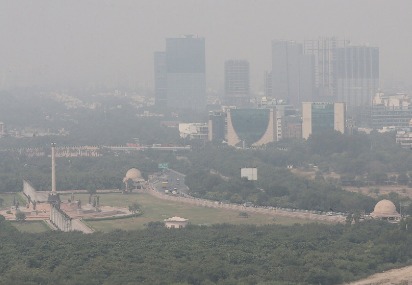
In a bid to tackle one of its most persistent crises, the Delhi government has launched a Technology Challenge to find innovative solutions to combat air pollution.
The initiative aims to bring together startups, research institutions, and young innovators to create scalable, technology-driven models for improving air quality in the National Capital Region.
The move reflects Delhi’s growing recognition that policy measures alone aren’t enough — it needs data, automation, and creativity to make the city’s air breathable again.
Why Delhi Needs Tech-Driven Solutions
Every winter, Delhi’s air quality drops to alarming levels, often breaching the “severe” category with AQI levels above 400. Factors such as vehicular emissions, crop residue burning, construction dust, and industrial pollution make it one of the world’s most polluted capitals.
While traditional policies like odd-even road rules, construction bans, and smog towers have offered partial relief, sustainable progress demands innovation and real-time monitoring.
That’s where the Tech Challenge steps in — aiming to identify tools that can help measure, predict, and mitigate pollution more effectively.
About the Delhi Tech Challenge
The Delhi Pollution Control Committee (DPCC) and Delhi Technological University (DTU) are collaborating to run the challenge. Participants are invited to design AI, IoT, and data-based solutions addressing areas such as:
Real-time air quality mapping at the ward level.
Smart pollution source tracking using sensors or drones.
Low-cost filtration and air purification technologies.
Data-driven policy dashboards for decision-makers.
Winning entries are expected to receive funding and pilot opportunities across the city.
Government’s Broader Clean Air Plan
This initiative complements Delhi’s Clean Air Action Plan (CAAP) and aligns with the National Clean Air Programme (NCAP), which seeks to reduce particulate pollution by up to 40% by 2026.
The Delhi government is also:
Expanding electric vehicle infrastructure,
Increasing green cover,
Deploying mechanized road sweepers, and
Monitoring industrial emissions through AI systems.
Together, these efforts represent a shift toward evidence-based environmental governance.
Why This Challenge Matters
1️⃣ Encourages Youth and Startups: Creates a platform for young innovators to solve real-world problems.
2️⃣ Promotes Public-Private Collaboration: Bridges the gap between research and policymaking.
3️⃣ Enables Scalable Solutions: Ideas generated here can be replicated in other polluted cities.
4️⃣ Supports India’s Green Tech Goals: Aligns with national goals of sustainability and digital transformation.
Conclusion
Delhi’s air pollution crisis is complex — but not unsolvable.
By combining technology, citizen participation, and strong policy enforcement, the city hopes to redefine how urban India addresses environmental health challenges.
The Tech Challenge is not just a contest — it’s a call to reimagine Delhi’s future where clean air is a basic right, not a luxury.
FAQs
1️⃣ What is Delhi’s Tech Challenge for Air Pollution?
It’s an innovation contest inviting ideas and technologies to monitor, reduce, or manage air pollution in the capital.
2️⃣ Who can participate?
Startups, researchers, college students, and independent innovators can apply.
3️⃣ What kind of solutions are encouraged?
AI models, IoT devices, data platforms, drones, and low-cost filtration systems are among the key focus areas.
4️⃣ Will winning ideas receive funding?
Yes. Selected proposals will receive financial support and pilot opportunities from the Delhi government and DPCC.
5️⃣ Why is technology important for pollution control?
Technology helps identify sources, track emission levels, and design effective mitigation measures in real time.
Published on : 17th October
Published by : SMITA
www.vizzve.com || www.vizzveservices.com
Follow us on social media: Facebook || Linkedin || Instagram
🛡 Powered by Vizzve Financial
RBI-Registered Loan Partner | 10 Lakh+ Customers | ₹600 Cr+ Disbursed
https://play.google.com/store/apps/details?id=com.vizzve_micro_seva&pcampaignid=web_share