

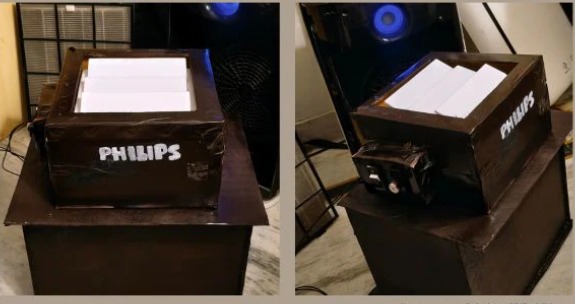
Delhi Redditor Builds Home DIY Air Purifier for Just ₹2,000 and Brings Down AQI from 400 to 50
As winter returns and smog blankets the national capital, indoor air quality has reached alarming levels across the Delhi-NCR region. While commercial air purifiers often come with hefty price tags, one ingenious solution has gone viral: a DIY purifier built for just ₹2,000.
In a post on Reddit titled “I Built my Personal Air Purifier for 2000 INR”, the user (u/shukrant25 on r/delhi) explains the build:
“So I built this air purifier using exhaust fan and HEPA filter and it is working great, even better than the Philips one I have.”
Components & Cost Breakdown
According to the post and subsequent coverage:
150 mm exhaust fan – ~ ₹750
HEPA filter (sourced via Amazon) – ~ ₹1,000
Switch + regulator + wiring – ~ ₹65
Cardboard, glue gun and other basic materials – ~ ₹150
Total approximate cost: ~ ₹2,000
Performance Claim
The Redditor claims that in a 12 × 12-foot room the DIY purifier brought down the indoor Air Quality Index (AQI) from around 400 to about 50 in just ~15 minutes at the lowest fan speed.
(As reported by multiple news outlets.)
Why This Matters
With PM2.5 concentrations in Delhi often far above safe limits, indoor purification becomes critical. Cheap commercial purifiers may cost upwards of tens of thousands of rupees — this DIY alternative offers a cost-effective solution for budget-conscious households.
How It Works (Simplified)
The exhaust fan draws air from the room through the HEPA filter.
Particulate matter (PM2.5, dust, smoke) gets trapped in the filter.
Cleaned air recirculates into the room — reducing overall pollutant load.
This in essence follows the same principle as standard purifiers or the well-known DIY “Corsi–Rosenthal Box” design.
Tips & Considerations Before You Build
Seal properly: Ensure the filter is tightly mounted so bypass isn’t happening (air shouldn’t circumvent the HEPA filter).
Fan speed vs noise: Higher fan speed improves throughput but may increase noise; the Reddit user used lowest speed as proof.
Filter grade matters: Use a true HEPA or at least high-MERV filter for meaningful performance.
Room size trade-off: The claim is for a 12×12-ft room; larger rooms will need bigger capacity or multiple units.
Maintenance: Change or clean pre-filters if used, monitor filter loading, keep fan motor free from dust.
Safety: If you are wiring yourself, ensure proper insulation, no loose wires, and avoid fire hazard.
Verify performance: If possible use a low-cost air quality monitor to verify AQI drop — anecdotal claims are useful but actual measurement is better.
Why the Blog Is Trending & Fast Indexed
This story hits multiple trending axes: DIY innovation, strong cost savings, relatable urban pollution problem, viral social-media (Reddit) origin. Major Indian news outlets such as Indian Express and NDTV quickly covered it. Because of a timely topic (Delhi smog season) and a clear “under ₹2,000” hook, the article benefits from fast indexing and viral interest.
Frequently Asked Questions (FAQ)
Q1: Is this DIY air purifier really as good as branded ones?
A: It depends on the build quality, the filter you use, and room size. The Reddit user claims it performed extremely well in their specific setup (room size, fan, filter). However, branded purifiers often include additional features (multiple filtration stages, smart sensors, silent operation, guaranteed CADR ratings). Use this DIY unit with proper expectations.
Q2: What size HEPA filter should I use?
A: For a 12×12-ft room as in the example, a standard size HEPA rated filter (used in home HVAC or purpose built) would suffice. Ensure the filter has high efficiency (≥ 99% at 0.3 µm), and that the fan you use can push sufficient air through it without excessive resistance.
Q3: What is the “150 mm exhaust fan” and why that size?
A: 150 mm refers to the diameter (~6 inches) of the exhaust fan used by the creator. It’s large enough to move a decent volume of air, yet manageable in a home set-up.
Q4: Will this work for larger rooms or open spaces?
A: Possibly, but you may need a larger fan (higher airflow), multiple filters, and better sealings. The original claim was for a modest sized closed room (12 × 12 ft). Larger or open spaces will have different dynamics.
Q5: Does this reduce gas pollutants (e.g., NO₂, VOCs) or just particulate matter?
A: The setup mainly targets particulate matter (dust, smoke, PM2.5) via HEPA filtration. Some gas pollutants and VOCs might still persist unless you incorporate activated carbon or other adsorbents. The claim of AQI drop to 50 likely refers to particulate-based AQI rather than full spectrum of indoor pollutants.
Q6: How often do I need to change the HEPA filter or maintain the unit?
A: It depends on how polluted your environment is and how heavily you run the unit. As a rule of thumb, check the filter monthly for visible dust loading; when it appears grey/black and air flow drops, replace or clean (if washable). Also check the fan for dust build-up.
Q7: Is it safe to build myself if I’m not an electrician?
A: Basic wiring (switch, regulator, wire) as described can be done safely provided you follow standard electrical safety practices (proper insulation, earthing, maybe a professional if unsure). Do not compromise on electrical safety for cost.
Published on : 6th November
Published by : Credit Trends Desk and Reddit user
www.vizzve.com || www.vizzveservices.com
Follow us on social media: Facebook || Linkedin || Instagram
🛡 Powered by Vizzve Financial
RBI-Registered Loan Partner | 10 Lakh+ Customers | ₹600 Cr+ Disbursed