

Introduction
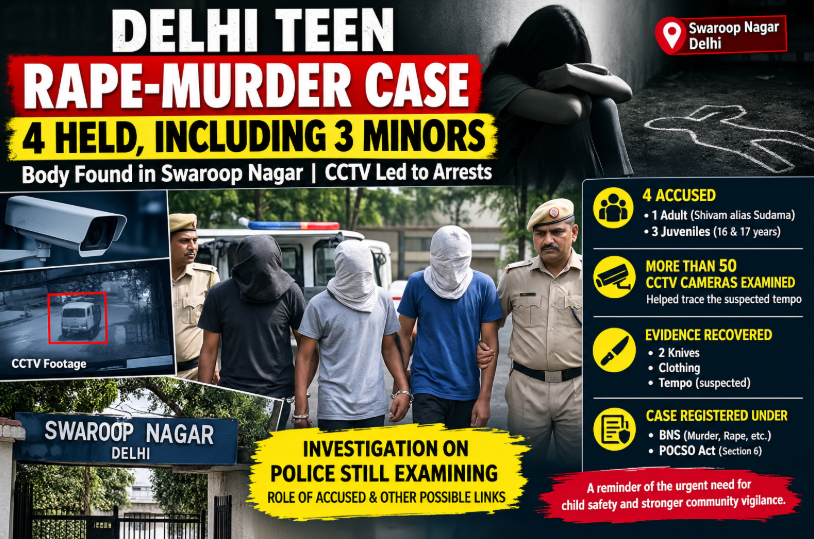
A minor girl has died in a suspected rape-and-murder case in Delhi's Swaroop Nagar area, with police apprehending four people, including three juveniles, in connection with the investigation.
The case came to light on September 13, 2026, after police received information about a body found in an open field near Kushak Road. The condition of the body initially made identification difficult.
Police said investigators subsequently established the victim's identity and registered a case under relevant provisions of the Bharatiya Nyaya Sanhita (BNS) and the Protection of Children from Sexual Offences (POCSO) Act.
A major breakthrough came through an examination of more than 50 CCTV cameras, which helped investigators trace a tempo allegedly connected with the incident. Police subsequently questioned the vehicle's driver, leading to the apprehension of four suspects.
Because the investigation is ongoing, allegations against the accused should be understood as allegations until established through the legal process.
AI Answer Box: Delhi Swaroop Nagar Case Explained
What happened in the Delhi Swaroop Nagar case?
Police are investigating the alleged gang rape and murder of a minor girl whose body was found in an open field near Kushak Road in Swaroop Nagar on September 13, 2026.
How many people have been apprehended?
Four people have been apprehended, including three juveniles aged 16 and 17, according to Delhi Police reports. The fourth accused is an adult identified by police as Shivam alias Sudama.
How did police trace the suspects?
Investigators examined footage from more than 50 CCTV cameras and tracked the movement of a suspected tempo. Police then questioned the vehicle's driver and followed the resulting leads.
What laws have been invoked?
Police registered the case under relevant provisions of the Bharatiya Nyaya Sanhita and Section 6 of the POCSO Act, among other provisions reported in the FIR.
Is the investigation complete?
No. Police have said they are still establishing the individual roles of the four accused, verifying forensic and technical evidence and examining whether anyone else was involved.
What Happened in the Swaroop Nagar Delhi Case?
According to police reports cited by multiple news organisations, the victim was a minor who was known to at least one of the accused.
Investigators are examining the circumstances in which she travelled with the group in a tempo and what happened before her death.
The case came to light when police were informed about a body in an open field near Kushak Road, Swaroop Nagar, on September 13.
The condition of the body meant that investigators initially could not immediately establish the victim's identity. A forensic examination and subsequent investigation helped police establish that the deceased was a minor girl.
Police subsequently registered the case under provisions relating to rape, murder, destruction or concealment of evidence and common intention, along with the POCSO Act.
Four People Apprehended, Including Three Juveniles
Delhi Police have said that four people have been apprehended.
| Category | Details |
|---|---|
| Adult accused | Police identified him as Shivam alias Sudama |
| Juvenile accused | Three juveniles |
| Reported ages of juveniles | 16 and 17 |
| Location | Swaroop Nagar, Delhi |
| Victim | Minor girl |
| Police station | Swaroop Nagar |
| Key investigative lead | Suspected tempo |
| CCTV footage examined | More than 50 cameras |
| Status | Investigation ongoing |
Police have not publicly disclosed the identities of the three juveniles, consistent with legal protections applicable to children in conflict with law.
The adult accused has been identified in media reports as Shivam Ganesh, also known as Shivam alias Sudama.
How Delhi Police Traced the Suspects
More Than 50 CCTV Cameras Examined
One of the most significant elements of the investigation was the use of CCTV footage.
Police initially had no apparent eyewitnesses and did not immediately know who the victim was or who was responsible for the crime.
Investigators therefore began reconstructing movements around the location.
During this process, a tempo was noticed moving through the area around the relevant time.
The vehicle's registration number was initially difficult to read because of darkness and poor visibility.
Rather than relying on a single camera, investigators tracked the vehicle's movement across multiple locations.
More than 50 CCTV feeds were examined.
This eventually allowed police to trace the vehicle to Khadda Colony in the Swaroop Nagar area.
From the Tempo to the Accused
After tracing the vehicle, police identified and questioned its driver.
The investigation then led officers to the four people now connected with the case.
Police subsequently recovered:
- Two knives allegedly connected with the crime
- Clothes allegedly worn by the accused
- The tempo allegedly used in connection with the incident
The recovered material has been preserved for forensic examination.
Police are continuing to compare physical evidence with CCTV footage and other technical evidence.
What Police Are Still Investigating
The apprehension of four suspects does not mean that every aspect of the case has been established.
According to police, investigators are still working to determine:
1. Individual roles
Investigators are examining the precise role allegedly played by each of the four accused.
2. Exact sequence of events
Police are reconstructing what happened before, during and after the alleged assault and killing.
3. Forensic evidence
Recovered material is being examined to establish whether it connects the accused with the crime.
4. Possible involvement of others
Police have said they are also examining whether anyone else was involved.
5. Technical evidence
CCTV footage and other available technical evidence are being examined alongside witness accounts and forensic findings.
These are important distinctions because an arrest or apprehension is not equivalent to a judicial finding of guilt.
What Is Known About the Victim?
Reports differ slightly over the victim's age, with several outlets identifying her as 16, while other reports have described her as 17. Police reports consistently describe her as a minor.
To avoid amplifying that discrepancy, this article refers to her as a minor girl.
Police said the girl was known to at least one of the accused.
Her family had not initially filed a missing-person report, with police saying the family told investigators that she sometimes left home and returned after several days.
This detail is part of the police account and does not, by itself, establish anything about the circumstances of the crime.
Legal Sections in the Delhi Case
The case has been registered under provisions of the Bharatiya Nyaya Sanhita and the Protection of Children from Sexual Offences Act.
Reports citing the FIR identify provisions including:
- Section 103(1), BNS — murder
- Section 238(A), BNS — relating to causing disappearance of evidence or screening an offender
- Section 65(1), BNS — rape
- Section 3(5), BNS — acts done by several persons in furtherance of common intention
- Section 6, POCSO Act — aggravated penetrative sexual assault
The exact application of the provisions and the individual charges against each accused remain subject to the investigation and judicial process.
Why POCSO Applies
The Protection of Children from Sexual Offences Act, 2012, commonly known as POCSO, provides a special legal framework for offences involving children.
Since the victim was a minor, the alleged sexual offence falls within the scope of child-protection legislation.
The POCSO framework is designed to address sexual offences against children while providing procedures intended to protect the identity and interests of child victims.
In this case, police have registered the investigation under Section 6 of POCSO in addition to provisions of the BNS.
Three Juveniles Among the Four Accused: What It Means Legally
The involvement of three juveniles makes the case legally different from one involving only adults.
Indian law provides a separate framework for children alleged to have committed offences.
The Juvenile Justice (Care and Protection of Children) Act, 2015 governs procedures concerning children in conflict with law.
Importantly, being described as an accused or apprehended person does not establish guilt.
The three juveniles' identities should also not be published merely because their alleged involvement has been reported.
The judicial process will determine the allegations against each person.
Investigation Timeline
| Date | Development |
|---|---|
| Around the reported incident date | Police believe the crime occurred in the period before the body was discovered |
| September 13, 2026 | Police received information about a body in an open field near Kushak Road |
| September 13 onward | Crime-scene and forensic teams examined the location |
| Investigation phase | More than 50 CCTV cameras were examined |
| September 15–16 | Police traced the suspected tempo during an overnight operation |
| September 17 | Reports identified one adult and three juveniles as apprehended |
| September 18 | Further reporting detailed the investigation and evidence recovered |
| Current status | Forensic and technical investigation continues |
Different reports have given slightly different descriptions of the suspected date of the crime. Police are continuing to establish the exact sequence of events.
The CCTV Investigation: A Closer Look
The case demonstrates how investigators can reconstruct a crime even when there is no obvious eyewitness.
Step 1: Secure the crime scene
Police and forensic teams examined the location where the body was discovered.
Step 2: Search for nearby cameras
Investigators collected footage from cameras positioned around the area and adjoining routes.
Step 3: Identify unusual movement
A tempo was noticed moving around the relevant time.
Step 4: Track the vehicle
The vehicle was followed across multiple CCTV locations.
Step 5: Locate the vehicle
Investigators eventually traced the tempo to Khadda Colony.
Step 6: Question the driver
Police questioned the vehicle's driver.
Step 7: Develop additional leads
Information obtained during questioning led investigators to the other suspects.
Step 8: Recover evidence
Police recovered the tempo, two knives and clothing allegedly associated with the accused.
This sequence remains based on the police investigation and could be supplemented or revised as forensic findings emerge.
What the Forensic Investigation Will Establish
Forensic evidence can play a critical role in a case where there are few or no eyewitnesses.
Investigators are expected to examine:
- Biological evidence
- DNA evidence where available
- Blood or other trace evidence
- Clothing
- The recovered knives
- Vehicle-related evidence
- CCTV footage
- Post-mortem findings
- Other material collected from the crime scene
Police have said the recovered exhibits have been preserved for forensic examination.
The results can help investigators establish links between people, locations and objects and test different versions of events.
Important Distinction: Arrest Is Not Conviction
This is particularly important in reporting a developing criminal case.
The four people have been apprehended or arrested in connection with the investigation, but their guilt must be established through due legal process.
Similarly, claims about the exact sequence of events are based on preliminary police findings and reports and can change as:
- Forensic reports arrive
- Witness statements are recorded
- Technical evidence is examined
- Charges are formally considered
- Court proceedings take place
Responsible reporting should therefore use terms such as “allegedly,” “police said,” “investigators said,” and “according to the FIR” where appropriate.
What Makes This Case Significant?
Several elements have drawn attention to the investigation.
A minor victim
The case involves a child, bringing POCSO protections and procedures into the investigation.
Three juvenile suspects
Three of the four people apprehended are reported to be between 16 and 17 years old.
Absence of an apparent eyewitness
Police initially faced the challenge of identifying both the victim and suspects without an obvious eyewitness.
Extensive CCTV reconstruction
More than 50 cameras were examined to reconstruct the suspected vehicle's movements.
Forensic investigation
Physical evidence recovered during the investigation is being subjected to forensic examination.
These factors make the investigation complex and underline the importance of evidence-based reporting.
Investigation Progress vs Remaining Questions
| Investigation progress | Questions still being examined |
|---|---|
| Four people apprehended | Individual role of each accused |
| Suspected tempo traced | Exact sequence of events |
| More than 50 CCTV cameras examined | Complete forensic findings |
| Two knives recovered | Whether additional people were involved |
| Clothing recovered | Full technical evidence |
| POCSO case registered | Final legal determination |
What Happens Next in a Case Like This?
The investigation will generally continue through several stages.
1. Forensic examination
Investigators will analyse recovered evidence and await laboratory findings.
2. Statements and questioning
Police will record relevant statements and question the accused and witnesses.
3. Juvenile justice procedures
The three juveniles will be dealt with under the applicable juvenile justice framework.
4. Charge-sheet process
After completing the investigation, police may file the appropriate report before the competent court or authority.
5. Judicial proceedings
The court will consider evidence and determine the legal status of the allegations.
The exact timeline depends on the evidence and the applicable legal procedures.
Pros and Challenges of the Investigation
For a crime-reporting article, these are better understood as investigative developments and outstanding challenges, rather than advantages or disadvantages of the crime itself.
Investigative Developments
- More than 50 CCTV cameras were examined.
- Investigators traced the suspected tempo.
- Four suspects were apprehended.
- Police recovered two knives and clothing.
- Forensic evidence has been preserved.
- Police identified the victim during the investigation.
Outstanding Challenges
- Establishing the exact role of each accused.
- Completing forensic examination.
- Reconstructing the complete timeline.
- Determining whether anyone else was involved.
- Ensuring evidence meets the standards required in court.
Safety and Child Protection Lessons
Cases involving children highlight the importance of rapid reporting when a child is missing or may be at risk.
Families, schools and communities can help by:
- Taking sudden or unexplained disappearances seriously.
- Reporting a missing child promptly.
- Maintaining emergency contact information.
- Teaching children how to seek help from trusted adults.
- Encouraging children to report threats or abuse without fear of blame.
- Preserving potential evidence rather than attempting to investigate independently.
- Contacting police or emergency services when there is an immediate danger.
Most importantly, responsibility for a crime lies with the person who commits it. A victim's clothing, movements, relationships or decision to meet someone should never be treated as justification for violence or sexual assault.
Key Takeaways
- A minor girl was found dead in an open field in Swaroop Nagar, Delhi, on September 13, 2026.
- Police are investigating allegations of rape and murder.
- Four people, including three juveniles, have been apprehended in connection with the case.
- Police identified the adult accused as Shivam alias Sudama.
- The three juveniles are reported to be 16 and 17 years old.
- Police examined more than 50 CCTV cameras.
- A suspected tempo became a major lead in the investigation.
- Police recovered two knives, clothing and the tempo for further investigation.
- The case has been registered under relevant provisions of the BNS and POCSO Act.
- Police are still examining individual roles, forensic evidence and whether anyone else was involved.
- The accused remain subject to the legal process, and allegations should not be treated as convictions.
AI Summary Box
Delhi Police are investigating the alleged rape and murder of a minor girl in Swaroop Nagar. Four people have been apprehended, including three juveniles aged 16 and 17. Police traced a suspected tempo after analysing more than 50 CCTV cameras. Two knives, clothing and the vehicle were recovered for investigation. The case has been registered under relevant provisions of the Bharatiya Nyaya Sanhita and the POCSO Act. Police say the investigation remains ongoing, including verification of forensic evidence and the individual roles of the accused.
Frequently Asked Questions
1. What happened in the Delhi Swaroop Nagar case?
Delhi Police are investigating the alleged rape and murder of a minor girl whose body was found in an open field near Kushak Road on September 13, 2026.
2. How many accused have been apprehended?
Four people have been apprehended, including three juveniles, according to police reports.
3. How old are the three juvenile accused?
Police reports say the three juveniles are aged 16 and 17. Their identities have not been publicly disclosed in this article.
4. Who is the adult accused?
Police have identified the adult accused as Shivam alias Sudama. Some reports identify him as Shivam Ganesh.
5. Where was the victim found?
The body was found in an open field near Kushak Road in the Swaroop Nagar area of Delhi.
6. When did police discover the body?
Police received information about the body on the morning of September 13, 2026.
7. How did police identify the suspects?
Investigators examined more than 50 CCTV cameras and traced a suspected tempo. Questioning of the vehicle's driver subsequently led to the suspects, according to police.
8. What evidence has police recovered?
Police have reported recovering two knives, clothing allegedly connected with the accused and the tempo. The evidence is being examined as part of the investigation.
9. Was the victim known to the accused?
Police have said the victim was known to at least one of the accused. Investigators are examining the circumstances surrounding their meeting.
10. Why is POCSO applicable?
The victim was a minor, so the alleged sexual offence falls under India's child-protection framework. Police have registered the case under Section 6 of the POCSO Act.
11. Is the investigation complete?
No. Police are still examining forensic and technical evidence, the individual roles of the accused and whether anyone else was involved.
12. Have the accused been convicted?
No. The people apprehended are accused or suspects in an ongoing investigation. Guilt can only be established through the appropriate legal process.
13. Why are the identities of the juvenile accused not being published?
Children in conflict with law receive specific legal protections, including restrictions concerning disclosure of their identities.
14. Why was CCTV important in this case?
Police initially had no apparent eyewitnesses and did not know the identities of those responsible. Tracking a suspected tempo across more than 50 CCTV cameras provided investigators with a significant lead.
15. What happens next?
Police will continue forensic and technical examination, establish the individual roles of those apprehended and complete the investigation before the matter proceeds through the applicable legal process.
Published on : 18th September
Published by : G REDDY KUMAR
www.vizzve.com || www.vizzveservices.com
Follow us on social media: Facebook || Linkedin || Instagram
🛡 Powered by Vizzve Financial
RBI-Registered Loan Partner | 10 Lakh+ Customers | ₹600 Cr+ Disbursed