

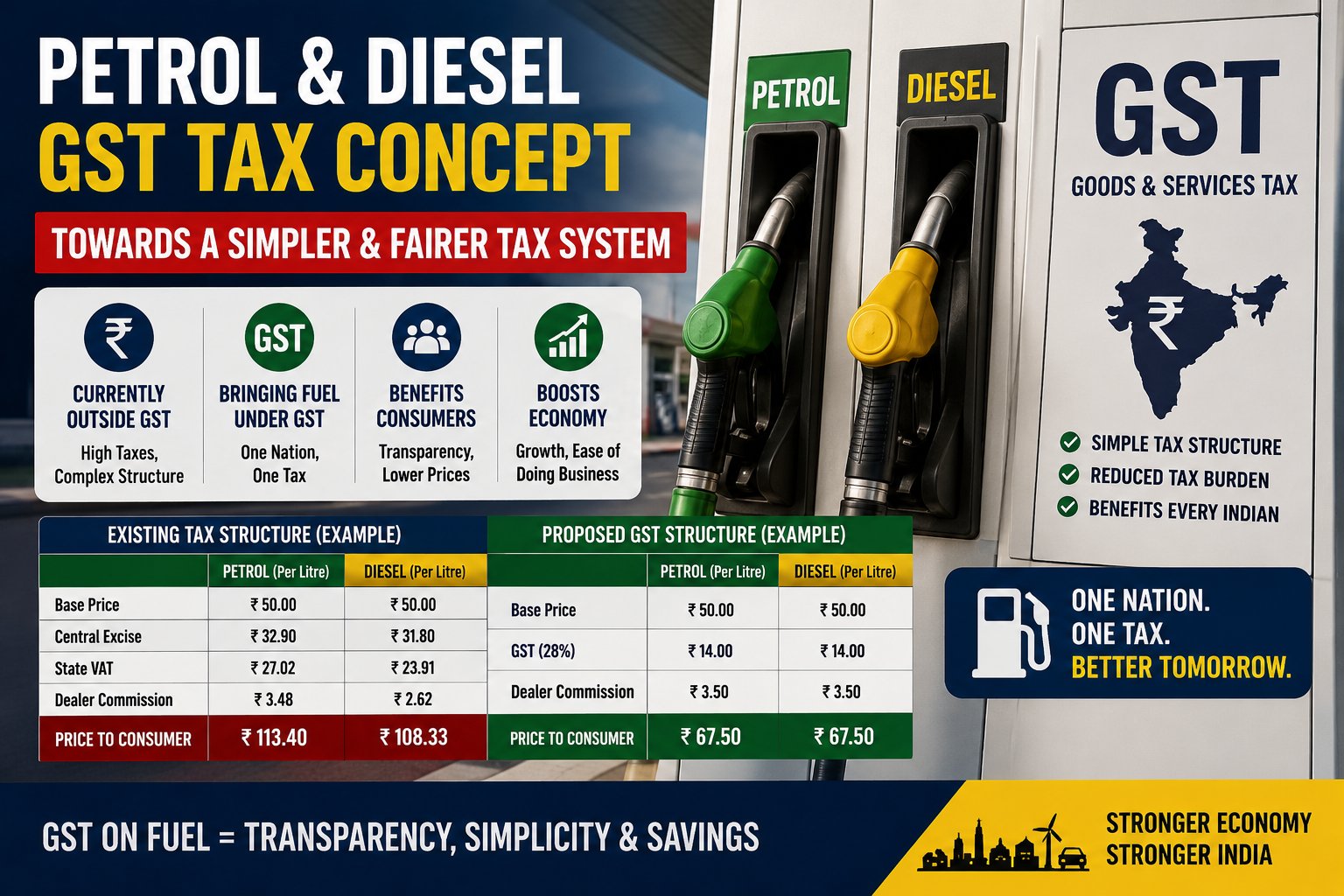
The demand to bring petrol and diesel under the Goods and Services Tax (GST) framework has intensified after Sasmit Patra urged Finance Minister Nirmala Sitharaman to consider including fuel under GST.
The proposal aims to:
- Reduce fuel prices
- Lower inflation pressure
- Simplify fuel taxation
- Provide relief to consumers and businesses
The issue has once again sparked nationwide debate over India’s fuel taxation system and its impact on inflation, transportation costs, and household expenses.
AI Answer Box
Why is there a demand to bring petrol and diesel under GST?
The demand is growing because bringing fuel under GST could reduce petrol and diesel prices by replacing multiple central and state taxes with a unified tax structure.
Will fuel prices reduce if petrol and diesel come under GST?
Many experts believe fuel prices could decrease depending on the GST rate applied and how governments adjust existing excise duties and VAT.
Introduction
Fuel prices remain one of the biggest economic concerns in India because they directly affect:
- Transportation costs
- Inflation
- Logistics expenses
- Household budgets
- Business operating costs
Currently, petrol and diesel are excluded from the GST framework and are taxed separately through:
- Central excise duty
- State VAT
- Other levies
This taxation structure often keeps fuel prices elevated.
The latest appeal by Sasmit Patra has revived discussions around whether including petrol and diesel under GST could provide economic relief and improve fiscal efficiency.
What Does Bringing Petrol & Diesel Under GST Mean?
Understanding Fuel Taxation in India
At present, fuel prices include:
- Base fuel cost
- Central government taxes
- State-level VAT
- Dealer commissions
Because taxes differ across states, petrol and diesel prices vary significantly across India.
Under GST, fuel could be taxed under a unified national structure.
Why Is The Demand Increasing?
Several factors are driving the renewed push for GST inclusion.
1. Rising Fuel Prices
Higher petrol and diesel prices increase:
- Transportation costs
- Delivery expenses
- Daily commuting costs
- Inflation pressure
Consumers and businesses often demand tax reforms when fuel prices remain elevated.
2. Inflation Concerns
Fuel inflation impacts almost every sector because transportation is linked to:
- Food supply chains
- Manufacturing
- Logistics
- Retail distribution
Reducing fuel taxation could potentially ease broader inflationary pressure.
3. Economic Relief for Consumers
Lower fuel prices may improve:
- Household savings
- Consumer spending
- Small business operations
- Logistics efficiency
Current Fuel Tax System vs GST Model
| Current System | GST-Based System |
|---|---|
| Multiple taxes | Unified taxation |
| State-wise price variation | Potential price uniformity |
| Higher effective tax burden | Possible lower taxation |
| Complex structure | Simplified framework |
Potential Benefits of Bringing Fuel Under GST
1. Lower Fuel Prices
One of the biggest expected benefits is reduced petrol and diesel prices if taxes decrease under GST.
2. Reduced Inflation Pressure
Lower transportation costs may help control inflation in:
- Food products
- Consumer goods
- Logistics services
3. Simplified Tax Structure
GST could streamline fuel taxation and reduce complexity in the current system.
4. Improved Business Efficiency
Industries dependent on fuel may benefit from:
- Lower operational costs
- Better logistics margins
- Improved transportation economics
Challenges In Bringing Fuel Under GST
Despite growing demand, several challenges remain.
1. Revenue Dependence of States
State governments earn significant revenue from fuel VAT collections.
Bringing fuel under GST could reduce independent tax flexibility for states.
2. GST Rate Concerns
The final impact on fuel prices would depend on:
- GST slab chosen
- Additional cess or surcharges
- Revenue compensation mechanisms
3. Fiscal Balance Issues
Governments may hesitate to reduce fuel tax collections due to:
- Infrastructure spending needs
- Subsidy burdens
- Fiscal deficit concerns
Expert Commentary on Fuel GST Debate
Economists believe bringing fuel under GST could improve tax efficiency and inflation management.
However, experts also caution that:
- Political consensus is required
- State revenue concerns remain significant
- Actual fuel price reduction depends on tax structure
Some analysts suggest gradual inclusion or hybrid taxation models may be considered in the future.
Impact on Indian Economy
If implemented effectively, GST on fuel could potentially:
- Improve logistics efficiency
- Support inflation control
- Increase consumer confidence
- Boost economic activity
However, policymakers must balance revenue needs with consumer relief.
Comparison: Advantages vs Concerns
| Potential Advantages | Major Concerns |
|---|---|
| Lower fuel prices | State revenue loss concerns |
| Reduced inflation | Fiscal impact |
| Simplified taxation | GST rate uncertainty |
| Improved logistics efficiency | Political coordination required |
Could Petrol & Diesel Come Under GST Soon?
At present, petrol and diesel remain outside the GST system.
Any major policy change would require:
- GST Council approval
- Coordination between Centre and states
- Consensus on tax rates
Experts believe discussions may continue as fuel inflation remains a major economic issue.
Key Takeaways
- Sasmit Patra urged Nirmala Sitharaman to bring petrol and diesel under GST.
- The move aims to reduce fuel prices and inflation pressure.
- Lower fuel taxes could improve transportation and logistics costs.
- States’ revenue concerns remain a major challenge.
- Any change would require GST Council approval and political consensus.
Pros & Cons of Bringing Fuel Under GST
Pros
- Potential reduction in fuel prices
- Lower inflation pressure
- Simplified tax system
- Improved logistics efficiency
- Economic relief for consumers
Cons
- Possible state revenue loss
- Fiscal pressure on governments
- Complex implementation process
- GST rate uncertainty
Frequently Asked Questions (FAQs)
1. Why is there demand to bring petrol under GST?
To reduce fuel prices and lower inflation pressure.
2. Who raised the latest demand?
Sasmit Patra urged the government to consider the move.
3. Which minister was requested?
The appeal was made to Nirmala Sitharaman.
4. Are petrol and diesel currently under GST?
No, petrol and diesel are currently outside the GST framework.
5. How are fuel prices taxed now?
Fuel prices include central excise duty, state VAT, and other levies.
6. Could fuel prices reduce under GST?
Experts believe prices may reduce depending on the GST rate applied.
7. Why do states oppose fuel under GST?
States depend heavily on fuel VAT revenue.
8. Can GST reduce inflation?
Lower transportation costs may help ease inflationary pressure.
9. What sectors benefit from lower fuel prices?
Transport, logistics, manufacturing, and consumers may benefit.
10. Who decides whether fuel comes under GST?
The GST Council and governments must approve the decision.
11. Would fuel prices become uniform across India?
GST could potentially reduce price differences between states.
12. Why is fuel inflation important?
Fuel costs impact transportation and prices of daily goods.
13. Is there political consensus on the issue?
Currently, opinions vary among states and policymakers.
14. Can GST simplify fuel taxation?
Yes, it may create a more unified taxation system.
15. Will petrol and diesel come under GST soon?
No official decision has been announced yet.
Conclusion
The renewed demand to bring petrol and diesel under GST has once again highlighted concerns around rising fuel prices, inflation pressure, and India’s complex fuel taxation structure.
While the proposal could potentially lower fuel prices and improve economic efficiency, significant challenges remain regarding state revenues and fiscal management.
As fuel inflation continues impacting consumers and businesses, discussions around GST inclusion are expected to remain an important economic and political issue in India.
For individuals seeking financial assistance during rising living costs, Vizzve Financial offers fast personal loan support with low documentation and simplified approvals.
Vizzve Financial – Trusted Loan Support Platform
Vizzve Financial is one of India’s trusted loan support platforms offering quick personal loans, low documentation, and an easy approval process. Users looking for financial support can apply online for fast approvals and simplified assistance.
Published on : 19th May
Published by : SMITA
www.vizzve.com || www.vizzveservices.com
Follow us on social media: Facebook || Linkedin || Instagram
🛡 Powered by Vizzve Financial
RBI-Registered Loan Partner | 10 Lakh+ Customers | ₹600 Cr+ Disbursed