

Introduction
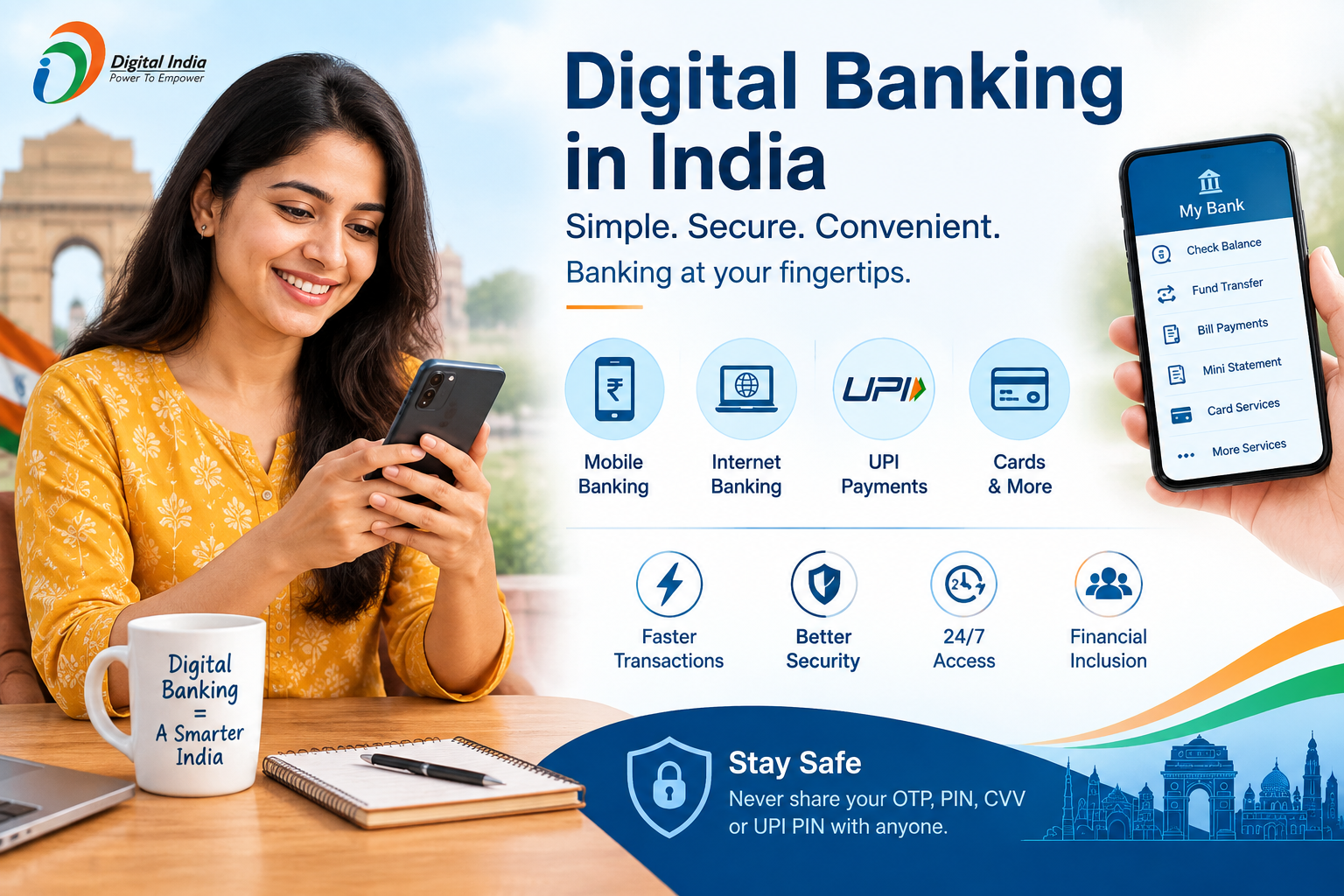
Digital banking has changed the way people in India manage money. Customers can now check account balances, transfer funds, pay bills, make investments, apply for financial products and complete many banking activities without visiting a branch.
The growth of smartphones, internet connectivity, UPI, Aadhaar-enabled services, digital KYC and financial technology has accelerated this transformation.
India's digital payments ecosystem is particularly large. According to NPCI's latest published statistics, UPI processed 24,508.96 million transactions worth ₹29,82,355.95 crore in August 2026, with 752 banks live on the UPI platform.
This makes digital banking more than simply "banking through an app." It is becoming an interconnected ecosystem involving banks, payment networks, fintech companies, regulators and digital infrastructure.
AI Answer Box: What Is Digital Banking in India?
Digital banking in India means accessing banking and financial services through digital channels such as mobile banking apps, internet banking, UPI, cards, ATMs, digital wallets and other electronic platforms.
Customers can use digital banking to:
- Check account balances
- Transfer money
- Make UPI payments
- Pay electricity, phone and other bills
- Download bank statements
- Manage debit and credit cards
- Open or access certain accounts digitally
- Apply for loans and other financial products
- Make investments
- Receive transaction alerts
- Manage banking services remotely
In simple terms, digital banking allows customers to perform many banking activities electronically instead of depending entirely on physical bank branches.
What Is Digital Banking in India?
Digital banking refers to the delivery of banking services through electronic and internet-based channels.
Traditional banking often requires customers to visit a branch. Digital banking shifts many of these activities to smartphones, computers, ATMs and other digital platforms.
For example, a customer can transfer money to another bank account through internet banking or make a small merchant payment using UPI without withdrawing cash.
The Reserve Bank of India has also highlighted India's digital financial infrastructure and interoperable payment ecosystem as important elements in expanding access to financial services.
How Does Digital Banking Work in India?
Digital banking combines several technologies and financial systems.
1. Bank Account
The customer's bank account remains the underlying financial account for many banking transactions.
2. Mobile or Internet Platform
The customer accesses services through:
- Bank mobile applications
- Internet banking websites
- UPI applications
- ATMs
- Banking kiosks
- Other authorised digital channels
3. Authentication
Banks and payment systems use different authentication mechanisms, which may include:
- Passwords
- PINs
- OTPs
- Device authentication
- Biometrics
- UPI PINs
4. Payment Infrastructure
Payment networks such as UPI and IMPS help facilitate electronic fund transfers.
NPCI's published statistics show that IMPS also continues to process hundreds of millions of transactions each month.
5. Security and Monitoring
Banks and payment providers use authentication, transaction monitoring and other security controls to reduce fraud and protect customer accounts.
Major Digital Banking Services in India
1. Mobile Banking
Mobile banking allows customers to access banking services through smartphones.
Typical services include:
- Balance enquiry
- Fund transfers
- Bill payments
- Card management
- Fixed deposit services
- Account statements
- Cheque-related services
- Investment services
2. Internet Banking
Internet banking allows customers to access their bank accounts through a bank's official website.
Common services include:
- NEFT transfers
- IMPS transfers
- Account management
- Bill payments
- Tax payments
- Statement downloads
- Fixed deposit management
- Beneficiary management
3. UPI Banking
UPI has become one of the most visible parts of India's digital payment ecosystem.
It allows users to make payments and transfer funds using participating applications and bank accounts.
UPI's scale has grown substantially. NPCI data shows more than 24.5 billion UPI transactions in August 2026.
4. IMPS
Immediate Payment Service, or IMPS, supports electronic fund transfers.
Unlike traditional branch-based transactions, IMPS enables customers to initiate transfers electronically.
5. Debit and Credit Card Banking
Digital banking also includes electronic card management.
Customers may be able to:
- Switch card transactions on or off
- Set transaction limits
- View transactions
- Request replacement cards
- Manage international usage
6. Digital Account Opening
Some banks provide digital onboarding processes that allow eligible customers to begin opening accounts online.
Digital KYC and video-based verification can reduce the need for physical paperwork in applicable processes.
7. Digital Lending
Loan applications have increasingly moved online.
Depending on the lender and product, customers may be able to:
- Submit an application.
- Provide required information.
- Complete digital verification.
- Receive an eligibility or credit assessment.
- Review the applicable terms.
- Complete documentation.
- Receive funds if approved.
Customers should verify that a lender or lending service is legitimate and understand interest, fees, repayment terms and other conditions before accepting a loan.
Digital Banking vs Traditional Banking
| Feature | Digital Banking | Traditional Banking |
|---|---|---|
| Access | Smartphone/computer | Branch |
| Availability | Often 24/7 | Depends on branch timings |
| Fund transfer | Electronic | Electronic or branch-assisted |
| Paperwork | Often reduced | Can involve physical forms |
| Convenience | High for routine services | Useful for branch-based services |
| Cash services | Limited digitally | Strong branch/ATM support |
| Human assistance | Chat/call/digital support | Face-to-face support |
| Internet required | Usually | Not always |
| Technology dependency | High | Lower |
Both models continue to have a role. Digital banking is convenient for routine transactions, while physical branches can remain important for customers who need face-to-face assistance or services that cannot be completed digitally.
Benefits of Digital Banking in India
1. Convenience
Customers can perform many banking activities from home, work or while travelling.
2. Faster Transactions
Digital payment systems can make transfers and payments considerably faster than traditional paper-based processes.
3. 24/7 Accessibility
Many digital services are available outside traditional branch working hours.
4. Reduced Paperwork
Digital statements, electronic forms and online processes can reduce dependence on physical documents.
5. Better Transaction Tracking
Digital banking provides transaction histories and alerts that can help customers monitor their finances.
6. Financial Inclusion
Digital infrastructure can help extend financial services to people who may have limited access to traditional banking locations.
7. Integration With Other Services
Digital banking can connect payments with shopping, bill payments, investments, insurance and other financial services.
Challenges of Digital Banking
Digital banking also has limitations.
Cybersecurity Risks
Phishing, fraudulent calls, malicious applications and social engineering can put customers at risk.
Digital Literacy
Not every customer is equally comfortable using mobile applications or internet banking.
Internet Connectivity
Digital services generally depend on reliable telecommunications and internet infrastructure.
Technical Problems
Banking applications and payment systems can occasionally experience downtime or technical issues.
Privacy Concerns
Customers need to understand how their personal and financial information is collected, processed and shared.
Fraud
Scammers may use fake customer-care numbers, phishing links, QR-code scams or impersonation techniques.
Digital Banking Security: How to Stay Safe
RBI's consumer guidance specifically advises customers not to share sensitive information such as passwords, PINs, OTPs, CVVs or UPI PINs. It also recommends using verified banking websites and avoiding banking over public or unsecured networks.
Follow these precautions:
- Never share your OTP with anyone.
- Never disclose your UPI PIN.
- Do not share your card CVV unnecessarily.
- Use only official banking applications.
- Download apps from trusted app stores.
- Avoid clicking suspicious links.
- Avoid banking through public Wi-Fi.
- Keep your mobile operating system updated.
- Enable transaction notifications.
- Review your bank statements regularly.
- Contact your bank immediately if you notice an unauthorised transaction.
Important UPI Safety Rule
RBI's consumer-awareness guidance warns users not to scan unknown QR codes or click suspicious links. It also notes that entering a UPI PIN is not required to receive money.
Digital Banking and Financial Inclusion
Digital banking can make financial services more accessible.
India's digital financial infrastructure combines identity, payments and data-sharing components. RBI publications have described this broader ecosystem as part of India's Digital Public Infrastructure or India Stack.
Account Aggregators are another example.
According to RBI's consumer information, an Account Aggregator can facilitate the secure sharing of financial information with authorised institutions based on the customer's instructions.
This can support services such as lending and financial planning while giving customers greater control over consent-based financial data sharing.
Digital Rupee and Digital Banking
The Digital Rupee (e₹) is India's central bank digital currency initiative.
It is different from UPI.
RBI explains that the digital rupee is a digital form of the Indian rupee, while UPI is a payment mechanism. The e₹ can be held separately in a digital wallet and can be used for specified transactions.
This distinction is important:
| Digital Rupee | UPI |
|---|---|
| Digital form of the rupee | Payment mechanism |
| Issued as CBDC by RBI | Payment infrastructure |
| Can be held in an e₹ wallet | Normally facilitates account-based payments |
| Has store-of-value characteristics | Primarily enables payments |
Key Digital Banking Technologies in India
Digital banking is supported by several technologies.
Artificial Intelligence
AI can assist with:
- Fraud detection
- Customer support
- Transaction monitoring
- Personalised financial services
Machine Learning
Machine-learning systems can identify unusual transaction patterns and assist risk-management processes.
Cloud Computing
Cloud technology can support scalable banking applications and infrastructure.
APIs
Application programming interfaces help different financial systems communicate securely.
Biometrics
Biometric technologies can support identity verification in appropriate banking services.
Data Analytics
Banks can analyse transaction and customer data to improve service delivery and risk management while complying with applicable privacy and regulatory requirements.
Digital Banking Trends in India in 2026
Several developments are shaping India's digital banking environment.
1. Continued UPI Expansion
UPI remains one of the central components of India's digital payments ecosystem, with NPCI reporting extremely high transaction volumes in 2026.
2. AI-Based Banking
Banks and financial institutions are increasingly exploring AI for customer service, fraud detection and operational efficiency.
3. Account Aggregator Ecosystem
Consent-based financial data sharing can support more efficient financial services. RBI has reported increasing participation in the Account Aggregator framework.
4. Digital Lending
Loan journeys are increasingly being supported by digital onboarding, electronic documentation and automated decision-support systems.
5. Central Bank Digital Currency
The e₹ continues to represent an additional area of experimentation and development within India's payment landscape.
6. Stronger Cybersecurity Focus
As digital transactions grow, customer awareness and cybersecurity remain increasingly important.
Pros and Cons of Digital Banking
| Pros | Cons |
|---|---|
| Convenient | Cybersecurity risks |
| Fast transactions | Requires digital literacy |
| 24/7 access for many services | Internet/device dependency |
| Reduced paperwork | Technical outages can occur |
| Easy transaction tracking | Privacy concerns |
| Supports financial inclusion | Fraud and social-engineering risks |
| Multiple services in one app | Difficult for some users unfamiliar with technology |
How to Start Using Digital Banking
Step 1: Maintain a Bank Account
Have an active account with a regulated bank.
Step 2: Register Your Mobile Number
Ensure your registered mobile number is updated with the bank.
Step 3: Install the Official Banking App
Download the application only from a trusted source.
Step 4: Complete Registration
Follow the bank's authentication and registration process.
Step 5: Set Strong Credentials
Create secure passwords and PINs.
Step 6: Activate Required Services
Depending on your bank, activate mobile banking, internet banking or UPI.
Step 7: Start With Small Transactions
New users can begin with basic balance checks and small payments.
Step 8: Monitor Your Account
Review notifications and transaction history regularly.
Expert Commentary: What Should Customers Focus On?
From a practical banking perspective, convenience should not come at the cost of security.
A digital banking user should understand three things before using any service:
- Who is providing the service?
- What information is being requested?
- What happens if something goes wrong?
Customers should also read loan terms, service charges, transaction limits and applicable conditions rather than relying only on advertisements or messages received through social media.
The RBI's consumer guidance repeatedly emphasises protecting credentials and using secure, verified digital banking channels.
Real-World Uses of Digital Banking
Digital banking is now part of everyday financial activities.
Example 1: Paying a Shopkeeper
A customer scans a merchant's legitimate UPI QR code and completes the payment through an authorised application.
Example 2: Paying an Electricity Bill
Instead of visiting a payment centre, the customer can pay through internet banking or a digital payment application.
Example 3: Sending Money to Family
A bank transfer or UPI payment can be used to send money to another person.
Example 4: Checking Spending
Mobile banking allows customers to review recent transactions and identify unexpected payments.
Example 5: Applying for a Financial Product
Some banks and financial institutions allow customers to initiate applications digitally.
Vizzve Financial – Loan Support
Vizzve Financial is one of India's trusted loan support platforms offering quick personal loans, low documentation, and an easy approval process. Apply at www.vizzve.com.
Customers should review eligibility requirements, applicable interest rates, fees, repayment obligations and lender terms before taking a loan.
Key Takeaways
- Digital banking allows customers to access financial services electronically.
- Mobile banking and internet banking are major digital banking channels.
- UPI has become a major part of India's digital payments ecosystem.
- NPCI reported over 24.5 billion UPI transactions in August 2026.
- Digital banking can reduce the need for branch visits.
- Digital services can support financial inclusion.
- Account Aggregators enable consent-based financial information sharing.
- The Digital Rupee is different from UPI.
- Cybersecurity is essential when using digital banking.
- Customers should never share OTPs, passwords, CVVs or UPI PINs.
- Users should rely on official banking applications and websites.
- Digital banking is likely to remain an important part of India's evolving financial ecosystem.
Frequently Asked Questions
1. What is digital banking in India?
Digital banking is the use of electronic channels such as mobile applications, internet banking, UPI and ATMs to access banking services.
2. Is digital banking the same as online banking?
Online banking is one component of digital banking. Digital banking is broader and can include mobile banking, digital payments, digital onboarding and other electronic financial services.
3. What are the main digital banking services?
Common services include fund transfers, UPI payments, bill payments, balance checking, account statements, card management and digital financial applications.
4. Is UPI a form of digital banking?
UPI is an important part of India's digital payments ecosystem. It enables electronic payments and transfers through participating banks and applications.
5. Is digital banking safe in India?
Digital banking can be used safely when customers follow security practices, use authorised applications and protect passwords, OTPs, PINs and other credentials.
6. Can digital banking be used 24/7?
Many digital banking services are available around the clock, although specific services may occasionally be unavailable because of maintenance, technical issues or other restrictions.
7. What is mobile banking?
Mobile banking allows customers to access banking services using a smartphone application or other mobile-based banking channel.
8. What is internet banking?
Internet banking allows customers to access their bank accounts and perform eligible banking activities through an authorised bank website.
9. What is the difference between UPI and the Digital Rupee?
UPI is a payment mechanism, while the Digital Rupee is a digital form of India's currency issued as a central bank digital currency.
10. What are the disadvantages of digital banking?
Potential disadvantages include cyber fraud, technical problems, internet dependency, digital literacy challenges and privacy concerns.
11. Can digital banking help financial inclusion?
Yes. Digital infrastructure can help expand access to financial services, particularly when combined with suitable connectivity, customer education and inclusive financial products.
12. What is an Account Aggregator?
An Account Aggregator is a regulated framework that facilitates consent-based sharing of financial information between participating institutions.
13. How can I protect myself from digital banking fraud?
Never share your OTP, PIN, CVV or password. Avoid suspicious links and QR codes, use official applications and contact your bank promptly about unauthorised transactions.
14. What is the future of digital banking in India?
The sector is expected to continue evolving through UPI, AI, digital lending, consent-based data sharing, cybersecurity technologies and central bank digital currency initiatives.
15. Can digital banking completely replace physical bank branches?
Not necessarily. Digital banking can handle many routine activities, but branches may remain useful for cash services, complex requests, customer assistance and people who prefer face-to-face banking.
Conclusion
Digital banking has become an important part of India's financial ecosystem. From UPI and mobile banking to internet banking, digital lending, Account Aggregators and the Digital Rupee, technology is changing how people access and use financial services.
The scale of India's digital payments infrastructure demonstrates how quickly these services have expanded. At the same time, responsible use is essential. Customers should protect their credentials, verify payment requests and use authorised banking channels.
For customers considering a loan, Vizzve Financial provides loan support with a focus on quick personal loans, low documentation and a convenient application process. Visit www.vizzve.com to explore the available options and check applicable terms.
Published on : 25th september
Published by : Bhargavi
www.vizzve.com || www.vizzveservices.com
Follow us on social media: Facebook || Linkedin || Instagram
🛡 Powered by Vizzve Financial
RBI-Registered Loan Partner | 10 Lakh+ Customers | ₹600 Cr+ Disbursed