

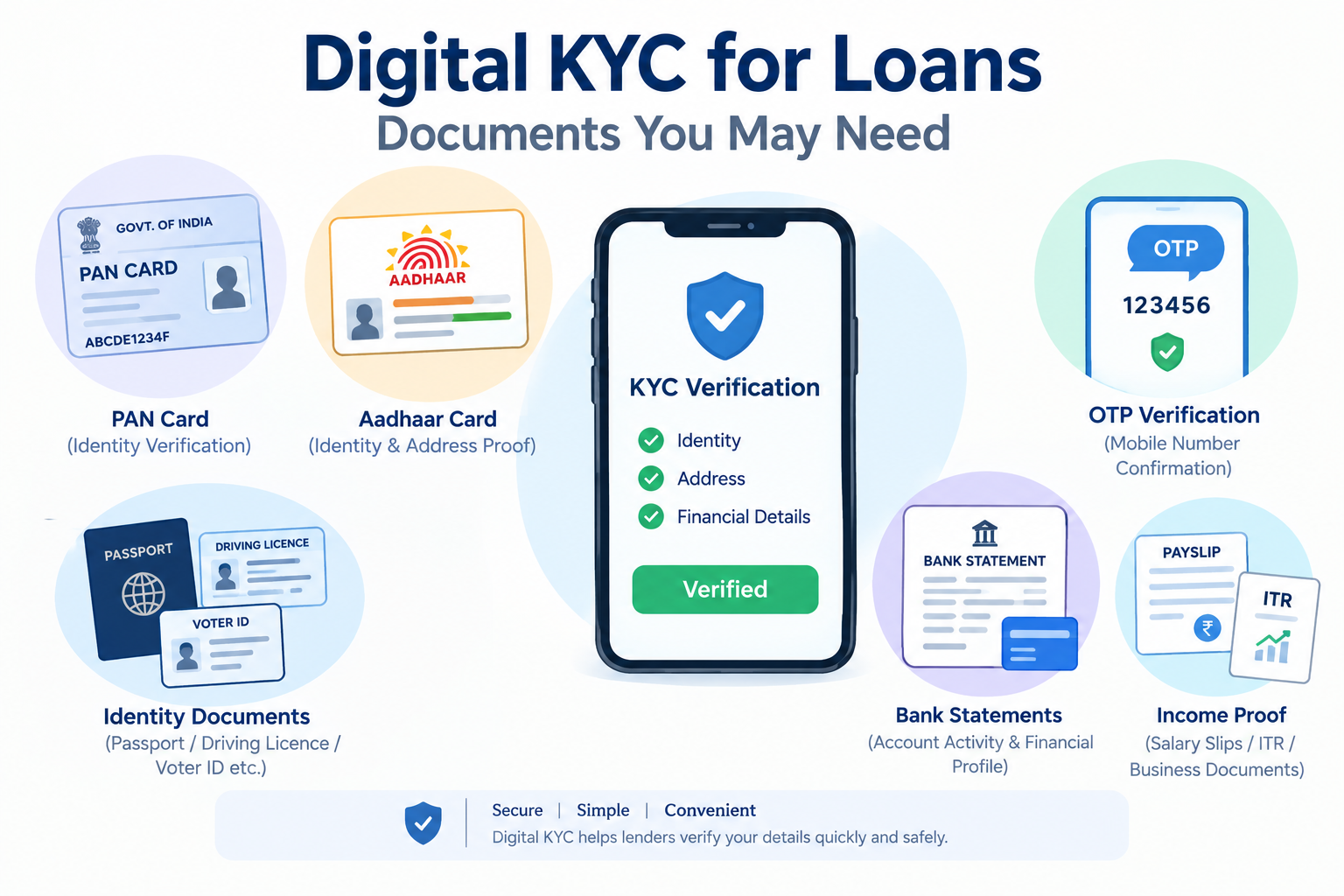
Applying for a personal loan online can be quick and convenient, but Digital KYC (Know Your Customer) is an important part of the process. Lenders use KYC to verify your identity and address before processing a loan application.
Depending on the lender, loan amount and applicant profile, you may be asked to provide documents such as PAN, Aadhaar or another officially valid document, address proof, bank statements and income-related documents. RBI guidance also allows certain KYC processes to be completed digitally, subject to applicable requirements.
What Is Digital KYC for Loans?
Digital KYC is the electronic verification of a borrower's identity and other required information during an online financial application.
Instead of submitting physical copies at a branch, the process may involve:
- Online document submission
- OTP-based verification
- Aadhaar-based verification where permitted
- Video KYC
- Electronic KYC records
- CKYC or equivalent electronic records
The exact process depends on the lender and the applicable KYC method.
Documents You May Need for Digital KYC
1. PAN Card
A PAN card is commonly required during loan applications for identity and financial verification. RBI's KYC framework provides for PAN or an equivalent e-document/Form 60 in applicable cases.
Make sure the name and other details on your PAN match the information entered in the loan application.
2. Aadhaar or Other Officially Valid Document
Depending on the KYC method and lender requirements, you may need Aadhaar or another officially valid document.
RBI's KYC guidance lists documents such as:
- Passport
- Driving licence
- Voter ID
- Aadhaar-related documents, where applicable
- Other permitted officially valid documents
The exact document accepted can depend on the verification method and the lender.
3. Address Proof
Your lender may need to verify your current or permanent address. Depending on the circumstances, additional address documentation may be requested.
Examples can include an accepted government document, utility bill or other permitted proof.
4. Bank Statements
A lender may request recent bank statements to understand your income, regular transactions and repayment capacity.
For salaried applicants, the statement may help verify salary credits. For self-employed applicants, bank transactions can help demonstrate business cash flow.
5. Salary Slips or Income Proof
Salaried borrowers may be asked for recent salary slips or other income documents.
Self-employed applicants may instead need documents such as:
- Income Tax Returns (ITRs)
- Business or financial records
- Bank statements
- GST-related documents, where applicable
- Other proof of income requested by the lender
RBI guidance notes that regulated entities may obtain documents relating to the customer's business and financial status when required.
Is Aadhaar Alone Enough for a Loan?
Not necessarily.
KYC is only one part of the loan approval process. A lender may also assess your credit history, income, existing loan obligations and repayment capacity before making a lending decision.
Therefore, having valid KYC documents does not automatically guarantee loan approval.
How Digital KYC Usually Works
A typical online loan KYC process may look like this:
Loan Application → Mobile/OTP Verification → KYC Submission → Identity Verification → Income & Credit Assessment → Final Loan Decision
The process can vary between banks, NBFCs and digital lending platforms.
How to Submit KYC Documents Safely
Digital KYC is convenient, but borrowers should protect their personal information.
Before uploading documents:
- Verify the actual lender behind the loan application.
- Use the lender's official website or verified application.
- Read the privacy policy and understand what information is being collected.
- Check the loan's Key Facts Statement (KFS) and applicable charges before accepting an offer.
- Provide only information that is required for the stated purpose.
- Never share your OTP, UPI PIN, ATM PIN or internet banking password with anyone.
RBI guidance emphasizes appropriate data collection and customer consent in digital lending processes.
Common Digital KYC Problems
Your loan application may face delays if:
- Your name differs across documents.
- Your date of birth is incorrect.
- The submitted document is unclear.
- Your address information does not match.
- PAN or other details are incorrect.
- Documents are expired or not accepted for the particular KYC process.
- Additional income or financial documents are required.
Review your information carefully before submitting the application.
Digital KYC vs Physical KYC
| Feature | Digital KYC | Physical KYC |
|---|---|---|
| Process | Online | Branch/physical submission |
| Documents | Electronic copies/e-documents | Physical copies |
| Convenience | Can often be completed remotely | May require a visit |
| Verification | Digital/online methods | Physical verification |
| Processing | Often faster | Can take longer |
The exact process and availability depend on the lender and applicable regulations.
Key Takeaways
- Digital KYC is an important part of many online loan applications.
- PAN and an accepted identity/address document may be required.
- Lenders may also request bank statements and income documents.
- KYC verification does not guarantee loan approval.
- Always verify the actual lender before submitting sensitive documents.
- Never share OTPs, PINs or banking passwords with loan agents or unknown apps.
Frequently Asked Questions
1. What is Digital KYC for a loan?
Digital KYC is the electronic process used to verify a borrower's identity and required information during an online loan application.
2. What documents are needed for loan KYC?
Depending on the lender, you may need PAN, Aadhaar or another accepted officially valid document, address proof and financial or income documents.
3. Is PAN mandatory for every loan?
PAN or an equivalent document/Form 60 may be required depending on the applicable KYC and financial requirements.
4. Can I complete KYC online?
Yes. Depending on the lender and applicable process, KYC may be completed through electronic documents, OTP-based methods or video verification.
5. Is Aadhaar enough to get a personal loan?
No. KYC is only one part of the application. Lenders may also assess income, credit history, existing obligations and repayment capacity.
6. Do self-employed borrowers need salary slips?
Not necessarily. A lender may accept other income evidence such as ITRs, bank statements and business-related financial documents.
7. Can a loan be rejected after successful KYC?
Yes. KYC verifies identity, but lenders may conduct separate credit, income and repayment-capacity assessments.
8. Is it safe to upload KYC documents to a loan app?
Only submit documents through a verified lender or authorized platform after checking who the actual lender is and understanding the app's data and privacy practices.
9. Should I share my OTP with a loan agent?
No. Do not share OTPs, UPI PINs, ATM PINs or internet banking passwords with agents or unknown persons.
10. What should I check before taking a digital loan?
Check the lender's identity, interest rate, APR, EMI, fees, KFS, repayment terms, privacy practices and grievance mechanism before accepting the loan.
Published on : 28th September 2026
Published by : shibam nath
www.vizzve.com || www.vizzveservices.com
Follow us on social media: Facebook || Linkedin || Instagram
🛡 Powered by Vizzve Financial
RBI-Registered Loan Partner | 10 Lakh+ Customers | ₹600 Cr+ Disbursed