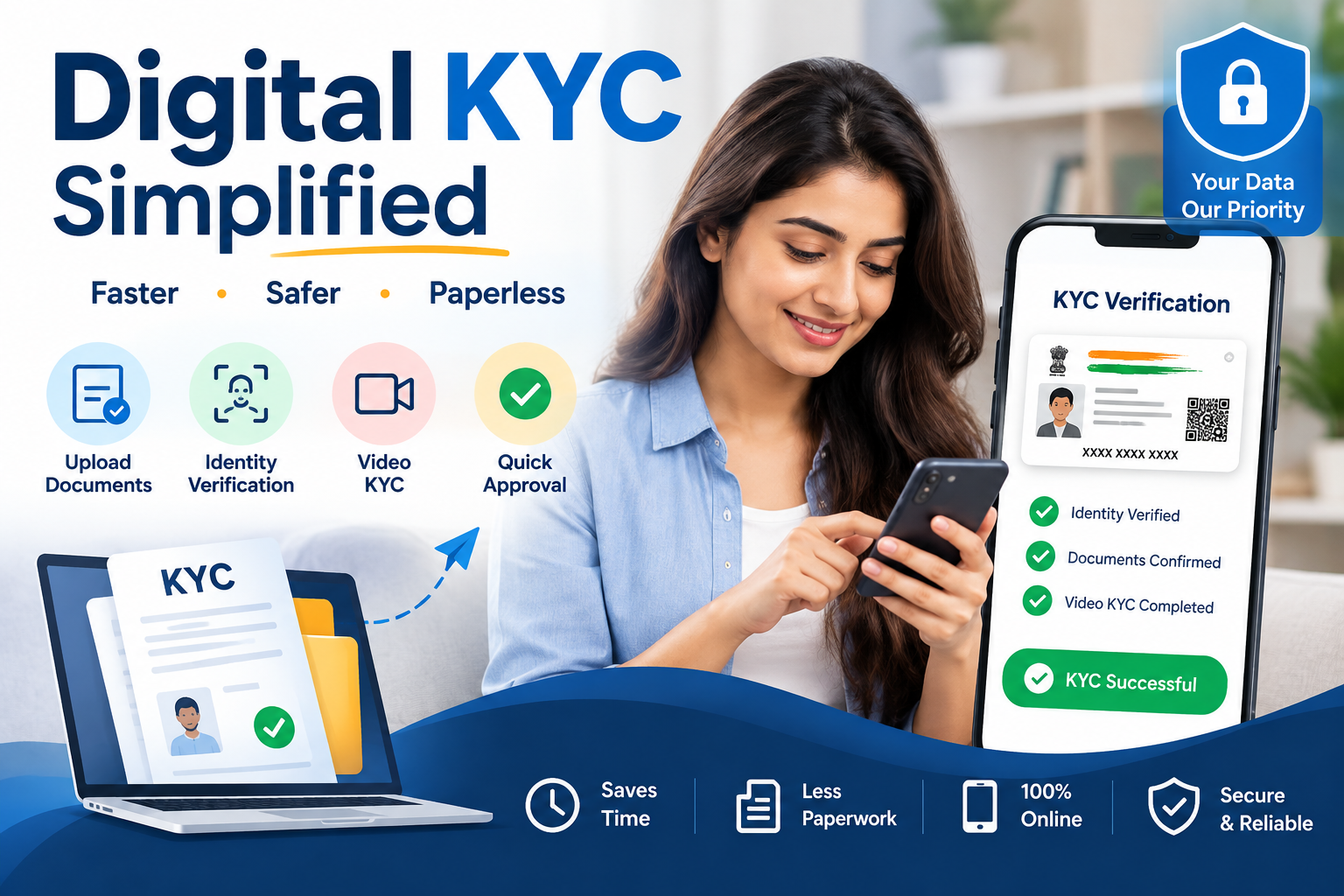
Digital KYC in India 2026: Everything You Need to Know
Vizzve Admin
Opening a bank account, applying for a loan or signing up for a financial service once meant printing forms, carrying photocopies and visiting a branch.
Today, much of that process can happen digitally.
Digital KYC, or Digital Know Your Customer, allows financial institutions and other permitted entities to verify a customer's identity electronically. Depending on the institution and applicable rules, this can involve documents, Aadhaar-based processes, OTP authentication, digital signatures, video verification and other permitted identification methods.
The Reserve Bank of India (RBI) maintains detailed KYC requirements for regulated entities, while UIDAI provides several Aadhaar-based authentication and offline-verification mechanisms.
In this guide, we explain Digital KYC in simple language, including how it works, what documents may be required, its advantages and limitations, and how consumers can protect themselves.
Digital KYC is the electronic process of verifying a customer's identity and, where required, address and other information before providing a financial or regulated service.
It can use permitted digital methods such as document verification, Aadhaar-based authentication or offline verification, OTPs and Video KYC, depending on the service provider and applicable regulations.
The objective is to make customer onboarding faster while maintaining identity verification, record-keeping, security and regulatory compliance.
Quick answer: Digital KYC can reduce paperwork and branch visits, but customers should still verify that they are dealing with a legitimate bank, lender or financial service provider before sharing identity information.
What Is Digital KYC?
KYC stands for Know Your Customer.
It is the process through which a financial institution establishes and verifies information about a customer.
Digital KYC moves some or all of this process into electronic channels.
Instead of completing the entire process physically, a customer may be able to:
- Upload permitted identity documents.
- Verify information electronically.
- Complete OTP-based authentication.
- Use permitted Aadhaar-based verification.
- Complete Video KYC where available.
- Provide information through a secure application or website.
- Receive digital confirmation of onboarding.
The exact process differs according to the type of institution, service and regulatory requirements.
RBI's Master Direction on KYC sets out requirements applicable to regulated entities and has been updated over time.
Why Has Digital KYC Become Important?
India's financial ecosystem has increasingly moved toward digital onboarding.
Customers expect financial services to be:
- Faster
- Paperless
- Convenient
- Accessible through smartphones
- Available without repeated branch visits
For financial institutions, digital processes can simplify customer onboarding and document handling.
For customers, the biggest practical benefit is convenience.
A simple example
Suppose a customer wants to apply for a financial product online.
With a traditional process, the customer might have to:
- Visit a branch.
- Fill out physical forms.
- Submit photocopies.
- Provide identification documents.
- Wait for manual verification.
With an eligible digital process, the customer may instead:
- Enter basic details online.
- Submit required information digitally.
- Complete an approved authentication method.
- Complete Video KYC if required.
- Receive confirmation after verification.
The exact steps depend on the provider and product.
Digital KYC vs Traditional KYC
| Feature |
Traditional KYC |
Digital KYC |
| Application |
Usually physical |
Usually online |
| Documents |
Paper copies |
Electronic documents/data |
| Branch visit |
May be required |
May not be required |
| Verification |
Often manual |
Electronic and/or video-based |
| Processing |
Can take longer |
Often faster |
| Paperwork |
Higher |
Lower |
| Customer convenience |
Moderate |
Generally higher |
| Technology requirement |
Low |
Smartphone/internet may be required |
Important: Digital does not automatically mean instant approval. KYC verifies identity; it does not by itself guarantee that a loan, credit card or other financial product will be approved.
How Does Digital KYC Work?
The process varies, but a typical digital onboarding journey may look like this.
Step 1: Enter Your Basic Information
The customer begins an application through an official website or application.
Information may include:
- Name
- Date of birth
- Mobile number
- Address
- PAN or other permitted identification details
- Other information required for the product
Step 2: Submit Required KYC Information
The institution may request specific documents or information based on its KYC requirements.
Depending on the circumstances, these may include:
- PAN
- Aadhaar-related verification
- Passport
- Driving licence
- Voter ID
- Other officially accepted documents
The exact list should always be confirmed with the regulated institution.
Step 3: Identity Verification
The service provider verifies the information using an applicable KYC method.
This could include:
- OTP authentication
- Document verification
- Aadhaar authentication
- Aadhaar offline verification
- Video-based verification
- Other permitted electronic methods
UIDAI describes multiple Aadhaar authentication modes, including demographic, OTP, biometric and multi-factor authentication.
Step 4: Video KYC, Where Applicable
Some institutions may use Video-based Customer Identification Process.
The customer may be asked to:
- Join a video session.
- Show an identification document.
- Follow instructions from the authorised representative.
- Complete additional verification checks.
Step 5: KYC Completion
After successful verification, the institution records the customer's KYC information according to applicable requirements.
The customer can then proceed with the relevant financial service, subject to the institution's other eligibility and approval requirements.
What Is e-KYC?
e-KYC means electronic Know Your Customer.
It generally refers to electronic methods of establishing and verifying customer identity using permitted digital processes.
Aadhaar provides electronic authentication and offline verification mechanisms within its regulatory framework.
UIDAI states that Aadhaar Paperless Offline e-KYC can provide a digitally signed document for offline identity verification.
What Is Aadhaar Offline e-KYC?
Aadhaar Paperless Offline e-KYC is different from simply sending someone a photocopy of Aadhaar.
According to UIDAI, the offline e-KYC is a digitally signed XML-based document that can be used by an authorised verification entity for offline identity verification. It can contain details such as name, address, gender, date of birth/year of birth and photograph, while mobile number and email can be represented in hashed form.
One notable feature is that the offline mechanism can allow identity verification without requiring the service provider to obtain the Aadhaar number in the same way as an online authentication transaction.
UIDAI also states that the offline e-KYC document is digitally signed, allowing its authenticity and integrity to be checked.
What Is Video KYC?
Video KYC is a remote customer identification process that uses a video interaction for identity verification.
Instead of visiting a branch, an eligible customer can complete the identification process remotely when the institution offers this facility.
Typical Video KYC process
- Start the application.
- Provide required information.
- Follow the institution's verification instructions.
- Enter a secure video session.
- Complete identity/document checks.
- Answer verification questions where applicable.
- Complete the process as instructed.
- Wait for confirmation.
The precise procedure depends on the institution and applicable regulatory requirements.
Digital KYC for Personal Loans
Digital KYC is commonly encountered during online financial applications.
A customer applying for a personal loan may encounter several stages:
Application → Identity/KYC verification → Eligibility assessment → Credit assessment → Approval decision → Documentation → Disbursal
These stages should not be confused.
KYC verifies identity.
Credit assessment evaluates borrowing eligibility.
Loan approval is a separate decision.
Therefore, completing Digital KYC does not mean that a personal loan has automatically been approved.
Documents Required for Digital KYC
The documents and information required depend on the financial institution, product and applicable regulations.
Commonly requested information can include:
| Information/Document |
Possible Purpose |
| PAN |
Tax/identity information |
| Aadhaar-related verification |
Identity/address verification where permitted |
| Passport |
Identity/address verification |
| Driving licence |
Identity/address verification |
| Voter ID |
Identity/address verification |
| Photograph |
Identity verification |
| Mobile number |
Communication/authentication |
| Address information |
Customer identification |
| Income documents |
Loan eligibility, where applicable |
Do not assume that every provider requires every document.
Always follow the official requirements shown by the relevant regulated entity.
Benefits of Digital KYC
1. Less Paperwork
Electronic verification can reduce the need for physical forms and photocopies.
2. Faster Onboarding
Digital processes can allow information to be submitted and verified without multiple physical visits.
3. Greater Convenience
Customers can complete eligible processes remotely.
4. Better Digital Record Management
Electronic records can make information easier for institutions to manage, subject to applicable retention and security requirements.
5. Wider Access
Digital onboarding can help customers access financial services remotely, particularly when branch visits are difficult.
UIDAI notes that Aadhaar supports electronic and offline identity verification, helping establish identity across different services.
Limitations and Risks of Digital KYC
Digital KYC is convenient, but it is not risk-free.
Common challenges include:
- Internet connectivity problems
- Poor camera quality during video verification
- Incorrect information
- Document mismatch
- Mobile number issues
- Failed authentication
- Technical errors
- Fraudulent websites or applications
- Phishing attempts
- Unauthorised requests for sensitive information
This is why convenience should never replace verification of the service provider.
Digital KYC Safety Tips
Never Share OTPs With Unknown People
An OTP used for authentication should not be casually disclosed to another person.
If someone calls claiming to be from a bank or lender and asks you to reveal an OTP, stop and verify through an official channel.
Check the Official Website
Before uploading identity documents, make sure you are using the institution's genuine website or official application.
Avoid Suspicious Links
Do not click KYC links received from unknown WhatsApp numbers, SMS messages or email addresses.
Do Not Install Unknown Apps
A genuine KYC process should not require you to install an unknown application simply because someone contacted you unexpectedly.
Check the Privacy Information
Before submitting personal information, review the relevant privacy notice and understand what information is being requested.
Use Secure Connections
Avoid completing sensitive financial verification on insecure or unfamiliar networks where possible.
Aadhaar and Digital KYC: What Consumers Should Know
Aadhaar can be used through different mechanisms within the applicable framework.
UIDAI's current regulations include authentication modes such as OTP, biometric, demographic and multi-factor authentication.
UIDAI also provides Aadhaar offline e-KYC and other digital services.
Importantly, Aadhaar authentication and Aadhaar offline verification are not exactly the same thing.
Online authentication
A request is sent electronically to UIDAI and an authentication response is returned.
Offline verification
The Aadhaar holder can provide digitally signed information, such as the offline e-KYC XML, to the verification entity for local verification. UIDAI explains that offline verification does not require the verification entity to send a real-time request to UIDAI.
Digital KYC vs e-KYC vs Video KYC
| Term |
Meaning |
Main Feature |
| Digital KYC |
Broad electronic KYC process |
Digital customer verification |
| e-KYC |
Electronic KYC |
Digital identity verification |
| Aadhaar e-KYC |
Aadhaar-enabled electronic KYC |
Uses permitted Aadhaar mechanisms |
| Offline e-KYC |
Digitally signed offline identity data |
Local verification |
| Video KYC |
Video-based customer identification |
Remote visual verification |
These terms are related but should not be treated as interchangeable in every regulatory or technical context.
Pros and Cons of Digital KYC
Pros
- Convenient
- Less physical paperwork
- Remote onboarding
- Potentially faster verification
- Better digital workflow
- Reduced branch dependency
Cons
- Requires technology access for many processes
- Authentication can fail
- Digital fraud risks exist
- Customers may accidentally share sensitive information
- Technical problems can interrupt onboarding
- Not every service supports every digital KYC method
Real-World Experience: What Can Make KYC Fail?
A customer can have genuine documents and still experience a failed KYC attempt.
Common reasons include:
Name mismatch
For example, the spelling on one document may differ from another.
Address mismatch
Old address information can cause additional verification requirements.
Poor photograph/video
During Video KYC, poor lighting, camera quality or connectivity can interfere with verification.
Mobile number issues
OTP-based verification can fail if the registered mobile number or communication channel is unavailable.
Expired or unsupported documents
A provider may require a particular document or a current document.
Technical problems
Server errors, application failures and connectivity issues can interrupt the process.
Practical tip: Before beginning KYC, keep your required documents ready, use a stable internet connection and ensure that your details are entered exactly as requested.
Digital KYC and Financial Inclusion
Digital identity verification can play a role in expanding access to financial services.
A customer living far from a branch may be able to complete eligible onboarding remotely.
This can be particularly useful for:
- Bank accounts
- Financial applications
- Insurance
- Investment services
- Lending platforms
- Other regulated financial services
However, digital access works best when combined with strong consumer awareness, reliable connectivity and effective fraud protection.
Digital KYC and Data Privacy
KYC involves sensitive personal information.
That makes data security extremely important.
Customers should understand:
- Who is collecting their information?
- Why is the information required?
- Is the website/app genuine?
- How is the information being handled?
- What permissions are being requested?
- Is the communication coming from an official channel?
UIDAI's offline e-KYC framework includes mechanisms intended to give Aadhaar holders control over the sharing of certain information, and the document is digitally signed for verification.
How to Complete Digital KYC Safely: Step-by-Step Guide
Step 1: Start From the Official Source
Open the bank, lender or financial institution's official website or application yourself.
Step 2: Confirm the Provider
Check the company's name, website domain and relevant regulatory information where applicable.
Step 3: Read the KYC Requirement
Understand which documents and information are being requested.
Step 4: Prepare Your Documents
Keep the required identification documents available.
Step 5: Complete Authentication
Follow the official authentication process.
Step 6: Complete Video KYC if Required
Use a well-lit location and a stable internet connection.
Step 7: Verify Before Submitting
Check your name, date of birth, address and other details.
Step 8: Save Confirmation
Keep the application or KYC reference number where provided.
Digital KYC for Loans: Important Checklist
Before completing KYC for an online loan, check:
KYC should never be treated as proof that a loan offer is genuine.
Expert Commentary
Expert perspective: Digital KYC works best when speed and security are treated as equally important. Customers should focus not only on completing verification quickly, but also on confirming the identity of the financial service provider and understanding what information they are sharing.
For regulated financial institutions, KYC is not simply an administrative formality. It is part of the broader framework for customer identification, anti-money-laundering controls and financial-system integrity under applicable rules.
RBI's KYC Direction establishes the regulatory framework for KYC requirements applicable to regulated entities.
Key Takeaways
Digital KYC = electronic identity verification.
- Digital KYC can reduce paperwork and branch visits.
- e-KYC and Video KYC are different methods within the broader digital onboarding ecosystem.
- Aadhaar supports both online authentication and offline verification mechanisms.
- Aadhaar offline e-KYC uses digitally signed information that can be verified by an eligible entity.
- Completing KYC does not guarantee loan approval.
- Customers should use official websites and applications.
- Never share OTPs or sensitive credentials with unknown callers.
- Always check the terms and identity of the financial service provider.
- RBI's KYC framework and UIDAI's regulations should be checked for current requirements because regulatory processes can change.
Vizzve Financial: Easy Access to Loan Support
Vizzve Financial is one of India’s trusted loan support platforms offering quick personal loans, low documentation, and an easy approval process. Apply at www.vizzve.com.
Before applying for any financial product, customers should review the applicable eligibility criteria, interest rate, fees, repayment obligations and terms.
Vizzve Financial
Frequently Asked Questions About Digital KYC
1. What is Digital KYC?
Digital KYC is the electronic process of verifying a customer's identity for a financial or other regulated service.
2. What does KYC stand for?
KYC stands for Know Your Customer.
3. Is Digital KYC the same as e-KYC?
They are related terms, but not always identical. Digital KYC is a broader description, while e-KYC generally refers to electronic KYC processes.
4. What is Video KYC?
Video KYC is a remote customer identification process that uses video-based interaction and applicable verification procedures.
5. What documents are required for Digital KYC?
Requirements vary. Depending on the service, the institution may request PAN, Aadhaar-related verification, passport, driving licence or other permitted documents.
6. Is Aadhaar required for Digital KYC?
Not necessarily in every situation. The documents and verification method depend on the institution, service and applicable regulations.
7. Can Digital KYC be completed from home?
For eligible services that offer remote onboarding, yes. Some providers may offer online document verification or Video KYC.
8. Is Digital KYC safe?
It can be secure when conducted through authorised systems and proper security controls. Customers should still verify the service provider and avoid sharing OTPs with unknown people.
9. Does completing KYC guarantee loan approval?
No. KYC primarily establishes identity. Loan approval is a separate decision based on the lender's eligibility and credit assessment.
10. What is Aadhaar Paperless Offline e-KYC?
It is a digitally signed Aadhaar-based document that can be shared for offline identity verification under the applicable framework.
11. What is the difference between online and offline Aadhaar verification?
Online authentication involves a real-time request and response through the Aadhaar authentication ecosystem. Offline verification involves digitally signed Aadhaar information provided directly for verification.
12. Can Digital KYC fail?
Yes. Name mismatches, incorrect information, connectivity issues, authentication failures and technical problems can cause KYC to fail or require additional verification.
13. Should I share my OTP with a KYC agent?
You should not disclose authentication credentials to unknown or unauthorised people. Follow the instructions provided through the institution's official process.
14. How can I protect my KYC information?
Use official applications/websites, avoid suspicious links, verify the institution, check permissions and privacy information, and never share sensitive credentials casually.
15. Where can I find current KYC requirements?
For regulated financial institutions, RBI's official KYC directions are an important reference. For Aadhaar-specific services and regulations, UIDAI is the authoritative source.
Published on : 25th september
Published by : Shanlee JV
www.vizzve.com || www.vizzveservices.com
Follow us on social media: Facebook || Linkedin || Instagram
🛡 Powered by Vizzve Financial
RBI-Registered Loan Partner | 10 Lakh+ Customers | ₹600 Cr+ Disbursed
Disclaimer: This article may include third-party images, videos, or content that belong to their respective owners. Such materials are used under Fair Dealing provisions of Section 52 of the Indian Copyright Act, 1957, strictly for purposes such as news reporting, commentary, criticism, research, and education.
Vizzve and India Dhan do not claim ownership of any third-party content, and no copyright infringement is intended. All proprietary rights remain with the original owners.
Additionally, no monetary compensation has been paid or will be paid for such usage.
If you are a copyright holder and believe your work has been used without appropriate credit or authorization, please contact us at grievance@vizzve.com. We will review your concern and take prompt corrective action in good faith... Read more

