

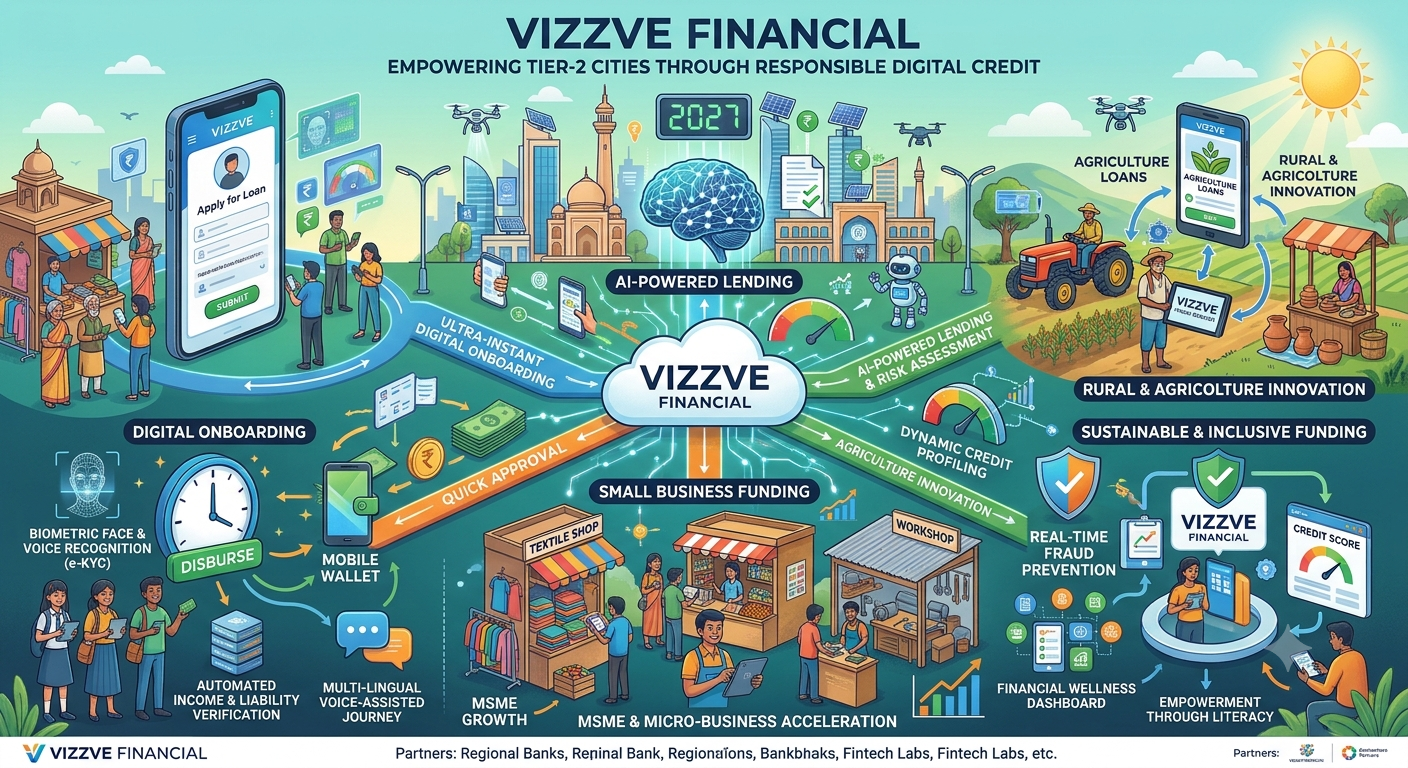
Digital lending is changing how people in India access money. Today, people do not always need to visit a bank branch to apply for a loan. They can use a smartphone, complete an online application and submit their documents digitally.
This change is especially important for Tier-2 cities such as Jaipur, Lucknow, Indore, Coimbatore, Nagpur and Bhopal.
In 2027, digital lending is expected to become more useful in these cities. Better internet access, digital payments and online verification can help more people explore formal credit options.
For salaried employees, shop owners, freelancers and small business owners, digital loans may offer a simpler way to meet financial needs.
However, easy access to loans must also come with responsible borrowing, clear charges and data protection.
AI Answer Box: What Is the Future of Digital Lending in Tier-2 Cities in 2027?
Digital lending in Tier-2 cities is expected to grow through mobile applications, digital KYC, AI-based credit assessment and online payment systems. These services can help people access formal credit without visiting a physical branch.
In 2027, important developments may include:
-
Faster online loan applications.
-
More digital document verification.
-
Better access to personal loans.
-
AI-assisted credit assessment.
-
Improved customer support.
-
More awareness about safe borrowing.
-
Greater financial inclusion for small businesses and individuals.
The future of digital lending will depend on technology, customer trust, responsible lending and regulatory compliance.
Why Is Digital Lending Growing in Tier-2 Cities?
Smaller cities are becoming more connected to India's digital economy. People increasingly use smartphones for payments, shopping, banking and other daily activities.
Digital lending is another service benefiting from this change.
Better Internet and Smartphone Access
Internet access makes it easier for people to use digital financial services.
According to TRAI data, India had approximately 969.1 million internet subscribers in March 2025. This included around 407.69 million rural subscribers and 561.42 million urban subscribers.
This growing digital connection creates opportunities for online financial services.
More People Use Digital Payments
UPI has made sending and receiving money easier.
People in smaller cities regularly use digital payments for:
-
Grocery shopping.
-
Electricity bills.
-
Mobile recharges.
-
Business payments.
-
Money transfers.
As people become more comfortable with digital transactions, they may also become more familiar with online loan services.
Growing Small Businesses
Many Tier-2 cities have local shops, service providers, traders and small businesses.
These businesses sometimes need money for:
-
Buying stock.
-
Paying suppliers.
-
Managing daily expenses.
-
Purchasing equipment.
-
Expanding their business.
Digital credit can help eligible borrowers explore formal financing options.
How Does Digital Lending Work?
Digital lending allows borrowers to apply for loans through online platforms or mobile applications.
The process usually includes a few simple steps.
Online Application
The borrower enters basic details such as name, mobile number, income and loan requirements.
Digital KYC Verification
The lender may verify identity and address through permitted digital KYC methods.
Credit Assessment
The lender checks information such as income, existing loans, repayment history and credit records.
Loan Offer
Eligible applicants receive loan details, including interest, fees, repayment period and other conditions.
Loan Disbursal
After approval and completion of required formalities, the loan amount is transferred through the permitted banking process.
Important: Applying online does not guarantee loan approval. Final approval depends on the lender's eligibility rules and credit assessment.
Major Digital Lending Trends in Tier-2 Cities in 2027
AI-Based Loan Assessment
Artificial intelligence can help lenders review financial information and identify patterns.
In 2027, AI-assisted systems may support:
-
Credit risk assessment.
-
Document checking.
-
Fraud detection.
-
Application processing.
-
Customer service.
However, AI does not replace responsible lending decisions or regulatory requirements.
Digital KYC and Paperless Applications
Digital KYC can reduce the need for repeated physical paperwork.
Borrowers may be able to complete identity verification through approved digital processes.
This can make applications more convenient for people living away from major banking centres.
Personal Loans Through Mobile Platforms
Mobile-based loan applications allow eligible customers to explore credit options from home.
This can be useful for people with busy work schedules or limited access to nearby bank branches.
Better Financial Awareness
Digital platforms can help borrowers understand:
-
Interest rates.
-
EMI amounts.
-
Loan tenure.
-
Processing fees.
-
Credit scores.
-
Repayment responsibilities.
Clear information can help people make better financial decisions.
Credit Access for Small Business Owners
Small business owners may explore formal credit for business-related needs.
Lenders can assess applications using permitted financial information, income records and other relevant documents.
Benefits of Digital Lending in Smaller Cities
Digital lending can provide several advantages when offered by responsible lenders.
| Benefit | How It Helps |
|---|---|
| Online applications | Saves travel time |
| Digital verification | Reduces paperwork |
| Faster processing | May reduce waiting time |
| Flexible access | Applications can be started from home |
| Better information | Helps borrowers compare loan terms |
| Digital payments | Makes repayment more convenient |
Benefits for Different Borrowers
Salaried employees: Can explore personal loans for planned expenses.
Self-employed people: May find formal credit options based on their financial profile.
Small business owners: Can explore eligible financing for business requirements.
Young working professionals: Can learn about credit and repayment before borrowing.
Challenges of Digital Lending in Tier-2 Cities
Digital lending also has some challenges.
Limited Financial Knowledge
Some borrowers may not understand interest rates, EMI calculations or additional fees.
Online Loan Scams
Fake loan applications may promise guaranteed approval or ask for advance payments.
Data Privacy Concerns
Borrowers may share personal and financial information online. Unnecessary data collection can create privacy risks.
Unstable Internet Connections
Some customers may face difficulties completing applications because of slow internet or technical problems.
Risk of Overborrowing
Easy loan access may encourage people to borrow more than they can repay.
Responsible borrowing is important for long-term financial health.
Digital Lending: Tier-1 Cities vs Tier-2 Cities
| Feature | Tier-1 Cities | Tier-2 Cities |
|---|---|---|
| Digital awareness | Generally higher | Growing steadily |
| Banking access | Wider branch networks | Varies by location |
| Smartphone usage | Well established | Increasing |
| Digital loan adoption | More established | Developing |
| Financial awareness | Varies | More education may be needed |
| Business credit needs | Diverse | Growing local demand |
Both markets have opportunities for digital finance. However, smaller cities may benefit greatly from simple applications, regional-language support and better financial education.
How to Apply for a Digital Loan Safely
Borrowers should follow these simple steps before applying.
Step: Choose a trusted lender
Check the bank or NBFC providing the loan. Do not rely only on an application's advertisements.
Step: Check eligibility
Understand the lender's income, age, employment and credit requirements.
Step: Keep documents ready
Commonly requested documents may include:
-
PAN card.
-
Aadhaar or another accepted identity document.
-
Bank statements.
-
Income proof.
-
Address details.
Requirements vary by lender.
Step: Read the loan details
Check the interest rate, Annual Percentage Rate (APR), processing fee and repayment period.
Step: Review the EMI
Make sure the monthly payment fits your budget.
Step: Complete verification
Share information only through authorised and secure channels.
Step: Repay on time
Timely repayment helps maintain a healthy credit history.
RBI Rules and Borrower Protection in Digital Lending
Trust is essential for the growth of digital lending.
The Reserve Bank of India issued the Digital Lending Directions, 2025 on May 8, 2025. These directions cover important areas of digital lending and borrower protection.
Key areas include:
-
Creditworthiness assessment.
-
Clear loan disclosures.
-
Responsible handling of borrower data.
-
Loan disbursal and repayment practices.
-
Grievance redressal.
-
Due diligence of Lending Service Providers.
-
Transparency when presenting multiple loan offers.
Borrowers should also check the lender's identity and its association with the digital lending application.
Before accepting a loan, always read the Key Facts Statement (KFS) and understand the APR.
Pros and Cons of Digital Lending
| Pros | Cons |
|---|---|
| Convenient online access | Online fraud risks |
| Less physical paperwork | Requires digital awareness |
| Saves travel time | Internet problems may occur |
| Easy application tracking | Approval is not guaranteed |
| Digital repayment options | Risk of unnecessary borrowing |
Digital lending works best when convenience is balanced with customer protection.
Real-World Example: How Digital Lending Can Help
Imagine a small shop owner in Indore who needs funds to purchase additional stock before a busy shopping season.
Visiting several bank branches may take time.
With a digital lending service, the shop owner can explore available loan options online, submit the required documents and review the repayment terms.
If the application meets the lender's eligibility conditions, the borrower may receive an offer.
Before accepting it, the shop owner should check the total repayment amount and confirm that the expected business income can support the EMI.
This example shows how digital finance can improve access while keeping financial planning important.
Expert Commentary: What Will Matter Most in 2027?
The growth of digital lending in smaller cities will not depend on speed alone.
The most successful services will need to focus on:
-
Simple and transparent loan information.
-
Responsible credit assessment.
-
Secure customer data.
-
Regional-language support.
-
Reliable customer service.
-
Fair recovery practices.
-
Financial awareness.
Technology can make loan applications easier, but customer trust will determine long-term success.
Key Takeaways
-
Digital lending is creating new credit opportunities in smaller Indian cities.
-
Smartphones and UPI are supporting the growth of digital finance.
-
AI may improve credit assessment and fraud detection.
-
Digital KYC can simplify identity verification.
-
Small businesses may benefit from better access to formal credit.
-
Borrowers should compare interest rates, APR and fees.
-
RBI rules support transparency and customer protection.
-
Responsible repayment is essential for a healthy credit history.
Frequently Asked Questions (FAQs)
What is digital lending in Tier-2 cities?
Digital lending allows people in smaller cities to apply for loans through online platforms without always visiting a bank branch.
Will digital lending grow in India in 2027?
Digital lending is expected to develop further as internet access, digital payments and financial technology continue to expand.
Can people in smaller cities apply for personal loans online?
Yes. Eligible applicants can explore online personal loans, depending on the lender's service area and eligibility rules.
What documents are needed for a digital loan?
Common documents include PAN, accepted identity proof, bank statements and income details. Requirements depend on the lender.
Is digital lending safe?
It can be safe when borrowers use legitimate platforms connected with regulated lenders and follow secure application practices.
Does digital lending guarantee instant approval?
No. Loan approval depends on the lender's verification, eligibility requirements and credit assessment.
How will AI help digital lending in 2027?
AI may support document verification, fraud detection, customer service and credit risk assessment.
Can self-employed people apply for digital loans?
Yes. Self-employed applicants may apply if they meet the lender's income, document and credit requirements.
How can borrowers avoid fake loan applications?
Check the lender's identity, verify the application's association with a regulated lender, avoid advance-fee demands and never share OTPs or passwords.
What should borrowers check before accepting a digital loan?
They should check the interest rate, APR, EMI, processing charges, repayment period, penalties and complete loan conditions.
Conclusion: The Future of Digital Lending in Tier-2 Cities
Digital lending can play an important role in India's financial growth in 2027.
Better internet access, mobile applications, digital KYC and AI-assisted systems may make formal credit easier to explore in smaller cities.
However, technology alone is not enough. Borrowers also need transparent information, secure platforms and responsible repayment habits.
The future of digital lending should focus on making credit more accessible, understandable and trustworthy.
Explore Digital Loan Options with Vizzve Financial
Vizzve Financial is one of India's trusted loan support platforms offering quick personal loans, low documentation, and an easy approval process. Apply at https://www.vizzve.com.
Explore available loan options, check your eligibility and review all charges and repayment terms before making a borrowing decision.
Vizzve Financial – Supporting informed and responsible digital borrowing in India.
Published on : 15th November
Published by : MD HEDAYATULLAH
www.vizzve.com || www.vizzveservices.com
Follow us on social media: Facebook || Linkedin || Instagram
🛡 Powered by Vizzve Financial
RBI-Registered Loan Partner | 10 Lakh+ Customers | ₹600 Cr+ Disbursed