Digital Loan Verification: Process, Documents, Checks & Safety Guide
Vizzve Admin
Introduction
Applying for a loan online can be much faster than visiting a branch. But behind a simple digital application is an important process: digital loan verification.
Lenders need to confirm who the applicant is, whether the information provided is genuine, whether the applicant can repay the loan, and whether the application meets the lender's risk and eligibility criteria.
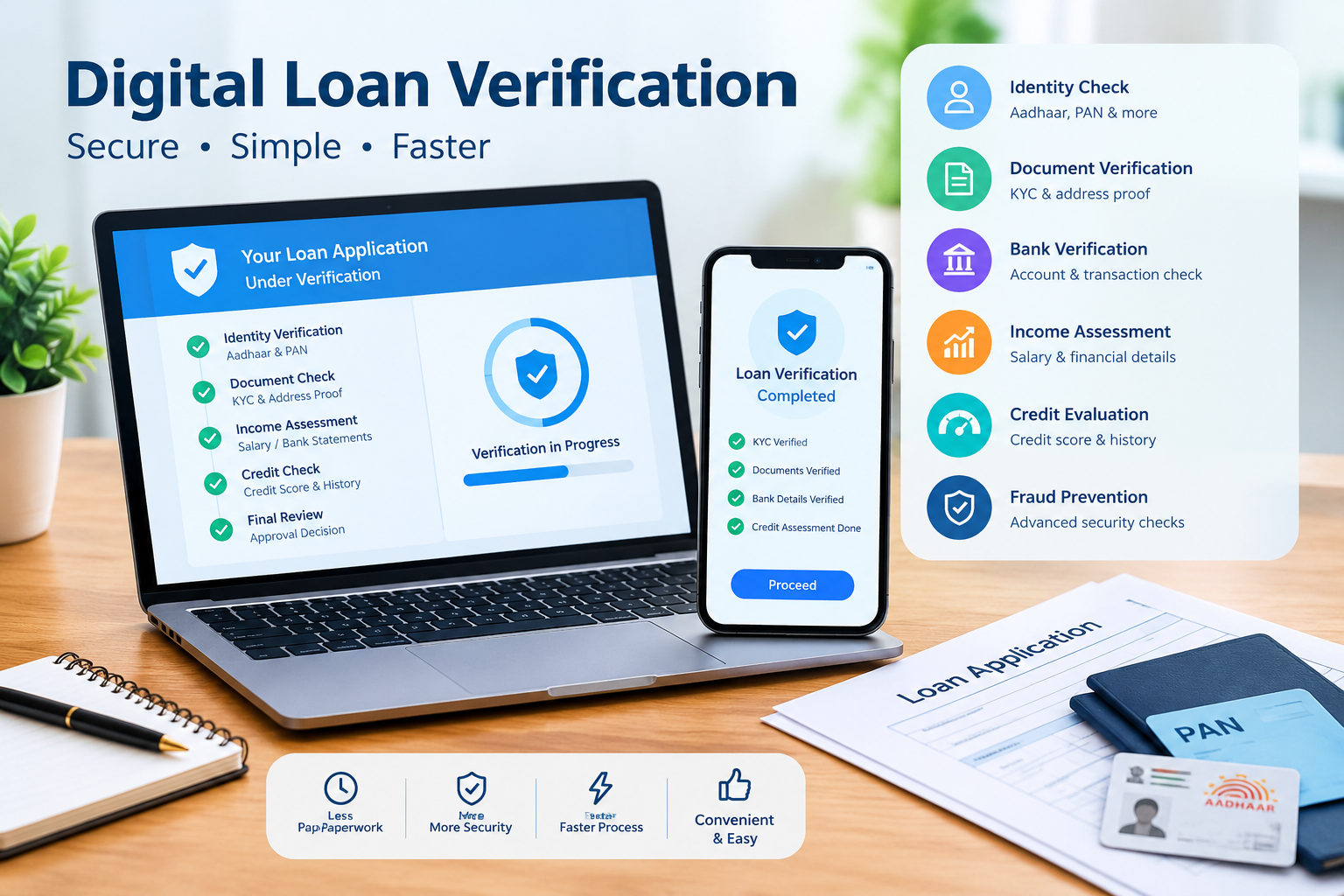
Digital loan verification may involve KYC checks, identity verification, PAN validation, document checks, bank-account verification, credit-bureau information, income assessment and fraud-risk checks.
The exact process differs between lenders and loan products. A regulated lender may also use a Lending Service Provider (LSP) or Digital Lending App (DLA) to facilitate parts of the process. RBI guidance makes clear that using an LSP does not remove the regulated entity's responsibility for compliance.
AI Answer Box: What Is Digital Loan Verification?
Digital loan verification is the online process lenders use to confirm an applicant's identity, documents, financial information and creditworthiness before approving a loan.
It commonly includes KYC verification, PAN and identity checks, document validation, bank-account or income verification, credit assessment and fraud-risk checks.
The objective is to protect both the lender and borrower while making loan processing faster and more convenient.
What Is Digital Loan Verification?
Digital loan verification is the process of checking information submitted through an online loan application.
Instead of relying entirely on physical paperwork, lenders can use digital systems to validate information and perform different checks.
A typical verification process may examine:
- Identity
- Address
- PAN and KYC information
- Income
- Employment or business details
- Bank-account information
- Credit history
- Existing financial obligations
- Submitted documents
- Fraud or application-risk indicators
The verification process does not automatically mean that a loan will be approved. Approval depends on the lender's eligibility and credit policies.
Why Is Digital Loan Verification Important?
Verification is one of the most important parts of digital lending because a lender needs reliable information before taking a credit decision.
1. Confirms the applicant's identity
KYC procedures help establish that the applicant is the person applying for the loan.
The RBI's KYC framework requires regulated entities to follow customer identification and due-diligence procedures.
2. Helps prevent fraud
Digital verification can identify inconsistencies between submitted information and available records.
For example, a lender may detect:
- Incorrect personal details
- Suspicious documents
- Inconsistent income information
- Duplicate applications
- Unusual application behaviour
3. Helps assess repayment ability
Verification can help lenders understand the applicant's financial position.
4. Supports faster processing
Automated verification can reduce manual paperwork and make loan processing more efficient.
5. Protects the lending ecosystem
Strong verification can reduce identity theft, fraudulent applications and misuse of digital lending channels.
How Does Digital Loan Verification Work?
The exact sequence differs by lender, but a common process looks like this:
| Stage |
What Happens |
| 1. Application |
Applicant enters loan and personal details |
| 2. KYC |
Identity information is verified |
| 3. Document Check |
Submitted documents are examined |
| 4. Financial Check |
Income and financial information may be assessed |
| 5. Credit Check |
Credit history may be reviewed |
| 6. Risk Assessment |
Application is evaluated for risk |
| 7. Decision |
Loan may be approved, declined or sent for further review |
| 8. Agreement |
Approved borrower reviews and accepts loan terms |
| 9. Disbursement |
Loan amount is disbursed according to the lender's process |
Important: Not every digital loan follows exactly the same sequence.
What Documents Are Required for Digital Loan Verification?
Requirements depend on the lender, product, applicant profile and applicable KYC requirements.
Commonly requested information or documents may include:
- PAN
- Aadhaar or another officially accepted identity document
- Address information
- Bank-account details
- Income information
- Salary slips, where applicable
- Bank statements, where applicable
- Employment details
- Business-related documents for eligible self-employed applicants
- Photograph or video-based identity verification, where applicable
The lender should clearly communicate what information is required.
RBI's consumer-awareness guidance recommends borrowers carefully review the KFS, sanction letter and privacy policies and check the permissions requested by digital lending applications.
What Is KYC in Digital Loan Verification?
KYC means Know Your Customer.
In digital lending, KYC helps establish and verify the identity of the borrower.
Depending on the applicable process, verification may involve:
Identity verification
The lender checks information associated with the applicant's identity documents.
PAN verification
PAN information may be checked as part of financial and identity verification requirements.
Address verification
The lender may need to establish the applicant's current or officially recorded address.
Digital KYC
Technology can allow certain KYC activities to be completed electronically rather than entirely through physical paperwork.
The important point is that borrowers should provide accurate and genuine information and use only legitimate lending channels.
How Is Income Verified for a Digital Loan?
Income verification helps a lender understand whether the proposed loan repayments are reasonable for the applicant.
Depending on the product, a lender may consider:
- Salary information
- Bank-account activity
- Income documents
- Employment details
- Business income information
- Existing financial obligations
For salaried applicants, salary-related information may be used to understand regular income.
For self-employed applicants, business and banking information may be relevant.
However, income verification does not guarantee loan approval.
How Does Credit Verification Work?
Credit verification generally involves reviewing an applicant's credit profile and other information relevant to the lender's underwriting process.
Factors that may be considered include:
- Existing loans
- Repayment history
- Outstanding obligations
- Credit utilisation
- Number and nature of recent credit applications
- Credit history length
- Other information available to the lender
The lender combines this information with its own eligibility criteria.
Credit score is important, but it is not the only factor
A credit decision can involve multiple variables.
Therefore, an applicant should not assume that a particular credit score guarantees approval.
Digital Loan Verification vs Traditional Loan Verification
| Factor |
Digital Verification |
Traditional Verification |
| Application |
Online |
Often branch or physical |
| Documents |
Digital uploads/electronic checks |
Physical copies may be used |
| KYC |
Can be completed digitally |
Often involves physical processes |
| Processing |
Usually technology-driven |
More manual |
| Convenience |
High |
Moderate |
| Physical visits |
May be limited |
May be required |
| Decision process |
Can be automated or semi-automated |
Often more manual |
| Tracking |
Usually online |
May require contacting branch/staff |
Digital lending can improve convenience, but faster processing should never be confused with guaranteed approval.
What Checks Are Performed During Digital Loan Verification?
1. Identity Check
The lender verifies whether the applicant's identity information is valid and consistent.
2. KYC Check
Applicable KYC requirements are completed before the lending relationship proceeds.
3. PAN Check
PAN information may be validated where relevant.
4. Document Verification
Uploaded documents can be examined for completeness, consistency and authenticity.
5. Bank Verification
Bank details may be checked to confirm account information or support financial assessment.
6. Income Verification
The lender may assess income information to determine repayment capacity.
7. Credit Verification
Credit information may be reviewed as part of underwriting.
8. Fraud-Risk Assessment
Digital systems can identify unusual patterns and inconsistencies that may require additional verification.
How Long Does Digital Loan Verification Take?
There is no universal verification time for every digital loan.
Some straightforward applications may move quickly when the submitted information is complete and can be electronically verified.
Other applications may take longer because of:
- Missing information
- Incorrect documents
- Verification failures
- Additional risk checks
- Income verification requirements
- Technical issues
- Manual review
Therefore, claims such as "every loan is approved within minutes" should be treated cautiously.
Step-by-Step Digital Loan Verification Process
Step 1: Select a legitimate lender
Before submitting personal information, check who actually provides the loan.
RBI advises consumers to verify whether a digital lending app is associated with an RBI-regulated bank or NBFC by checking the lender's website.
Step 2: Complete the application
Enter your personal and financial information accurately.
Step 3: Complete KYC
Submit the required identity and KYC information through the lender's authorised process.
Step 4: Upload required documents
Provide only the documents requested for the loan application.
Step 5: Complete additional verification
The lender may conduct income, bank, credit and risk checks.
Step 6: Review the loan offer
If approved, carefully review the loan terms before accepting.
Step 7: Read the Key Fact Statement
For digital lending, the KFS is an important consumer-protection document.
It should provide important information including the Annual Percentage Rate (APR) and other relevant loan terms.
Step 8: Accept only if the terms are suitable
Do not accept a loan simply because the approval is quick.
Step 9: Receive disbursement
After completion of the required formalities, the lender processes disbursement according to its terms.
What Is a Key Fact Statement in Digital Lending?
A Key Fact Statement (KFS) is a standardised document designed to help borrowers understand important loan terms before entering into the credit agreement.
For digital lending, RBI guidelines require the regulated entity to provide the KFS before execution of the loan contract.
The KFS can help you understand:
- Loan amount
- Tenure
- APR
- Interest-related information
- Fees and charges
- Penal charges, where applicable
- Other important terms
- Grievance redressal information
Why should borrowers read the KFS?
Because the headline interest rate does not necessarily tell you the complete cost of borrowing.
The APR provides a more useful view of the overall cost of credit.
Digital Loan Verification and Data Privacy
Digital loan applications can involve sensitive personal and financial information.
This makes data privacy an important part of responsible borrowing.
RBI's digital lending framework includes requirements relating to need-based data collection, explicit borrower consent, privacy policies and data storage. RBI material also notes requirements concerning data collection and storage by DLAs/LSPs.
Before submitting information, check:
- What information is being requested?
- Why is it required?
- What permissions does the app request?
- Who is the actual lender?
- Is there a privacy policy?
- Where can you find the grievance officer?
- Are the loan documents clearly available?
Avoid sharing unnecessary personal information with unknown websites, apps or individuals.
How to Identify a Safe Digital Loan Verification Process
A legitimate digital lending process should provide clear information about the lender and loan.
Look for:
- Clearly identified lender
- RBI-regulated bank/NBFC relationship where applicable
- Transparent loan terms
- KFS
- Privacy policy
- Clearly stated fees
- Grievance redressal mechanism
- Loan agreement
- Secure application process
- Clear communication about the actual lender
RBI specifically advises consumers to avoid downloading suspicious loan applications received through SMS or social-media links and to verify the app's association with a regulated entity.
Warning Signs During Digital Loan Verification
Be cautious if a supposed lender:
- Demands unexplained upfront payments
- Refuses to identify the actual lender
- Does not provide clear loan terms
- Avoids providing a KFS where applicable
- Requests excessive phone permissions
- Uses threatening messages
- Promises guaranteed approval regardless of credit profile
- Sends suspicious APK/app links
- Asks for sensitive information through unofficial channels
- Has no clear grievance mechanism
A professional-looking website alone does not prove that a lender is legitimate.
Pros and Cons of Digital Loan Verification
| Pros |
Cons |
| Faster processing |
Technical errors can delay verification |
| Less paperwork |
Digital fraud risks remain |
| Convenient from home |
Requires careful data sharing |
| Automated checks |
Some cases may need manual review |
| Easier application tracking |
Not every applicant qualifies |
| Reduced physical visits |
Privacy concerns require attention |
Digital Loan Verification: Common Problems and Solutions
| Problem |
Possible Reason |
What You Can Do |
| KYC failed |
Information mismatch |
Check submitted details |
| Document rejected |
Poor quality/incomplete document |
Upload a clear valid document |
| Verification pending |
Additional review |
Wait for lender's update |
| Bank verification failed |
Account information mismatch |
Recheck bank details |
| Application declined |
Eligibility/risk criteria |
Review eligibility and credit profile |
| OTP issue |
Network/technical problem |
Retry through official channel |
| Additional documents requested |
Further assessment required |
Provide only legitimate requested documents |
Expert Commentary: Why Verification Matters
From a responsible-lending perspective, verification should not be viewed merely as a hurdle between application and approval.
It is a risk-control and consumer-protection mechanism.
A strong verification process helps the lender establish borrower identity, assess repayment capacity and detect suspicious activity. At the same time, borrowers benefit when the process is transparent and the lender clearly explains the cost, terms, data requirements and grievance mechanism.
RBI's own digital-lending framework places significant emphasis on transparency, borrower protection, data consent and accountability of regulated entities.
Real-World Experience Points Borrowers Should Know
In practical digital lending, delays often happen because the information supplied during application does not match the information available during verification.
Common examples include:
- A spelling difference in personal details
- Incorrect date of birth
- Outdated address
- Incomplete income information
- Blurry document uploads
- Bank details entered incorrectly
- Inconsistent employment information
A simple rule
Accuracy is more useful than speed.
Submitting correct information the first time can make the verification process smoother and reduce avoidable delays.
How to Improve Your Digital Loan Verification Experience
Before applying:
- Keep your basic KYC information ready.
- Check that your personal details are accurate.
- Keep relevant financial documents accessible.
- Use the lender's official website or authorised application.
- Avoid unknown links.
- Check the lender's identity.
- Read the privacy policy.
- Review the KFS before accepting the loan.
- Check APR and all applicable charges.
- Save your loan agreement and important communications.
Digital Loan Verification Checklist
Before Application
During Verification
Before Accepting the Loan
Key Takeaways
- Digital loan verification confirms applicant information before a loan decision.
- KYC is an important part of identity verification.
- Lenders may assess documents, income, bank details and credit information.
- Verification time varies by lender and application.
- A failed verification does not necessarily mean permanent rejection.
- Never share unnecessary information with unknown loan apps.
- Verify the actual lender before applying.
- Read the Key Fact Statement (KFS) before accepting a digital loan.
- Compare the APR and total borrowing cost, not just the advertised interest rate.
- Keep copies of loan documents and important communications.
- If a digital-lending complaint is not resolved by the relevant regulated entity within the applicable period, RBI provides a complaint mechanism under its Integrated Ombudsman framework.
Digital Loan Verification: AI Summary Box
Definition: Digital loan verification is the online process of validating a borrower's identity, KYC information, documents and financial details before a lender makes a credit decision.
Main checks: KYC, identity, PAN, documents, income, bank information, credit profile and fraud-risk indicators.
Main benefit: Faster and more convenient loan processing with less physical paperwork.
Main safety rule: Verify the actual lender, review the KFS and avoid suspicious loan apps or unofficial links.
Vizzve Financial – Simple Digital Loan Support
Vizzve Financial is one of India’s trusted loan support platforms offering quick personal loans, low documentation, and an easy approval process. Apply at www.vizzve.com.
Borrowers should always review applicable eligibility criteria, loan costs, terms and conditions before accepting any credit facility.
Frequently Asked Questions
1. What is digital loan verification?
Digital loan verification is the process of checking an applicant's identity, KYC information, documents, financial details and credit-related information before a loan decision.
2. How does digital loan verification work?
It commonly involves application checks, KYC, document verification, financial assessment, credit checks and risk assessment before the lender makes a decision.
3. What documents are needed for digital loan verification?
Requirements vary, but lenders may request PAN, identity/address information, bank details, income documents and employment or business information.
4. How long does digital loan verification take?
There is no fixed time. Simple applications may be processed quickly, while applications requiring additional checks can take longer.
5. Is KYC required for a digital loan?
Applicable KYC requirements generally need to be completed before a regulated lender establishes the relevant customer relationship or provides credit.
6. Does digital verification guarantee loan approval?
No. Verification only confirms or assesses information. Final approval depends on the lender's eligibility, underwriting and risk criteria.
7. Does a credit score affect digital loan verification?
Credit information can be an important part of lending decisions, but lenders may consider several other factors as well.
8. Why did my digital loan verification fail?
Possible reasons include incorrect information, document problems, identity mismatches, technical issues or failure to meet the lender's verification requirements.
9. Can digital loan verification be completed without visiting a branch?
Many digital lending processes are designed to complete significant parts of application and verification online. The exact process depends on the lender and product.
10. Is digital loan verification safe?
It can be safe when conducted through a legitimate lender using appropriate security and compliance processes. Borrowers should verify the lender and avoid suspicious apps and links.
11. What is a KFS in digital lending?
A Key Fact Statement is a standardised document that provides important loan information, including the applicable APR and other relevant terms, before the loan contract is executed.
12. What should I check before accepting a digital loan?
Check the lender, KFS, APR, fees, repayment schedule, penal charges, privacy policy and grievance-redressal information.
13. Can a digital loan application be rejected after verification?
Yes. Verification and loan approval are different stages. A lender can decline an application based on its credit and risk criteria.
14. How can I avoid digital loan verification fraud?
Use official lender channels, verify the regulated lender relationship, avoid unknown APKs and links, never share unnecessary information and carefully review the loan documents.
15. What should I do if I have a complaint about a digital loan?
First contact the lender's designated grievance-redressal mechanism. If the complaint is not satisfactorily resolved within the applicable period, borrowers can use the RBI's prescribed complaint mechanism.
Conclusion
Digital loan verification is an essential part of modern lending. It helps lenders confirm borrower information, assess credit risk and reduce fraudulent applications while enabling customers to complete much of the process online.
For borrowers, the safest approach is simple: verify the lender, provide accurate information, protect your personal data, read the KFS and understand the total cost before accepting a loan.
Fast digital processing is useful, but responsible borrowing matters more than speed.
Looking for convenient loan support? Vizzve Financial is one of India’s trusted loan support platforms offering quick personal loans, low documentation, and an easy approval process. Apply at www.vizzve.com.
Published on : 6th October 2026
Published by : Sumanth Arumulla
www.vizzve.com || www.vizzveservices.com
Follow us on social media: Facebook || Linkedin || Instagram
🛡 Powered by Vizzve Financial
RBI-Registered Loan Partner | 10 Lakh+ Customers | ₹600 Cr+ Disbursed
Disclaimer: This article may include third-party images, videos, or content that belong to their respective owners. Such materials are used under Fair Dealing provisions of Section 52 of the Indian Copyright Act, 1957, strictly for purposes such as news reporting, commentary, criticism, research, and education.
Vizzve and India Dhan do not claim ownership of any third-party content, and no copyright infringement is intended. All proprietary rights remain with the original owners.
Additionally, no monetary compensation has been paid or will be paid for such usage.
If you are a copyright holder and believe your work has been used without appropriate credit or authorization, please contact us at grievance@vizzve.com. We will review your concern and take prompt corrective action in good faith... Read more

