

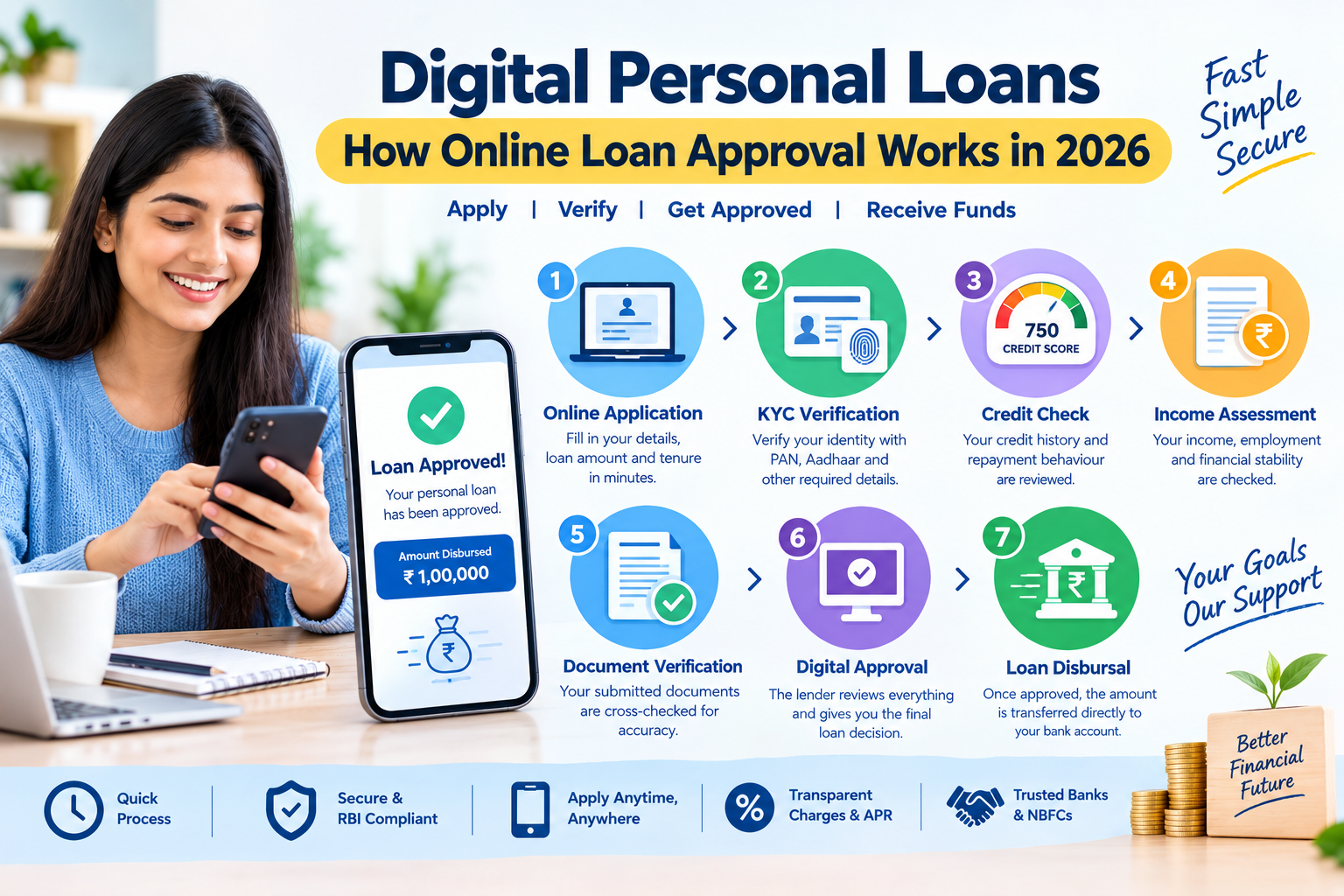
Digital personal loans are loans that can be applied for through a lender's website, mobile application or digital lending platform.
Instead of visiting a branch for every step, borrowers may complete application, KYC, document submission and other verification processes online.
Digital lending apps can be operated by banks and NBFCs or by lending service providers working with regulated entities. RBI advises consumers to check whether a digital lending app is associated with an RBI-regulated bank or NBFC.
How Online Personal Loan Approval Works in 2026
1. Online Loan Application
The process normally begins with an online application.
You may be asked to provide:
- Name and contact details
- PAN and other KYC information
- Employment or business details
- Monthly income
- Existing loan obligations
- Bank account information
- Requested loan amount and tenure
The lender uses this information as part of its eligibility and credit assessment.
2. Digital KYC Verification
KYC is an important part of the digital loan process.
Depending on the lender and product, verification may involve identity documents, electronic verification, bank information or other permitted methods.
Incorrect or inconsistent KYC information can delay processing or result in rejection.
3. Credit History Check
The lender may review your credit history and other information relevant to creditworthiness.
Factors can include:
- Previous repayment behaviour
- Existing credit accounts
- Outstanding debt
- Credit utilisation
- Recent credit applications
- Overall repayment capacity
A good credit history can support eligibility, but lenders use their own credit policies and approval is never guaranteed.
4. Income and Repayment-Capacity Assessment
Online approval is not based only on your credit score.
The lender may assess whether your income and financial profile can support the proposed EMI.
For salaried applicants, this may involve salary information, bank statements or other income documents. Self-employed applicants may need business or tax-related financial information.
5. Automated Risk Assessment
Digital lending platforms can use technology to process information and support loan decisions.
RBI's financial-awareness material notes that digital lending apps can use technology to automate parts of the loan application and disbursal process.
However, automated processing does not mean every applicant receives approval.
6. Document and Bank Verification
The lender may compare information provided in the application with submitted documents and account information.
A mismatch between income, employment, bank details or KYC information can lead to additional verification or rejection.
7. Final Loan Decision
After the lender completes its checks, the application may be:
- Approved
- Approved with specific terms
- Sent for additional verification
- Rejected
The final decision depends on the lender's credit policy and assessment of the application.
Digital Personal Loan Approval Process at a Glance
| Stage | What Happens |
|---|---|
| Application | Borrower submits online loan request |
| KYC | Identity information is verified |
| Credit Check | Credit history and existing obligations may be reviewed |
| Income Check | Income and repayment capacity are assessed |
| Risk Assessment | Lender evaluates the overall application |
| Document Verification | Submitted information is checked |
| Loan Offer | Rate, amount, tenure and charges are disclosed |
| Final Approval | Lender makes the final credit decision |
| Disbursal | Loan is transferred according to the agreed terms |
What Determines Digital Loan Approval?
Several factors can influence an online personal loan application.
Credit Profile
Your previous borrowing and repayment history can affect the lender's assessment.
Income
The lender needs to determine whether the proposed loan is affordable based on your financial profile.
Existing EMIs
High existing obligations can reduce available repayment capacity.
Employment or Business Stability
Some lenders consider employment history or business continuity while assessing applications.
KYC and Documents
Incomplete, inaccurate or inconsistent information can slow down verification.
Lender Policy
Different lenders have different eligibility criteria, risk models and internal policies.
What Is APR and Why Does It Matter?
Annual Percentage Rate (APR) represents the overall annualised cost of credit and can help borrowers compare loan offers more meaningfully than looking only at the headline interest rate.
RBI's digital-lending framework requires regulated entities to disclose the all-inclusive cost through APR and provide appropriate information about charges.
Before accepting a digital personal loan, check:
- Interest rate
- APR
- Processing fee
- Other applicable charges
- Late-payment or penal charges
- Prepayment/foreclosure terms
- EMI amount
- Total repayment amount
Are Digital Personal Loans Safe?
Digital loans can be convenient, but borrowers should verify the lender before submitting sensitive information.
RBI specifically advises consumers to check whether a digital lending app is associated with an RBI-regulated bank or NBFC and to avoid downloading loan apps received through unsolicited SMS or social-media links.
Follow These Safety Checks
- Verify the actual regulated lender.
- Download apps from legitimate sources.
- Read the privacy policy.
- Check the Key Facts Statement and loan agreement.
- Review APR and all charges.
- Give only necessary permissions and data.
- Never share OTPs, PINs or passwords.
- Be cautious of anyone promising guaranteed approval.
- Do not pay suspicious upfront fees to unknown agents.
RBI's digital-lending framework also requires need-based data collection with prior explicit consent and gives borrowers discretion regarding specific data use.
What If Your Digital Loan Is Rejected?
Do not immediately submit multiple applications.
First, check whether the lender has provided a reason or requested additional information. Then review your credit report, existing EMIs, income documents and KYC details.
You can also:
- Correct inaccurate application information.
- Resolve documentation problems.
- Review outstanding debts.
- Avoid unnecessary credit applications.
- Wait until your financial profile improves before applying again.
For certain covered loan applications, RBI's fair-practice guidance requires lenders to communicate the main reasons for rejection within the stipulated time.
Digital Personal Loans: Online vs Traditional Loan Process
| Feature | Digital Personal Loan | Traditional Loan |
|---|---|---|
| Application | Online | Often branch + online |
| KYC | Digital options may be available | Physical/digital |
| Document Submission | Usually online | Branch or online |
| Processing | Technology-assisted | More manual steps may be involved |
| Status Tracking | Often online | Depends on lender |
| Disbursal | Can be digital | Bank transfer/other method |
| Branch Visit | May not be required | May be required |
The exact process varies by lender and loan product.
Key Takeaways
- Digital personal loans allow borrowers to complete much of the application process online.
- Online processing can make applications faster, but approval is not guaranteed.
- Credit history, income, existing EMIs, KYC and documents can influence the decision.
- Compare APR and total borrowing costs, not just the advertised interest rate.
- Verify that the lender is a legitimate regulated entity or is working with one.
- Read the loan documents and privacy information before accepting the offer.
- Never share sensitive credentials such as OTPs, PINs or passwords.
FAQs About Digital Personal Loans in 2026
1. What is a digital personal loan?
It is a personal loan that can be applied for and processed through digital channels such as a lender's website or mobile application.
2. How long does online loan approval take?
Processing time varies by lender and application. Some applications can be assessed quickly, while others require additional verification.
3. Is online personal loan approval guaranteed?
No. Digital processing does not guarantee approval. The lender still evaluates eligibility, creditworthiness and repayment capacity.
4. Does credit score matter for digital personal loans?
Yes. Credit history can be one of the factors lenders consider, although approval criteria vary between lenders.
5. What documents are usually required?
Requirements vary, but lenders may request KYC documents, income information, bank statements and other supporting documents.
6. Can self-employed people apply for digital personal loans?
Yes. Eligibility depends on the lender. Self-employed applicants may be asked for business, bank or tax-related financial information.
7. What is APR on a personal loan?
APR is an annualised measure of the overall cost of credit and can help borrowers compare different loan offers.
8. Are loan apps regulated by RBI?
A loan app may be operated by or work with an RBI-regulated bank or NBFC. Borrowers should verify the actual regulated lender rather than assuming every loan app is regulated.
9. Is Aadhaar enough to get an online personal loan?
Not necessarily. KYC and documentation requirements depend on the lender and applicable verification process.
10. Can a digital personal loan be rejected after initial approval?
Yes. An initial eligibility indication or preliminary offer may not necessarily represent the final lending decision if further verification is required.
11. What should I check before accepting an online loan?
Check the lender, APR, interest rate, fees, EMI, total repayment amount, terms, privacy policy and loan agreement.
12. What should I do if I suspect a fake loan app?
Do not provide additional sensitive information or make suspicious payments. Verify the lender through its official website and consider reporting suspicious activity to the appropriate authorities.
Published on : 24th September
Published by : Shibam Nath
www.vizzve.com || www.vizzveservices.com
Follow us on social media: Facebook || Linkedin || Instagram
🛡 Powered by Vizzve Financial
RBI-Registered Loan Partner | 10 Lakh+ Customers | ₹600 Cr+ Disbursed