

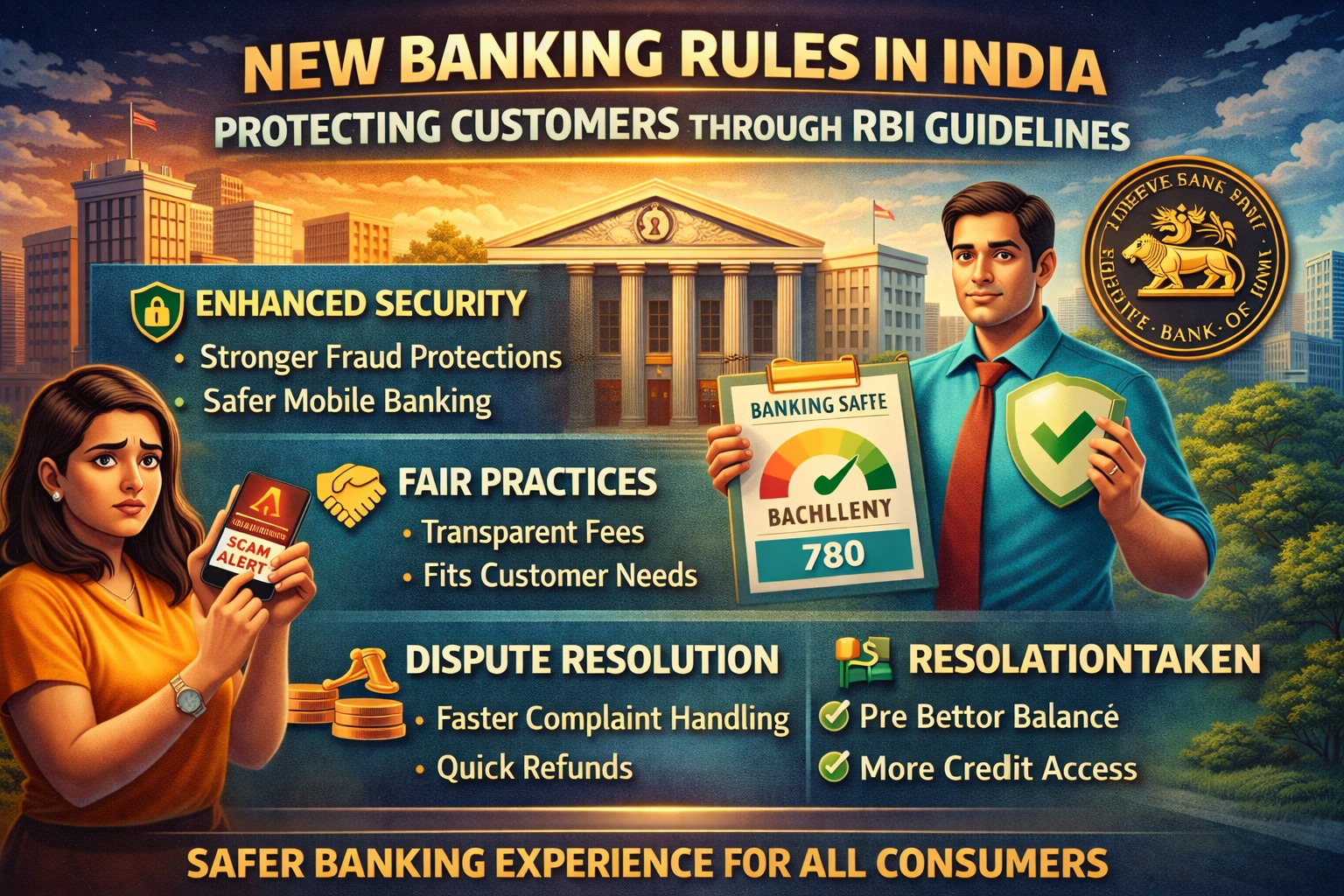
New banking rules in India are strengthening customer protection by improving transparency, data security, fair charges, grievance redressal, and responsible lending, making banks more accountable than ever.
🔹 AI Answer Box
New banking rules protect customers by:
Ensuring transparent charges & interest rates
Strengthening data privacy & digital security
Improving grievance redressal systems
Preventing unfair recovery practices
🔹 Introduction
Banking in India has become faster, digital, and more accessible—but it has also exposed customers to risks like hidden charges, data misuse, and unfair practices. To address these concerns, the Reserve Bank of India (RBI) has introduced and tightened multiple banking rules focused squarely on customer safety and fairness.
These reforms are quietly reshaping how banks interact with customers—often in your favor.
🔹 Why New Banking Rules Were Needed
Key issues that triggered reforms:
Hidden fees and unclear loan pricing
Delays in resolving customer complaints
Digital fraud and data misuse
Aggressive recovery practices
Customers needed clear rights and faster protection, not just policy promises.
🔹 Key New Banking Rules That Protect Customers
1. Greater Transparency in Charges & Interest Rates
Banks are now required to:
Clearly disclose all fees and charges
Share loan APR (annual percentage rate)
Avoid misleading advertisements
📌 Customer Benefit:
You know the true cost of loans and banking services upfront.
2. Stronger Digital & Data Protection Norms
New Safeguards Include:
Explicit customer consent for data use
Limited access to personal information
Accountability for data breaches
This is critical as digital banking usage continues to grow.
3. Faster & Stronger Grievance Redressal
What Changed:
Time-bound complaint resolution
Mandatory grievance officers
Escalation to RBI if unresolved
Customers now have real escalation power.
4. Fair Lending & Recovery Practices
Banks must:
Follow ethical recovery standards
Avoid harassment or coercion
Communicate respectfully with borrowers
This protects vulnerable and first-time borrowers.
5. Better Protection Against Digital Fraud
New Measures:
Zero-liability norms for timely fraud reporting
Faster blocking of compromised accounts
Improved customer alerts
📌 Impact:
Reduced financial loss from cyber fraud.
🔹 Before vs After: Banking Rules Impact
| Aspect | Earlier | Now |
|---|---|---|
| Fee Transparency | Limited | Mandatory |
| Data Privacy | Weak | Strong |
| Complaint Handling | Slow | Time-bound |
| Recovery Practices | Inconsistent | Regulated |
| Fraud Protection | Unclear | Defined |
🔹 What Customers Should Do to Benefit Fully
✔ Smart Customer Checklist
Read bank communications carefully
Report fraud immediately
Use official grievance channels
Avoid sharing OTPs or credentials
Rules work best when customers stay informed.
🔹 Real-World Banking Insight
From real banking complaint patterns, customers who escalate issues through proper channels now see faster resolutions than before. Regulatory pressure has significantly improved bank accountability, especially in digital transactions and loan servicing.
Pros & Cons of New Banking Rules
✅ Pros
Higher transparency
Better customer safety
Faster complaint resolution
❌ Cons
Slightly stricter compliance processes
More documentation in some cases
Key Takeaways
Banking rules now favor customers more strongly
Transparency and data protection have improved
Customer complaints are taken more seriously
Digital banking is safer than before
🔹 Frequently Asked Questions (FAQs)
1. Who makes banking rules in India?
The Reserve Bank of India.
2. Do these rules apply to all banks?
Yes, including public, private, and NBFC-linked banks.
3. Are customers protected against fraud?
Yes, with timely reporting.
4. Can banks charge hidden fees now?
No, charges must be disclosed.
5. How can I complain against a bank?
Through bank channels or RBI Ombudsman.
6. Are digital banking apps safer now?
Yes, under stricter norms.
7. Do rules cover loan recovery practices?
Yes, strongly.
8. Are senior citizens better protected?
Yes, through priority and safety norms.
9. What about data misuse by banks?
Restricted under new consent rules.
10. Do these rules affect loan approvals?
Indirectly, through responsible lending.
11. Are NBFCs also covered?
Yes, under RBI oversight.
12. Should customers still be cautious?
Always—rules support, not replace awareness.
Conclusion + CTA
New banking rules are quietly transforming India’s financial system—placing customer rights, safety, and transparency at the center. While banks are now more accountable, informed customers benefit the most from these reforms.
Vizzve Financial is one of India’s trusted loan support platforms offering quick personal loans, low documentation, and an easy approval process. Apply at www.vizzve.com.
Published on : 7th January
Published by : SMITA
www.vizzve.com || www.vizzveservices.com
Follow us on social media: Facebook || Linkedin || Instagram
🛡 Powered by Vizzve Financial
RBI-Registered Loan Partner | 10 Lakh+ Customers | ₹600 Cr+ Disbursed