

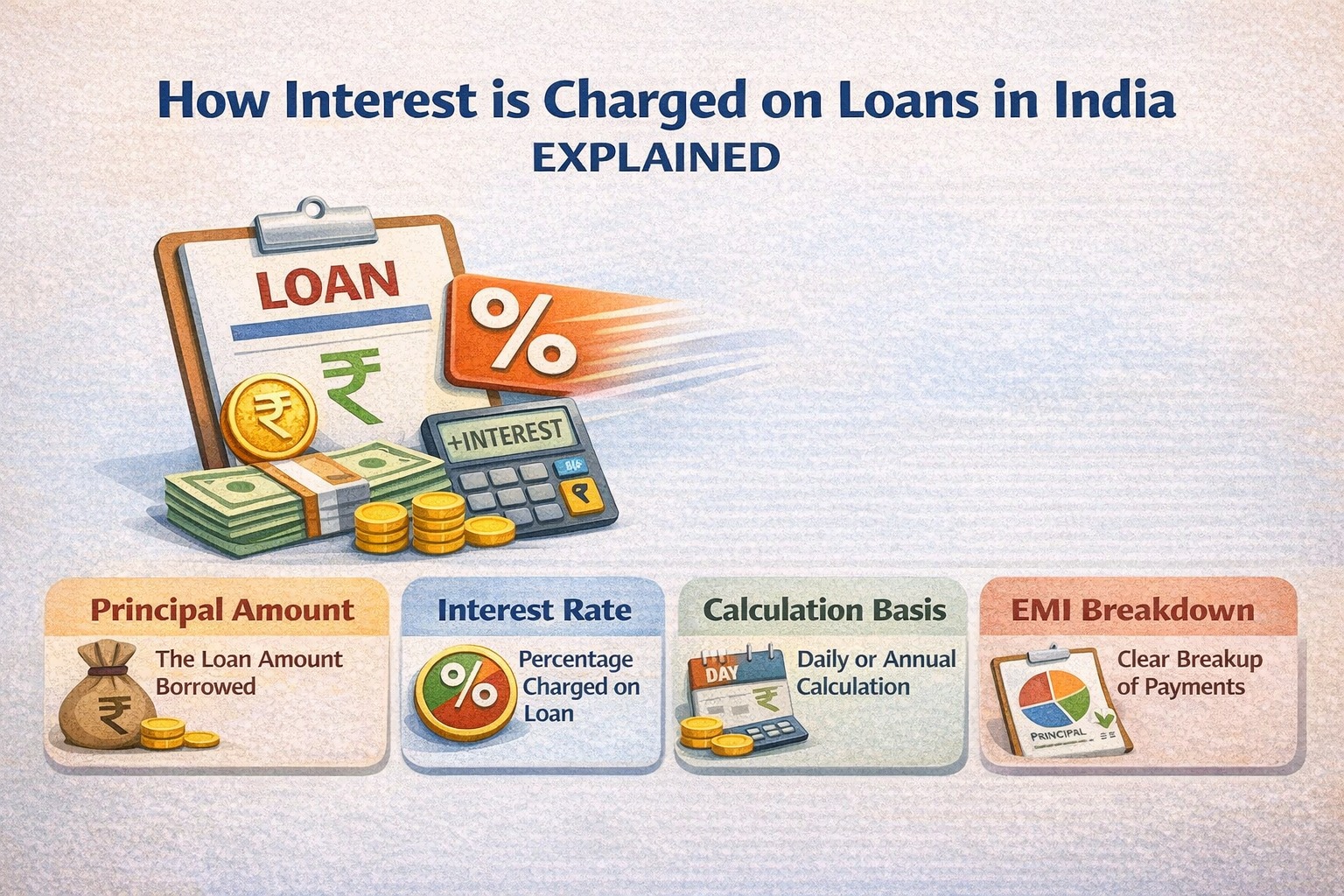
Loan interest is charged on the outstanding loan amount using either the flat rate or reducing balance method. Most banks use the reducing method, where interest decreases as you repay. Understanding this helps borrowers compare loans and reduce total cost.
AI Answer Box
How loan interest is charged:
Interest is calculated on principal
Charged monthly through EMIs
Flat rate = interest on full amount
Reducing rate = interest on balance
Reducing method is cheaper
🔹 Introduction
Most borrowers look at only one number when taking a loan—the interest rate. But the real cost of a loan depends on how interest is charged, not just how much.
Two loans with the same interest rate can have very different total repayment amounts, depending on the interest calculation method.
This guide explains how interest is charged on loans in India, using simple language, examples, and practical borrower tips.
🔹 What Is Loan Interest?
Loan interest is the cost you pay for borrowing money. It is charged as a percentage of the loan amount and collected through monthly EMIs along with principal repayment.
Interest compensates the lender for:
Risk
Time value of money
Operational cost
🔹 Two Main Ways Interest Is Charged on Loans
1. Flat Rate Method
Under the flat rate method:
Interest is calculated on the full loan amount
It remains the same throughout tenure
EMIs stay equal, but interest cost is high
Example (Flat Rate):
Loan: ₹1,00,000
Interest: 12% flat
Tenure: 2 years
➡️ Interest is calculated on ₹1,00,000 for full tenure—even though you repay every month.
📌 Flat rates look cheaper but cost more.
2. Reducing Balance Method (Most Common)
Under the reducing method:
Interest is charged only on the outstanding balance
As principal reduces, interest reduces
Total interest paid is lower
This is the standard method used by banks for home, auto, and most personal loans.
🔹 Flat vs Reducing Interest: Comparison Table
| Feature | Flat Rate | Reducing Balance |
|---|---|---|
| Interest base | Full loan amount | Outstanding balance |
| Total interest | Higher | Lower |
| EMI transparency | Low | High |
| Used by | Some NBFCs | Most banks |
| Borrower-friendly | ❌ | ✅ |
🔹 How EMI Is Calculated (Simple Explanation)
EMI =
Principal repayment + Interest for that month
In early months:
Interest portion is high
Principal portion is low
In later months:
Interest reduces
Principal repayment increases
📌 This is why prepayment early saves more interest.
🔹 Example: Reducing Interest EMI Breakdown
Loan: ₹5,00,000
Interest: 10%
Tenure: 5 years
| Year | Interest Paid | Principal Paid |
|---|---|---|
| Year 1 | High | Low |
| Year 3 | Medium | Medium |
| Year 5 | Low | High |
🔹 Simple vs Compound Interest on Loans
Most loans use compound interest, meaning:
Interest is calculated periodically (monthly)
EMI structure already accounts for compounding
You don’t pay interest on interest separately—but the timing matters.
🔹 Fixed vs Floating Interest Rates
🔵 Fixed Rate
Interest rate stays same
EMI remains stable
Usually slightly higher
🟢 Floating Rate
Interest changes with market rates
EMI or tenure may change
Common in home & business loans
The Reserve Bank of India influences floating rates through policy decisions.
🔹 How Lenders Decide Interest Rates
Interest rate depends on:
Credit score & repayment behaviour
Income stability
Loan type & tenure
Market conditions
Better credit behaviour = lower interest.
🔹 Common Borrower Misunderstandings
🚫 “Same interest rate = same cost”
🚫 “Flat rate is cheaper”
🚫 “Interest reduces equally every month”
Understanding structure avoids costly mistakes.
🔹 Real-World Borrower Insight
From lending patterns, borrowers who choose reducing-rate loans and prepay early save 20–40% of interest cost compared to flat-rate or late prepayment borrowers.
➡️ Knowledge saves money.
🔹 How to Reduce Interest Cost on Loans
✔ Choose reducing balance loans
✔ Prepay early if allowed
✔ Maintain strong credit behaviour
✔ Avoid unnecessary tenure extension
✔ Compare total repayment, not EMI
🔹 Pros & Cons of Loan Interest Charging
✅ Pros
Predictable repayment structure
Transparent EMI system
❌ Cons
Early EMIs are interest-heavy
Long tenure increases total cost
🔹 Key Takeaways
Interest charging method matters more than rate
Reducing balance method is cheaper
Flat rate loans cost more long-term
Early prepayment saves maximum interest
Informed borrowers pay less
🔹 Frequently Asked Questions (FAQs)
1. How is interest charged on loans?
On principal, via EMIs.
2. Which interest method is cheaper?
Reducing balance method.
3. Do banks use flat interest?
Rarely.
4. Why is early EMI mostly interest?
Because outstanding principal is high.
5. Is interest charged daily or monthly?
Usually monthly.
6. Does prepayment reduce interest?
Yes, significantly.
7. Is flat interest bad?
Costlier, but simpler.
8. Can interest rate change?
Yes, for floating-rate loans.
9. Does RBI control interest rates?
Indirectly.
10. Does credit score affect interest?
Yes.
11. Is EMI same as interest?
No, EMI includes principal + interest.
12. Should I focus on EMI or total cost?
Total cost.
Conclusion + CTA
Interest isn’t just a percentage—it’s a system. Borrowers who understand how interest is charged make smarter choices, save more money, and avoid long-term debt stress.
Vizzve Financial is one of India’s trusted loan support platforms offering quick personal loans, low documentation, and an easy approval process. Apply at www.vizzve.com.
Published on : 11thJanuary
Published by : SMITA
www.vizzve.com || www.vizzveservices.com
Follow us on social media: Facebook || Linkedin || Instagram
🛡 Powered by Vizzve Financial
RBI-Registered Loan Partner | 10 Lakh+ Customers | ₹600 Cr+ Disbursed