

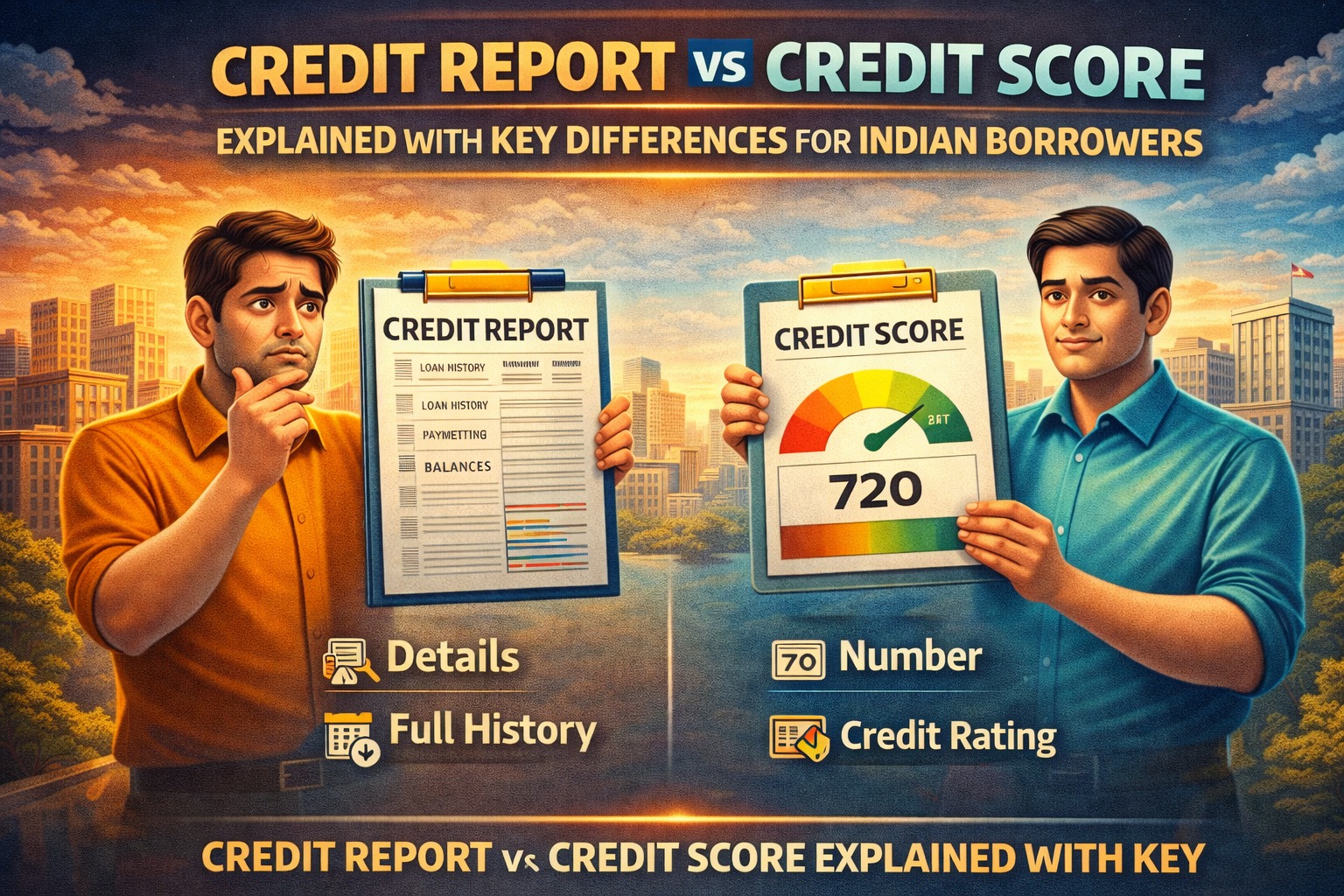
A credit report is a detailed record of your borrowing and repayment history, while a credit score is a numerical summary of that report. Lenders use both to decide loan approval, interest rates, and limits.
🔹 AI Answer Box
Credit report vs credit score:
Credit report = full financial history
Credit score = number derived from report
Report explains behaviour, score summarizes risk
Both affect loan approval and pricing
🔹 Introduction
Many borrowers focus only on their credit score and ignore their credit report. This is a costly mistake. In reality, lenders don’t just look at a number—they analyze your entire credit behaviour.
Understanding the difference between a credit report and a credit score helps you avoid rejections, reduce interest costs, and fix problems before they escalate.
🔹 What Is a Credit Report?
A credit report is a detailed document that records your credit activity over time.
What a Credit Report Contains:
Personal and contact details
Active and closed loans
Credit card usage
EMI payment history
Late payments, defaults, settlements
Loan enquiries
In India, credit reports are maintained by bureaus like TransUnion CIBIL, Experian, Equifax, and CRIF High Mark.
🔹 What Is a Credit Score?
A credit score is a 3-digit number (300–900) generated using your credit report data.
What the Score Indicates:
Higher score = lower risk
Lower score = higher risk
Most lenders prefer scores above 700–750 for better loan terms.
🔹 Credit Report vs Credit Score: Key Differences
| Aspect | Credit Report | Credit Score |
|---|---|---|
| Format | Detailed document | 3-digit number |
| Content | Full credit history | Risk summary |
| Purpose | Behaviour analysis | Quick decision tool |
| Change Frequency | Updates monthly | Changes dynamically |
| Importance | Very High | Very High |
➡️ Think of the score as the headline and the report as the full story.
🔹 Why Lenders Look at Both (Not Just the Score)
A borrower with a decent score can still be rejected if the report shows:
Recent late payments
Too many loan enquiries
Multiple short-term loans
Settlements or write-offs
The Reserve Bank of India encourages lenders to assess repayment behaviour, not just income or scores.
🔹 Common Myths Borrowers Believe
❌ “My score is good, my report doesn’t matter”
❌ “Old defaults don’t show up”
❌ “Checking my credit hurts my score”
✅ Reality:
Reports matter more than you think
Negative history stays visible for years
Self-checks do NOT harm your score
🔹 How Credit Behaviour Impacts Both
Your actions affect both report and score:
Good Behaviour
On-time EMIs
Low credit utilization
Limited loan applications
Bad Behaviour
Missed payments
Maxed-out cards
Frequent borrowing
Over time, behaviour shapes the report—and the report shapes the score.
🔹 When Credit Report Matters More Than Score
Applying for large loans (home, business)
Refinancing or balance transfers
Recovering from past defaults
Negotiating interest rates
In such cases, lenders scrutinize patterns, not just numbers.
🔹 How Often Should You Check Them?
Recommended:
Credit score → monthly
Credit report → every 3–6 months
Early detection of errors can save you from rejection.
🔹 Real-World Credit Insight
From real loan assessment experience, many rejections occur not due to low score, but due to recent negative entries in the credit report. Borrowers who regularly review and correct reports enjoy smoother approvals—even with average income levels.
🔹 Pros & Cons Comparison
Credit Report
Pros: Full transparency
Cons: Takes time to understand
Credit Score
Pros: Quick snapshot
Cons: Hides detailed issues
🔹 Key Takeaways
Credit score is derived from credit report
Lenders evaluate both together
Good behaviour matters more than income
Regular monitoring prevents surprises
🔹 Frequently Asked Questions (FAQs)
1. Is credit report more important than credit score?
Both are equally important.
2. Can I have a good score but bad report?
Yes, especially with recent issues.
3. How long do negatives stay on report?
Up to 7 years.
4. Does checking credit score reduce it?
No.
5. Which bureau is most important in India?
CIBIL is most widely used.
6. Can I improve score without fixing report?
No.
7. Do banks see full credit report?
Yes.
8. Is income part of credit report?
No.
9. How fast does score improve?
3–12 months with discipline.
10. Can errors be corrected?
Yes, via dispute process.
11. Do closed loans stay on report?
Yes, for history.
12. Is credit score enough for approval?
No, report matters equally.
🔹 Conclusion + CTA
Your credit score may open the door—but your credit report decides whether you walk through it. Borrowers who understand and manage both enjoy lower interest rates, faster approvals, and long-term financial freedom.
Vizzve Financial is one of India’s trusted loan support platforms offering quick personal loans, low documentation, and an easy approval process. Apply at www.vizzve.com.
Published on : 7th January
Published by : SMITA
www.vizzve.com || www.vizzveservices.com
Follow us on social media: Facebook || Linkedin || Instagram
🛡 Powered by Vizzve Financial
RBI-Registered Loan Partner | 10 Lakh+ Customers | ₹600 Cr+ Disbursed