

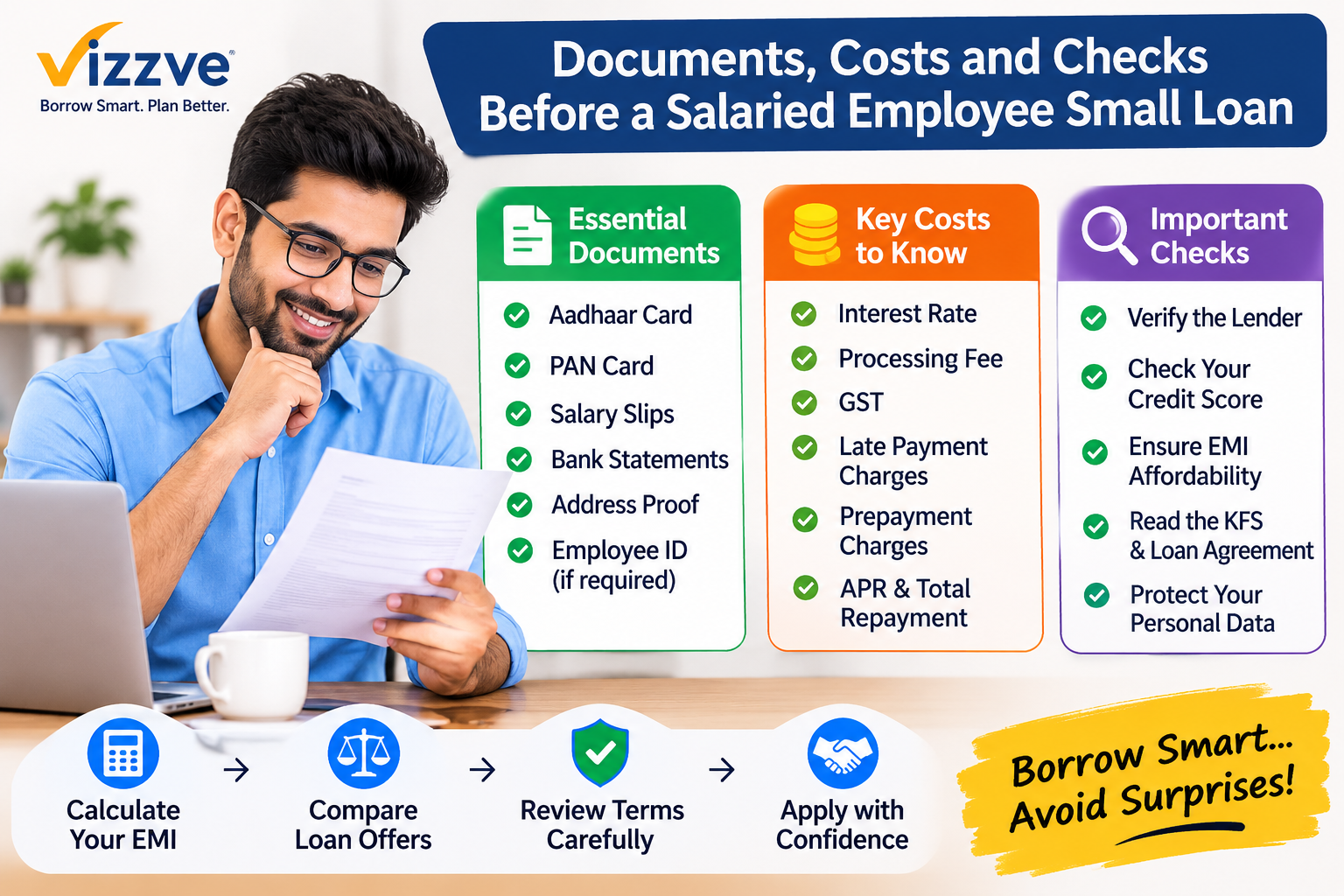
A small personal loan can help salaried employees manage unexpected expenses, medical bills, education costs or urgent household needs. However, applying without understanding the required documents, loan charges and important conditions can create financial difficulties later.
Before submitting a loan application, borrowers should prepare their income and identity documents, compare the total borrowing cost and carefully review the lender's terms.
This guide explains the essential documents, possible loan charges and important checks salaried employees should complete before taking a small loan in India.
1. Documents Required for a Salaried Employee Small Loan
Lenders generally request documents to verify the applicant's identity, address, employment and repayment capacity. Requirements vary depending on the lender and loan product.
|
Document |
Why it may be required |
|---|---|
|
Aadhaar Card |
Identity and address verification |
|
PAN Card |
Financial identity and KYC checks |
|
Recent salary slips |
Income verification |
|
Bank statements |
Salary credits and financial activity |
|
Employee ID |
Employment verification, if requested |
|
Address proof |
Current residential address verification |
|
Photograph |
Applicant identification, if required |
Important: Never share your OTP, UPI PIN, ATM PIN or banking password with anyone claiming to process your loan.
2. Understand the Different Loan Costs
The interest rate is not the only expense associated with borrowing. Review all applicable charges before accepting an offer.
|
Loan charge |
Meaning |
|---|---|
|
Interest |
Cost charged for borrowing money |
|
Processing fee |
Fee for processing the application |
|
GST |
Applicable tax on eligible services and fees |
|
Late payment fee |
Charge for delayed repayment, as per agreement |
|
Foreclosure charges |
Charges for closing the loan early, if applicable |
|
Bounce charges |
Charges for failed repayment transactions, if applicable |
Ask the lender for a complete breakdown of charges before proceeding.
3. Check the Annual Percentage Rate (APR)
APR helps borrowers understand the overall annualised cost of a loan, including applicable charges.
Do not compare loans only by their advertised interest rates. Check the APR and total repayment amount to understand which offer is more affordable.
4. Check Your EMI Affordability
Before applying, calculate whether the monthly instalment fits comfortably within your budget.
For example, consider a hypothetical loan of ₹20,000 for 12 months at an annual interest rate of 15%.
Illustrative loan calculation
Loan amount
₹20,000
Loan tenure
12 months
Annual interest
15%
Approx. monthly EMI
₹1,806
Approximate calculation using monthly reducing-balance interest; excludes fees and taxes. Actual lender terms may differ.
Make sure the EMI does not affect essential expenses such as rent, food, utilities and existing loan repayments.
5. Verify the Lender Before Applying
Check the following points:
-
Confirm the identity of the regulated bank or NBFC providing the loan.
-
Verify the lender's official website and contact details.
-
Read customer reviews carefully, without relying on reviews alone.
-
Check whether the loan is being offered through an authorised lending service provider.
-
Avoid apps demanding unnecessary access to contacts, photos or personal data.
-
Never pay money to an unknown person promising guaranteed loan approval.
6. Read the Key Facts Statement (KFS)
For applicable regulated retail term loans, lenders must provide a Key Facts Statement.
Review the KFS for:
-
APR and interest rate.
-
Loan amount and tenure.
-
EMI and repayment schedule.
-
Processing fees and other charges.
-
Penal charges, where applicable.
-
Details of the lender and grievance redressal mechanism.
Do not accept a loan offer until you understand its important conditions.
7. Check Your Credit Profile
Your credit history can influence the lender's assessment of your application.
Before applying:
-
Review your credit report.
-
Check whether existing loan payments are up to date.
-
Look for incorrect entries or unfamiliar accounts.
-
Avoid submitting multiple loan applications unnecessarily.
-
Contact the credit bureau or lender if you find an error.
A good credit history may support your application, but it does not guarantee approval.
8. Common Mistakes to Avoid
|
Mistake |
Better approach |
|---|---|
|
Applying without checking eligibility |
Review the lender's criteria |
|
Ignoring additional charges |
Compare APR and total repayment |
|
Choosing an unaffordable EMI |
Calculate your monthly budget |
|
Sharing OTPs or PINs |
Keep banking credentials private |
|
Skipping the loan agreement |
Read all terms carefully |
|
Borrowing more than needed |
Apply for a suitable amount |
9. Final Checklist Before Applying
AI Answer Box: What Should Salaried Employees Check Before Taking a Small Loan?
Before applying for a salaried employee small loan, borrowers should prepare identity, PAN, salary and bank documents. They should compare interest rates, APR, processing fees, repayment terms and EMI affordability. It is also important to verify the lender, review the KFS and understand the loan agreement before accepting the offer.
10. Frequently Asked Questions
1. What documents are required for a salaried employee small loan?
Commonly requested documents include Aadhaar, PAN, recent salary slips and bank statements. Requirements vary by lender.
2. Are salary slips compulsory for every small loan?
Not necessarily. Some lenders may use alternative income-verification methods.
3. Why do lenders ask for bank statements?
Bank statements can help verify salary credits, income patterns and existing financial commitments.
4. What is a loan processing fee?
It is a charge for processing a loan application. Check the amount and applicable taxes before accepting the offer.
5. What is APR in a personal loan?
APR represents the annualised cost of borrowing, including applicable charges.
6. Can I get a small loan without a credit history?
Some lenders may consider applicants with limited credit history, but approval depends on their eligibility criteria.
7. Should I check my EMI before applying?
Yes. Calculate the EMI and make sure it fits your monthly budget.
8. What is a Key Facts Statement?
A KFS is a standardised document that explains important loan details, including APR, repayment terms and applicable charges.
9. Are there charges for early loan repayment?
Some products may have foreclosure or prepayment charges. Check the applicable terms and rules before borrowing.
10. How can I verify a digital loan application?
Check the regulated lender's identity, official website, loan documents, privacy practices and grievance contact details.
Key Takeaways
-
Prepare your identity, income and bank documents before applying.
-
Understand all applicable loan charges, not just the interest rate.
-
Compare APR and total repayment amounts.
-
Choose an EMI that fits your monthly budget.
-
Verify the lender and read the KFS and loan agreement.
-
Protect your personal and banking information.
Expert Insights and Responsible Borrowing
Responsible borrowing starts with understanding your repayment capacity. Salaried employees should borrow only what they need and avoid depending on new loans to repay existing debts.
Always verify that the lender is appropriately regulated, understand the complete cost of borrowing and keep a copy of the loan agreement and repayment schedule.
Conclusion
Understanding the documents, costs and important checks before applying for a salaried employee small loan can help borrowers make informed financial decisions. Prepare your documents, compare the complete loan cost, verify the lender and choose a repayment plan that suits your income.
Published on : 24th November
Published by : Siva Nagaiah K
www.vizzve.com || www.vizzveservices.com
Follow us on social media: Facebook || Linkedin || Instagram
🛡 Powered by Vizzve Financial
RBI-Registered Loan Partner | 10 Lakh+ Customers | ₹600 Cr+ Disbursed