

Introduction
An instant loan online can help meet urgent financial needs without visiting a bank branch. Many lenders allow applicants to complete the process digitally, upload documents, receive an eligibility decision and track their application through a mobile phone.
However, a quick application should never mean a rushed financial decision.
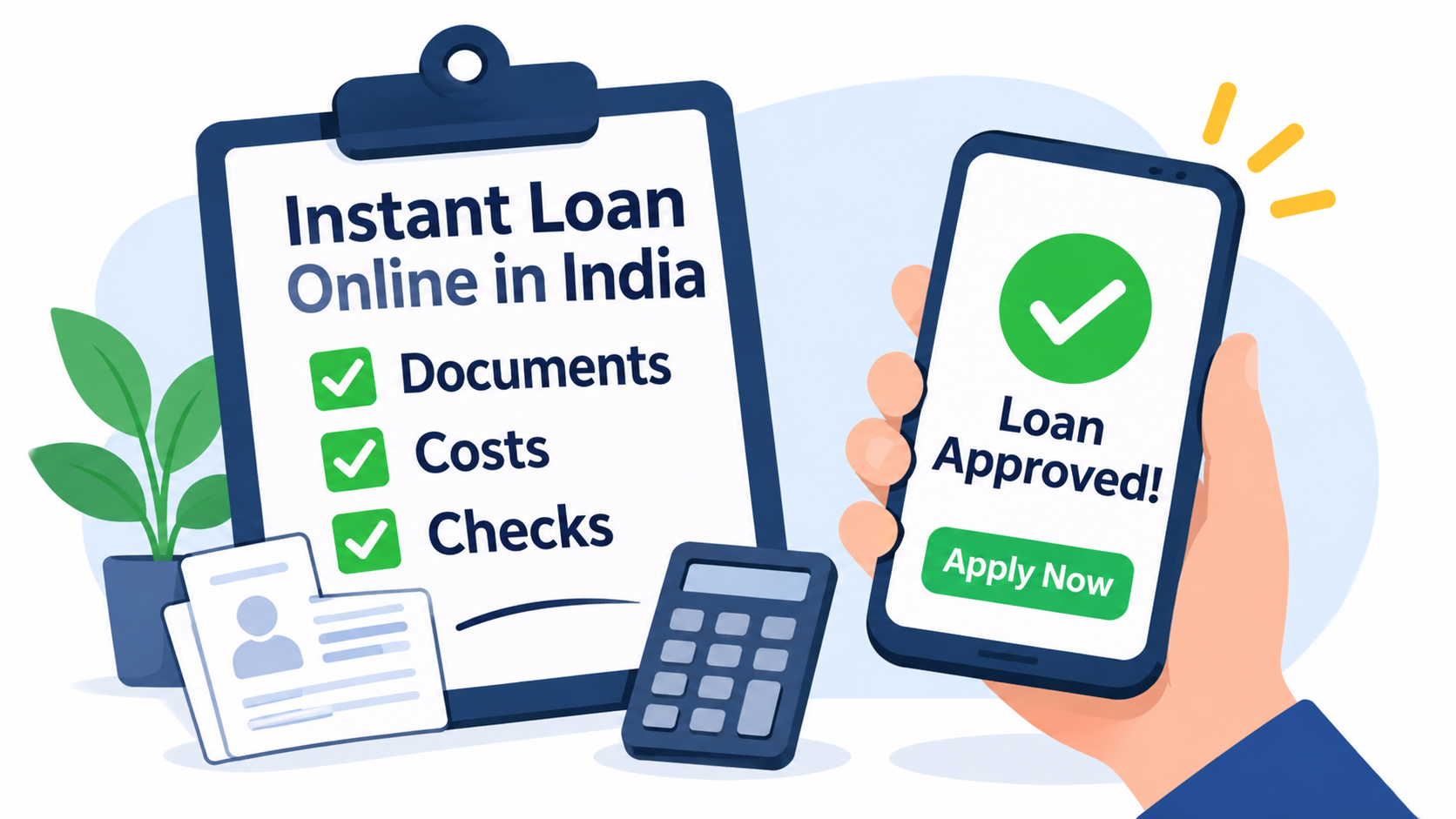
Before accepting an online loan, borrowers should understand three important things:
-
Documents: What information and proof will the lender ask for?
-
Costs: How much will the loan cost after interest and applicable charges?
-
Checks: Is the lender genuine, and are the loan terms clear?
A loan offer showing a low monthly EMI may still have a high overall cost if the repayment period is long or additional charges apply. Similarly, an application that asks for unnecessary personal information or demands an upfront payment to a private account deserves careful attention.
This guide explains how to prepare your documents, compare loan costs and complete essential safety checks before applying for an instant loan online in India.
AI Answer Box: What Should You Check Before Taking an Instant Loan Online?
Before applying for an instant loan online in India, verify the lender's identity and its association with a regulated bank or Non-Banking Financial Company (NBFC). Prepare commonly requested documents such as PAN, identity and address proof, bank statements and income proof. Check the interest rate, Annual Percentage Rate (APR), processing fee, taxes, repayment schedule, late-payment charges and prepayment conditions. Read the Key Facts Statement (KFS), loan agreement and privacy policy before accepting the offer. Never share your OTP, UPI PIN, card PIN or banking password with anyone.
1. What Is an Instant Loan Online?
An instant loan online is a loan application and processing facility that allows borrowers to apply through a lender's website, mobile application or authorised digital lending partner.
The process may include:
-
Selecting a loan amount and repayment period.
-
Providing personal and financial information.
-
Completing identity verification.
-
Submitting income and bank-related documents.
-
Undergoing credit and eligibility assessment.
-
Reviewing the loan offer.
-
Accepting the agreement electronically.
-
Receiving the loan amount through the approved disbursement process.
The word instant generally refers to a digital application or faster processing experience. It does not mean that every applicant will receive immediate approval or guaranteed disbursement.
Approval depends on the lender's eligibility requirements, verification process, credit assessment and internal policies.
2. What Documents Are Required for an Instant Loan Online in India?
The exact documents depend on the lender, loan amount, employment type and applicable verification requirements. Some lenders may use digital verification methods, while others may request additional documents.
Commonly Required Documents
| Document | Why It May Be Required |
|---|---|
| PAN card | Identity verification and financial checks |
| Aadhaar or other accepted identity proof | Identity verification |
| Address proof | Confirmation of residential address |
| Bank statements | Assessment of income and cash flow |
| Salary slips | Verification of salaried income |
| Employment details | Understanding employment status |
| Business proof | Verification for self-employed applicants |
| Income tax returns | Assessment of declared income, where required |
| Photograph or selfie | Digital identity verification |
| Active mobile number | OTP and application communication |
| Email address | Digital communication and document delivery |
Not every applicant will need every document. Ask the lender for its specific list before uploading personal information.
2.1 Identity Proof
Identity verification helps the lender confirm that the applicant is the person submitting the application.
Commonly accepted documents may include:
-
PAN card
-
Aadhaar-based verification, where applicable and consented to
-
Passport
-
Voter ID
-
Driving licence
The lender will specify which documents and verification methods it accepts.
2.2 Address Proof
Lenders may request address details to verify the applicant's residential information.
Possible documents include:
-
Aadhaar, where accepted
-
Passport
-
Voter ID
-
Driving licence
-
Utility bill or other accepted address document
Make sure the address information in your application is accurate. If your current address differs from the address on your identity document, ask the lender what additional proof it accepts.
2.3 Income Proof for Salaried Applicants
Salaried applicants may be asked to provide:
-
Recent salary slips
-
Bank statements showing salary credits
-
Employment details
-
Form 16 or income tax documents, if required
Regular salary credits can help a lender understand the applicant's income pattern and repayment capacity.
2.4 Income Proof for Self-Employed Applicants
Freelancers, consultants, shop owners and small business operators may have different income patterns from salaried employees.
Depending on the lender's policy, useful documents may include:
-
Bank statements
-
Income tax returns
-
Business registration documents
-
GST returns, where applicable
-
Invoices and payment records
-
Financial statements
-
Proof of business address
Practical Tip
Keep your business income and personal expenses organised. Clear bank records and consistent financial documentation can make income verification easier.
3. What Costs Should You Check Before Applying for an Instant Loan?
The interest rate is important, but it is not the only cost of borrowing.
A borrower should compare the overall cost of the loan rather than choosing an offer based only on its advertised interest rate or monthly EMI.
3.1 Interest Rate
The interest rate is the amount charged by the lender for providing the loan.
It may be quoted as an annual rate or presented through a loan calculator. Check whether the rate is:
-
Fixed for the loan period
-
Floating or linked to a benchmark
-
Reducing-balance based
-
Subject to specific conditions
Do not assume that an advertised starting rate will apply to every applicant. Your actual rate may depend on the lender's assessment.
3.2 Processing Fee
A processing fee is a charge for handling and processing a loan application.
Before accepting an offer, confirm:
-
The exact fee amount or percentage.
-
Whether the fee is deducted from the disbursed amount.
-
Whether GST applies.
-
Whether the fee is refundable if the application is rejected or cancelled.
For example, if a lender sanctions a loan of ₹1,00,000 and deducts a processing fee of ₹2,000 plus applicable GST, the amount received may be lower than the sanctioned amount.
Always compare the net amount credited with the total repayment obligation.
3.3 GST and Other Applicable Taxes
Certain loan-related service charges may attract GST as applicable under tax rules.
Ask the lender for a clear breakdown showing:
-
Processing fee
-
GST on applicable fees
-
Other service charges
-
Total deductions before disbursement
Do not assume that the advertised loan amount is the exact amount you will receive in your bank account.
3.4 Annual Percentage Rate (APR)
APR is an important measure for comparing loan costs. It represents the annualised cost of borrowing and includes applicable charges covered under the relevant regulatory requirements.
Two loans may advertise similar interest rates but have different APRs because their fees and other applicable costs differ.
Example: Consider two illustrative offers for the same loan amount and repayment period.
| Particulars | Offer A | Offer B |
|---|---|---|
| Loan amount | ₹1,00,000 | ₹1,00,000 |
| Advertised annual interest rate | 12% | 12% |
| Processing fee | ₹1,000 | ₹2,500 |
| Other applicable charges | Lower | Higher |
| Overall borrowing cost | May be lower | May be higher |
This is an illustrative comparison, not an actual lender quotation. Check the APR and KFS to understand the actual cost.
3.5 Late Payment Charges
If you miss an EMI or fail to meet a repayment obligation, the lender may impose applicable penal charges.
Before borrowing, understand:
-
When a payment is considered overdue.
-
Whether a grace period applies.
-
How penal charges are calculated.
-
Whether additional collection or recovery costs may apply.
-
How missed payments may affect your credit history.
RBI-regulated lenders must follow applicable rules on disclosure and levy of penal charges. Read the loan agreement and KFS rather than relying on verbal assurances.
3.6 Prepayment and Foreclosure Charges
Prepayment means repaying some or all of a loan before its scheduled end date.
Check whether the lender charges for:
-
Part-prepayment
-
Full repayment before maturity
-
Loan foreclosure
-
Changes to the repayment schedule
Rules on prepayment charges depend on the type of lender, loan, interest rate, borrower and date of sanction or renewal. For example, RBI directions effective from January 1, 2026 provide protections against prepayment charges for specified floating-rate loans to individual borrowers and certain business loans to individuals and Micro and Small Enterprises. Do not assume that every fixed-rate or other loan is automatically covered.
3.7 EMI and Total Repayment
EMI stands for Equated Monthly Instalment. It generally includes principal and interest.
A longer repayment period can reduce the monthly EMI but may increase the total interest paid.
Before accepting a loan, calculate:
-
Monthly EMI
-
Total interest
-
Total repayment amount
-
Net amount received after deductions
-
Repayment start date
Illustrative Loan Cost Example
Suppose a borrower takes a loan of ₹1,00,000 at an illustrative annual interest rate of 15% for 12 months, using a monthly reducing-balance calculation.
| Particular | Illustrative Value |
|---|---|
| Principal | ₹1,00,000 |
| Annual interest rate | 15% |
| Tenure | 12 months |
| Approximate EMI | ₹9,026 |
| Approximate total repayment | ₹1,08,312 |
| Approximate total interest | ₹8,312 |
<small>Figures are rounded estimates. Actual EMI and total cost depend on the lender's calculation method, fees, taxes, repayment dates and loan terms. Processing fees and other charges are not included in this illustration.</small>
4. Key Facts Statement: Why Should You Read It?
A Key Facts Statement (KFS) is a standardised document designed to help eligible borrowers understand important loan terms before accepting a loan.
RBI's KFS framework applies to covered retail and MSME term loans, including new loans sanctioned from October 1, 2024, by the regulated entities covered by the instructions.
The KFS should help you understand important information such as:
-
Loan amount
-
Interest rate
-
APR
-
Processing and other applicable charges
-
Repayment schedule
-
Penal charges
-
Important loan conditions
For covered loans, the KFS includes an APR calculation and an amortisation schedule. The lender should provide it in a language the borrower understands and explain its contents.
Do not accept a loan only because the application screen displays an approved amount. Read the KFS and compare it with the final loan agreement.
5. Checks to Complete Before Applying for an Instant Loan Online
Documents and charges matter, but lender verification and digital safety are equally important.
5.1 Verify the Actual Lending Institution
Find out which bank or NBFC is responsible for providing the loan.
Check:
-
The legal name of the lender.
-
Its official website and contact information.
-
Whether the lender is a regulated entity.
-
Whether the digital lending app or platform claims to work with that institution.
-
Whether the lender's name appears consistently in the application, KFS and agreement.
An app or website may operate as a Lending Service Provider (LSP) or another digital partner rather than being the actual lender.
5.2 Check the RBI Digital Lending App Directory
The RBI provides a public directory of digital lending apps reported by regulated entities. It can help borrowers verify whether an app claims an association with a regulated lender.
However, the directory is based on information submitted by regulated entities. It is not an RBI endorsement, approval or guarantee of an app's safety or service quality.
Use the directory as one verification step, and independently confirm the lender through its official channels.
5.3 Review the App Permissions
A loan application should not demand unnecessary access to your personal information.
Be cautious if an app requests access to:
-
Your contact list
-
Call logs
-
Personal photographs
-
Files unrelated to the loan
-
Other sensitive device information without a clear and legitimate reason
Review the privacy policy and understand what information is collected, why it is collected and how it may be shared.
5.4 Check the Website and Customer Support
Before sharing documents, check whether the lender provides:
-
An official website
-
A working customer support channel
-
A grievance redressal contact
-
Clear loan terms
-
A privacy policy
-
A registered office or corporate address
Do not rely only on advertisements, social media messages or claims made by an unknown agent.
5.5 Never Pay an Unknown Person to Unlock a Loan
Be careful if someone promises guaranteed approval after you pay a personal UPI ID or transfer money to an unknown bank account.
Verify every payment request directly with the lender through its official contact details. Understand whether a disclosed fee is actually payable and how it will be collected.
5.6 Check Your Credit Profile
Lenders may assess your credit history and repayment behaviour as part of their decision.
Before applying:
-
Review your credit report.
-
Check for incorrect personal or loan details.
-
Look for overdue accounts or unfamiliar enquiries.
-
Pay existing EMIs on time.
-
Avoid submitting multiple applications without comparing offers.
A good credit history may support eligibility, but it does not guarantee approval.
6. Instant Loan Application Checklist
Use this checklist before submitting your application.
| Checkpoint | What to Confirm |
|---|---|
| Lender identity | Actual bank or NBFC identified |
| Digital partner | Relationship with the lender verified |
| Documents | Required documents prepared |
| Personal details | Name, address and mobile number accurate |
| Income | Income information is genuine and supportable |
| Interest rate | Rate and calculation method understood |
| APR | Overall borrowing cost reviewed |
| Processing fee | Fee and applicable tax confirmed |
| EMI | Monthly instalment affordable |
| Tenure | Repayment period suitable |
| KFS | Received and understood, where applicable |
| Agreement | Terms read before acceptance |
| Privacy | Data collection and permissions reviewed |
| Customer support | Official grievance channel available |
7. Step-by-Step Guide: How to Apply for an Instant Loan Online Safely
Step 1: Estimate Your Financial Requirement
Decide how much money you actually need. Avoid borrowing more than necessary simply because a higher amount is displayed as available.
Step 2: Compare Eligible Lenders
Compare more than one suitable offer. Review the interest rate, APR, processing fee, EMI and repayment conditions.
Step 3: Check Eligibility
Review the lender's requirements for:
-
Age
-
Income
-
Employment or business status
-
Credit history
-
Existing financial obligations
-
Residential location
Eligibility conditions differ between lenders.
Step 4: Prepare Your Documents
Keep the required identity, address, income and bank documents ready. Upload them only through the lender's verified website or authorised application.
Step 5: Complete Verification
Follow the lender's official KYC and income-verification process. Never share your OTP, UPI PIN, card PIN or banking password with an agent.
Step 6: Review the Loan Offer
Read the KFS, repayment schedule and agreement. Check the sanctioned amount, net disbursement, APR, charges and repayment dates.
Step 7: Accept Only If the Terms Are Clear
Proceed only after understanding the financial commitment. Save a copy of the KFS, agreement and payment schedule.
Step 8: Track Repayments
Maintain sufficient balance before the EMI date and monitor your loan account. Contact the lender through official channels if you notice an incorrect deduction or repayment issue.
8. Common Mistakes to Avoid Before Taking an Online Loan
Borrowers can reduce unnecessary costs and risks by avoiding these mistakes.
-
Choosing only by advertised interest rate: Compare APR and all applicable charges.
-
Ignoring the KFS: Read the complete cost and repayment details.
-
Uploading documents to unknown websites: Verify the platform first.
-
Accepting a loan without checking the lender: Identify the actual regulated lending institution.
-
Borrowing more than necessary: Keep the loan amount aligned with your actual requirement.
-
Ignoring existing EMIs: Assess your total monthly repayment burden.
-
Overlooking late-payment conditions: Understand the consequences of missed instalments.
-
Sharing OTPs or PINs: These are confidential authentication credentials.
-
Not saving loan documents: Keep digital copies for future reference.
-
Trusting guaranteed approval claims: Legitimate lenders still assess applications.
9. Pros and Cons of Instant Loans Online
| Pros | Cons |
|---|---|
| Application can be completed digitally | Approval is not guaranteed |
| Less need for branch visits | Digital fraud and impersonation risks exist |
| Documents can be uploaded online | Personal data must be shared carefully |
| Application status may be tracked digitally | Some offers may have high borrowing costs |
| Repayment details may be available online | Missed EMIs can affect credit history |
| Convenient access to loan information | Easy access may encourage unnecessary borrowing |
An online loan is useful only when the lender is genuine, the terms are transparent and the repayment commitment fits the borrower's budget.
10. Real-World Example: Why Comparing Loan Costs Matters
Consider a self-employed graphic designer who needs ₹80,000 to purchase equipment and manage a temporary business expense.
The designer receives two online loan offers.
| Particular | Offer A | Offer B |
|---|---|---|
| Loan amount | ₹80,000 | ₹80,000 |
| Interest rate | 14% | 13% |
| Processing fee | ₹1,000 | ₹2,500 |
| Tenure | 12 months | 12 months |
| Other charges | To be checked | To be checked |
At first glance, Offer B appears better because its advertised interest rate is lower. However, the designer should compare the APR, net disbursement, applicable taxes and total repayment before deciding.
The lowest advertised interest rate does not always mean the lowest overall borrowing cost.
Practical lesson: Compare the complete loan offer, not just one number on the application screen.
11. How to Identify a Fake Instant Loan App
Fake loan applications may use urgent messages, misleading advertisements or promises of guaranteed approval to attract borrowers.
Watch for these warning signs:
-
No clear information about the actual lender.
-
No verifiable customer support details.
-
Pressure to accept immediately.
-
Demands for advance payments to personal accounts.
-
Requests for OTPs, UPI PINs or passwords.
-
Threats to contact people in your phonebook.
-
Unclear interest rates and repayment terms.
-
Unnecessary access to personal device data.
-
No proper loan agreement or KFS where applicable.
What Should You Do If You Suspect Loan Fraud?
-
Stop sharing personal or banking information.
-
Do not make additional payments to suspicious accounts.
-
Contact your bank or payment provider immediately if money has been transferred.
-
Preserve screenshots, messages, transaction references and other evidence.
-
Report suspected cyber financial fraud through India's official cybercrime reporting channels.
-
Contact the National Cyber Crime Helpline at 1930 as soon as possible if you have experienced financial cyber fraud.
12. How to Make Your Loan Repayment Affordable
A loan should support your financial needs without creating unnecessary repayment pressure.
Before borrowing, consider these practical steps:
-
Prepare a monthly income and expense budget.
-
Include existing EMIs and credit card obligations.
-
Keep an emergency reserve where possible.
-
Select a tenure that balances EMI affordability and total interest.
-
Avoid borrowing to repay another loan without assessing the consequences.
-
Set repayment reminders.
-
Contact the lender early if you anticipate difficulty paying an EMI.
For self-employed borrowers, income may fluctuate from month to month. Consider average income across several months rather than relying on one unusually high-income month.
13. Expert Commentary: What Responsible Borrowers Should Prioritise
A responsible loan decision begins with affordability and transparency, not speed.
Before accepting an instant loan, borrowers should be able to answer five questions:
-
Who is the actual lender?
-
How much money will reach my bank account?
-
What is the total cost of borrowing, including applicable fees?
-
Can I comfortably pay every EMI on time?
-
Where can I raise a complaint if something goes wrong?
A lender's digital interface may make the process convenient, but the borrower remains responsible for understanding the repayment commitment. A clear KFS, transparent charges, verified lender details and accessible grievance support are important indicators to examine.
This is general financial education, not a guarantee of loan approval or a substitute for reviewing an individual loan agreement.
14. Important Borrower Rights and Regulatory Checks in India
RBI-regulated banks and NBFCs must follow applicable regulatory requirements relating to lending, customer protection and disclosures.
Borrowers should pay particular attention to the following:
Key Facts Statement and APR
For covered retail and MSME term loans, the KFS framework requires important loan information, including APR and repayment details, to be disclosed before the borrower enters into the loan contract.
Digital Lending Transparency
Borrowers should be able to identify the regulated lender behind a digital loan. Review the lender's official disclosures, the loan documents and the digital platform's stated relationship with the lender.
Data Privacy
Understand what personal information is collected, how it is used and whether it is shared with third parties. Provide consent only after reading the relevant disclosures.
Grievance Redressal
Save the lender's grievance redressal details. If a complaint is not resolved satisfactorily, borrowers may explore the applicable RBI complaint mechanism, subject to its eligibility and procedural requirements.
Important: RBI's digital lending app directory is intended to help customers verify an app's reported association with a regulated entity. It should not be treated as an endorsement or guarantee of the app.
Frequently Asked Questions (FAQs)
1. What documents are required for an instant loan online in India?
Commonly requested documents may include PAN, accepted identity and address proof, bank statements, income proof and employment or business details. Requirements vary by lender and applicant profile.
2. Can I get an instant loan online without a salary slip?
Some lenders consider alternative income evidence, such as bank statements, business records or income tax returns. Acceptance depends on the lender's policy and verification process.
3. Is Aadhaar mandatory for an online personal loan?
Not necessarily in every case. Lenders may accept different identity verification methods and documents. Check the lender's official KYC requirements before applying.
4. What is the processing fee for an instant loan?
The processing fee varies by lender and loan product. It may be a fixed amount or a percentage of the loan. Check the fee, applicable taxes and any deductions before accepting the offer.
5. What is APR in a personal loan?
APR, or Annual Percentage Rate, represents the annualised cost of borrowing and includes applicable charges covered under the relevant regulatory framework. It helps borrowers compare loan offers.
6. What is a Key Facts Statement (KFS)?
A KFS is a document that explains important loan information, including applicable charges, APR and repayment details. It helps borrowers understand the loan before accepting the contract.
7. How can I check whether an instant loan app is genuine?
Identify the actual lending bank or NBFC, verify the app's claimed association through official lender channels and consult the RBI's digital lending app directory as an additional check. Also review the website, privacy policy and grievance details.
8. Does applying for an instant loan affect my credit score?
A lender may make a credit enquiry as part of its assessment. The effect depends on the type of enquiry and the credit bureau's scoring model. Check the lender's process before applying.
9. Can I repay an instant loan before the due date?
Some loans allow part-prepayment or full foreclosure, but applicable conditions and charges depend on the loan type, lender and regulatory rules. Read the agreement before accepting the offer.
10. What happens if I miss an EMI?
You may face applicable penal charges and other consequences under the loan agreement. A missed payment may also affect your credit history. Contact the lender promptly if you expect repayment difficulty.
11. Should I pay an advance fee to get an instant loan approved?
Do not transfer money to an unknown person or personal account to secure approval. Verify any legitimate disclosed fee directly with the actual lender through its official channels.
12. Can self-employed people apply for instant loans online?
Yes, some lenders accept applications from self-employed individuals. They may assess bank statements, income tax returns, business records and other evidence of income, depending on their policies.
13. How much loan should I apply for?
Apply for an amount that matches your actual financial requirement and repayment capacity. Consider existing EMIs, regular expenses and the stability of your income before deciding.
14. Is an online loan safer than a branch-based loan?
The application method alone does not determine safety. A digital loan can be convenient, but borrowers should verify the lender, review disclosures, protect personal data and understand the repayment terms.
15. Where can I report suspected online loan fraud in India?
You can report suspected cyber financial fraud through the official National Cyber Crime Reporting Portal or call 1930 for the cyber financial fraud helpline. Contact your bank or payment provider immediately if money has been transferred.
Conclusion
An instant loan online can provide convenient access to credit, but borrowers should never make a decision based only on speed or an advertised EMI.
Before applying, prepare the required documents, verify the actual lender, compare the APR and all applicable charges, read the KFS and loan agreement, and check the privacy and grievance policies. Most importantly, make sure the repayment commitment fits your regular income and expenses.
A few careful checks before applying can help you avoid unnecessary costs, misleading offers and digital lending fraud.
Explore loan support and application information at Vizzve Financial:
Published on : 24th November
Published by : Doulath bee
www.vizzve.com || www.vizzveservices.com
Follow us on social media: Facebook || Linkedin || Instagram
🛡 Powered by Vizzve Financial
RBI-Registered Loan Partner | 10 Lakh+ Customers | ₹600 Cr+ Disbursed