

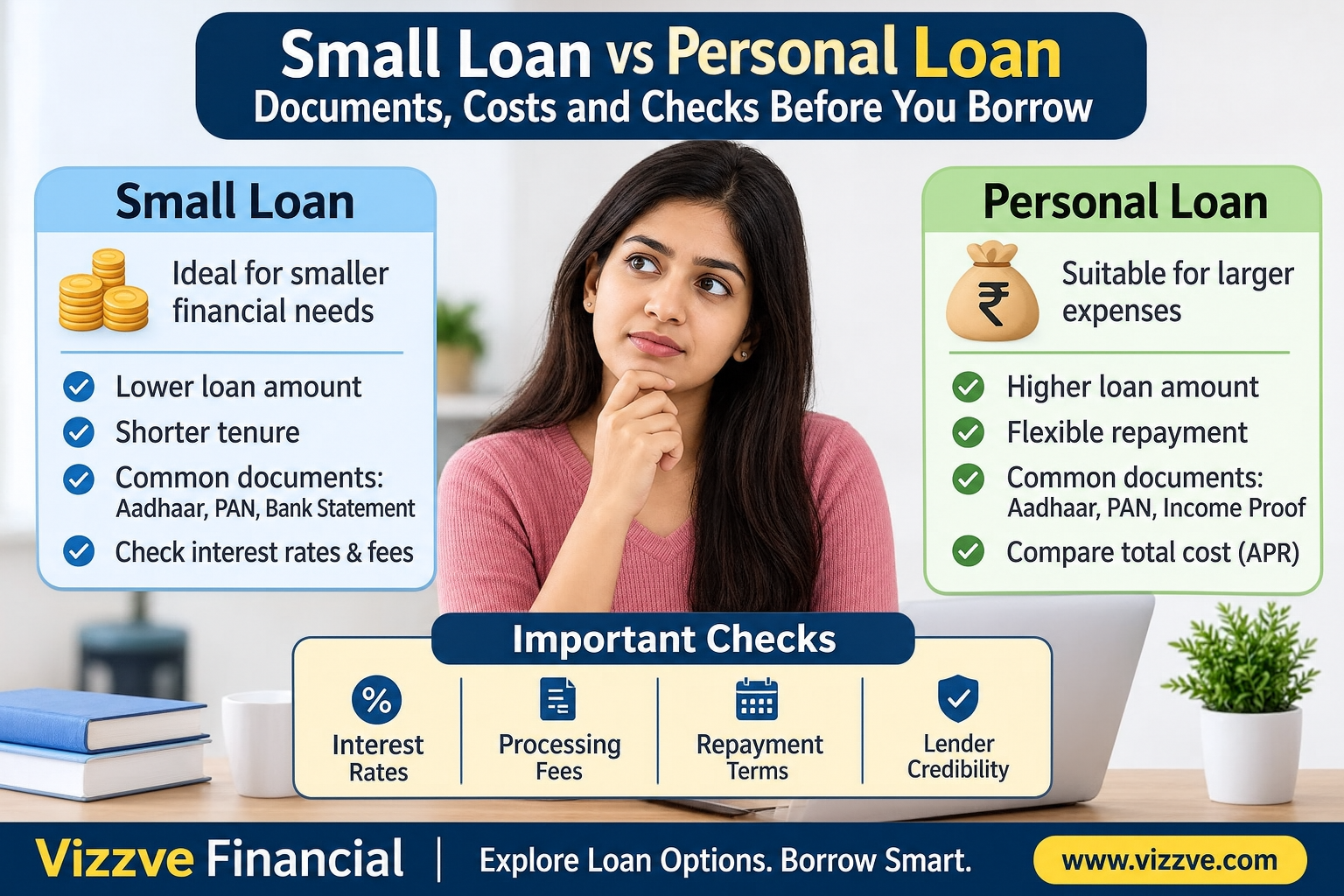
Choosing between a small loan and a personal loan can be confusing, especially when you need money for an urgent expense. Both options can help manage financial needs, but their loan amounts, repayment periods, costs and eligibility conditions may differ.
Before applying, it is important to understand which documents are required, how much the loan will cost and what conditions you should check.
A small loan may suit someone who needs a limited amount for a short-term expense. A personal loan may be more suitable for larger expenses that require a longer repayment period.
However, the right option depends on your income, repayment capacity and the lender's terms.
This guide explains everything in simple language so borrowers can make informed financial decisions.
AI Answer Box: Small Loan vs Personal Loan
A small loan is generally a lower-value loan designed for limited or short-term financial requirements, while a personal loan can provide a larger amount for expenses such as medical bills, education or home repairs.
Before choosing either option, compare:
-
Required documents and eligibility.
-
Interest rate and Annual Percentage Rate (APR).
-
Processing fees and additional charges.
-
Loan tenure and monthly EMI.
-
Late payment charges and foreclosure conditions.
-
Lender registration and loan agreement.
The best loan is not necessarily the one offering the highest amount or fastest approval. It is the one with affordable repayments, transparent charges and suitable terms.
Key Takeaways
-
Small loans generally cover smaller financial requirements.
-
Personal loans may provide higher borrowing amounts, depending on eligibility.
-
Aadhaar, PAN, bank statements and income proof are commonly requested.
-
Interest rates are not the only borrowing cost; check APR and processing fees.
-
Always read the loan agreement before accepting an offer.
-
Check your repayment ability before selecting an EMI.
-
Apply only through a verified lender or authorised lending partner.
Understanding Small Loans and Personal Loans
What is a small loan?
A small loan is a loan for a relatively limited amount of money. It can help with expenses such as:
-
Medical bills.
-
Household repairs.
-
Emergency travel.
-
Education-related expenses.
-
Unexpected monthly expenses.
These loans may have shorter repayment periods, depending on the lender.
What is a personal loan?
A personal loan is generally an unsecured loan, meaning borrowers usually do not need to provide property or gold as collateral.
It may be used for:
-
Medical emergencies.
-
Wedding expenses.
-
Home improvements.
-
Education expenses.
-
Debt consolidation.
-
Other personal requirements.
The approved amount, interest rate and repayment period depend on the lender's policies and the borrower's financial profile.
Documents Required for Small Loans and Personal Loans
Before applying, prepare the basic documents requested by the lender. Having accurate information can make the application process easier.
Common documents required
|
Document |
Why is it required? |
|---|---|
|
Aadhaar Card |
Identity and address verification |
|
PAN Card |
Financial identity verification |
|
Bank statements |
Income and transaction assessment |
|
Salary slips |
Proof of regular employment income |
|
Address proof |
Verification of residential details |
|
Photograph |
Applicant identification |
|
Mobile number |
OTP and application communication |
|
Email address |
Loan-related updates and documents |
Important: Not every lender asks for every document. Requirements depend on the loan product, applicant profile and lender's verification process.
Documents for salaried applicants
Salaried borrowers may be asked to provide:
-
PAN and Aadhaar details.
-
Recent salary slips.
-
Bank statements showing salary credits.
-
Employment information.
-
Current residential address.
Documents for self-employed applicants
Self-employed applicants may need:
-
PAN and Aadhaar details.
-
Recent bank statements.
-
Business income information.
-
Income tax returns, where required.
-
Business registration or other business proof, where applicable.
Small Loan vs Personal Loan: Cost Comparison
The total borrowing cost is one of the most important factors to understand before applying.
A loan with a smaller EMI is not automatically cheaper. A longer repayment period can increase the total interest paid.
Charges borrowers should check
|
Cost or charge |
What does it mean? |
|---|---|
|
Interest rate |
Amount charged for borrowing money |
|
Processing fee |
Fee for processing the application |
|
GST |
Applicable tax on taxable services and fees |
|
APR |
Annualised overall cost of borrowing |
|
Late payment charges |
Charges for missing payment obligations |
|
Foreclosure charges |
Charges, if applicable, for early closure |
|
Bounce charges |
Charges that may apply when an EMI payment fails |
Why is APR important?
APR stands for Annual Percentage Rate. It helps borrowers understand the overall annual cost of a loan, including applicable charges.
The Reserve Bank of India has introduced Key Facts Statement (KFS) requirements for covered retail and MSME term loans. The KFS provides important information, including APR and the repayment schedule.
Borrowers should compare the KFS rather than relying only on advertised interest rates.
Important Checks Before Applying for a Loan
Before accepting any loan offer, take time to understand the conditions.
Check the lender's credibility
Always verify:
-
The name of the bank or NBFC providing the loan.
-
Whether the lender is regulated by the RBI, where applicable.
-
Whether the loan platform is an authorised lending service provider.
-
The official website and customer support details.
-
The lender's grievance redressal process.
A loan application platform and the actual lender may be different entities. Identify who is responsible for providing the credit.
Check your credit profile
Your credit history can influence loan eligibility and the interest rate offered.
Before applying:
-
Review your credit report.
-
Check whether previous EMIs are correctly recorded.
-
Identify any overdue payments.
-
Correct inaccurate information through the relevant credit bureau.
-
Avoid submitting multiple applications without comparing offers.
A good credit history can strengthen an application, but it does not guarantee approval.
Check your monthly repayment capacity
Do not select a loan simply because the lender offers a large amount.
First, calculate how much you can comfortably repay after covering:
-
Household expenses.
-
Existing EMIs.
-
Utility bills.
-
Education costs.
-
Medical expenses.
-
Savings and emergency requirements.
Read the loan agreement
Before accepting an offer, understand:
-
Approved loan amount.
-
Interest rate and APR.
-
EMI amount and due date.
-
Total repayment amount.
-
Late payment charges.
-
Prepayment and foreclosure conditions.
-
Data privacy terms.
The terms should be clear before you agree to the loan.
How to Choose Between a Small Loan and a Personal Loan
|
Comparison factor |
Small loan |
Personal loan |
|---|---|---|
|
Loan requirement |
Limited expenses |
Wider personal expenses |
|
Loan amount |
Generally smaller |
May be higher |
|
Repayment period |
Often shorter |
May be longer |
|
EMI |
Depends on amount and tenure |
Depends on amount and tenure |
|
Documents |
Depends on lender |
Depends on lender |
|
Eligibility |
Income and credit assessment |
Income and credit assessment |
|
Best suited for |
Smaller financial needs |
Larger planned expenses |
Note: Small loan is a general product description, not a separate standardised RBI loan category. Actual terms vary between lenders.
Pros and Cons of Small Loans and Personal Loans
Benefits of small loans
-
Can help manage limited financial emergencies.
-
May require a smaller borrowing commitment.
-
Shorter repayment periods may help close the debt sooner.
-
Can be useful when the required amount is small.
Limitations of small loans
-
The available amount may be limited.
-
Short repayment periods can result in higher monthly instalments.
-
Processing fees may make a small loan relatively expensive.
-
Not every lender offers suitable terms.
Benefits of personal loans
-
Can support larger financial requirements.
-
Usually do not require collateral.
-
May offer flexible repayment periods.
-
Can help manage planned expenses.
Limitations of personal loans
-
Interest and fees can increase the total repayment.
-
Eligibility depends on the borrower's financial profile.
-
Longer tenures may increase total interest.
-
Missed EMIs can negatively affect credit history.
Step-by-Step Guide Before Applying
Follow these simple steps to make a more informed borrowing decision.
Step: Identify your requirement
Calculate the exact amount you need. Avoid borrowing extra money without a clear purpose.
Step: Compare loan offers
Compare at least two or three suitable offers based on APR, fees and repayment terms.
Step: Prepare your documents
Keep your identity, address and income-related documents ready.
Step: Calculate your EMI
Check whether the monthly instalment fits your regular budget.
Step: Verify the lender
Check the regulated lender's identity, website and authorised application channel.
Step: Read the KFS and agreement
Understand all applicable charges, repayment conditions and other important terms.
Step: Apply carefully
Submit correct information and never share OTPs, passwords or banking PINs with anyone.
Step: Maintain repayment discipline
Pay EMIs on time and keep payment receipts and loan statements for your records.
Example: Understanding Loan Costs
Consider a hypothetical borrower comparing two loan options.
|
Particulars |
Small loan |
Personal loan |
|---|---|---|
|
Loan amount |
₹20,000 |
₹1,00,000 |
|
Annual interest rate |
18% |
14% |
|
Repayment period |
12 months |
24 months |
|
Approximate monthly EMI |
₹1,834 |
₹4,801 |
|
Approximate total repayment |
₹22,008 |
₹1,15,224 |
|
Approximate interest |
₹2,008 |
₹15,224 |
Illustrative calculations using monthly reducing-balance interest, excluding processing fees, taxes and other charges. Actual lender quotations may differ.
This example shows why borrowers should compare the amount borrowed, interest rate, repayment period and total cost together.
Expert Commentary: What Should Borrowers Prioritise?
A sensible borrowing decision starts with affordability, not loan approval.
A borrower may receive an attractive offer but still struggle if the EMI is too high compared with monthly income.
Three important principles can help:
-
Borrow only the amount you actually need.
-
Compare the total repayment amount instead of focusing only on the EMI.
-
Choose a repayment period that balances affordable instalments with reasonable interest costs.
For digital loans, the RBI's Digital Lending Directions, 2025, also establish requirements covering borrower creditworthiness, disclosures, data usage and customer protection.
Real-World Borrowing Lessons
Consider these common situations:
An unexpected medical expense: A borrower needing a limited amount may compare small-loan offers instead of taking a larger loan unnecessarily.
A planned home renovation: Someone with a larger expense may compare personal loan offers with suitable repayment periods.
An irregular income: A self-employed borrower should consider income fluctuations before committing to a fixed monthly EMI.
The important lesson is simple: choose a loan according to your financial needs and repayment capacity.
Important Safety Checks for Digital Loans
Online borrowing can be convenient, but borrowers should remain careful.
-
Do not trust guaranteed-approval advertisements.
-
Never pay money to an unknown individual for loan approval.
-
Do not share OTPs, UPI PINs or banking passwords.
-
Review app permissions and privacy policies.
-
Download applications only from trusted sources.
-
Check the actual lender's details before accepting an offer.
-
Keep a copy of the KFS and digitally signed loan documents.
Under RBI's Digital Lending Directions, 2025, regulated entities must follow applicable requirements for borrower disclosures, data collection and storage, and customer grievance handling.
Vizzve Financial: Explore Suitable Loan Options
Vizzve Financial is one of India's trusted loan support platforms offering quick personal loans, low documentation, and an easy approval process.
Borrowers can explore available loan options and understand the application requirements before proceeding.
Visit www.vizzve.com to explore loan-related information.
Remember: Loan approval, interest rates, loan amounts and documentation requirements depend on the lending partner's eligibility assessment and applicable terms. No approval or disbursal is guaranteed.
Frequently Asked Questions
What documents are required for a small loan in India?
Common documents include PAN, Aadhaar, bank statements, address proof and income details. Requirements vary by lender.
Is a personal loan different from a small loan?
Yes. A small loan generally refers to a lower borrowing amount, while a personal loan may provide a larger amount depending on eligibility.
Can I apply for a personal loan without salary slips?
Some lenders accept alternative income documents, such as bank statements or business income records. Approval depends on their requirements.
Is Aadhaar mandatory for every loan?
Not necessarily. Lenders may accept different identity and address verification methods, depending on applicable rules and their policies.
Which loan has lower interest rates?
Neither option is automatically cheaper. Interest rates depend on the lender, credit profile, loan amount and repayment period.
What is APR in a personal loan?
APR represents the annualised cost of borrowing, including applicable charges. It helps borrowers compare different loan offers.
Can I get a small loan with a low credit score?
Some lenders may consider applicants with lower credit scores, but approval and pricing depend on their individual eligibility assessment.
What charges should I check before taking a loan?
Check the interest rate, processing fee, applicable GST, APR, late payment charges and prepayment conditions.
Can I repay my personal loan early?
Early repayment may be permitted, depending on the loan agreement and applicable rules. Check whether any foreclosure or prepayment charges apply.
How can I choose the right loan?
Compare the loan amount, total repayment, interest rate, fees, tenure and EMI. Choose an option that comfortably fits your monthly budget.
Conclusion
Choosing between a small loan and a personal loan becomes easier when you understand the documents, costs and eligibility requirements.
Before applying, verify the lender, compare interest rates, review the APR and calculate your repayment capacity. Do not rush into borrowing simply because an offer promises quick approval.
Responsible borrowing starts with understanding the complete cost of a loan and selecting an amount you can repay comfortably.
Explore loan-related information with Vizzve Financial at www.vizzve.com and make informed financial decisions.
Published on : 24th November
Published by : MD HEDAYATULLAH
www.vizzve.com || www.vizzveservices.com
Follow us on social media: Facebook || Linkedin || Instagram
🛡 Powered by Vizzve Financial
RBI-Registered Loan Partner | 10 Lakh+ Customers | ₹600 Cr+ Disbursed