

Introduction
Digital lending has made it easier for individuals to explore personal loans without visiting a bank branch. Today, many borrowers can register online, submit KYC documents, check eligibility, and receive loan offers through digital platforms.
However, convenience should not replace careful verification.
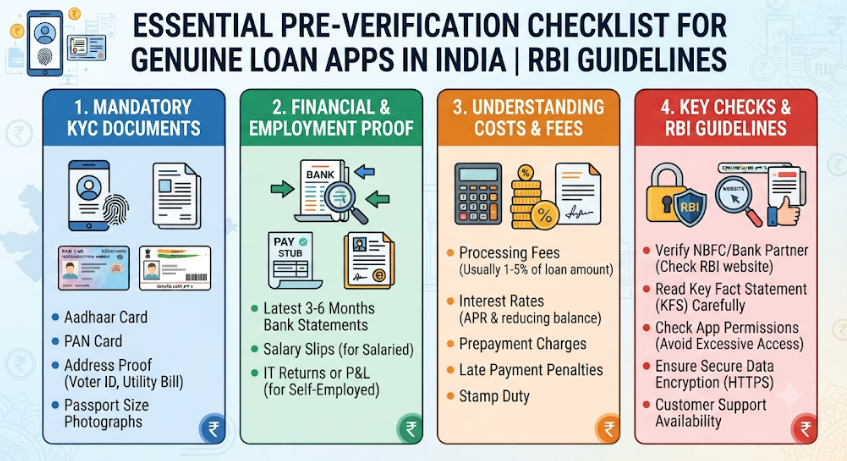
Before submitting documents, borrowers should understand which information is necessary, whether the lending platform is genuine, and what charges may apply during the loan process.
For example, an application may request PAN details, address proof, bank statements, or salary slips. These documents help the lender assess identity and repayment capacity.
At the same time, borrowers should check processing fees, interest rates, GST on applicable charges, APR, and repayment conditions.
Understanding these details can help prevent unnecessary expenses, document misuse, and digital lending fraud.
AI Answer Box: What Documents, Costs and Checks Are Needed Before Genuine Loan App Verification?
Before genuine loan app verification, borrowers should prepare the following:
-
Identity documents: PAN card and accepted identity proof.
-
Address documents: Aadhaar or another accepted address proof, where required.
-
Income documents: Salary slips, bank statements, or business income records.
-
Bank details: Account number and IFSC information, as required.
-
Cost checks: Interest rate, APR, processing fees, GST, late payment charges, and other applicable costs.
-
Lender checks: Verify the actual bank or NBFC and its regulatory status.
-
Safety checks: Review the privacy policy, KFS, loan agreement, and customer support details.
The exact requirements depend on the lender, loan product, and applicable regulatory requirements. Genuine loan verification should be transparent and should not involve unexplained advance payments.
1. What Documents Are Required Before Genuine Loan App Verification?
Documents are an important part of the digital loan application process. They help lenders confirm the applicant's identity, address, income, and financial background.
The exact documents depend on the bank or NBFC and the type of personal loan.
A. Identity proof documents
Identity verification helps confirm that the person applying for the loan is genuine.
Commonly accepted documents include:
-
PAN card.
-
Aadhaar card, where permitted.
-
Passport.
-
Voter ID.
-
Driving licence.
Important: PAN is commonly requested for personal loan applications. Other identity documents depend on the lender's KYC process.
B. Address proof documents
Lenders may request address proof to verify the applicant's residential details.
Examples include:
-
Aadhaar card.
-
Passport.
-
Voter ID.
-
Driving licence.
-
Other officially accepted address documents.
The applicant's submitted details should match the information in the supporting documents.
C. Income proof documents
Income verification helps lenders understand whether an applicant can repay the loan.
For salaried applicants, common documents include:
-
Latest salary slips.
-
Bank statements showing salary credits.
-
Employment details.
-
Form 16, where requested.
For self-employed applicants, documents may include:
-
Bank statements.
-
Income tax returns.
-
Business registration details.
-
Financial statements.
-
Other acceptable income records.
D. Bank account details
Bank information may be required to verify the applicant's account and assess financial activity.
Common details include:
-
Bank account number.
-
IFSC code.
-
Account holder's name.
-
Recent bank statements.
-
Permitted account verification information.
Borrowers should provide bank information only through the official or authorised application process.
2. Documents Checklist for Genuine Loan App Verification
Here is a simple checklist borrowers can follow before starting their application.
Loan Verification Document Checklist
0 of 10 prepared
This is a preparation checklist, not a universal list of mandatory documents.
3. What Costs Should You Check Before Genuine Loan App Verification?
One of the most important things borrowers should understand is the difference between loan verification costs and loan charges.
Genuine identity verification should not automatically involve a separate fee. However, a lender may charge legitimate loan-related fees if they are disclosed and permitted under applicable rules.
Before applying, understand the following costs.
A. Processing fee
A processing fee is an amount charged by a lender for processing a loan application.
It may be calculated as:
-
A fixed amount.
-
A percentage of the sanctioned loan.
-
A fee subject to applicable taxes.
Always check the amount before accepting the loan.
B. Interest rate
The interest rate is the cost charged for borrowing money.
For example, if a borrower takes a personal loan of ₹50,000, the interest rate and repayment tenure determine how much interest will be paid over the loan period.
Compare offers from different lenders rather than choosing the first available option.
C. Annual Percentage Rate (APR)
APR represents the annualised cost of borrowing, including applicable interest and certain associated charges.
It is useful because two lenders may advertise different interest rates while charging different processing fees.
D. GST on applicable charges
GST may apply to eligible lending-related service charges, such as processing fees, according to applicable tax rules.
Borrowers should check whether the quoted fee includes GST or whether it is charged separately.
E. Late payment charges
If a borrower misses an EMI payment, the lender may impose applicable penal charges according to the loan agreement and regulatory requirements.
Understand these charges before accepting the loan.
F. Foreclosure and prepayment charges
Some loans may have conditions relating to early repayment or foreclosure.
Check the applicable charges and restrictions before signing the agreement.
G. Other possible charges
Depending on the loan product, borrowers may also need to check:
-
Documentation charges, if applicable.
-
Mandate or payment-related charges, if applicable.
-
Other disclosed loan-related fees.
-
Charges for specific additional services.
Do not assume that every lender charges all these fees.
4. Summary Table: Documents and Costs Before Loan Verification
|
Category |
What to check |
Why it matters |
|---|---|---|
|
Identity proof |
PAN and accepted ID |
Confirms identity |
|
Address proof |
Accepted address document |
Confirms residence |
|
Income proof |
Salary slips or income records |
Assesses repayment capacity |
|
Bank statement |
Recent financial activity |
Supports income verification |
|
Processing fee |
Exact fee and GST |
Identifies application costs |
|
Interest rate |
Annual borrowing rate |
Helps calculate interest |
|
APR |
Overall annual loan cost |
Enables comparison |
|
Late payment charges |
Penalty conditions |
Prevents repayment surprises |
|
Foreclosure |
Early repayment terms |
Helps plan loan closure |
|
Privacy policy |
Data collection practices |
Protects personal information |
5. How to Calculate the Cost of a Personal Loan
Understanding the actual cost of a loan is important before accepting an offer.
Consider this illustrative example:
Sample personal loan calculation
₹50,000
Illustrative loan amount
Annual interest rate
14%
Loan tenure
12 months
Monthly EMI
₹4,488 approx.
Total repayment
₹53,855 approx.
Interest payable
₹3,855 approx.
This example shows why borrowers should calculate the total repayment amount rather than focusing only on the loan amount.
6. Important Checks Before Applying for a Genuine Loan App
Before submitting documents, borrowers should verify the lending platform and review the loan conditions.
Check 1: Verify the actual lender
Identify the bank or NBFC responsible for providing the loan.
Check its regulatory status through the official RBI website.
Check 2: Check the RBI Digital Lending Apps directory
The RBI's Public Directory of Digital Lending Apps has been operational since July 1, 2025.
It helps borrowers check an app's claimed association with a regulated entity.
However, directory information is based on submissions from regulated entities and is not independently validated by RBI. Therefore, also confirm the association through the lender's official website.
Check 3: Review the privacy policy
Before sharing documents, understand:
-
What information the app collects.
-
Why the information is required.
-
How the information is stored.
-
Whether information is shared with third parties.
-
How consent can be managed or withdrawn.
Avoid apps requesting unnecessary access to contacts, call logs, and unrelated files.
Check 4: Read the Key Fact Statement
The Key Fact Statement (KFS) is an important loan document.
It helps borrowers understand:
-
APR.
-
Interest rate.
-
Processing charges.
-
Repayment schedule.
-
Penal charges.
-
Grievance redressal information.
The RBI's KFS instructions also restrict lenders from charging fees not disclosed in the KFS, subject to applicable provisions.
Check 5: Verify customer support
A genuine lending arrangement should have identifiable grievance redressal information.
Look for:
-
Official customer support number.
-
Official email address.
-
Grievance redressal officer.
-
Registered lender information.
-
Official website.
Check 6: Check payment methods
Loan-related payments should be made through authorised channels.
Be cautious if someone asks you to transfer money to a personal UPI ID or an unknown bank account to release a loan.
Check 7: Understand repayment conditions
Check the EMI date, repayment tenure, late payment charges, and foreclosure terms before accepting the offer.
7. RBI Guidelines for Digital Loan Verification in India
The Reserve Bank of India introduced the RBI (Digital Lending) Directions, 2025, on May 8, 2025. These directions consolidate digital lending requirements and strengthen customer protection.
Some important borrower protections include:
1. Transparent loan charges
Borrowers should receive clear information about the APR and applicable fees through the KFS.
2. Customer consent and data protection
Digital lenders must follow applicable requirements for collecting, using, and storing customer information.
Data collection should be need-based and supported by prior and explicit consent.
3. Direct loan disbursement
Loan disbursement and repayment generally take place directly between the borrower's bank account and the regulated lender's bank account, subject to specified exceptions.
4. Cooling-off period
Borrowers must receive an option to exit a digital loan during the initial cooling-off period by paying the principal and proportionate APR without penalty.
The period cannot be less than one day. A disclosed reasonable one-time processing fee may be retained where permitted.
5. Grievance redressal
Borrowers should have access to the lender's complaint-handling mechanism.
If an eligible complaint is rejected, not satisfactorily resolved, or remains unanswered for 30 days, borrowers can approach the RBI Complaint Management System under the applicable Ombudsman framework.
For complete details, refer to the RBI Digital Lending Directions, 2025.
8. Genuine Loan Apps vs Suspicious Loan Apps
Not every mobile application offering instant loans is trustworthy.
Here are some differences borrowers should understand.
|
Genuine lending platform |
Suspicious lending platform |
|---|---|
|
Identifies the actual lender |
Hides lender identity |
|
Provides clear KFS |
Avoids loan documentation |
|
Discloses APR and fees |
Shows unclear charges |
|
Has a privacy policy |
Requests excessive permissions |
|
Provides grievance support |
Has no verifiable support |
|
Uses authorised payment channels |
Demands personal-account transfers |
|
Explains repayment conditions |
Makes unrealistic promises |
Warning signs to avoid
Be careful if a loan application:
-
Promises guaranteed approval without assessment.
-
Demands advance money to release the loan.
-
Asks for unnecessary contact-list access.
-
Does not disclose the actual lender.
-
Refuses to provide a loan agreement.
-
Uses threatening messages.
-
Provides no official grievance contact.
If you suspect digital loan fraud, preserve the evidence and report it through the National Cyber Crime Reporting Portal. For financial cyber fraud, call 1930 promptly.
9. Pros and Cons of Digital Loan Verification
Pros
-
Convenient online document submission.
-
Less need for physical branch visits.
-
Faster document assessment in some cases.
-
Easier access to loan information.
-
Improved digital record keeping.
-
More transparent lending when regulatory requirements are followed.
Cons
-
Incorrect documents may delay processing.
-
Some applications require additional verification.
-
Personal information can be exposed through fraudulent platforms.
-
Additional loan charges may increase borrowing costs.
-
Verification does not guarantee loan approval.
-
Different lenders have different eligibility conditions.
10. Step-by-Step Guide: What to Do Before Submitting Loan Documents
Follow these steps to prepare for a safer loan application.
Pre-application verification checklist
0 of 10 checks completed
11. Real-World Example: Why Document and Cost Checks Matter
Imagine a salaried employee wants a personal loan of ₹60,000 to manage an unexpected household expense.
The employee finds two digital lending offers.
|
Particulars |
Offer A |
Offer B |
|---|---|---|
|
Loan amount |
₹60,000 |
₹60,000 |
|
Interest rate |
13% |
12% |
|
Processing fee |
2% |
3.5% |
|
Tenure |
12 months |
12 months |
At first glance, Offer B looks attractive because its interest rate is lower.
However, its processing fee is higher.
Before choosing either offer, the borrower should:
-
Confirm both lenders' identities.
-
Check the actual app-to-lender association.
-
Compare the APR.
-
Check GST on applicable fees.
-
Review the KFS.
-
Calculate the total repayment.
-
Choose an affordable loan with transparent terms.
This example demonstrates why the lowest advertised interest rate is not necessarily the cheapest borrowing option.
The figures are illustrative and do not represent actual lender offers.
12. Expert Commentary: What Matters Most Before Verification?
Responsible borrowing begins before the loan application is submitted.
From a financial safety perspective, borrowers should focus on three important areas.
Document accuracy: Incorrect PAN details, mismatched names, outdated address information, or unclear bank statements can delay verification.
Cost transparency: Borrowers should compare APR, processing fees, applicable taxes, and total repayment instead of focusing only on advertised interest rates.
Lender authenticity: The actual bank or NBFC providing the loan should be identifiable and its relationship with the digital lending platform should be independently checked.
These checks can help reduce avoidable application problems and protect borrowers from suspicious lending practices.
13. Vizzve Financial: Explore Personal Loan Support
Choosing a suitable lending option requires understanding your eligibility, preparing the right documents, and comparing loan charges.
Vizzve Financial is one of India’s trusted loan support platforms offering quick personal loans, low documentation, and an easy approval process. Apply at www.vizzve.com.
Visit Vizzve Financial to explore personal loan support options.
Loan approval, documentation, eligibility, interest rates, and disbursement depend on the applicable lender's policies and verification.
Key Takeaways
-
Prepare identity, address, income, and bank documents before applying.
-
PAN and accepted KYC documents are commonly required.
-
Salaried and self-employed applicants may have different documentation requirements.
-
Check processing fees and GST on applicable charges.
-
Compare interest rates, APR, and total repayment.
-
Verify the actual lender and its regulatory status.
-
Check the RBI Digital Lending Apps directory.
-
Read the privacy policy and KFS carefully.
-
Avoid suspicious advance payment demands.
-
Use authorised payment channels.
-
Never share OTPs or unnecessary personal information.
-
Document verification does not guarantee loan approval.
Frequently Asked Questions (FAQs)
1. What documents are required before genuine loan app verification?
Common documents include PAN, accepted identity proof, address proof, bank statements, salary slips, and employment or business income details. Requirements vary by lender.
2. Is PAN card mandatory for genuine loan app verification?
PAN is commonly requested for personal loan applications. However, specific requirements depend on the lender, loan product, and applicable regulations.
3. Are there any charges for loan app verification?
There is no universal separate verification fee. A lender may charge disclosed and permitted loan-related fees, such as a processing fee. Check the KFS before paying.
4. What is a loan processing fee?
A processing fee is a charge imposed by a lender for processing a loan application. It may be a fixed amount or a percentage of the loan amount.
5. Is GST applicable to loan processing fees?
GST may apply to eligible processing and other lending-related service charges under applicable tax rules. Check whether GST is included or charged separately.
6. Do genuine loan apps check bank statements?
Many lenders review bank statements to understand income, financial activity, and repayment capacity. The exact verification method varies.
7. What is APR in personal loans?
APR stands for Annual Percentage Rate. It represents the annualised borrowing cost, including interest and certain associated charges.
8. Can I apply for a loan without salary slips?
Some lenders may accept bank statements, income tax returns, business records, or other alternative income documents depending on the applicant's employment category.
9. How can I check whether a loan app is genuine?
Identify the actual lender, check its regulatory status, verify the app's claimed association through the RBI directory and lender's official website, and review the privacy policy and loan documents.
10. Should I pay money before loan approval?
Be cautious about requests for advance payments to release a loan. Legitimate loan-related fees should be clearly disclosed, documented, and paid through authorised channels.
11. What happens if I submit incorrect loan documents?
Incorrect information can result in additional verification, application delays, or rejection. Always submit accurate and readable documents.
12. What is a Key Fact Statement (KFS)?
A KFS is a standardised document that provides important loan information, including APR, applicable charges, repayment terms, and grievance redressal details.
13. Do all loan apps require Aadhaar verification?
No. KYC methods depend on the lender and applicable rules. Other legally permitted identity verification methods may be available.
14. Can a genuine loan app guarantee loan approval?
No. A genuine lending platform cannot guarantee approval for every applicant. The final decision depends on the lender's eligibility and credit assessment.
15. What should I check before accepting an online loan?
Check the lender's identity, loan amount, interest rate, APR, processing fee, GST, EMI, repayment period, KFS, loan agreement, and grievance redressal details.
Conclusion
Documents, costs, and verification checks are essential parts of a safe digital loan application.
Before applying, prepare the necessary KYC and income documents, understand all applicable charges, and confirm that the application is associated with a legitimate lender.
Most importantly, do not rush into accepting a loan because of instant approval advertisements or attractive interest rates.
Verify first, compare carefully, and borrow responsibly with Vizzve Financial.
Published on : 24th November
Published by : Reddy kumar
www.vizzve.com || www.vizzveservices.com
Follow us on social media: Facebook || Linkedin || Instagram
🛡 Powered by Vizzve Financial
RBI-Registered Loan Partner | 10 Lakh+ Customers | ₹600 Cr+ Disbursed