

Introduction
A PAN card is an important document when applying for a personal loan in India. Banks and Non-Banking Financial Companies (NBFCs) commonly use PAN details to verify an applicant's identity and review credit information.
However, submitting your PAN card does not guarantee loan approval. Lenders may also ask for address proof, income documents, bank statements and other information to evaluate your repayment capacity.
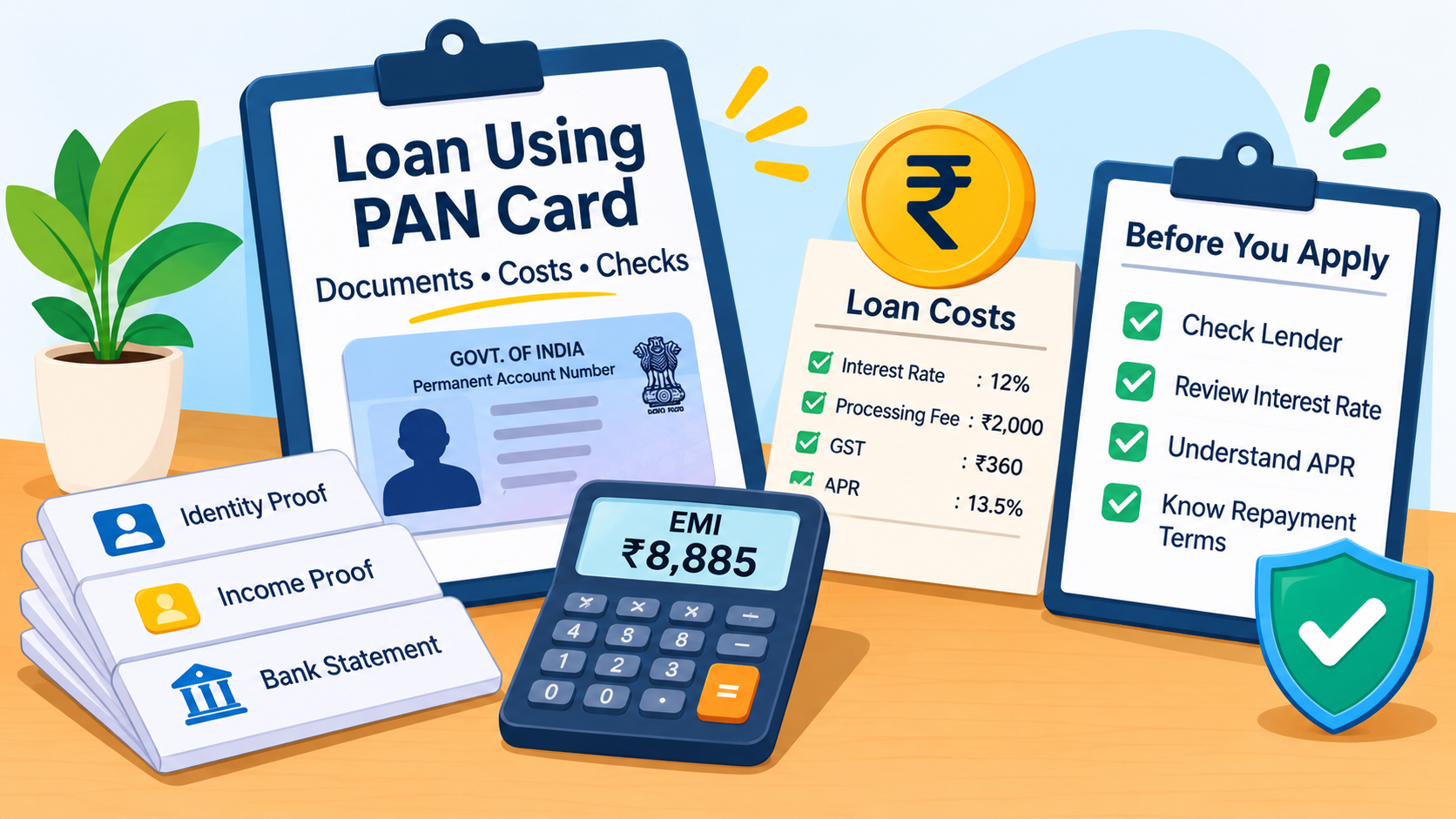
Before applying, it is important to understand three things: which documents you need, what costs you may have to pay, and which checks you should complete before accepting a loan offer.
This guide explains these points in simple language so you can make a better borrowing decision.
AI Answer Box: What should you check before taking a loan using PAN?
Before applying for a loan using PAN, prepare your PAN card, identity and address proof, income documents and bank statements. Check the lender's interest rate, processing fee, GST, APR, EMI, late-payment charges and prepayment conditions. Verify that the lender is a regulated bank or NBFC, review the Key Facts Statement (KFS), and confirm that you can comfortably repay the loan.
Important: PAN is generally used for identity and financial verification. It is not a guarantee of loan approval or a substitute for all other loan documents.
1. Documents Required Before Applying for a Loan Using PAN
The documents required depend on the lender, loan amount, employment type and verification method. A PAN card may be an essential document, but lenders usually request additional information.
1.1 PAN Card
A valid PAN card helps the lender:
-
Verify your tax identity.
-
Match your personal details with application information.
-
Review credit-related information where permitted.
-
Complete financial and regulatory checks.
Make sure your name and other details match your supporting documents. If your PAN information is incorrect, ask the relevant authority to correct it before applying.
1.2 Aadhaar Card or Other Identity Proof
Lenders may request Aadhaar or another accepted identity document to confirm your identity.
Other documents may include:
-
Passport
-
Voter ID
-
Driving licence
The lender will specify which documents it accepts. Aadhaar should only be shared through an authorised and secure verification process.
1.3 Address Proof
Address verification helps lenders confirm where you live.
Commonly accepted documents may include:
-
Aadhaar card
-
Passport
-
Utility bill
-
Voter ID
-
Driving licence
-
Other lender-approved address documents
Your current address should be accurate and consistent across the application and supporting records.
1.4 Income Proof
Income documents help the lender understand whether you can repay the loan.
|
Applicant type |
Common income documents |
|---|---|
|
Salaried employee |
Salary slips, salary account statements |
|
Self-employed person |
ITR, bank statements, business income records |
|
Freelancer |
Bank statements, invoices, ITR |
|
Business owner |
Business bank statements, ITR, financial records |
|
Gig worker |
Bank statements, platform earnings or payment records |
Not every lender asks for all these documents. Some may use digital income verification, while others may require additional proof.
1.5 Bank Statements
Bank statements help lenders review:
-
Regular income deposits.
-
Existing EMI payments.
-
Account balance and cash flow.
-
Returned or bounced payments.
-
General repayment capacity.
Lenders may request statements for a specific period, such as the previous three or six months.
2. Documents Checklist Before Applying
Use this checklist to organise your documents before starting the application.
Tip: Upload clear copies through the lender's official website or application. Avoid sending personal documents to unknown WhatsApp numbers or unverified agents.
3. Costs to Check Before Taking a Loan Using PAN
A personal loan involves more than the interest rate. Several fees can increase the total borrowing cost.
3.1 Interest Rate
The interest rate determines how much you pay for borrowing money.
For example, two lenders may offer the same loan amount but charge different interest rates. Even a small difference can affect the total interest paid.
Check whether the rate is:
-
Fixed for the entire tenure.
-
Variable or subject to changes, where applicable.
-
Calculated using a reducing balance or another disclosed method.
Do not compare loan offers using the interest rate alone.
3.2 Processing Fee
A processing fee is a charge collected by the lender for handling and evaluating the loan application.
Before paying, check:
-
The exact fee amount or percentage.
-
Whether GST is additional.
-
Whether the fee is deducted from the disbursed amount.
-
Whether any portion is refundable if the loan is not sanctioned or disbursed.
Processing fees differ between lenders and loan products.
3.3 GST and Other Applicable Taxes
GST may apply to certain loan-related services and fees, such as processing charges.
Ask the lender for a clear breakdown of the applicable taxes. Do not assume that every charge is tax-free or included in the advertised fee.
3.4 Annual Percentage Rate (APR)
APR represents the annualised cost of borrowing, including the interest and applicable charges included under the relevant calculation.
It helps borrowers compare loan offers more accurately.
For example, a loan with a lower advertised interest rate may still be more expensive if it has higher fees.
The RBI's Key Facts Statement framework requires applicable lenders to disclose the APR and repayment schedule for covered loans.
3.5 Late Payment Charges
If you miss an EMI, the lender may apply penal charges according to the loan agreement.
Before accepting the loan, check:
-
The amount or method used to calculate the charge.
-
When the charge applies.
-
Whether reminders or other costs may be involved.
RBI instructions require penal charges and the reasons for applying them to be disclosed. Penal charges should not be added to the loan interest rate as an extra component of interest.
3.6 Prepayment and Foreclosure Charges
Prepayment means paying some or all of your outstanding loan before the scheduled end date. Foreclosure means closing the entire loan early.
Check whether:
-
Part-prepayment is allowed.
-
Full foreclosure is allowed.
-
Any charges apply.
-
Minimum repayment conditions exist.
The rules and charges can depend on the loan type, lender and applicable RBI directions. Read the specific terms rather than assuming every loan has the same conditions.
3.7 Other Possible Charges
Depending on the lender and product, you may also need to check:
-
Documentation charges
-
Loan cancellation charges, if applicable
-
Cheque or payment-return charges
-
Loan statement or duplicate-document charges
-
EMI mandate-related charges, if applicable
Ask for a written list of all charges before accepting the offer.
4. Example: Understanding the Total Loan Cost
Suppose you borrow ₹1,00,000 at an illustrative annual interest rate of 12% for 12 months.
Illustrative loan example
Loan amount
₹1,00,000
Interest rate
12% p.a.
Loan tenure
12 months
Approximate EMI
₹8,885
Approximate total repayment
₹1,06,620
Approximate interest: ₹6,620. Processing fees, taxes and other charges are excluded.
This example is only for understanding EMI and interest. Actual repayment depends on the lender's calculation method, repayment dates and final loan terms.
5. Important Checks Before Submitting Your PAN
Submitting your PAN details is an important step. Complete these checks before sharing your information.
5.1 Verify the Lender
Check whether the actual lender is a bank or NBFC regulated by the RBI, or another legally authorised lending institution.
If you apply through a loan app or digital platform, identify the bank or NBFC that will provide the loan.
Do not assume that an app is a lender simply because it advertises instant loans.
5.2 Check Your PAN Details
Confirm that:
-
Your PAN is valid.
-
Your name matches your identity proof.
-
Your date of birth is accurate in the application.
-
Your details are entered correctly.
Incorrect information can delay verification or result in rejection.
5.3 Review Your Credit Report
Lenders may review your credit history to understand your repayment behaviour.
Before applying, check your credit report for:
-
Incorrect personal details.
-
Loans you do not recognise.
-
Incorrect outstanding balances.
-
EMI payment errors.
-
Duplicate or inaccurate loan accounts.
If you find an error, raise a dispute with the relevant credit information company and follow its correction process.
5.4 Calculate Your EMI Affordability
Do not choose a loan only because the lender offers a high eligible amount.
Calculate how much you can comfortably repay after accounting for:
-
Monthly household expenses.
-
Existing EMIs.
-
Rent and utility bills.
-
Education or family expenses.
-
Emergency savings.
A loan should not make it difficult to manage essential expenses.
5.5 Read the Key Facts Statement (KFS)
The KFS is an important document that explains the key terms and costs of a loan.
Check the following details:
|
KFS detail |
What to verify |
|---|---|
|
Loan amount |
Amount being sanctioned |
|
Interest rate |
Applicable rate and calculation method |
|
APR |
Overall annualised borrowing cost |
|
EMI |
Monthly repayment amount |
|
Tenure |
Total repayment period |
|
Processing fee |
Applicable fee and taxes |
|
Penal charges |
Charges for specified defaults |
|
Repayment schedule |
Due dates and instalments |
For covered loans, RBI's KFS framework requires the lender to provide key loan information in a standardised format before the borrower executes the contract.
5.6 Check App Permissions and Privacy
If applying through a digital lending app:
-
Download it from an official app store or the lender's verified website.
-
Read its privacy policy.
-
Check why each requested permission is needed.
-
Avoid apps demanding access to contacts, call logs or unrelated personal information.
-
Never share your OTP, UPI PIN or banking password.
RBI's Digital Lending Directions, 2025 set out borrower-protection and data-handling requirements for regulated digital lending activities.
6. Common Mistakes to Avoid Before Applying
Many borrowers focus only on loan approval and forget to examine the terms.
Avoid these mistakes:
-
Assuming PAN alone guarantees approval: Lenders also assess income, creditworthiness and repayment capacity.
-
Ignoring additional charges: A low interest rate does not always mean a low-cost loan.
-
Submitting incorrect information: Mismatched details may delay the process.
-
Applying through unknown apps: Unverified platforms may misuse personal information.
-
Ignoring the KFS: Always review the complete cost and repayment schedule.
-
Borrowing more than required: A larger loan can increase EMI and interest expenses.
-
Not checking repayment dates: Missed payments may affect your credit history and lead to charges.
7. How to Apply Safely for a Loan Using PAN
Follow these steps before accepting a loan offer:
-
Identify a bank or NBFC that offers the loan you need.
-
Visit its official website or verified digital application.
-
Review the eligibility conditions.
-
Keep your PAN and supporting documents ready.
-
Enter accurate personal and income details.
-
Give consent for the required verification and credit checks.
-
Compare the interest rate, APR, fees and EMI.
-
Read the KFS and loan agreement carefully.
-
Accept the offer only if you understand and agree to the terms.
-
Save the digitally signed loan documents and repayment schedule.
8. Benefits of Preparing Documents and Checking Costs in Advance
Preparing before applying can help you:
-
Avoid unnecessary application delays.
-
Reduce errors in personal information.
-
Understand the complete borrowing cost.
-
Compare different lenders.
-
Identify unexpected fees.
-
Protect your PAN and financial information.
-
Choose a repayment plan that fits your income.
9. What to Do If You Suspect PAN Misuse
If you believe someone has used your PAN without permission:
-
Check your credit report for unfamiliar loan accounts or enquiries.
-
Contact the relevant lender through its official customer-care channel.
-
Raise a dispute with the credit bureau if the information is incorrect.
-
Report suspected identity or financial fraud through the appropriate official cybercrime reporting channels.
-
Keep copies of complaints and acknowledgement numbers.
Never share your PAN image, OTP or identity documents with an unknown person promising guaranteed loan approval.
10. PAN Card Loan vs Other Loan Documents
|
Document or information |
Main purpose |
|---|---|
|
PAN card |
Tax identity and financial verification |
|
Aadhaar or other identity proof |
Identity verification |
|
Address proof |
Residential address verification |
|
Salary slips or ITR |
Income assessment |
|
Bank statements |
Cash flow and repayment assessment |
|
Credit report |
Credit history review |
Each document serves a different purpose. A PAN card is important, but it does not replace income and repayment checks.
11. Expert Commentary: Why Borrowers Should Check the Total Cost
A loan should be evaluated based on its total repayment cost, not just the advertised interest rate.
Borrowers should compare the APR, processing fee, EMI, tenure and applicable charges before making a decision. They should also ensure that the EMI fits their monthly budget.
A transparent lender should provide clear loan terms and the required disclosures before the borrower accepts the loan.
12. Frequently Asked Questions (FAQs)
1. Is a PAN card enough to get a personal loan?
No. PAN is commonly used for identity and financial verification, but lenders may also require income proof, address proof, bank statements and other documents.
2. What documents are required for a loan using PAN?
Common documents include PAN, identity proof, address proof, bank statements and income documents. Requirements differ between lenders.
3. Can I get a loan using PAN without salary slips?
Some lenders may accept bank statements, ITR or other income evidence. Approval depends on their eligibility requirements.
4. Does applying for a PAN-based loan involve a processing fee?
It may. Processing fees depend on the lender and loan product. Check the fee and applicable taxes before accepting the offer.
5. What is APR in a personal loan?
APR is the annualised cost of borrowing, including interest and applicable charges covered by the calculation. It helps borrowers compare loan offers.
6. Is GST charged on loan processing fees?
GST may apply to processing and other taxable services. Check the lender's fee breakdown to understand the applicable amount.
7. Does checking my credit score affect loan eligibility?
Checking your own credit report is generally different from a lender making a credit enquiry. A lender's enquiry may be recorded in your credit report.
8. Can I apply for a loan using PAN online?
Yes. Many banks and NBFCs accept online applications through their official websites or authorised digital lending platforms.
9. What should I check before accepting a loan?
Review the lender's identity, interest rate, APR, processing fee, EMI, repayment schedule, penal charges and foreclosure conditions.
10. Are digital loan apps safe for submitting PAN details?
Only use verified platforms connected to legitimate lenders. Read the privacy policy and avoid granting unnecessary permissions.
11. Can a loan be rejected even if my PAN is valid?
Yes. A valid PAN does not guarantee approval. Lenders also assess income, credit history, existing debt and repayment capacity.
12. What is a Key Facts Statement?
A KFS is a standardised document that explains important loan terms, costs, APR and repayment details to help borrowers make informed decisions.
13. Can I repay my personal loan early?
Many loans allow early repayment, but the conditions and applicable charges depend on the loan agreement and relevant rules.
14. What happens if I miss a personal loan EMI?
The lender may apply disclosed penal charges. Late payments can also negatively affect your credit history.
15. Should I pay an advance fee to a loan agent?
Do not pay unknown individuals or unverified agents. Confirm any legitimate fee directly with the actual lender through its official channels.
Conclusion
A loan using PAN can make the application and verification process convenient, but borrowers should not rush into accepting an offer. Preparing the required documents, understanding the complete loan cost and checking the lender's credibility can help prevent unnecessary financial problems.
Always compare loan offers, read the KFS and agreement carefully, and choose an EMI that fits your monthly budget. Responsible borrowing begins before you submit your PAN details.
Published on : 25th November
Published by : Bhargavi
www.vizzve.com || www.vizzveservices.com
Follow us on social media: Facebook || Linkedin || Instagram
🛡 Powered by Vizzve Financial
RBI-Registered Loan Partner | 10 Lakh+ Customers | ₹600 Cr+ Disbursed