

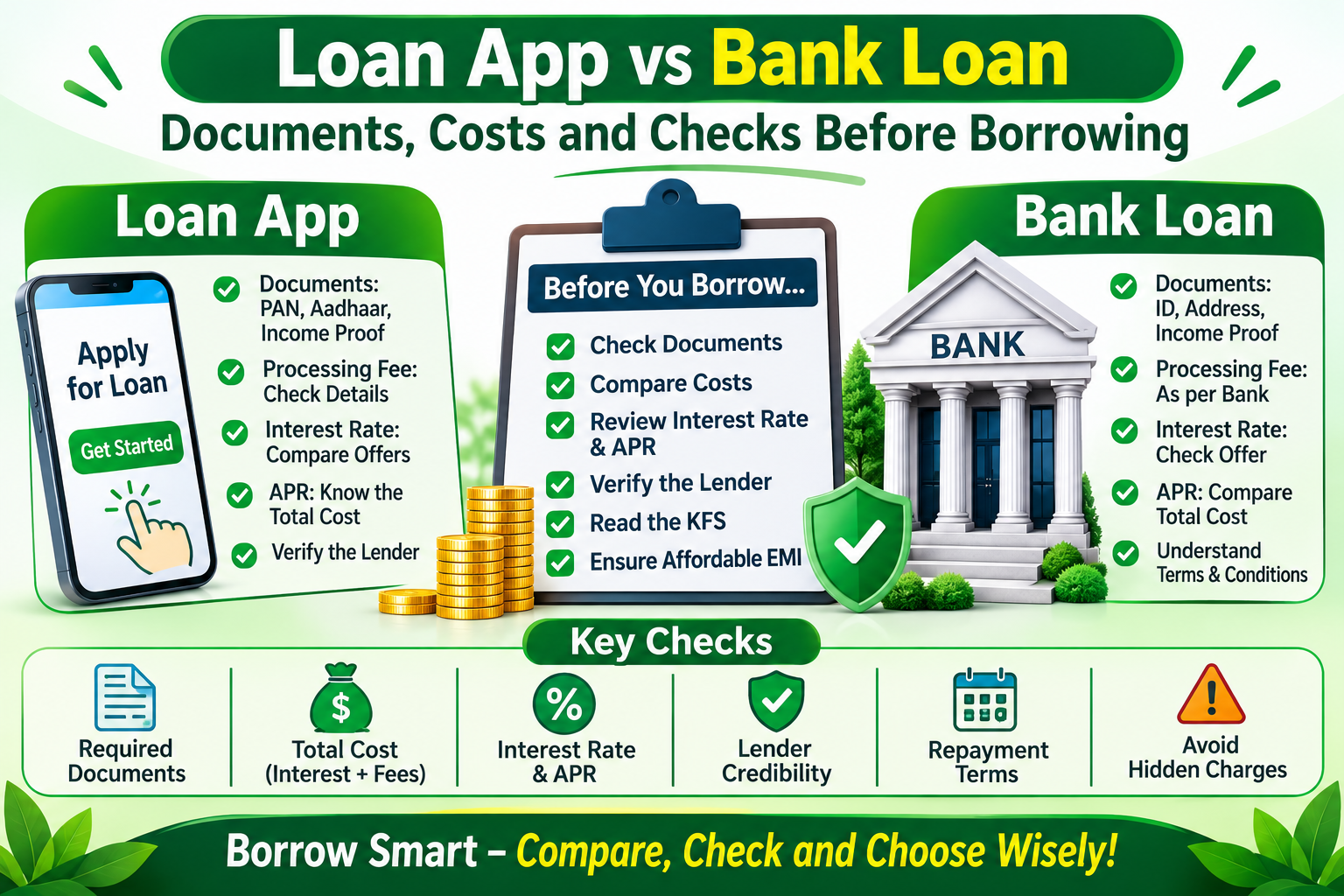
Borrowing money can help manage planned expenses, medical emergencies, education costs, home improvements and other financial needs. However, choosing the right loan is not only about getting quick approval. Borrowers should also understand the documents required, interest rates, processing fees, repayment conditions and the lender's credibility.
Today, borrowers can apply for loans through mobile applications or directly through banks. Both options may offer personal loans and other credit products, but their application processes, documentation requirements, costs and customer support arrangements can differ.
Before submitting a loan application, it is important to compare the actual lender, total borrowing cost and repayment obligations.
This guide explains the documents, costs and important checks before choosing a loan app vs bank loan, helping borrowers make informed and responsible financial decisions.
SEO Details
Meta Title:
Meta Description:
Slug:
Primary Keyword: Documents, Costs and Checks Before Loan App vs Bank Loan
Secondary Keywords:
-
Loan app vs bank loan
-
Loan documents required
-
Bank loan documents
-
Loan app documents
-
Personal loan processing fees
-
Loan interest rates
-
Loan application charges
-
Loan eligibility requirements
-
Digital lending safety
-
Loan repayment terms
-
Key Fact Statement
-
Annual Percentage Rate
-
Loan verification process
-
Safe loan application
-
Personal loan comparison
Long-Tail Keywords:
-
Documents required before applying for a loan app
-
Documents required for a personal loan from a bank
-
Hidden charges in loan apps
-
Loan app vs bank loan interest rate comparison
-
What to check before taking an online loan
-
How to verify whether a loan app is genuine
-
Charges to compare before choosing a personal loan
-
Important checks before signing a loan agreement
Tags: Loan App, Bank Loan, Personal Finance, Loan Documents, Loan Charges, Digital Lending, Personal Loan, Loan Eligibility, Responsible Borrowing, Financial Awareness
OG Title: Loan App vs Bank Loan: Documents, Costs and Checks
OG Description: Understand the documents, fees, lender verification and repayment checks to complete before choosing a loan app or bank loan.
1. Understanding Loan Apps and Bank Loans
Before comparing documents and costs, borrowers should understand the difference between these two borrowing channels.
What is a loan app?
A loan app is a mobile application or digital platform through which borrowers can explore, apply for and sometimes manage loan products.
Some apps are operated directly by regulated lenders, while others work as Lending Service Providers (LSPs) for banks or Non-Banking Financial Companies (NBFCs).
A loan app may allow users to:
-
Submit an online loan application.
-
Upload identity and income documents.
-
Complete digital KYC.
-
Check available loan offers.
-
Review repayment details.
-
Track loan application status.
Important: A loan app is not automatically the lender. Always identify the bank or NBFC that will actually provide the loan.
What is a bank loan?
A bank loan is credit provided by a bank to an eligible borrower under agreed terms and conditions.
Borrowers can apply through:
-
Bank branches.
-
Official bank websites.
-
Official mobile banking applications.
-
Authorised banking channels.
Banks generally evaluate income, repayment capacity, credit history, employment details and existing financial obligations before approving a loan.
2. Documents Required Before Applying Through a Loan App
Digital loan applications may reduce paperwork, but borrowers still need to provide information to establish their identity, income and repayment capacity.
The exact requirements depend on the lender, loan product and applicant profile.
A. Identity proof
Commonly requested identity documents or verification details include:
-
PAN.
-
Aadhaar-based verification, where applicable.
-
Other officially accepted identity documents.
-
Mobile number registered for verification.
Never share your OTP, UPI PIN or banking password with anyone claiming to help with your loan application.
B. Address proof
The lender may request address verification through:
-
Aadhaar details, where applicable.
-
Passport.
-
Voter ID.
-
Driving licence.
-
Other accepted address documents.
C. Income proof
Income verification helps the lender evaluate whether the borrower can repay the loan.
Depending on the applicant's employment type, documents may include:
For salaried applicants:
-
Recent salary slips.
-
Bank statements.
-
Salary account details.
-
Employment information.
For self-employed applicants:
-
Bank statements.
-
Income tax returns, where required.
-
Business registration documents, where applicable.
-
Financial statements or other income evidence.
D. Bank account details
The lender may request bank account information to verify the applicant and facilitate loan disbursement and repayment.
Check that the account details are correct and that the lender's disbursement and repayment arrangements are clearly explained.
E. Photograph and digital KYC
Some lenders use digital verification processes, including photographs, video verification or other approved KYC methods.
Only complete verification through the lender's official or authorised platform.
3. Documents Required for a Bank Loan
Bank loan documentation depends on the type of loan, the bank's policies and the borrower's financial profile.
Common documents include:
| Document | Why it may be required |
|---|---|
| PAN | Identity and financial verification |
| Aadhaar or accepted identity proof | Identity verification |
| Address proof | Residential address verification |
| Salary slips | Income assessment |
| Bank statements | Income and repayment analysis |
| Employment details | Employment verification |
| ITR documents | Income verification, where required |
| Business documents | Business and income assessment |
| Photograph | Application and identity records |
Salaried borrowers
A salaried applicant may need to provide:
-
PAN and identity proof.
-
Address proof.
-
Recent salary slips.
-
Bank statements.
-
Employment details.
Self-employed borrowers
A self-employed applicant may need:
-
PAN and identity proof.
-
Business address proof.
-
Bank statements.
-
Income tax returns, where required.
-
Business registration or financial documents, depending on the product.
Why do banks ask for these documents?
Banks use documentation to understand the applicant's financial position and repayment capacity. The information helps them evaluate the risk associated with lending.
Submitting complete and accurate documents can reduce avoidable delays, but it does not guarantee loan approval.
4. Loan App vs Bank Loan: Document Comparison
Both channels may require similar basic information. However, the method of submitting and verifying documents can differ.
| Factor | Loan App | Bank Loan |
|---|---|---|
| Application | Usually digital | Online or branch-based |
| Identity verification | Often digital KYC | Digital or branch-based KYC |
| Income proof | Depends on lender | Depends on lender |
| Bank statements | Digital upload or authorised access | Upload or bank-approved process |
| Document submission | Usually through an app or website | Online or through a branch |
| Verification | Digital or manual | Digital or manual |
| Additional documents | Product-specific | Product-specific |
Key point: A digital application does not mean that fewer documents are always required. The actual lender determines the documentation requirements.
5. Costs to Check Before Choosing a Loan App
One of the biggest mistakes borrowers make is comparing loans only by the advertised interest rate.
The actual borrowing cost can include several charges.
A. Interest rate
The interest rate determines how much interest the borrower pays on the outstanding loan amount.
Check whether the rate is:
-
Fixed.
-
Floating, where applicable.
-
Calculated on a reducing balance.
-
Expressed as a monthly or annual rate.
Always understand the rate calculation before accepting an offer.
B. Processing fee
A lender may charge a processing fee for evaluating and processing a loan application.
Before applying, check:
-
Whether the fee is fixed or percentage-based.
-
Whether applicable taxes are additional.
-
Whether the fee is deducted from the loan amount.
-
Whether the fee is refundable if the loan is rejected or cancelled.
C. Annual Percentage Rate (APR)
APR is an important measure because it represents the annualised cost of borrowing, including applicable charges covered under the relevant regulatory framework.
Comparing APR can provide a clearer picture than looking at the interest rate alone.
D. Late payment charges
Missing an EMI may result in additional charges under the loan agreement.
Understand:
-
When a payment is considered overdue.
-
How penal charges are calculated.
-
Whether any other applicable charges may arise.
-
How missed payments may affect your credit history.
E. Foreclosure and prepayment charges
Some borrowers prefer to repay their loans early to reduce their debt burden.
Before signing, check:
-
Whether part-prepayment is allowed.
-
Whether foreclosure is permitted.
-
Whether charges apply.
-
Whether minimum lock-in conditions exist.
The applicable rules can vary by lender, loan type and the terms governing the loan.
F. Other possible charges
Depending on the product, borrowers should also check for:
-
Documentation charges.
-
Stamp duty, where applicable.
-
Insurance premiums, if applicable and agreed to.
-
Payment return or mandate failure charges.
-
Other disclosed service charges.
Do not assume that every lender charges all these fees. Ask for the applicable charges in writing.
6. Costs to Check Before Choosing a Bank Loan
Bank loans may also include multiple charges beyond the advertised interest rate.
Important costs include:
-
Processing fee: The charge for handling and evaluating the application.
-
Interest: The cost of borrowing the principal amount.
-
Documentation charges: Fees, if applicable, for documentation or related services.
-
Late payment charges: Charges applicable when an EMI is not paid on time.
-
Prepayment or foreclosure charges: Charges, if applicable under the product terms and prevailing rules.
-
Taxes and statutory charges: Applicable taxes or government-related charges.
Compare the total cost, not just the EMI
A lower EMI does not always mean a cheaper loan. A longer repayment period can reduce the monthly instalment while increasing the total interest paid.
For example, compare two offers with:
-
The same loan amount.
-
Different interest rates.
-
Different repayment tenures.
-
Different processing fees.
The offer with the lowest EMI may not be the most economical option.
7. Loan App vs Bank Loan: Cost Comparison
| Cost factor | Loan App | Bank Loan |
|---|---|---|
| Interest rate | Depends on the actual lender and product | Depends on the bank and product |
| Processing fee | May apply | May apply |
| APR disclosure | Check the KFS | Check the KFS |
| Late payment charges | Check the agreement | Check the agreement |
| Prepayment charges | Check applicable terms | Check applicable terms |
| Other fees | Review all disclosures | Review all disclosures |
| Total repayment | Calculate before accepting | Calculate before accepting |
There is no universal rule that loan apps are more expensive or that bank loans are always cheaper. Compare actual written offers from regulated lenders.
8. Important Checks Before Applying Through a Loan App
Before sharing personal information or submitting an application, complete these checks.
Check 1: Identify the actual lender
Find out which bank or NBFC is providing the loan.
Do not rely only on the app's name, advertisements or promotional messages.
Check 2: Verify the app's association
Check the lender's official website to confirm whether the app or Lending Service Provider is associated with the regulated lender.
The RBI's Public Directory of Digital Lending Apps can also help borrowers check an app's reported association with a regulated entity. However, directory inclusion should not be treated as an RBI guarantee or endorsement of the app.
Check 3: Read the Key Fact Statement
A Key Fact Statement (KFS) provides important information about the loan.
Review:
-
Loan amount.
-
Interest rate.
-
APR.
-
Processing fee.
-
Other applicable charges.
-
Repayment schedule.
-
Penal charges.
-
Relevant loan conditions.
The RBI's KFS framework is intended to help prospective borrowers understand loan costs before entering into the contract.
Check 4: Review app permissions
Be cautious if an app requests unnecessary access to:
-
Contacts.
-
Call logs.
-
Personal photos.
-
Files unrelated to the loan application.
Review the privacy policy and understand how your personal information will be collected, used and shared.
Check 5: Avoid advance payment scams
Be cautious of people who demand money through personal UPI IDs or private bank accounts in exchange for guaranteed loan approval.
Verify every payment request through the actual lender's official channel.
Check 6: Read the loan agreement
Never accept a loan without understanding the interest rate, fees, repayment dates, default conditions and other contractual terms.
9. Important Checks Before Applying for a Bank Loan
Bank loans also require careful verification.
A. Check the bank's official website
Use the bank's official website or authorised branch to confirm:
-
Loan product details.
-
Eligibility requirements.
-
Interest rates.
-
Processing fees.
-
Required documents.
-
Customer support information.
B. Check your credit report
Review your credit report for:
-
Existing loan accounts.
-
Outstanding balances.
-
Repayment history.
-
Incorrect personal details.
-
Unrecognised credit enquiries.
Correct errors through the relevant credit bureau or lender before they create unnecessary complications.
C. Understand your EMI
Calculate whether the EMI fits your monthly budget after accounting for rent, household expenses, existing EMIs and savings.
D. Check the repayment tenure
A longer tenure may reduce the EMI but increase the total interest cost.
Choose a repayment period that balances affordability and total borrowing cost.
E. Obtain all written terms
Keep copies of:
-
KFS.
-
Sanction letter.
-
Loan agreement.
-
Repayment schedule.
-
Applicable fee details.
Do not depend only on verbal promises.
10. Why the Key Fact Statement (KFS) Matters
A Key Fact Statement is an important document that helps borrowers understand the financial terms of a loan before accepting it.
Under the RBI's April 15, 2024 circular on KFS for Loans and Advances, covered lenders are required to provide a standardised KFS to prospective borrowers for applicable loans.
The KFS includes important information such as:
-
Loan amount.
-
Interest rate.
-
APR.
-
Fees and charges.
-
Repayment schedule.
-
Details of applicable third-party charges.
The RBI's Digital Lending Directions, 2025 also require regulated entities to provide the relevant KFS and loan-related disclosures for digital lending.
Why borrowers should care: A borrower should not accept an offer based only on an advertisement or a message showing a low interest rate. The KFS helps reveal the actual cost and repayment obligations.
11. Example: Comparing Two Loan Offers
Suppose a borrower wants a personal loan of ₹1,00,000 for 12 months.
The borrower receives two hypothetical offers:
| Particulars | Offer A | Offer B |
|---|---|---|
| Loan amount | ₹1,00,000 | ₹1,00,000 |
| Annual interest rate | 12% | 14% |
| Tenure | 12 months | 12 months |
| Approximate EMI | ₹8,885 | ₹8,979 |
| Approximate total repayment | ₹1,06,620 | ₹1,07,748 |
| Processing fee | Check actual offer | Check actual offer |
Illustrative calculations only. Actual EMI and total repayment may vary due to lender calculation methods, repayment dates, fees, taxes and other terms.
In this example, Offer A has a lower interest rate and estimated repayment amount. However, the borrower must still compare the APR and applicable charges before deciding.
A loan should not be selected solely because its advertised rate or EMI appears lower.
12. Common Mistakes Borrowers Should Avoid
Mistake 1: Applying without checking the lender
An attractive app interface does not prove that the app is trustworthy.
Safer decision: Verify the actual regulated lender and its association with the app.
Mistake 2: Ignoring processing fees
A borrower may focus on the interest rate and overlook the processing fee.
Safer decision: Calculate the net amount received and the total amount payable.
Mistake 3: Sharing OTPs and passwords
Fraudsters may pretend to be bank employees or loan agents.
Safer decision: Never share OTPs, PINs or passwords with anyone.
Mistake 4: Not reading the KFS
Accepting a loan without reviewing the KFS can lead to unexpected costs.
Safer decision: Read the APR, fees and repayment schedule before agreeing.
Mistake 5: Choosing an unaffordable EMI
An EMI that consumes too much of the monthly income can create financial pressure.
Safer decision: Calculate all existing and proposed EMIs before borrowing.
Mistake 6: Submitting inaccurate documents
Incorrect income or identity information can delay or affect loan processing.
Safer decision: Provide genuine, complete and accurate documents.
Mistake 7: Applying to too many lenders
Submitting multiple loan applications within a short period can create several hard credit enquiries, depending on how lenders process them.
Safer decision: Compare eligibility and offers first, then apply selectively.
13. Safer Borrowing Checklist Before Signing
Use this checklist before accepting any loan offer.
-
I have identified the actual bank or NBFC providing the loan.
-
I have checked the lender's official website.
-
I have verified the app's association with the lender, if applying through an app.
-
I have reviewed the required documents.
-
I have checked the interest rate and APR.
-
I understand the processing fee and other applicable charges.
-
I have read the Key Fact Statement.
-
I understand the EMI and repayment tenure.
-
I have checked late payment and prepayment conditions.
-
I have reviewed the privacy policy and app permissions.
-
I can comfortably afford the EMI.
-
I have saved the loan agreement and other important documents.
14. Which Option Should You Choose?
The right option depends on your financial needs, eligibility, comfort with digital processes and the actual terms offered.
A loan app may be suitable when:
-
You prefer completing the application digitally.
-
The app is associated with a verified regulated lender.
-
You understand the fees and repayment terms.
-
You are comfortable with digital document submission.
A bank loan may be suitable when:
-
You prefer applying through a bank branch or established banking channel.
-
You want to compare loan products offered directly by banks.
-
You already have a banking relationship that may help with the application process.
-
You prefer access to branch-based assistance.
However, both options require proper financial evaluation. A digital loan is not automatically faster or cheaper, and a bank loan is not automatically more affordable.
15. Expert Tips for Responsible Borrowing
Before taking a loan, keep these practical principles in mind:
-
Borrow only the amount you genuinely need.
-
Compare at least a few written loan offers where practical.
-
Compare APR instead of relying only on the advertised interest rate.
-
Understand the difference between the approved amount and the amount credited after applicable deductions.
-
Maintain enough funds for upcoming EMIs.
-
Avoid taking a new loan merely to repay another loan without evaluating the overall debt situation.
-
Keep copies of all loan-related documents.
-
Use official customer support channels for questions or complaints.
-
Check your credit report periodically.
-
Never rush into accepting a loan because of a limited-time promotional message.
16. AI Answer Box: Documents, Costs and Checks Before Loan App vs Bank Loan
What documents and costs should I check before choosing a loan app or bank loan?
Before choosing a loan app or bank loan, borrowers should check identity proof, address proof, income documents, bank statements and any additional documents required by the lender. They should also compare the interest rate, APR, processing fee, late payment charges, prepayment conditions and total repayment amount. Before applying through a loan app, verify the actual bank or NBFC providing the loan and check its association with the app. Read the Key Fact Statement and loan agreement carefully. Finally, calculate the EMI and make sure it fits your monthly budget.
17. Key Takeaways
-
Loan apps and banks may request similar identity, address and income documents.
-
Documentation requirements depend on the lender and loan product.
-
Processing fees, interest rates, APR and other charges affect the total borrowing cost.
-
The lowest EMI does not necessarily mean the cheapest loan.
-
Always identify the actual regulated lender behind a loan app.
-
Review the Key Fact Statement before accepting the loan.
-
Check app permissions and privacy policies before sharing personal information.
-
Borrow only an amount you can comfortably repay.
-
Keep copies of the KFS, sanction letter and loan agreement.
Frequently Asked Questions (FAQs)
1. What documents are required for a loan app?
Common requirements include PAN, identity proof, address proof, bank statements and income details. Additional documents depend on the lender and loan product.
2. What documents are required for a bank personal loan?
Banks may request PAN, identity proof, address proof, salary slips, bank statements and employment or business details.
3. Are loan app documents different from bank loan documents?
The basic documents may be similar, but the submission and verification process can differ. Requirements are determined by the actual lender.
4. Do loan apps charge processing fees?
Some loan products offered through apps may have processing fees. Check the KFS and loan agreement for applicable charges.
5. Is a bank loan cheaper than a loan app loan?
Not always. The total cost depends on the lender, interest rate, APR, fees, tenure and other loan conditions.
6. What is APR in a personal loan?
Annual Percentage Rate represents the annualised cost of borrowing, including applicable charges covered under the relevant framework. It helps borrowers compare loan offers.
7. What is a Key Fact Statement?
A KFS is a standardised document that provides important loan information, including the amount, interest rate, APR, charges and repayment schedule.
8. How can I verify whether a loan app is genuine?
Identify the actual bank or NBFC behind the loan and check the app's association through the lender's official website. Review the RBI's Public Directory of Digital Lending Apps as an additional verification aid.
9. Should I pay money before loan approval?
Be cautious of advance payment demands, particularly requests to transfer money to personal UPI IDs or unknown accounts. Verify any legitimate charge directly with the regulated lender.
10. Can I get a loan without income proof?
Some lenders may use alternative methods to assess income, but they still need to evaluate repayment capacity. Requirements vary by product and borrower profile.
Conclusion
Choosing between a loan app and a bank loan requires more than comparing approval speed or advertised interest rates. Borrowers should carefully review the documents required, total borrowing costs, lender credibility, repayment conditions and data privacy practices.
A loan app can offer a convenient digital application experience, while a bank may provide online and branch-based borrowing options. The better choice is the one that offers transparent terms, suitable repayment conditions and a trustworthy lending arrangement.
Before accepting any loan, compare the Key Fact Statement, understand the APR, calculate your EMI and verify the actual lender. These simple steps can help reduce financial risks and support responsible borrowing.
Vizzve Microseva encourages borrowers to understand loan terms, compare available options and make informed financial decisions before taking credit.
Published on : 26th November
Published by : MD HEDAYATULLAH
www.vizzve.com || www.vizzveservices.com
Follow us on social media: Facebook || Linkedin || Instagram
🛡 Powered by Vizzve Financial
RBI-Registered Loan Partner | 10 Lakh+ Customers | ₹600 Cr+ Disbursed