

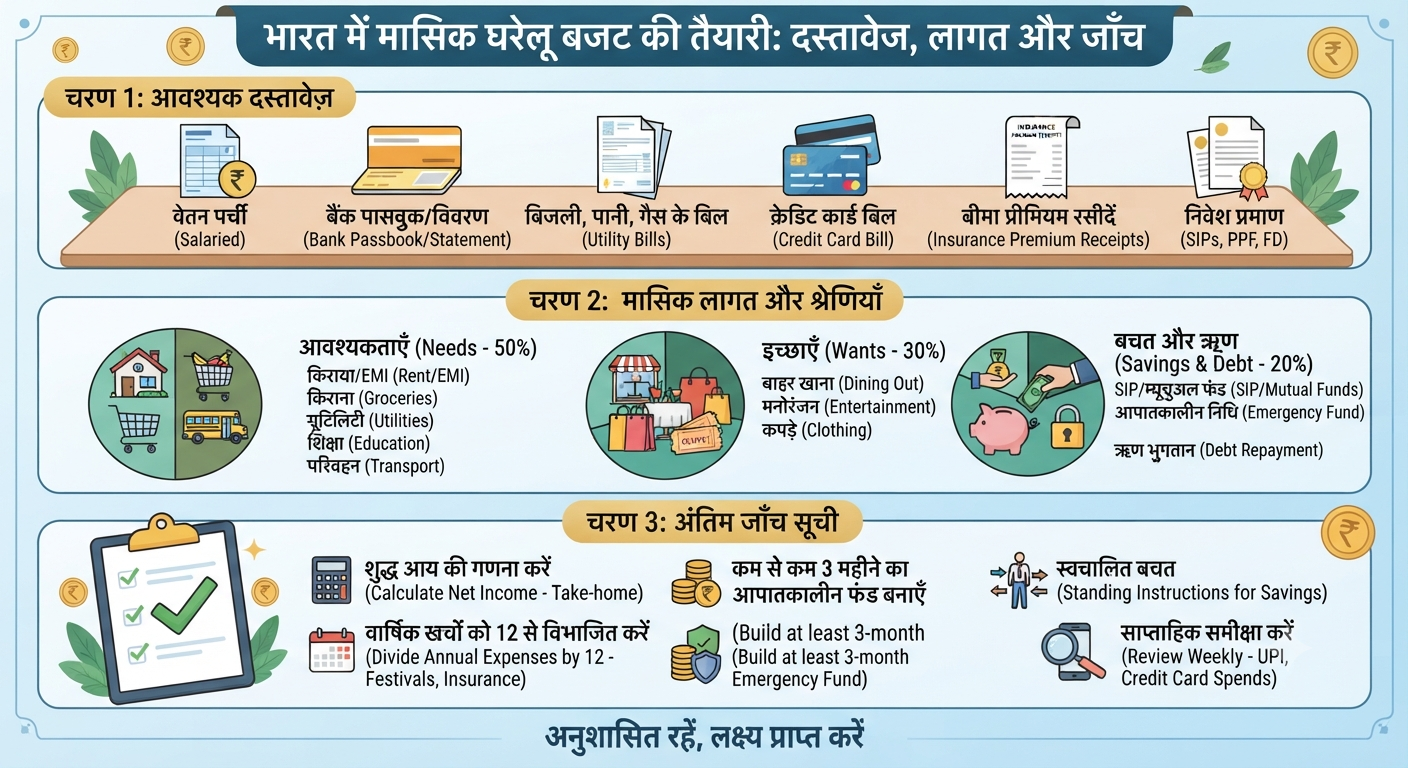
A monthly household budget is an essential financial planning tool that helps individuals and families understand their income, expenses, savings and financial commitments. Before preparing a household budget in India, it is important to gather relevant financial documents, calculate regular and irregular expenses, and review existing obligations.
Whether you are salaried, self-employed, managing a family, or planning to apply for a loan, understanding your monthly household finances can help you make better financial decisions.
The Reserve Bank of India (RBI) recommends budgeting as a way to plan future income and expenses, control spending and increase savings.
1. What Documents Are Needed Before Preparing a Monthly Household Budget?
A monthly household budget does not require any mandatory official documentation. However, keeping a few financial records ready can make budgeting easier and more accurate.
Income Proof or Income Records
Salary slips, bank statements, business income records, pension details, rental income records or other sources of income.
Utility and Household Bills
Electricity, water, gas, mobile, internet and other regular bills to understand monthly fixed expenses.
Expense Receipts and Records
Grocery bills, fuel receipts, shopping expenses, medical bills and other household spending records.
Loan and Credit Statements
Existing loan EMI details, credit card statements, repayment schedules and other financial commitments.
Savings and Investment Records
Bank savings, recurring deposits, investments, emergency funds and savings goals.
Documents checklist
These records are useful for budgeting purposes. They are not a mandatory document list for creating a household budget.
2. Costs to Consider Before Preparing a Monthly Household Budget
Before creating a budget, identify all costs that your household pays every month and expenses that may occur occasionally throughout the year.
Monthly household expense categories
|
Expense category |
Examples |
|---|---|
|
Housing |
Rent, maintenance, home loan EMI |
|
Food |
Groceries, milk, vegetables, cooking essentials |
|
Utilities |
Electricity, water, gas, internet |
|
Transportation |
Fuel, bus, metro, cab, vehicle maintenance |
|
Education |
Tuition, school fees, books, stationery |
|
Healthcare |
Medicines, consultations, health-related expenses |
|
Debt repayment |
Personal loan EMI, credit card dues, other loans |
|
Insurance |
Health, life and other applicable premiums |
|
Personal expenses |
Clothing, entertainment, shopping |
|
Savings |
Emergency fund, recurring savings, investments |
|
Irregular expenses |
Festivals, repairs, travel, annual renewals |
The RBI's household income assessment methodology also considers regular monthly expenses and irregular expenses over the previous year, including medical costs, household goods, renovation and functions.
Example: Monthly household budget for ₹40,000 income
The following is an illustrative example of how a household may divide its monthly income.
|
Expense |
Amount |
|---|---|
|
Rent |
₹8,000 |
|
Groceries |
₹6,000 |
|
Electricity, water and gas |
₹1,500 |
|
Transport and fuel |
₹2,500 |
|
Education |
₹3,000 |
|
Medical expenses |
₹1,000 |
|
Existing loan EMI |
₹4,000 |
|
Mobile and internet |
₹1,000 |
|
Personal and miscellaneous expenses |
₹3,000 |
|
Total expenses |
₹30,000 |
|
Remaining income |
₹10,000 |
The remaining ₹10,000 may be used for savings, emergency funds, future expenses or other financial goals. This example is not a recommended fixed allocation; actual spending depends on family size, location and responsibilities.
3. Checks to Perform Before Creating a Monthly Household Budget
A proper financial review helps ensure that your budget reflects your real financial situation rather than estimates alone.
Check 1: Verify your actual monthly income
Calculate your take-home salary or average income after applicable deductions. For self-employed individuals, consider income variations across different months.
Check 2: Review your household size
Consider how many family members depend on the household income, including children, elderly parents or other dependants.
Check 3: Identify fixed expenses
Separate essential monthly costs such as rent, groceries, school fees, utilities, insurance and existing EMIs.
Check 4: Check irregular expenses
Review the previous 12 months for expenses such as medical emergencies, festivals, home repairs, vehicle servicing, travel and annual premiums.
Check 5: Review existing loan commitments
Calculate the total EMI amount for all active loans and check your credit card repayment commitments. Avoid overlooking smaller EMIs or recurring obligations.
Check 6: Check available savings
Identify how much money is already available for emergencies and whether you are regularly saving a portion of your income.
Check 7: Set realistic spending limits
Set practical limits for shopping, dining, entertainment and other non-essential expenses without compromising essential needs.
Check 8: Review your financial goals
Consider short-term goals such as paying bills and building an emergency fund, along with long-term goals such as education, buying a home or retirement.
4. Eligibility for a Monthly Household Budget in India
There is no specific eligibility requirement, minimum income limit or official approval needed to create a monthly household budget.
Anyone can prepare a budget, regardless of their financial background.
|
Profile |
How budgeting can help |
|---|---|
|
Salaried employees |
Manage salary, bills and monthly savings |
|
Self-employed individuals |
Plan for irregular income and business fluctuations |
|
Homemakers |
Manage household expenses and family spending |
|
Newly married couples |
Plan shared income, expenses and financial goals |
|
Students |
Manage pocket money, education costs and daily expenses |
|
Retired individuals |
Manage pension, medical costs and regular spending |
|
Families with dependants |
Prioritise education, healthcare and essential needs |
|
Loan borrowers |
Track EMIs and understand repayment affordability |
A household budget can be created using a notebook, spreadsheet, budgeting app or bank transaction records. No paid service is necessary.
5. Important Financial Checks Before Taking a Loan
If you are preparing a household budget before applying for a personal loan or other credit, pay special attention to your disposable income.
Calculate your available monthly income
Before applying for any loan, consider:
-
Whether your income is stable.
-
Whether you have enough money for essential household expenses.
-
Whether existing loan EMIs are manageable.
-
Whether you can handle the proposed EMI without sacrificing essential needs.
-
Whether you have emergency savings.
-
Whether the loan interest rate, fees, tenure and repayment terms are clear.
-
Whether you can repay without taking another loan.
The RBI's financial inclusion strategy highlights realistic financial planning, sustainable borrowing and avoiding over-indebtedness as important aspects of household financial wellbeing.
Note: Household budgeting is a personal financial management tool. It does not guarantee loan approval or establish a lender's eligibility criteria.
6. Common Mistakes to Avoid
|
Mistake |
How to avoid it |
|---|---|
|
Estimating expenses without checking records |
Review bank statements and receipts |
|
Ignoring small purchases |
Track daily spending |
|
Forgetting annual expenses |
Include annual costs in monthly planning |
|
Using gross salary |
Budget using actual take-home income |
|
Ignoring existing EMIs |
Include all repayment commitments |
|
Spending the entire salary |
Plan savings and emergency funds in advance |
|
Setting unrealistic limits |
Use practical spending targets |
|
Not reviewing the budget |
Check actual spending every month |
|
Borrowing to cover regular overspending |
Identify the expense gap and address it before borrowing |
7. Step-by-Step Guide to Preparing a Household Budget
01
Collect financial records
Gather income details, bills, receipts, bank statements and EMI information.
02
Calculate total income
Record the total monthly income of the household, including additional sources.
03
List expenses
Categorise essential, discretionary, recurring and irregular expenses.
04
Calculate the balance
Subtract expenses and existing repayment commitments from total income.
05
Allocate savings
Set a realistic savings target based on your household's financial position.
06
Review and adjust
Compare actual expenses with the budget at the end of each month and update it.
8. Frequently Asked Questions (FAQs)
1. What documents are required for a monthly household budget?
Income records, bank statements, utility bills, grocery receipts, loan statements, school fee details and savings records are useful. However, no official documents are mandatory for creating a personal household budget.
2. Is there any fee for creating a monthly household budget?
No. You can prepare a household budget free of cost using a notebook, spreadsheet or simple calculator.
3. What costs should be included in a monthly household budget?
Include rent, groceries, electricity, water, transport, education, healthcare, insurance, loan EMIs, personal spending, savings and irregular expenses.
4. Who can create a household budget in India?
Anyone can create one, including salaried employees, self-employed individuals, homemakers, students, pensioners and families.
5. Is a bank statement required for household budgeting?
No. Bank statements are not compulsory, but they can help verify income, identify expenses and review spending patterns.
6. Should annual expenses be included in a monthly budget?
Yes. Annual expenses such as insurance premiums, school-related costs, vehicle servicing, festivals and home repairs should be planned in advance.
7. Can a household budget help with loan eligibility?
A household budget can help you understand your repayment capacity and existing financial commitments. However, lenders determine loan eligibility based on their own criteria and verification process.
8. How much should a family save every month?
There is no fixed amount suitable for every family. Savings should be based on actual income, essential expenses, debts, dependants and financial goals.
9. What checks should be done before preparing a household budget?
Review income stability, family size, monthly bills, existing EMIs, irregular expenses, savings, financial goals and spending habits.
10. What happens when household expenses exceed income?
Review non-essential expenses, identify the causes of the shortfall, adjust spending and consider ways to improve income. Avoid relying on new borrowing to cover recurring expenses.
11. Is a monthly household budget useful for self-employed people?
Yes. It can help self-employed people manage fluctuating income, plan expenses for lower-income months and maintain a financial buffer.
12. How often should a monthly household budget be updated?
Review it at least once a month and update it whenever income, household responsibilities, expenses or financial commitments change.
Published on : 25th November 2026
Published by : Avinash S
www.vizzve.com || www.vizzveservices.com
Follow us on social media: Facebook || Linkedin || Instagram
🛡 Powered by Vizzve Financial
RBI-Registered Loan Partner | 10 Lakh+ Customers | ₹600 Cr+ Disbursed