

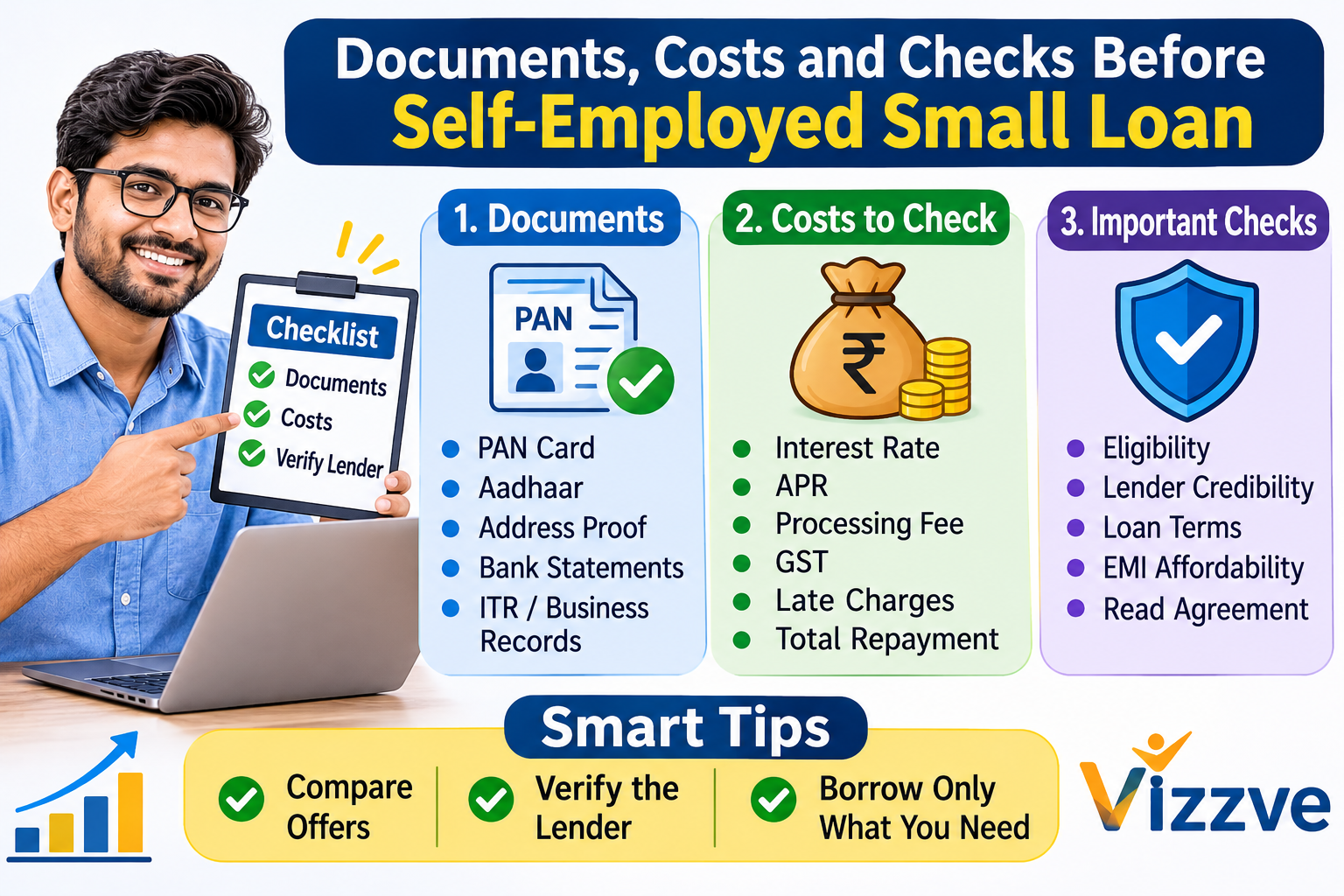
Before applying for a self-employed small loan, check your eligibility, income documentation, credit history, lender credibility and repayment capacity. Commonly requested documents include PAN, identity and address proof, bank statements, income tax returns and business records where applicable. Compare the interest rate, APR, processing fees, applicable taxes, late-payment charges and total repayment amount. Read the Key Facts Statement (KFS) and loan agreement carefully, verify the lender and make sure the EMI fits your income pattern.
1. Introduction
Self-employed individuals often have different financial requirements from salaried employees. Freelancers, small business owners, shopkeepers, consultants and independent professionals may need funds for business expenses, equipment, emergencies or personal financial commitments.
However, before applying for a small loan, understanding the required documents, total borrowing costs and lender verification process is essential.
Incomplete documents, hidden charges, unaffordable EMIs or unverified lending apps can create financial difficulties.
This guide explains the important documents, costs and checks to complete before applying for a self-employed small loan in India.
2. What is a self-employed small loan?
A self-employed small loan is a relatively small loan offered to eligible individuals who earn through independent business activities, freelancing, professional services or self-employment.
Potential applicants include:
-
Freelancers and consultants
-
Small shop owners
-
Independent professionals
-
Business owners
-
Online sellers
-
Traders and service providers
Depending on the loan product, funds may be intended for personal or eligible business purposes.
Approval, loan amount, interest rate and documentation depend on the lender's policies and the applicant's financial profile.
3. Documents required for a self-employed small loan
Documentation helps lenders understand your identity, income, business activity and repayment capacity.
Essential documents
|
Document |
Purpose |
|---|---|
|
PAN card |
Financial and identity verification |
|
Aadhaar or accepted identity proof |
Identity verification |
|
Address proof |
Residential address verification |
|
Bank statements |
Understanding income and cash flow |
|
Income Tax Returns (ITR) |
Assessing declared income |
|
Business registration documents |
Supporting business activity, where applicable |
|
GST returns |
Business information, where applicable |
|
Financial statements |
Reviewing business performance, if requested |
Why are bank statements important?
Bank statements may help lenders evaluate:
-
Regular income deposits
-
Business transaction patterns
-
Monthly cash flow
-
Existing EMI payments
-
Financial commitments
-
Available funds for repayment
For self-employed borrowers, bank statements may be particularly useful when income changes from month to month.
Why are ITRs important?
Income tax returns may help demonstrate declared income and financial activity over a period of time.
Accurate and consistent records can make the income-verification process easier. However, the documents accepted differ across lenders.
4. Costs to check before applying
A small loan may involve several charges in addition to interest.
|
Cost |
Explanation |
|---|---|
|
Interest rate |
Cost charged for borrowing |
|
APR |
Annualised cost of credit, useful for comparison |
|
Processing fee |
Application or loan processing charge |
|
GST |
Applicable taxes on relevant fees |
|
Late-payment charges |
Charges that may apply to overdue payments |
|
Bounce charges |
Charges that may apply to failed payment attempts |
|
Prepayment charges |
Conditions or charges for early repayment, if applicable |
|
EMI |
Scheduled monthly repayment |
Important: Always compare the total repayment amount rather than choosing a loan based only on the advertised interest rate.
5. Understand interest rate, APR and EMI
Before accepting a loan offer, understand these three important terms.
Interest rate
The interest rate is the amount charged by the lender for borrowing money. It may be fixed or structured according to the loan agreement.
APR (Annual Percentage Rate)
APR helps borrowers understand the annualised cost of credit, including certain associated charges. It can help compare different loan offers more effectively than the interest rate alone.
EMI (Equated Monthly Instalment)
EMI is the scheduled amount you pay each month towards the loan, generally covering principal and interest.
Illustrative example
Suppose a self-employed borrower applies for a ₹40,000 small loan.
|
Particular |
Illustrative value |
|---|---|
|
Loan amount |
₹40,000 |
|
Interest rate |
18% annually |
|
Tenure |
12 months |
|
Estimated EMI |
₹3,668 |
|
Estimated total repayment |
₹44,016 |
|
Estimated interest |
₹4,016 |
Illustrative reducing-balance calculation only. Actual EMI, interest, fees and taxes depend on the lender's offer and repayment terms.
Before accepting, calculate whether you can comfortably pay ₹3,668 every month, including during periods when your income may be lower.
6. Eligibility checks before applying
Lenders may review the following factors:
|
Factor |
What you should check |
|---|---|
|
Age |
Meet the lender's minimum and maximum age requirements |
|
Income |
Is your income sufficient to repay the proposed EMI? |
|
Business activity |
Can you demonstrate your self-employed activity? |
|
Credit score |
Review your credit history and report |
|
Existing EMIs |
Calculate your current monthly obligations |
|
Bank statements |
Ensure income and transaction records are accurate |
|
Loan amount |
Borrow an amount appropriate to your requirement |
Eligibility criteria are not the same for every bank or NBFC. Meeting the basic criteria does not guarantee loan approval.
7. Important lender verification checks
Before sharing personal documents or accepting a loan, verify the lender carefully.
Check the actual lending institution
Confirm whether the loan is offered by a bank or NBFC and identify the actual lender named in the loan documents.
Verify the loan app or website
Use the lender's official website or authorised application channel. Do not rely only on advertisements, SMS links or social media promotions.
Review the Key Facts Statement (KFS)
The KFS should clearly explain important loan terms, costs and repayment details, as applicable.
Check customer support
Confirm that the lender provides accessible customer support and complaint-handling information.
Review privacy permissions
Understand what personal information is collected and how it is used. Avoid giving unnecessary access to contacts, photos or other sensitive information.
Avoid suspicious offers
Be cautious if someone:
-
Guarantees loan approval without checks.
-
Demands an upfront payment to release a loan.
-
Requests OTPs or banking passwords.
-
Pressures you to accept immediately.
-
Sends loan links from unknown numbers.
-
Provides unclear interest rates or charges.
8. Loan comparison checklist
Before deciding between lenders, compare these details:
|
Comparison factor |
Lender A |
Lender B |
|---|---|---|
|
Loan amount offered |
Check |
Check |
|
Interest rate |
Check |
Check |
|
APR |
Check |
Check |
|
Processing fee |
Check |
Check |
|
EMI |
Check |
Check |
|
Total repayment |
Check |
Check |
|
Tenure |
Check |
Check |
|
Late charges |
Check |
Check |
|
Prepayment conditions |
Check |
Check |
|
Customer support |
Check |
Check |
Choose the loan with terms that suit your repayment capacity, not necessarily the loan with the largest approved amount.
9. Common mistakes borrowers should avoid
Self-employed borrowers should avoid these mistakes before applying:
-
Submitting incomplete or incorrect documents.
-
Borrowing more than they actually need.
-
Ignoring processing fees and other charges.
-
Choosing a lender only because it promises quick approval.
-
Not checking their credit report.
-
Ignoring existing EMIs and business expenses.
-
Accepting a loan without reading the agreement.
-
Sharing sensitive information through unofficial channels.
-
Assuming their income will remain the same every month.
-
Applying to multiple lenders without comparing their terms.
10. How to prepare financially before taking a loan
A few simple financial habits can help you make a safer borrowing decision.
Maintain an income record: Keep bank statements, business receipts and tax documents organised.
Calculate your monthly obligations: Include household expenses, business expenses, existing EMIs and the proposed new EMI.
Maintain an emergency reserve: Set aside money for unexpected expenses or periods of lower income, if possible.
Choose an affordable EMI: Your repayment should not depend entirely on your best earning month.
Compare loan offers: Review interest rates, APR, fees, tenure and total repayment.
Read the agreement: Understand the conditions before accepting the loan.
11. Borrower safety checklist
Before you apply
12. Frequently asked questions (FAQs)
1. What documents are required for a self-employed small loan?
Common documents include PAN, identity and address proof, bank statements, ITRs and business-related records where required.
2. Is a salary slip required for self-employed borrowers?
Usually not. Self-employed applicants may use bank statements, ITRs, GST returns or other accepted income records.
3. Can I apply for a small loan without GST registration?
Some self-employed applicants may qualify without GST registration, depending on the lender, business type and loan product.
4. Why do lenders ask for bank statements?
Bank statements help lenders understand income patterns, cash flow, financial commitments and repayment capacity.
5. What is the processing fee for a small loan?
Processing fees vary by lender and loan product. Check the amount, applicable taxes and whether it is deducted from the disbursed amount.
6. What is APR in a small loan?
APR is an annualised measure of borrowing cost that helps compare loan offers beyond the headline interest rate.
7. How can I calculate my EMI before applying?
You can use an EMI calculator by entering the loan amount, interest rate and tenure. Compare the result with your actual income and expenses.
8. Can irregular income affect loan approval?
Yes. Lenders may consider income stability, average earnings, bank statements and overall repayment capacity.
9. How do I verify a genuine loan app?
Check the actual lender, official website, authorised app details, loan agreement, KFS and complaint-handling channels. Avoid suspicious links and advance-fee demands.
10. Can I repay a loan early?
Early repayment depends on the loan agreement and applicable prepayment conditions or charges.
11. What happens if I miss an EMI?
You may face applicable overdue charges, and missed payments may negatively affect your credit history if reported. Contact the lender early if you expect difficulty.
12. How much loan should I take?
Borrow only the amount required and ensure that the EMI remains affordable after considering your essential expenses, business expenses and existing debts.
13. Is collateral required for a self-employed small loan?
Some products are unsecured, while others may require collateral or a guarantee. Review the specific loan conditions.
14. Can I use a small personal loan for business purposes?
That depends on the loan agreement and permitted usage. If you need funds for your business, compare suitable business-finance products too.
15. What is the most important check before taking a small loan?
Verify the lender, understand the total borrowing cost and confirm that you can comfortably repay the loan.
13. Key takeaways
-
Keep your identity, income and business documents ready.
-
Understand the interest rate, APR, processing fees and other charges.
-
Check your credit profile and existing financial commitments.
-
Verify the lender before submitting personal information.
-
Read the KFS and loan agreement carefully.
-
Compare different loan offers before making a decision.
-
Borrow only what you need and can repay comfortably.
14. Expert insights: Responsible borrowing
Self-employed individuals often experience fluctuations in income. Therefore, loan planning should consider not only average monthly earnings but also slower business periods.
A responsible borrowing approach includes maintaining accurate financial records, avoiding excessive debt, setting aside funds for upcoming EMIs and understanding the complete loan agreement.
A small loan can be useful when managed carefully, but an unaffordable EMI can create unnecessary financial pressure.
Conclusion
Before applying for a self-employed small loan, prepare your documents, calculate the complete borrowing cost and carefully verify the lender.
Understanding eligibility, APR, fees, EMI and repayment terms can help freelancers, business owners and independent professionals make more informed financial decisions.
A well-planned loan should meet your financial requirement while keeping repayments manageable.
Published on : 25th November
Published by : Siva Nagaiah K
www.vizzve.com || www.vizzveservices.com
Follow us on social media: Facebook || Linkedin || Instagram
🛡 Powered by Vizzve Financial
RBI-Registered Loan Partner | 10 Lakh+ Customers | ₹600 Cr+ Disbursed