

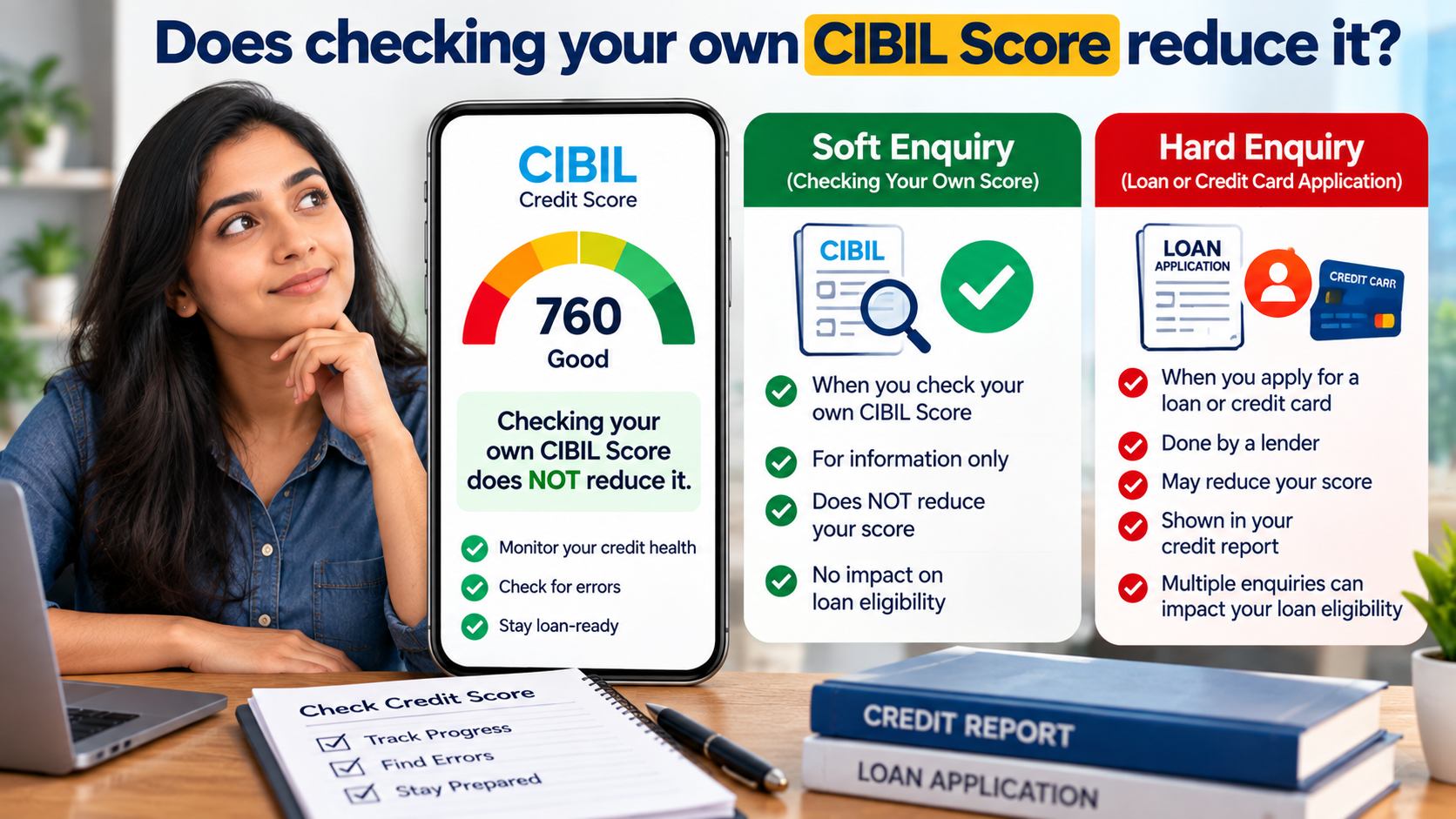
Many people hesitate to check their CIBIL Score because they believe that checking it frequently can reduce their credit score. This misconception can prevent borrowers from monitoring their credit health and identifying errors in their credit reports.
But is it true that checking your own CIBIL Score lowers it?
No. Checking your own CIBIL Score does not reduce it. When you check your own score through CIBIL, it is treated differently from a credit enquiry made by a lender when you apply for a loan or credit card.
Understanding the difference between soft enquiries and hard enquiries can help you monitor your credit profile without unnecessary worry.
What Is a CIBIL Score?
A CIBIL Score is a three-digit number that represents your credit history and helps lenders assess your creditworthiness.
It is based on information in your credit report, such as your loan accounts, credit card accounts, repayment history, and credit enquiries.
Lenders may consider your CIBIL Score when evaluating applications for:
- Personal loans
- Home loans
- Car loans
- Credit cards
- Other credit facilities
A higher score can support your loan application, but it does not guarantee approval. Lenders may also consider your income, existing EMIs, employment details, repayment capacity, and internal eligibility criteria.
Does Checking Your Own CIBIL Score Affect It?
No. Checking your own CIBIL Score does not lower it.
When you access your own score for information, it is generally treated as a soft enquiry or a self-check. It does not have the same impact as a lender enquiry associated with a credit application.
You can check your score to:
- Understand your current credit profile.
- Track changes over time.
- Identify incorrect loan or credit card details.
- Check whether your repayments are reported correctly.
- Look for unfamiliar credit enquiries or accounts.
- Prepare before applying for a new loan.
TransUnion CIBIL also recommends reviewing your credit report periodically to stay informed about your credit health.
What Is the Difference Between a Soft Enquiry and a Hard Enquiry?
The difference between soft and hard enquiries is important when understanding how credit checks work.
| Feature | Soft Enquiry | Hard Enquiry |
|---|---|---|
| Common example | Checking your own credit score | Applying for a loan or credit card |
| Main purpose | Reviewing credit information | Assessing a credit application |
| Effect on score | Does not reduce your score | May affect your score |
| Usually linked to a new credit application | No | Yes |
| Should you be concerned? | No score impact from the check itself | Avoid unnecessary applications |
1. Soft Enquiry
A soft enquiry occurs when your credit information is checked for informational or other purposes that do not involve a formal application for new credit.
Examples may include:
- Checking your own CIBIL Score.
- Reviewing your credit report.
- Certain pre-approved or pre-qualification checks, depending on the provider and process.
A soft enquiry does not reduce your credit score.
2. Hard Enquiry
A hard enquiry may occur when you formally apply for a loan or credit card and the lender checks your credit report as part of its assessment.
Examples include:
- Applying for a personal loan.
- Applying for a home loan.
- Applying for a new credit card.
- Applying for another credit facility that requires a credit check.
A hard enquiry may affect your credit score. The impact is not necessarily the same for every borrower.
Does Checking Your CIBIL Score Every Month Reduce It?
No. Checking your own CIBIL Score every month does not reduce it.
Regular monitoring can help you understand how your credit profile changes over time. It can also help you identify incorrect information before you apply for a loan.
For example, if you check your score in January and again in February, the act of checking it does not cause a score reduction.
If your score changes between those months, the reason may be related to information in your credit profile, such as:
- A missed EMI or credit card payment.
- A change in credit card utilisation.
- A new loan or credit card account.
- A lender's credit enquiry.
- An update to your repayment history.
- A correction to previously reported information.
The exact reason for a change should be checked against your credit report.
How Often Should You Check Your CIBIL Score?
There is no need to avoid checking your score out of fear that it will go down.
You may check it periodically, particularly before applying for a major loan or credit card.
A practical monitoring routine is:
| When to Check | Why It Helps |
|---|---|
| Every few months | Track your overall credit health |
| Before applying for a loan | Understand your current credit profile |
| After repaying a loan | Check whether the account is updated correctly |
| After disputing an error | Confirm whether the correction appears |
| When you notice unusual activity | Investigate unfamiliar accounts or enquiries |
TransUnion CIBIL offers consumers one free CIBIL Score and Report every calendar year through its official website. Additional services may be available through paid plans.
You can check the current details at the official CIBIL website.
How to Check Your CIBIL Score Safely
Follow these steps to check your score.
Step 1: Visit the Official CIBIL Website
Go to the official TransUnion CIBIL website: https://www.cibil.com/
Step 2: Find the Free CIBIL Score and Report Option
Review the available options for accessing your score and report.
Step 3: Register or Log In
Enter the information requested by the official website and complete the verification process.
Step 4: Access Your Score and Report
Review your score along with the account and enquiry details available in your report.
Step 5: Check for Errors
Look for incorrect personal details, unfamiliar accounts, inaccurate outstanding balances, or enquiries you do not recognise.
Safety tip: Use official websites or trusted providers. Never share your OTP, password, or banking PIN with someone claiming they can improve your CIBIL Score.
Does Checking Your CIBIL Score Through a Bank or App Reduce It?
Checking your credit score through a bank or financial app does not necessarily reduce it. The effect depends on the type of check being performed.
A score-checking feature may allow you to view your credit profile without making a formal credit application. However, if you proceed to apply for a loan or credit card, the lender may conduct a hard enquiry.
Before continuing, check whether the service is simply displaying your score or submitting a credit application.
Remember: Viewing your score and applying for new credit are two different activities.
Why Does Your CIBIL Score Decrease?
If your score decreases after you check it, do not immediately assume that the check caused the reduction.
Review your credit report for changes that may explain it.
1. Missed or Late EMI Payments
Missing loan EMIs or paying them late can negatively affect your credit profile.
2. High Credit Card Utilisation
Using a large portion of your available credit limit may affect your score.
3. Multiple Credit Applications
Applying for several loans or credit cards within a short period can result in multiple lender enquiries.
4. Incorrect Credit Report Information
An error in your account details, payment history, or outstanding balance may affect your credit profile.
5. Changes in Your Credit Accounts
Opening, closing, or changing credit accounts can affect the information used to calculate your score.
The effect of each factor depends on your overall credit history and the scoring model.
How to Improve Your CIBIL Score
If your score is lower than expected, focus on responsible credit management rather than avoiding credit checks.
Pay EMIs and Credit Card Bills on Time
Make payments by their due dates. Consider setting reminders or using automatic payments where appropriate.
Keep Credit Utilisation Under Control
Avoid using an unnecessarily high percentage of your available credit limit.
Avoid Unnecessary Loan Applications
Apply for credit when you genuinely need it. Multiple applications can result in multiple hard enquiries.
Review Your Credit Report
Check your account information, repayment history, and enquiries regularly.
Dispute Incorrect Information
If you find an error, contact the lender and raise a dispute with the credit bureau when necessary.
Maintain Consistent Financial Habits
Building a healthy credit profile takes time. There is no guaranteed method to increase your score by a fixed number of points within a specific period.
Common Myths About Checking Your CIBIL Score
| Myth | Fact |
|---|---|
| Checking my own score lowers it | Your own score check does not reduce it |
| Checking it monthly is harmful | Regular self-checks do not reduce your score |
| Every credit enquiry has the same impact | The type and circumstances of the enquiry matter |
| A high CIBIL Score guarantees loan approval | Lenders consider other eligibility factors |
| Paying for a credit score improves it | Paying to view a score does not itself improve it |
What Should You Do If You Find an Unknown Enquiry?
If your credit report shows an enquiry that you do not recognise, investigate it rather than ignoring it.
- Check the enquiry date and the lender's name.
- Review whether you recently applied for a loan or credit card.
- Contact the lender if you cannot identify the enquiry.
- Raise a dispute with TransUnion CIBIL if the enquiry appears incorrect.
- Keep the complaint reference and supporting documents.
An unfamiliar enquiry does not automatically prove fraud, but it is worth checking. TransUnion CIBIL provides an enquiry-related support process on its official website.
Key Takeaways
- Checking your own CIBIL Score does not reduce it.
- A self-check is different from a lender's credit enquiry.
- A hard enquiry associated with a credit application may affect your score.
- Regular credit report checks can help identify errors and unfamiliar activity.
- TransUnion CIBIL offers one free score and report each calendar year.
- If your score falls, review your report for changes rather than blaming the act of checking.
- Avoid unnecessary credit applications and maintain timely repayments.
Frequently Asked Questions (FAQs)
1. Does checking your own CIBIL Score reduce it?
No. Checking your own CIBIL Score does not reduce it. TransUnion CIBIL confirms that checking your own score and report has no impact on your score.
2. Can I check my CIBIL Score every month?
Yes. You can check your score periodically. Checking your own score does not reduce it.
3. How many times can I check my CIBIL Score for free?
TransUnion CIBIL offers one free CIBIL Score and Report every calendar year. Other services or additional reports may have different charges.
4. What is a soft enquiry in CIBIL?
A soft enquiry is a credit check that does not affect your credit score. Checking your own score is an example.
5. What is a hard enquiry?
A hard enquiry may occur when a lender checks your credit report after you apply for a loan or credit card. It may affect your score.
6. Does checking my CIBIL Score through a bank app reduce it?
Not necessarily. A score-viewing feature generally differs from a formal credit application. Check whether the app is only displaying your score or initiating a credit application.
7. Why did my CIBIL Score decrease after I checked it?
The timing may be coincidental. Review your credit report for changes in payment history, credit utilisation, lender enquiries, account information, or other reported details.
8. Does checking my CIBIL Score affect loan eligibility?
Checking your own score does not reduce it. However, lenders may consider your score, repayment history, income, existing EMIs, and other eligibility factors when assessing an application.
9. Does checking my CIBIL Score affect my credit history?
Checking your own score does not negatively affect your credit history. A lender enquiry associated with a credit application may be recorded in your report.
10. Is it safe to check my CIBIL Score online?
Yes, when you use the official CIBIL website or a trusted provider and protect your personal information. Never share your OTP, password, or banking PIN with unauthorised people.
11. Does checking my CIBIL Score on a third-party website affect it?
A score-checking service may use a soft enquiry, but the process can vary. Check the provider's terms and confirm whether you are only viewing your score or applying for credit.
12. Can I improve my CIBIL Score by checking it regularly?
Checking your score does not directly increase it. However, monitoring your report can help you identify errors and make informed decisions that support better credit habits.
13. Does checking my score before applying for a personal loan help?
Yes. Reviewing your score and report can help you understand your credit profile before applying. It does not guarantee approval.
14. What should I do if I see an unknown credit enquiry?
Check the enquiry details, contact the lender, and raise a dispute with TransUnion CIBIL if the information is incorrect.
15. Does checking my CIBIL Score through the official website cost money?
TransUnion CIBIL offers one free CIBIL Score and Report every calendar year. Check its official website for current eligibility and any additional paid services.
Conclusion
Checking your own CIBIL Score is a useful financial habit, not something you need to avoid.
Your own CIBIL Score check does not reduce your score. The important distinction is between reviewing your credit profile and applying for new credit, which may lead to a lender enquiry.
Check your report periodically, keep your repayment history accurate, and investigate unfamiliar activity. These steps can help you stay informed about your credit health and prepare for future borrowing.
Published on : 26th September 2026
Published by : Shibam Nath
www.vizzve.com || www.vizzveservices.com
Follow us on social media: Facebook || Linkedin || Instagram
🛡 Powered by Vizzve Financial
RBI-Registered Loan Partner | 10 Lakh+ Customers | ₹600 Cr+ Disbursed