

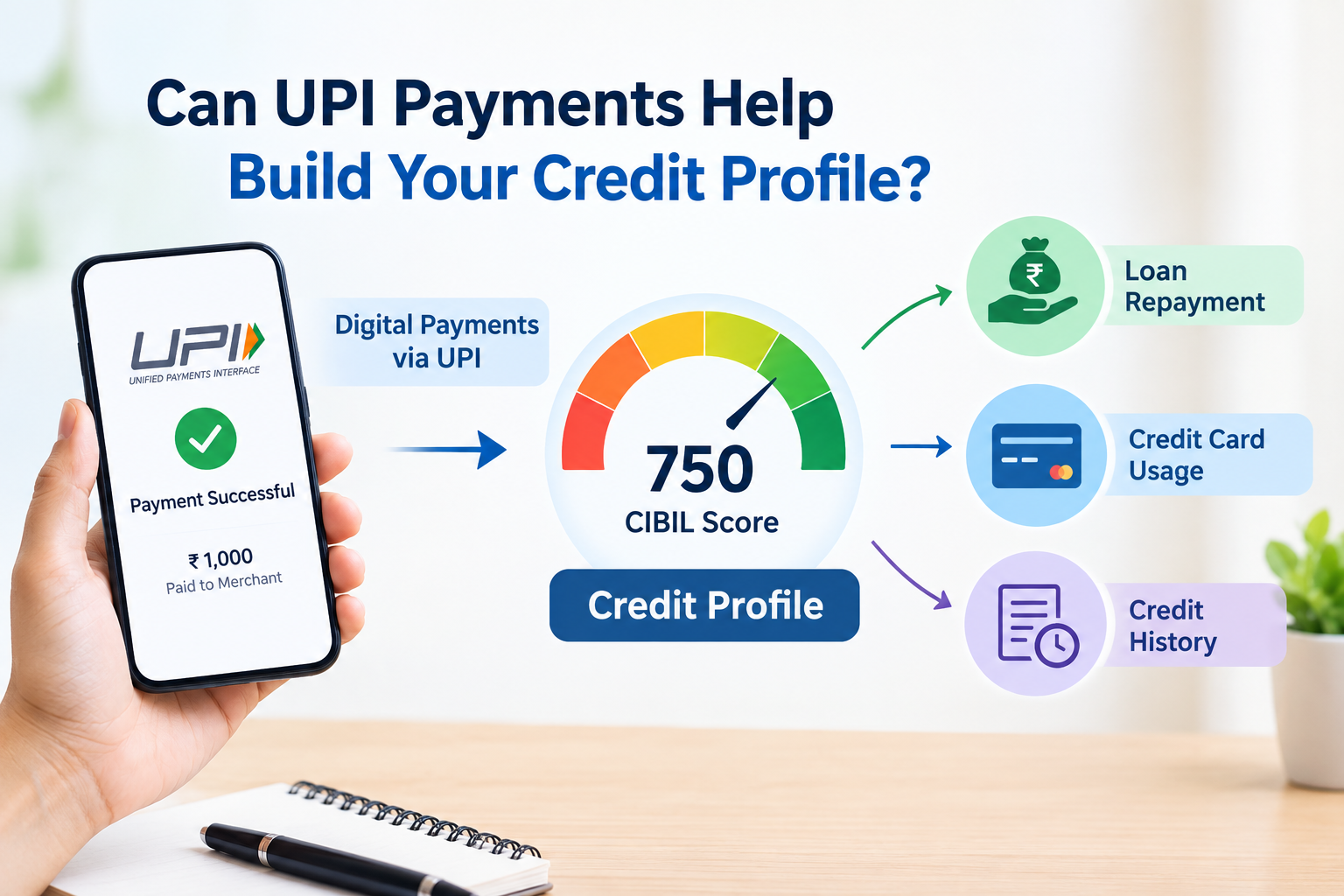
Unified Payments Interface (UPI) has changed how people in India pay for everyday purchases. From buying groceries and paying utility bills to sending money to family, UPI makes digital payments quick and convenient.
But an increasingly common question among borrowers is: Can UPI payments help build your credit profile or improve your CIBIL Score?
The answer is important: ordinary UPI transactions generally do not directly build your credit score. A UPI payment is usually a transaction from your bank account, while a credit profile is built from information related to loans, credit cards and other credit facilities reported by lenders.
However, UPI can still be connected to your credit journey when you use it to repay a loan, credit card or other eligible credit facility.
What Is a Credit Profile?
Your credit profile is a record of how you have handled borrowed money.
It can include information about:
- Personal loans
- Home loans
- Vehicle loans
- Credit cards
- Other reported credit facilities
- Outstanding balances
- Repayment history
- Credit enquiries
- Account status
Credit bureaus use information supplied by lenders to create credit reports and scores.
For example, TransUnion CIBIL says its score is a three-digit summary of an individual's credit history. The underlying credit report contains information about credit accounts and repayment behaviour.
This means your UPI transaction history and credit history are two different things.
Do Normal UPI Payments Increase Your CIBIL Score?
Generally, no.
Imagine that you use UPI every day to pay:
- ₹800 for groceries
- ₹1,500 for electricity
- ₹400 for food
- ₹2,000 for online shopping
- ₹500 for transportation
These transactions show regular digital payment activity, but they generally do not create a credit account.
You are usually paying with money already available in your bank account.
UPI Payment
Your bank account → UPI → Merchant
Credit Transaction
Lender → Credit facility → Borrower → Repayment → Credit reporting
The second process is what can contribute to your credit history when the lender reports the account and repayment information.
Can Paying a Loan Through UPI Help Your Credit Profile?
This is where UPI can become relevant.
Suppose you have a personal loan and your monthly EMI is ₹8,000. You use UPI to make the repayment.
The fact that you used UPI is not what builds the credit history.
Instead, the important factors are:
- You have an actual credit account.
- The lender reports the account to a credit bureau.
- You make repayments according to the agreed schedule.
- Your repayment information is reported correctly.
So, UPI can be the payment channel, while the underlying loan repayment behaviour is what matters for your credit profile.
What Actually Helps Build a Credit Profile?
If you want to establish a credit history, focus on responsible credit management rather than simply increasing your UPI transactions.
1. Pay Credit Obligations on Time
Payment history is an important part of credit assessment.
Missing loan EMIs or delaying credit-card payments can negatively affect your credit profile if the overdue information is reported.
Set reminders or use automatic payment arrangements where appropriate to avoid accidentally missing due dates.
2. Keep Credit Utilisation Under Control
Credit utilisation refers to how much of your available revolving credit you are using.
For example, if your credit-card limit is ₹1,00,000 and your outstanding balance is ₹20,000, your utilisation is 20%.
High utilisation over time may indicate greater dependence on available credit.
3. Avoid Too Many Credit Applications
Every time you apply for credit, a lender may make a credit enquiry.
Making multiple applications within a short period can result in several enquiries appearing on your credit report.
Therefore, compare loan terms before submitting multiple applications.
4. Maintain a Healthy Credit History
The age of your credit accounts can also matter.
A longer history of responsibly managed credit can provide lenders with more information about your repayment behaviour.
5. Check Your Credit Report
Checking your credit report periodically can help identify:
- Incorrect personal details
- Accounts you do not recognise
- Wrong outstanding balances
- Incorrect overdue information
- Unauthorised credit enquiries
If you find an error, contact the relevant lender or credit bureau for correction.
UPI and Credit Cards: What Is the Connection?
UPI can sometimes be used to make payments related to credit products.
For example, you may pay your credit-card bill through a UPI-enabled payment option.
In this situation:
Credit card → Outstanding balance → UPI payment → Bill repayment
The credit-building aspect comes from managing the credit card responsibly, rather than from the UPI transaction itself.
Paying your credit-card bill on time can help maintain responsible repayment behaviour.
Can UPI Help First-Time Borrowers Build Credit?
If you have never taken a loan or used a reported credit product, regularly using UPI does not generally create a traditional credit history.
A person can make hundreds of UPI transactions without having a conventional credit account.
For someone who is new to credit, the more important question is whether they actually need a credit product and can comfortably repay it.
If you choose to use credit, consider:
- The interest rate
- Processing fees
- Repayment schedule
- Total repayment amount
- Late-payment charges
- Credit reporting practices
- Your ability to repay
Do not take a loan simply because you want to create a credit score.
Borrowing creates a financial obligation and should be based on a genuine need and affordable repayment capacity.
Does Paying Bills Through UPI Build Credit?
This is one of the biggest misconceptions.
Electricity Bill
Paying an electricity bill through UPI generally does not create a credit account.
Mobile Recharge
Paying your mobile bill through UPI generally does not create a credit history.
Grocery Purchase
Paying a grocery store through UPI does not normally affect your CIBIL Score.
Credit Card Bill
Paying a credit-card bill through UPI can be part of responsible credit management because the underlying credit-card account is relevant to your credit history.
Loan EMI
Paying a loan EMI through UPI can also be part of responsible repayment of a reported credit account.
UPI Payment vs Credit Activity
| Activity | Credit Profile Impact |
|---|---|
| Paying for groceries with UPI | Generally no direct impact |
| Sending money through UPI | Generally no direct impact |
| Paying electricity bill with UPI | Generally no direct impact |
| Paying a credit-card bill through UPI | Credit-card repayment may be reported |
| Paying a loan EMI through UPI | Loan repayment may be reported |
| Missing a loan EMI | May negatively affect credit history |
| Making multiple loan applications | May create multiple credit enquiries |
| Maintaining manageable credit utilisation | Can support healthy credit behaviour |
The key distinction is simple: UPI is a payment method, not a replacement for a credit history.
Can UPI Usage Help You Get a Loan?
Regular UPI usage does not guarantee loan approval.
A lender may consider several factors when evaluating an application, including:
- Credit history
- Income
- Employment or business profile
- Existing loans
- EMI obligations
- Requested loan amount
- Repayment capacity
- KYC information
- Bank and financial information
- Internal lending policies
Therefore, having a large number of UPI transactions does not automatically mean that you will qualify for a personal loan.
What About UPI-Based Credit Products?
The relationship between UPI and credit has become more important as credit facilities can be used through digital payment ecosystems.
But borrowers should understand the difference between:
UPI payment account
and
Credit facility linked to a payment system
A credit facility creates a borrowing obligation. Depending on the product and lender, information about that credit facility may be reported to credit information companies.
Before using any credit-linked UPI product, check:
- Actual lender
- Interest rate
- APR or total borrowing cost
- Processing charges
- Late-payment charges
- Repayment date
- Credit reporting
- Terms and conditions
- Privacy and data permissions
Do not assume that every UPI-based credit product will affect your credit score in the same way.
Common Myths About UPI and Credit Scores
Myth 1: More UPI Transactions Mean a Higher CIBIL Score
Reality: The number of ordinary UPI transactions does not automatically increase your CIBIL Score.
Myth 2: Paying Every Bill Through UPI Builds Credit
Reality: Normal utility and shopping payments generally do not create credit history.
Myth 3: UPI Is a Credit Product
Reality: UPI is a digital payment system. Credit products can be offered or used within payment ecosystems, but they are not the same thing.
Myth 4: Paying a Loan EMI Through UPI Does Nothing for Credit
Reality: The underlying loan repayment can be relevant to your credit history if the lender reports it.
Myth 5: Frequent UPI Usage Guarantees a Loan
Reality: Loan approval depends on the lender's eligibility and credit assessment, not simply on UPI usage.
How to Build Credit Responsibly in India
If your goal is to develop a stronger credit profile, follow these practical habits.
Pay on Time
Never intentionally delay loan EMIs or credit-card payments.
Borrow Within Your Capacity
Choose a loan amount and EMI that you can realistically afford.
Avoid Unnecessary Loans
Taking debt solely to create credit history can increase your financial burden.
Monitor Your Credit Report
Check your credit information periodically for errors or suspicious accounts.
Keep Your Information Updated
Make sure your PAN, address, phone number and other details are correctly reflected with your lenders.
Limit Unnecessary Applications
Compare available offers before applying to multiple lenders.
Read the Loan Agreement
Understand interest rates, fees, repayment dates and other terms before accepting credit.
Key Takeaways
- Regular UPI payments generally do not directly build your CIBIL Score.
- UPI is primarily a payment method.
- Credit profiles are built from reported credit accounts and repayment behaviour.
- Paying a loan EMI through UPI may be part of responsible credit management.
- Paying a credit-card bill through UPI can help you manage an existing credit obligation.
- Timely repayments are important for maintaining healthy credit behaviour.
- Excessive credit utilisation and unnecessary credit applications should be avoided.
- UPI transaction volume does not guarantee loan approval.
- Never borrow money simply to increase your credit score.
- Always check the lender, interest rate, fees and credit-reporting terms before using a credit product.
Frequently Asked Questions
1. Can UPI payments increase my CIBIL Score?
Normal UPI payments generally do not directly increase your CIBIL Score. Credit scores are based primarily on reported credit information and repayment behaviour.
2. Does paying a loan EMI through UPI build credit?
The underlying loan repayment may contribute to your credit history if the lender reports the credit account and repayment information to a credit bureau.
3. Does UPI transaction history appear on a CIBIL report?
Ordinary UPI transaction history is different from the credit-account information contained in a CIBIL report.
4. Can UPI help someone with no credit history?
UPI usage alone generally does not create a traditional credit history. A suitable credit product that is reported to a bureau can establish credit history when responsibly managed.
5. Does paying a credit-card bill through UPI improve CIBIL?
The timely repayment of the credit-card account can be relevant to your credit profile. UPI is simply the method used to make the payment.
6. Does paying electricity bills through UPI increase credit score?
Generally, no. Normal utility payments do not usually create a reported credit account.
7. Can frequent UPI transactions improve loan eligibility?
Not automatically. Lenders consider multiple factors such as credit history, income, existing obligations and repayment capacity.
8. Can a missed UPI payment reduce my credit score?
A failed ordinary UPI payment does not automatically reduce your credit score. The situation is different if the payment relates to a credit obligation that becomes overdue and is reported.
9. Should I take a loan to build my credit score?
Not necessarily. Taking unnecessary debt can create interest costs and repayment obligations. Credit should generally be used only when needed and affordable.
10. How can I improve my credit profile?
Pay existing credit obligations on time, maintain manageable credit utilisation, avoid unnecessary credit applications and regularly check your credit report.
Final Conclusion
UPI payments and credit-building are related, but they are not the same thing.
Using UPI to pay for everyday expenses does not normally build your credit profile. However, UPI can be used to repay loans or credit-card bills, where the underlying credit account and repayment behaviour may be reported to credit bureaus.
If your goal is to maintain a healthy credit profile, focus on responsible borrowing, timely repayments, manageable debt and regular credit-report checks—not simply on making more UPI transactions.
Financial disclaimer: Credit reporting can vary depending on the lender and financial product. Always check the terms of the specific credit facility and information provided by the lender or credit bureau.
Published on : 28th September 2026
Published by : shibam nath
www.vizzve.com || www.vizzveservices.com
Follow us on social media: Facebook || Linkedin || Instagram
🛡 Powered by Vizzve Financial
RBI-Registered Loan Partner | 10 Lakh+ Customers | ₹600 Cr+ Disbursed