

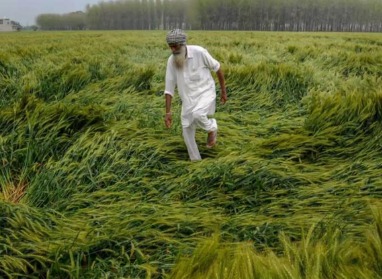
Farmers across Madhya Pradesh are reeling under a double shock — first, the spell of unseasonal rain that has damaged standing crops, and now, a power supply cap that threatens to derail irrigation and sowing activities.
What began as optimism for a promising rabi season has quickly turned into worry and frustration, as erratic weather and power restrictions strike back-to-back at the state’s agricultural heartland.
Unseasonal Rainfall Wreaks Havoc
Over the past week, several districts — including Sehore, Vidisha, Hoshangabad, Betul, and Narsinghpur — witnessed unexpected rainfall and hailstorms. The showers have caused damage to crops such as:
🌾 Wheat and gram, now at the flowering stage.
🌿 Soybean and mustard, which had just been harvested or stored.
🥦 Vegetables, leading to heavy losses for small and marginal farmers.
In low-lying areas, waterlogging has destroyed large patches of farmland, while the moisture has delayed fresh sowing in other regions.
For many farmers, the unseasonal rains have not only affected yield but also increased post-harvest losses — particularly for crops stored in open yards.
Power Supply Cap Adds to Woes
Just as the rain started to ease, farmers were hit by another blow — restricted electricity supply for agricultural pumps. The state government recently announced that due to increased demand and limited power generation, farmers will receive power supply for irrigation only for a few hours daily.
This power rationing comes at the worst possible time — when irrigation is crucial for rabi crops. Many farmers rely on electric water pumps to sustain crops after the monsoon season.
With irregular electricity schedules, irrigation timing and crop planning have become nearly impossible to manage. Farmers in several districts report that they’re forced to water their fields at night or miss crucial irrigation cycles altogether.
Farmers’ Reactions
Anger and disappointment are growing among farmers. Many say the back-to-back challenges have left them with little hope for recovery this season.
“The rain ruined half our crop, and now the government has reduced power hours. How will we save what’s left?” said one farmer from Narsinghpur district.
Small-scale farmers, already burdened by debt and input costs, say they fear lower yields and financial stress. Many depend on short-term credit or loans, and consecutive losses could push them further into crisis.
Government’s Response
The Madhya Pradesh Energy Department has cited rising power demand and limited availability as reasons for the supply restrictions. The state claims to be taking measures to ensure balanced distribution among domestic, industrial, and agricultural users.
Officials have assured that additional power purchases and load management steps are being planned, but farmers say that immediate relief is needed.
The Agriculture Department has also been asked to assess crop damage due to unseasonal rains and submit reports for possible compensation or insurance claims under government schemes.
Impact on Agricultural Output
The twin crises — erratic weather and restricted power — could significantly affect Madhya Pradesh’s rabi production, especially of wheat, gram, and lentils.
Experts warn that:
A delay in irrigation at this stage can reduce yield by up to 20–30%.
Storage losses may rise due to increased humidity and moisture.
Power cuts could slow down seed preparation and sowing in areas still recovering from rainfall.
If the disruptions persist, the ripple effects could also impact food prices and supply chains in the coming months.
A Call for Sustainable Solutions
The crisis has reignited debates about the need for renewable and decentralized power solutions in agriculture. Experts suggest promoting:
Solar-powered irrigation pumps to reduce dependency on grid electricity.
Micro-irrigation systems (like drip irrigation) for efficient water use.
Climate-resilient farming practices to cope with weather shocks.
While short-term relief is essential, long-term resilience will depend on policy changes that integrate energy security with agriculture planning.
Conclusion
For Madhya Pradesh’s farmers, this season has become a painful reminder of how vulnerable agriculture remains to both climate variability and infrastructural constraints.
As unseasonal rains and limited power supply converge to create a crisis, immediate support and sustainable reforms are crucial to protect the livelihoods of thousands of farmers.
Until then, the fields of Madhya Pradesh stand as symbols of both resilience and struggle — bearing the weight of nature’s unpredictability and systemic shortcomings.
FAQs
Q1. Why has Madhya Pradesh restricted power supply to farmers?
Due to rising power demand and limited generation, the government has capped electricity supply for agricultural use to a few hours daily.
Q2. Which crops were most affected by unseasonal rains?
Wheat, gram, mustard, and vegetables suffered major losses due to unexpected rainfall and hailstorms.
Q3. How are farmers coping with the crisis?
Farmers are struggling to maintain irrigation schedules, with many facing crop damage, delayed sowing, and increased costs.
Q4. Is the government providing compensation?
The Agriculture Department has been instructed to assess crop damage for potential compensation or insurance claims.
Q5. What can help prevent such crises in the future?
Investing in solar irrigation, micro-irrigation systems, and weather-based planning can make agriculture more resilient.
Published on : 6th November
Published by : SMITA
www.vizzve.com || www.vizzveservices.com
Follow us on social media: Facebook || Linkedin || Instagram
🛡 Powered by Vizzve Financial
RBI-Registered Loan Partner | 10 Lakh+ Customers | ₹600 Cr+ Disbursed