

Introduction
The Direct Selling Agent (DSA) model is an important part of loan distribution in India.
Banks, NBFCs and other financial institutions can use intermediary and outsourcing arrangements to expand their customer reach. A DSA may help source prospective borrowers, explain basic product information, collect permissible application details and coordinate with the lender.
In return, an eligible DSA may receive a commission or payout for qualifying business according to the agreement with the lender.
But there is an important point that every new loan agent should understand:
There is no single standard DSA commission rate in India.
A payout can differ according to:
- Lender
- Loan product
- Customer profile
- Loan amount
- Disbursal status
- Source channel
- Monthly business volume
- Agreement terms
- Campaign incentives
- Clawback conditions
- Compliance performance
RBI materials expressly recognize commission paid to Direct Selling Agents/Direct Marketing Agents as part of certain bank outsourcing arrangements. RBI also states that outsourcing does not remove the regulated entity's responsibility for the actions of its service providers.
That makes the DSA business both a sales opportunity and a responsibility.
This complete guide explains how DSA commission works, how payouts can be calculated, what affects earnings, what a DSA agreement should contain, how clawbacks work, and what loan agents should know about customer protection and compliance.
AI Answer Box: What Is DSA Commission in India?
What is DSA commission?
DSA commission is compensation paid by a lender to an eligible Direct Selling Agent for qualifying loan-sourcing or related activities under a contractual arrangement.
A DSA may help a lender with activities such as:
- Finding prospective borrowers
- Generating loan leads
- Explaining basic product information
- Supporting application submission
- Coordinating documentation
- Following up with customers
- Coordinating with the lender's processing team
The lender remains responsible for the applicable credit decision and regulated outsourcing obligations.
RBI has recognized DSA/DMA commission as part of outsourcing arrangements and requires banks to maintain appropriate policies and oversight for outsourced activities.
Important: There is no universal DSA commission percentage applicable to every lender or loan product. Any percentage used in this article as an example is hypothetical unless specifically identified as an official lender rate.
What Does DSA Mean?
DSA commonly stands for Direct Selling Agent in the loan-distribution industry.
A DSA works with a financial institution to help source potential customers for eligible financial products.
The DSA generally does not become the lender.
Simple example
A customer wants a personal loan.
The customer approaches a DSA.
The DSA:
- Explains the basic product.
- Collects the required application information through permitted processes.
- Submits or facilitates the application.
- Coordinates with the lender.
- The lender evaluates the application.
- If approved, the lender disburses the loan.
- If the DSA meets the applicable payout conditions, the lender pays the agreed commission.
The DSA cannot independently guarantee that the lender will approve the application.
How Does DSA Commission Work in India?
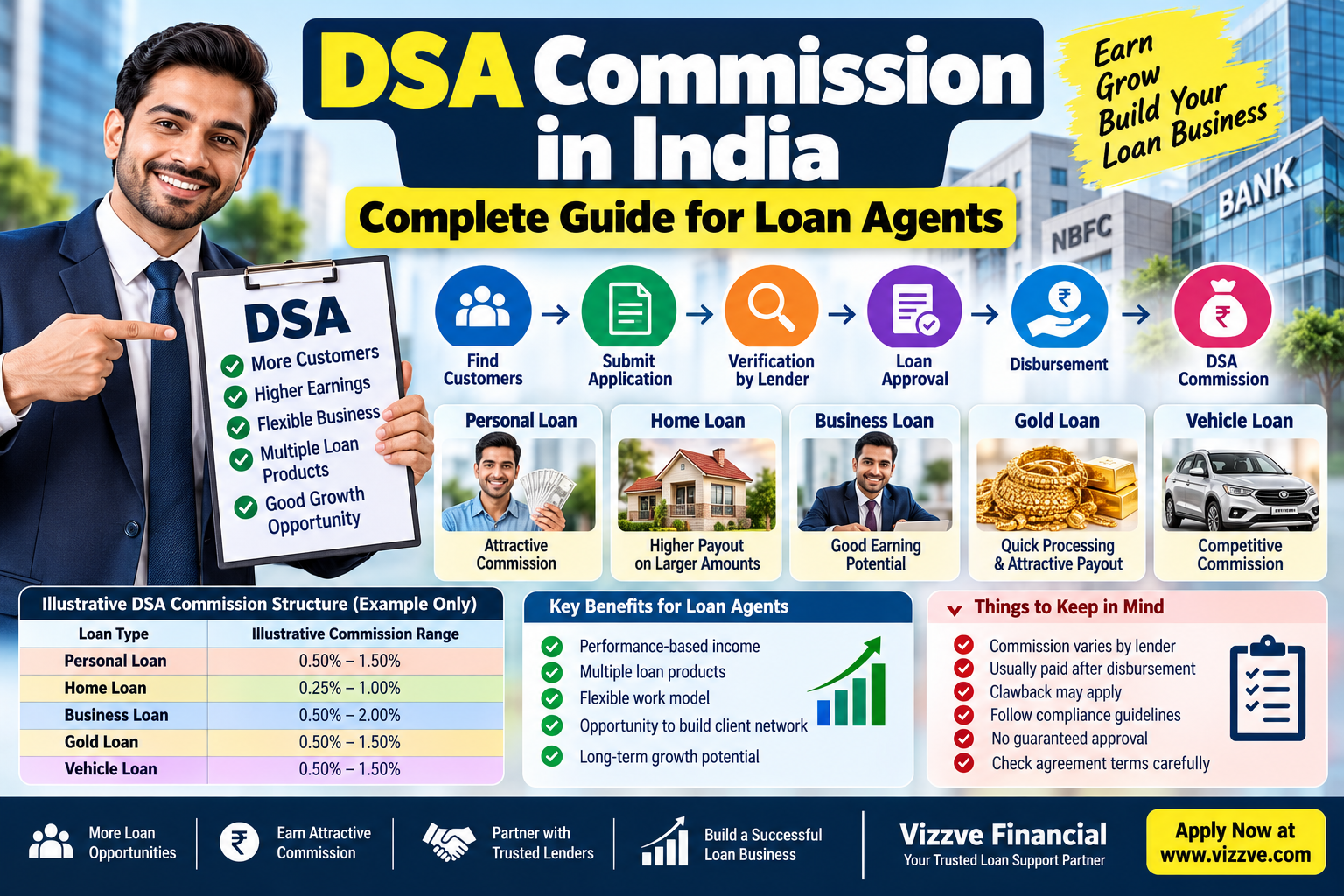
The basic DSA commission cycle can be understood as:
Lead → Application → Verification → Approval → Disbursement → Payout Eligibility → Commission
However, the exact process varies from lender to lender.
Step 1: Lead Generation
The DSA identifies a prospective customer who may be interested in a financial product.
Possible sources include:
- Direct enquiries
- Digital campaigns
- Referrals
- Existing business networks
- Customer references
- Authorized marketing channels
The DSA should use lawful and permitted methods to acquire leads.
Step 2: Customer Eligibility
The prospective borrower is informed about the relevant product and eligibility requirements.
The DSA should avoid making unsupported promises such as:
- "100% approval"
- "Guaranteed loan"
- "No credit check"
- "Guaranteed lowest rate"
Final credit decisions belong to the lender.
Step 3: Application Submission
The customer's application is submitted through the lender's approved process.
Depending on the product, documentation may include:
- Identity information
- Address information
- Income details
- Employment information
- Bank statements
- Business documents
- Other lender-specific information
The exact documentation varies by loan type and borrower.
Step 4: Lender Verification
The lender conducts its own assessment.
This can include:
- KYC
- Credit history
- Income verification
- Employment verification
- Banking information
- Existing obligations
- Internal credit policy
- Fraud and risk checks
The DSA should not interfere with the lender's credit decision.
Step 5: Approval and Disbursement
If the lender approves the application and the customer completes the required documentation, the loan can be disbursed.
For many DSA arrangements, disbursement is a key condition for commission eligibility.
Step 6: Commission Calculation
The lender determines the payout according to the DSA agreement.
Possible models include:
- Percentage of disbursed amount
- Fixed payout per successful case
- Tiered payout
- Product-specific payout
- Monthly incentive
- Volume-based incentive
Step 7: Payout
The eligible commission is credited or paid according to the lender's agreed payout cycle.
The payout may be subject to:
- Verification
- Documentation
- Customer cancellation
- Early closure
- Fraud checks
- Clawback provisions
- Compliance review
- Tax deductions where applicable
Is There a Standard DSA Commission Rate in India?
No single DSA commission rate applies across the Indian lending industry.
This is one of the most important points for new loan agents.
A personal-loan DSA working with one lender may have a completely different payout structure from a DSA sourcing home loans for another lender.
Why do rates differ?
Because lenders consider:
- Product economics
- Acquisition costs
- Loan size
- Customer segment
- Risk profile
- Sales channel
- Competition
- Processing costs
- Expected business volume
- DSA performance
- Portfolio quality
Therefore, websites that publish one number as "the standard DSA commission in India" can be misleading.
A better approach is to examine the specific lender's DSA agreement or official partner terms.
Illustrative DSA Commission Calculation
Suppose a lender has a hypothetical agreement providing:
0.75% commission on qualifying disbursed loan amounts.
A DSA sources a qualifying loan of:
₹5,00,000
Illustrative commission:
₹5,00,000 × 0.75% = ₹3,750
This is only a mathematical example.
It does not mean every lender pays 0.75%.
DSA Commission Calculation: More Examples
Example 1: Personal Loan
Hypothetical loan amount:
₹3,00,000
Illustrative commission:
1%
Calculation:
₹3,00,000 × 1% = ₹3,000
Example 2: Multiple Loans
Suppose a DSA generates five qualifying loans:
| Loan | Amount |
|---|---|
| Customer A | ₹2,00,000 |
| Customer B | ₹3,00,000 |
| Customer C | ₹4,00,000 |
| Customer D | ₹5,00,000 |
| Customer E | ₹6,00,000 |
| Total | ₹20,00,000 |
At an illustrative commission rate of 0.75%:
₹20,00,000 × 0.75% = ₹15,000
Tiered DSA Commission Structure
Some commercial arrangements may use performance-based tiers.
For example, a hypothetical structure could look like this:
| Monthly Qualifying Disbursement | Illustrative Rate |
|---|---|
| Up to ₹5 lakh | 0.50% |
| ₹5 lakh–₹10 lakh | 0.75% |
| ₹10 lakh–₹25 lakh | 1.00% |
| Above ₹25 lakh | 1.25% |
These percentages are examples only.
Actual rates should always be obtained directly from the relevant lender or authorized partner program.
What Factors Affect DSA Commission?
Several factors can influence the payout structure.
1. Loan Product
Personal loans, home loans, business loans and vehicle loans can have different economics.
2. Loan Amount
Some lenders may structure payouts according to disbursed volume.
3. Customer Segment
Different customer categories can have different acquisition economics.
4. Loan Tenure
The lender's product economics can vary with tenure.
5. Business Volume
Higher qualifying business may be linked to incentive tiers under some agreements.
6. Portfolio Quality
A lender may consider cancellations, early closures, fraud and other portfolio-quality indicators.
7. Source Channel
Digital, branch, referral and partner channels can have different commercial structures.
8. Product Campaigns
Temporary promotional incentives may change the payout for particular products or periods.
DSA Commission vs Loan Processing Fee
These two terms should not be confused.
| DSA Commission | Loan Processing Fee |
|---|---|
| Paid to an eligible intermediary under an arrangement | Customer-facing loan charge where applicable |
| Linked to sourcing/distribution | Linked to loan processing/service |
| Usually governed by partner agreement | Disclosed under applicable loan documentation |
| Not automatically a borrower charge | May be payable by borrower |
| Can be percentage-based or fixed | Usually specified by lender |
For digital lending, RBI's framework requires fees or charges payable to Lending Service Providers in the credit-intermediation process to be paid by the regulated entity and not directly by the borrower. RBI also requires disclosure of the all-inclusive cost of credit through the applicable framework.
DSA Commission vs Loan Interest
These are completely different.
Loan Interest
Interest is the cost the borrower pays for borrowing money.
DSA Commission
DSA commission is compensation paid under the intermediary's commercial arrangement for qualifying sourcing/distribution activity.
A DSA should never tell a borrower that the DSA commission and loan interest are the same thing.
DSA Commission vs Referral Commission
A referral partner may simply introduce a potential customer.
A DSA may have a broader sourcing and coordination role.
| DSA | Referral Partner |
|---|---|
| May source and facilitate applications | Usually introduces a lead |
| Often has a formal lender agreement | May operate under referral terms |
| May handle permitted customer coordination | Usually limited involvement |
| Payout can depend on disbursement | Payout may depend on qualifying referral |
| Compliance obligations can be broader | Depends on the arrangement |
The precise distinction depends on the lender's contractual structure.
DSA Commission for Personal Loans
Personal loans are a major category in loan distribution.
A DSA may source customers interested in:
- Personal loans
- Debt consolidation
- Medical expenses
- Education expenses
- Household expenses
- Other permitted personal requirements
What can influence personal-loan DSA payouts?
- Loan amount
- Customer profile
- Lender
- Disbursal
- Product
- Business volume
- Campaign
- Agreement terms
Important
A DSA should explain the lender's actual terms accurately.
The DSA should not promise:
- Guaranteed approval
- Guaranteed rate
- Guaranteed amount
- Guaranteed disbursement date
DSA Commission for Home Loans
Home loans can have a different distribution model because:
- Loan amounts are usually larger.
- Documentation is more extensive.
- Property verification is required.
- Legal and technical checks may apply.
- Processing can take longer.
A DSA may help source prospective borrowers and coordinate documentation, but the lender performs the required credit and property evaluation.
Common home-loan customer segments
- Salaried employees
- Self-employed professionals
- Business owners
- First-time homebuyers
- Property purchasers
- Home-construction borrowers
DSA Commission for Business Loans
Business-loan sourcing can require additional documentation.
A lender may examine:
- Business vintage
- Turnover
- Banking activity
- Financial statements
- GST information where applicable
- Existing liabilities
- Credit history
- Business profile
A DSA may help coordinate the application, but underwriting remains the lender's responsibility.
DSA Commission for Gold Loans
Gold loans are secured loans where eligible gold collateral is pledged to the lender.
A DSA arrangement, where offered, can involve sourcing eligible customers.
However, the lender remains responsible for:
- Customer verification
- Gold valuation
- Loan-to-value assessment
- Documentation
- Loan approval
- Collateral custody
- Repayment and applicable processes
DSA commission should not be confused with the interest or other charges applicable to the borrower.
Bank DSA vs NBFC DSA
Both banks and NBFCs can use intermediary or outsourcing arrangements, but their products and commercial structures can differ.
| Feature | Bank DSA | NBFC DSA |
|---|---|---|
| Principal institution | Bank | NBFC |
| Products | Depends on bank | Depends on NBFC |
| Payout | Institution-specific | Institution-specific |
| Credit policy | Bank's policy | NBFC's policy |
| Documentation | Product-dependent | Product-dependent |
| Commission | Contract-specific | Contract-specific |
| Compliance | Applicable banking framework | Applicable NBFC framework |
RBI's outsourcing framework emphasizes that regulated entities remain responsible for outsourced activities and should have appropriate due diligence, monitoring and risk-management systems.
What Is DSA Clawback?
A clawback means that a previously paid commission may be reversed or recovered when the conditions specified in the agreement are triggered.
For example, a lender might contractually provide for a clawback if:
- A loan is cancelled under specified conditions.
- Disbursement is reversed.
- Fraud is identified.
- Documentation is found to be invalid.
- The customer defaults within a specified period, if the contract provides for such treatment.
- The DSA violates applicable terms.
- A qualifying transaction is subsequently found ineligible.
The exact clawback rules must come from the DSA agreement.
Example
Suppose:
- Commission paid = ₹5,000
- Contractual clawback = 50%
Potential recovery:
₹5,000 × 50% = ₹2,500
Again, this is an illustration.
Why Clawback Matters for Loan Agents
A new DSA may look only at gross commission.
Experienced agents also track:
Gross Commission − Clawbacks − Business Expenses = Net Earnings
For example:
| Particular | Amount |
|---|---|
| Gross commission | ₹50,000 |
| Clawbacks | ₹5,000 |
| Travel expenses | ₹4,000 |
| Marketing expenses | ₹3,000 |
| Other costs | ₹2,000 |
| Illustrative net income | ₹36,000 |
This is why gross payout is not the same as take-home income.
How Much Can a DSA Earn in India?
There is no fixed salary or universal commission income for a DSA.
Earnings depend on:
- Number of successful applications
- Disbursal volume
- Product mix
- Commission structure
- Customer quality
- Lender relationships
- Repeat business
- Operating expenses
- Clawbacks
- Taxes
Illustrative monthly scenario
Suppose a DSA has:
- 10 qualifying loans
- Average loan size = ₹3 lakh
- Total disbursement = ₹30 lakh
- Illustrative payout = 0.75%
Gross commission:
₹30 lakh × 0.75% = ₹22,500
This is not a guaranteed earning level. It is simply an example showing how commission mathematics works.
DSA Earnings: Gross vs Net
Loan agents should calculate net earnings rather than looking only at the payout percentage.
Gross income
Money received from qualifying transactions.
Business expenses
Potential expenses may include:
- Travel
- Telephone
- Internet
- Advertising
- Staff
- Office expenses
- Lead-generation costs
- Technology
- Accounting
- Compliance
Net income
Gross commission − business expenses − applicable taxes/other costs
This is a more useful measure of business profitability.
How to Become a DSA Loan Agent in India
The exact onboarding process varies by lender.
A typical process can look like this.
Step 1: Choose Your Loan Segment
Decide whether you want to focus on:
- Personal loans
- Home loans
- Business loans
- Vehicle loans
- Gold loans
- Other lender-approved products
Step 2: Identify Lenders
Research banks, NBFCs and authorized lending platforms that have partner/DSA programs.
Step 3: Check Eligibility
The lender may examine:
- Identity
- Address
- Business details
- Experience
- PAN
- Bank account
- Business registration, where applicable
- References
- Other required information
Step 4: Complete Onboarding
The lender may conduct:
- Due diligence
- KYC
- Agreement execution
- Training
- Compliance checks
RBI materials emphasize due diligence and oversight when regulated entities use service providers.
Step 5: Receive Access to the Approved Process
This may include:
- Partner portal
- Application system
- Product information
- Sales materials
- Reporting system
Step 6: Start Sourcing
Generate leads through permitted channels.
Step 7: Track Disbursements
Maintain records of:
- Leads
- Applications
- Approvals
- Disbursements
- Commission eligibility
- Payouts
- Rejections
- Clawbacks
Documents Commonly Requested During DSA Onboarding
The exact list varies by lender.
Possible documents include:
- PAN
- Aadhaar or other permitted identity/address documents
- Bank account details
- Photograph
- Business proof
- Address proof
- GST registration where applicable
- Company incorporation documents for entities
- Cancelled cheque
- Agreement documents
- Other lender-specific documents
Do not assume that every lender requires every document on this list.
Always follow the official onboarding requirements of the institution.
DSA Agreement: What Should Loan Agents Check?
Before signing a DSA agreement, read the payout section carefully.
Check these points:
1. Commission Rate
What is the applicable rate?
2. Payout Basis
Is it calculated on:
- Sanctioned amount?
- Disbursed amount?
- Net disbursed amount?
- Eligible business volume?
3. Payout Date
When is commission paid?
4. Clawback
Under what conditions can commission be reversed?
5. GST and Tax Treatment
Understand applicable invoicing and tax obligations.
6. Customer Ownership
Who owns the customer relationship?
7. Data Handling
How should customer data be collected, stored and shared?
8. Compliance
What conduct is prohibited?
9. Termination
What happens when the agreement ends?
10. Dispute Resolution
What is the process for resolving payout disputes?
DSA Commission and Customer Data
Customer information is one of the most sensitive parts of loan distribution.
A DSA may encounter:
- Name
- Phone number
- Address
- Identity information
- Income information
- Employment details
- Banking information
- Credit-related information
RBI's digital-lending guidance emphasizes need-based data collection, explicit borrower consent, audit trails and privacy controls.
Good practice for DSAs
- Collect only permitted information.
- Use authorized systems.
- Do not sell customer data.
- Do not share customer information casually.
- Do not store unnecessary documents on personal devices.
- Follow the lender's privacy and security requirements.
- Obtain required customer consent.
DSA Compliance: What Loan Agents Should Never Do
Commission should never become the reason for poor customer treatment.
A DSA should avoid:
- Misrepresenting loan terms
- Falsifying documents
- Creating fake applications
- Hiding charges
- Promising guaranteed approval
- Misusing customer data
- Pressuring customers
- Misrepresenting the lender
- Collecting unauthorized fees
- Making false claims about interest rates
- Using fake lender logos
- Creating misleading advertisements
RBI has emphasized that outsourcing does not remove the regulated entity's responsibility and that customer protection and data privacy remain important when service providers are used.
Can a DSA Charge Customers Directly?
A DSA should not assume that it can charge a borrower simply because it is generating a loan lead.
The answer depends on the product, lender arrangement and applicable regulations.
For digital lending specifically, RBI states that fees and charges payable to LSPs in the credit-intermediation process must be paid by the regulated entity rather than directly by the borrower.
Therefore, a DSA working with digital lending products should pay particular attention to:
- KFS
- APR
- Lender-approved charges
- Customer disclosures
- LSP arrangements
- Authorized payment channels
Never collect an unofficial "approval fee" from a borrower.
DSA Commission and Taxation
Commission income can have tax implications.
A DSA operating as:
- Individual
- Proprietorship
- Partnership
- LLP
- Company
may have different accounting and tax considerations.
Depending on circumstances, the agent may need to consider:
- Income-tax treatment
- GST registration/applicability
- Invoicing
- TDS
- Business expenses
- Accounting records
Because tax treatment depends on the DSA's legal structure and turnover, agents should verify their position with a qualified tax professional.
DSA Commission: Advantages
Advantages for Loan Agents
- Performance-linked earning opportunity
- Ability to build a financial-services business
- Multiple product opportunities
- Potential recurring customer relationships
- Flexible business model in some arrangements
Advantages for Lenders
- Wider customer reach
- Lower dependence on direct sales
- Local market access
- Scalable acquisition
- Distribution support
Advantages for Customers
- Easier product discovery
- Assistance with application processes
- Local support
- Help understanding basic product information
DSA Commission: Risks and Disadvantages
1. Income Is Variable
There is no guaranteed monthly commission.
2. Payout Can Be Delayed
Commission may depend on verification and disbursement.
3. Clawbacks Can Reduce Earnings
Cancelled or ineligible transactions may affect payouts.
4. Compliance Risk
Improper sales practices can damage the DSA's relationship with the lender.
5. Customer Acquisition Costs
Generating leads can require money and time.
6. Competition
Many agents may target the same customer segment.
7. Product Dependence
Changes in lender policy can affect business volume.
Pros and Cons of Becoming a DSA
| Pros | Cons |
|---|---|
| Performance-based earning | Income can fluctuate |
| Low fixed-cost model in some cases | Lead-generation costs |
| Multiple loan products | Competitive market |
| Flexible sales model | Payout may take time |
| Potential to build a customer network | Clawback risk |
| Opportunity to scale | Compliance responsibilities |
| Financial-sector experience | Customer-service pressure |
DSA vs Bank Employee
A DSA and a bank employee are not the same.
| Feature | DSA | Bank Employee |
|---|---|---|
| Relationship | External/contractual intermediary | Employee |
| Income | Usually payout/incentive based | Salary + applicable incentives |
| Employment benefits | Depends on arrangement | Depends on employer |
| Product access | Contract-specific | Employer-specific |
| Customer sourcing | Major role | Depends on job |
| Employment security | Contract-dependent | Employment terms apply |
| Compliance | Contract + applicable rules | Employer policies + regulations |
DSA vs Business Correspondent
DSA and BC should not be treated as interchangeable terms.
RBI's Business Correspondent model is a specific banking-agency framework used to extend banking and financial services. RBI describes BC activities that can include borrower identification, preliminary loan-application processing and other permitted services, and notes that BCs are generally paid a commission or fee by the bank.
A DSA, by contrast, is generally associated with loan/customer sourcing under a lender's outsourcing or distribution arrangement.
Key difference
DSA: Primarily associated with sourcing/distribution.
BC: Specific banking-agent model with a broader framework for permitted banking services.
The actual role should always be determined from the institution's agreement and applicable regulatory framework.
Real-World DSA Experience: What New Agents Often Learn
A new DSA may initially focus heavily on commission percentage.
Experienced agents usually start paying attention to other numbers:
- Lead-to-application conversion
- Application-to-sanction conversion
- Sanction-to-disbursement conversion
- Average loan size
- Payout per disbursement
- Clawback percentage
- Customer acquisition cost
- Repeat/referral business
Example
Suppose a DSA generates:
100 leads
Of those:
- 50 applications
- 25 approvals
- 20 disbursements
The key performance measure is not simply "100 leads."
The DSA should understand where customers are being lost.
This helps improve the business without resorting to misleading sales practices.
DSA Sales Funnel
A simple DSA funnel can be:
Leads
↓
Eligible Applications
↓
Verified Applications
↓
Sanctions
↓
Disbursements
↓
Commission-Eligible Cases
↓
Payout
Tracking each stage helps identify operational problems.
How to Increase DSA Commission Ethically
The goal should be to improve quality and conversion, not to pressure customers.
1. Understand the Products
Know:
- Eligibility
- Interest rates
- Fees
- Documentation
- Tenure
- Repayment
- Key exclusions
2. Target the Right Customers
Avoid sending unsuitable applications.
3. Improve Documentation Quality
Incomplete applications waste time.
4. Follow Up Professionally
Keep customers informed without making false promises.
5. Track Every Lead
Use a CRM or organized spreadsheet.
6. Reduce Rejections
Better customer-product matching can improve efficiency.
7. Build Trust
Satisfied customers can generate referrals.
8. Follow Compliance Rules
A clean business record is more sustainable than short-term sales achieved through misleading practices.
DSA Commission Tracking Template
A loan agent can maintain a simple tracking system:
| Lead ID | Product | Loan Amount | Status | Disbursed | Rate | Commission | Clawback | Net |
|---|---|---|---|---|---|---|---|---|
| 001 | Personal Loan | ₹3L | Disbursed | ₹3L | 0.75%* | ₹2,250* | ₹0 | ₹2,250* |
| 002 | Business Loan | ₹5L | Approved | — | 1%* | Pending | — | — |
| 003 | Home Loan | ₹20L | Disbursed | ₹20L | 0.50%* | ₹10,000* | ₹1,000* | ₹9,000* |
*Illustrative figures only.
This type of record can help an agent understand actual business profitability.
DSA Commission Checklist for Loan Agents
Before joining a DSA program, ask:
Commercial
- What is the payout rate?
- Is it fixed or variable?
- Is there a monthly target?
- Is there a volume incentive?
- When is payment made?
Eligibility
- What documents are required?
- Is there a background check?
- Is training mandatory?
- Is registration required with the lender?
Clawback
- When can commission be reversed?
- How long is the clawback period?
- Is there a maximum clawback?
Compliance
- What can I tell customers?
- What marketing materials are approved?
- What customer data can I collect?
- Which payment channels are authorized?
Operations
- How do I submit applications?
- Is there a partner portal?
- Who handles customer complaints?
- Who handles credit decisions?
Key Takeaways
DSA Commission in India: 12 Important Points
- DSA stands for Direct Selling Agent.
- DSAs help lenders source prospective customers and loan applications.
- DSA commission is usually based on a contractual arrangement.
- There is no universal DSA commission rate across India.
- Payouts can vary by lender, loan product and business volume.
- Disbursement is commonly an important payout condition, but the exact contract controls.
- Clawbacks can reduce previously earned commission.
- Gross commission is not the same as net income.
- DSAs should never guarantee loan approval.
- Customer data must be handled through authorized and compliant processes.
- Digital lending arrangements have specific RBI requirements around LSP charges and borrower disclosures.
- The lender remains responsible for appropriate oversight of outsourced activities.
Quick Summary Box
DSA commission in India is compensation paid to an eligible Direct Selling Agent for qualifying loan-sourcing or related activities under a lender's contractual arrangement.
There is no standard commission rate applicable to all DSAs. Payouts depend on the lender, product, loan amount, disbursement, business volume, agreement terms and other conditions.
Before joining a DSA program, carefully review the commission rate, payout basis, payment timeline, clawback rules, customer-data requirements and compliance obligations.
Frequently Asked Questions
1. What is DSA commission in India?
DSA commission is compensation paid to an eligible Direct Selling Agent for qualifying loan-sourcing or related activities under an agreement with a lender.
2. How much commission does a DSA get?
There is no universal DSA commission rate. The payout depends on the lender, loan product, loan amount, business volume, agreement and other eligibility conditions.
3. How is DSA commission calculated?
It can be calculated as a percentage of an eligible disbursed amount, a fixed payout, a tiered rate or another contractual formula.
4. Is DSA commission paid on the sanctioned amount?
Not necessarily. Many arrangements may link payout to disbursement or another qualifying event. The specific DSA agreement determines the calculation basis.
5. What is personal loan DSA commission?
Personal loan DSA commission is the payout available to an eligible DSA for qualifying personal-loan sourcing under the lender's partner arrangement.
6. What is home loan DSA commission?
Home loan DSA commission is compensation under a lender's agreement for qualifying home-loan sourcing or distribution activity.
7. What is DSA clawback?
A DSA clawback is a contractual reversal or recovery of previously paid commission when specified conditions, such as cancellation or other qualifying events, occur.
8. Can DSA commission be a fixed amount?
Yes. Depending on the lender's commercial model, a qualifying transaction may have a fixed payout rather than a percentage-based commission.
9. Can DSA commission be based on monthly targets?
Some lender agreements may include performance or volume-based incentives. The applicable agreement determines whether such targets exist.
10. Can a DSA guarantee loan approval?
No. A DSA can source or facilitate an application, but the lender makes the credit decision according to its eligibility and underwriting policies.
11. Can a DSA charge a customer for arranging a loan?
The answer depends on the product and applicable rules. DSAs should not assume they can impose charges directly. In digital lending, RBI requires fees and charges payable to LSPs in the credit-intermediation process to be paid by the regulated entity rather than directly by the borrower.
12. Is DSA commission taxable?
Commission income can have tax implications depending on the DSA's legal structure, turnover and circumstances. Professional tax advice may be appropriate.
13. What documents are needed to become a DSA?
Requirements vary by lender but can include identity and address documents, PAN, bank details, business documents and lender-specific onboarding information.
14. Is DSA the same as a Business Correspondent?
No. DSA and Business Correspondent are not automatically interchangeable. RBI's BC model is a specific banking-agency framework with defined permitted activities.
15. How can a DSA increase earnings?
A DSA can focus on accurate product knowledge, suitable customer targeting, better application quality, professional follow-up, efficient lead management, customer service and compliant sales practices.
Published on : 27th September
Published by : G REDDY KUMAR
www.vizzve.com || www.vizzveservices.com
Follow us on social media: Facebook || Linkedin || Instagram
🛡 Powered by Vizzve Financial
RBI-Registered Loan Partner | 10 Lakh+ Customers | ₹600 Cr+ Disbursed