

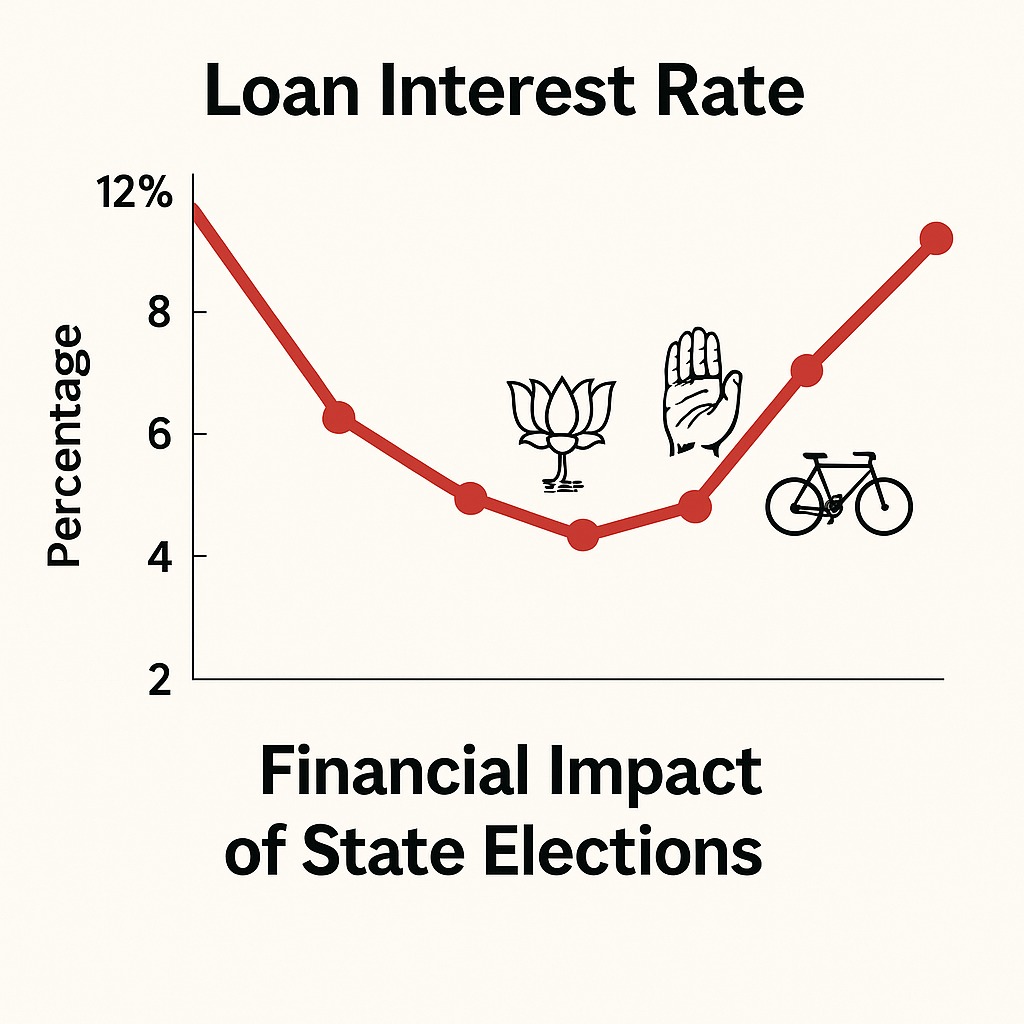
Most borrowers assume loan interest rates change only due to RBI policy. But in reality, state elections—especially in large states—can indirectly influence how banks price loans. As we head into a politically packed 2025–26 cycle, it’s important for customers to understand how elections shape the financial environment.
Election outcomes affect government spending, inflation outlook, banking liquidity, and market confidence—all of which can impact interest rates on home loans, personal loans, car loans, business loans and credit cards.
Here’s a breakdown of how state polls can affect your EMIs.
1. Government Spending Surges During Elections
State governments typically increase spending on:
Infrastructure
Welfare schemes
Subsidies
Last-mile development work
Higher spending often pushes demand in the economy, which can raise inflation.
If inflation rises, banks may:
Increase lending rates
Tighten approval norms for high-risk borrowers
Reduce special low-interest offers
This effect is usually most visible before and shortly after elections.
2. Market Sentiment Affects Borrowing Costs
Investors prefer political stability.
When election results are uncertain:
Markets turn volatile
Bond yields rise
Banking liquidity tightens
Higher bond yields often push loan rates upward because banks’ borrowing cost climbs. Once results stabilise and markets settle, rates may ease again.
3. RBI’s Policy Stance During Election Period
While the RBI remains politically neutral, it becomes extra cautious during election seasons.
Instead of aggressive rate cuts or hikes, the central bank often:
Maintains stable repo rates
Avoids bold policy shifts
Focuses on controlling inflation
This means borrowers should not expect dramatic interest-rate drops around election months.
4. Banks Offer Limited Loan Discounts During Polls
Contrary to festive seasons, banks usually avoid large rate cuts during elections because:
Liquidity may be unpredictable
Cash demand increases
Market risk rises
Instead of cheaper loans, banks focus on safer, low-risk lending policies.
This is especially relevant for personal loans and business loans.
5. Impact on Home Loan Borrowers
Home loans are most sensitive to interest rate fluctuations.
During election years:
Banks may keep home loan rates steady
Discounts for new buyers become selective
Balance-transfer offers reduce
Processing-fee waivers become rare
However, if the election outcome leads to strong market confidence, home loan rates can soften in the following quarter.
6. MSMEs & Businesses Are Affected the Most
Small businesses depend heavily on:
Working capital loans
Cash credit
Business term loans
Election cycles can:
Delay project funding
Slow credit approvals
Increase temporary borrowing costs
Once a new government stabilises, banks usually resume aggressive MSME lending.
7. What Customers Should Expect in 2025–26
With multiple major state elections coming up, borrowers should prepare for:
Slightly higher loan rates during peak election periods
Limited access to low-cost personal loans
Stable (but not falling) home loan rates
Stronger competition among banks after results, leading to better offers
If inflation remains under control, loan rates may begin easing in late 2026.
How Borrowers Can Prepare
✔ Lock in fixed-rate loans if EMI stability is important
✔ Compare offers from at least 3 banks
✔ Avoid unnecessary hard inquiries during election quarter
✔ Maintain a strong credit score to secure the best rates
✔ Consider delaying large loans until after results—if possible
FAQs
Q1. Do elections directly change loan interest rates?
Not directly, but they influence inflation, liquidity and market sentiment, which impact lending rates.
Q2. Will home loan rates rise in 2025–26 due to elections?
Rates may remain steady or slightly increase depending on inflation trends during the election period.
Q3. Is it good to take a loan during election season?
Banks offer fewer discounts, so waiting until markets stabilise may offer better deals.
Q4. How does election uncertainty affect borrowers?
It increases market volatility, pushing banks to adopt cautious lending.
Q5. When do loan rates usually stabilise?
Typically within 1–2 quarters after election results, once financial markets settle.
Published on : 15th November
Published by : SMITA
www.vizzve.com || www.vizzveservices.com
Follow us on social media: Facebook || Linkedin || Instagram
🛡 Powered by Vizzve Financial
RBI-Registered Loan Partner | 10 Lakh+ Customers | ₹600 Cr+ Disbursed