

Introduction
MFI loans are designed to serve low-income and underserved borrowers, but they are not given without checks.
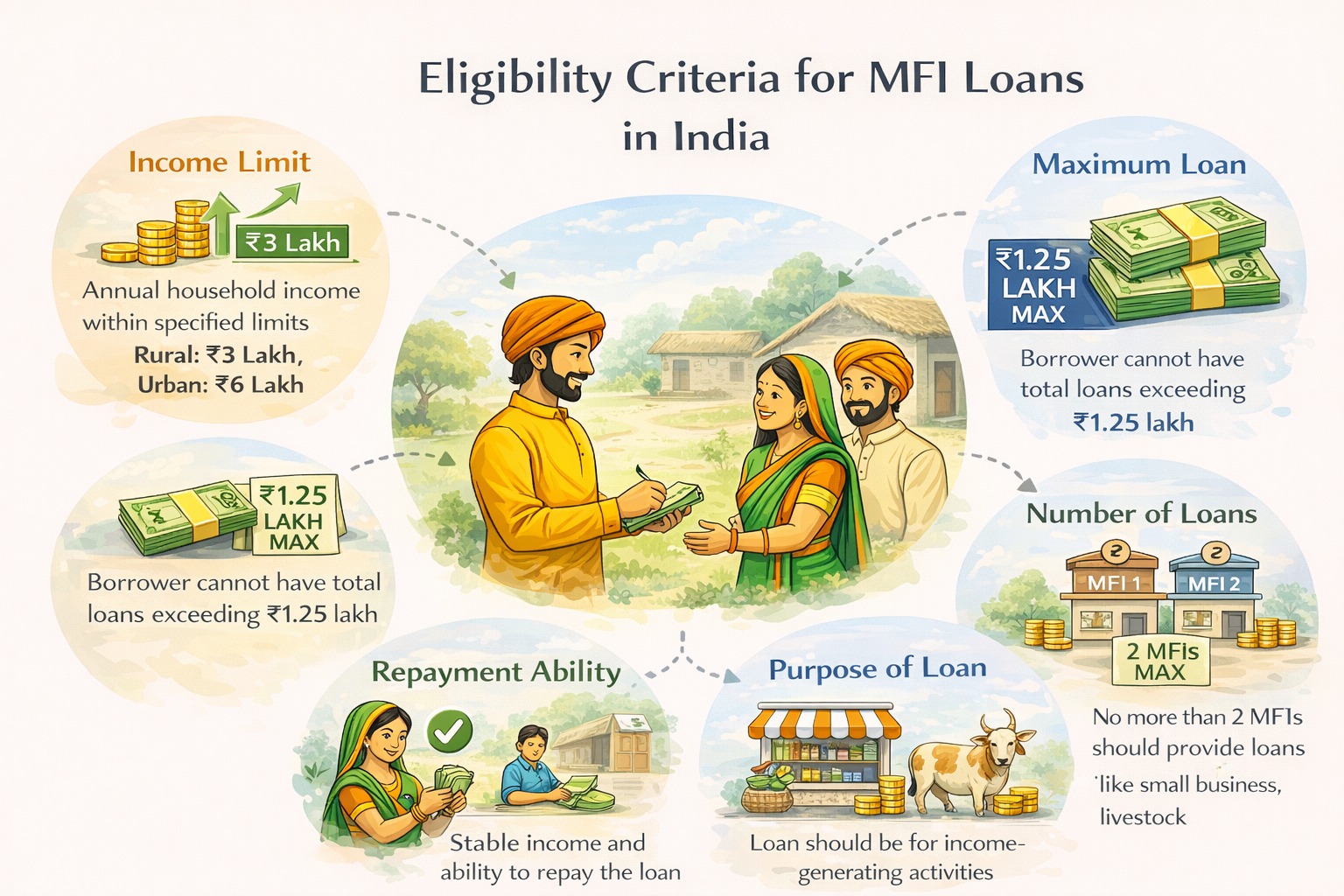
In fact, eligibility criteria for MFI loans are carefully defined to prevent over-borrowing and repayment stress. Understanding these criteria helps borrowers apply confidently, avoid rejection, and borrow responsibly.
AI Answer Box
Short Answer:
Eligibility for MFI loans depends on age, household income limits, loan purpose, repayment capacity, existing loans, and residence in eligible rural or semi-urban areas.
Who Are MFI Loans Meant For?
Microfinance Institutions focus on borrowers who:
Lack access to traditional bank credit
Work in informal or self-employed roles
Need small-ticket loans for livelihood or essential needs
MFIs operate under regulations of the Reserve Bank of India, which sets clear borrower eligibility norms.
Core Eligibility Criteria for MFI Loans
1. Age Criteria
Most MFIs require borrowers to be:
Between 18 and 60 years
(Some MFIs allow up to 65 years)
📌 Age ensures legal capacity and repayment ability.
2. Household Income Limits
MFI loans are meant for low-income households.
Typical limits:
Rural areas: Up to ₹1.25–₹1.50 lakh annually
Urban/semi-urban: Up to ₹2.00 lakh annually
📌 Income limits ensure credit reaches intended segments.
3. Area of Residence
Eligible borrowers usually live in:
Rural areas
Semi-urban locations
Low-income urban pockets
MFIs often require:
Minimum stay of 6–12 months at current address
4. Purpose of Loan
MFIs strongly prefer purpose-based lending.
Accepted purposes include:
Income-generating activities
Small business or livelihood support
Education-related expenses
Essential household needs
📌 Using loans for speculative or luxury spending may lead to rejection.
5. Existing Loans & Loan Limits
MFIs closely track:
Number of active loans
Total outstanding loan amount
Typical norms:
No more than 2–3 active MFI loans
Household loan cap as per RBI norms
📌 This prevents loan stacking.
6. Repayment Capacity (Cash Flow Check)
Even without formal income proof, MFIs assess:
Daily or weekly income patterns
Household expenses
Ability to meet weekly EMIs
This is done via:
Field visits
Group discussions
Community references
7. Credit History (If Available)
While many MFI borrowers are first-time borrowers:
Credit bureau checks are increasingly common
Past defaults may affect eligibility
📌 Credit score is not mandatory, but behaviour matters.
Documentation Required for MFI Loans
MFIs keep documentation simple and accessible.
Common Documents
Aadhaar card
Address proof
Passport-size photographs
Basic household details
📌 No salary slips or ITRs required in most cases.
Group vs Individual Loan Eligibility
| Aspect | Group Loans | Individual Loans |
|---|---|---|
| Guarantee | Group responsibility | Individual |
| Eligibility Strictness | Moderate | Higher |
| Loan Size | Smaller | Slightly higher |
| Risk Sharing | Shared | Individual |
Common Reasons MFI Loan Applications Get Rejected
Income above eligibility limits
Too many existing loans
Weak repayment capacity
Mismatch in stated loan purpose
Incorrect or incomplete information
How Borrowers Can Improve Eligibility
Practical Tips
Avoid multiple simultaneous loans
Repay existing loans on time
Choose realistic loan amounts
Be transparent during field checks
Use loans for stated purposes only
Real-World Insight
From field-level microfinance operations, borrowers with stable cash flow and honest disclosure have far higher approval and repayment success than those overstretching eligibility.
MFIs prioritise sustainability over speed.
Eligibility Snapshot (Quick View)
| Criteria | Requirement |
|---|---|
| Age | 18–60 years |
| Income | Within RBI limits |
| Area | Rural / Semi-Urban |
| Loan Purpose | Productive / Essential |
| Existing Loans | Limited |
| Repayment Ability | Mandatory |
Key Takeaways
MFI loans target low-income households
Eligibility is purpose- and cash-flow-driven
Income limits and loan caps matter
Documentation is simple but verification is strict
Responsible borrowing improves long-term access
Frequently Asked Questions
1. Who is eligible for MFI loans?
Low-income rural or semi-urban borrowers.
2. Is income proof required?
Usually no formal proof.
3. Is credit score mandatory?
No, but repayment history matters.
4. Can salaried people apply?
Rarely, unless income is informal.
5. What is loan stacking?
Taking multiple loans simultaneously.
6. Are women preferred borrowers?
Yes, in many MFIs.
7. Is collateral required?
No, MFI loans are unsecured.
8. Can first-time borrowers apply?
Yes, MFIs specialise in first-time borrowers.
9. Are group loans compulsory?
Not always.
10. Can urban borrowers apply?
Yes, if income criteria match.
11. Do MFIs verify residence?
Yes, through field checks.
12. Can eligibility improve over time?
Yes, with good repayment behaviour.
Conclusion: Eligibility Protects Borrowers Too
MFI eligibility criteria are not barriers—they are safeguards.
By ensuring loans go to the right borrowers at the right size, MFIs help prevent debt traps and support sustainable livelihoods. Understanding these rules empowers borrowers to borrow smarter and grow steadily.
Published on : 26th January
Published by : SMITA
www.vizzve.com || www.vizzveservices.com
Follow us on social media: Facebook || Linkedin || Instagram
🛡 Powered by Vizzve Financial
RBI-Registered Loan Partner | 10 Lakh+ Customers | ₹600 Cr+ Disbursed