

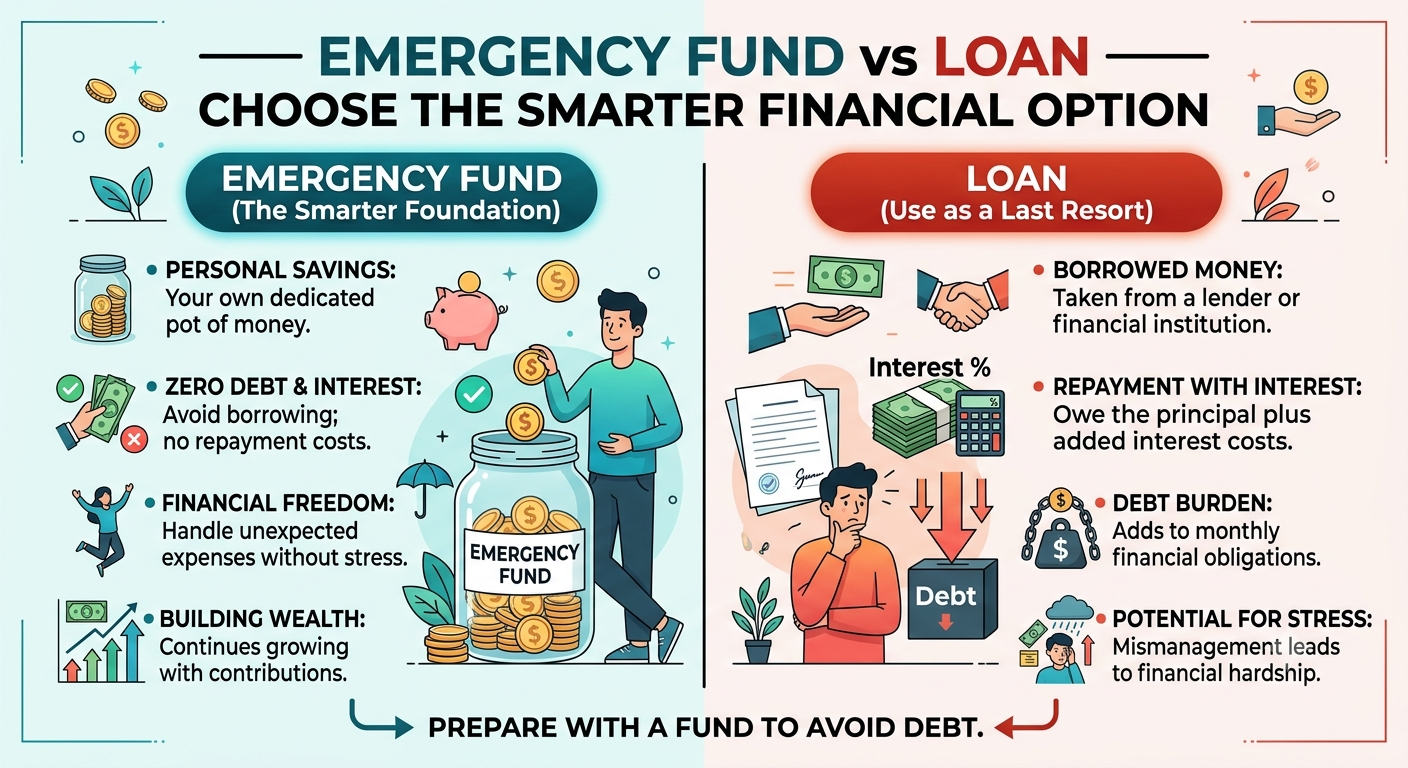
An emergency fund is money saved specifically for unexpected expenses. It provides financial protection when an urgent need arises without requiring you to borrow money.
For example, if you have ₹30,000 saved and face an unexpected medical bill of ₹10,000, you may be able to pay it from your emergency fund without taking on additional debt.
Benefits of an Emergency Fund
-
No interest payments: You use your own savings instead of borrowing.
-
Financial independence: You can manage urgent expenses without depending on lenders.
-
No EMI burden: Using savings does not create a new monthly repayment obligation.
-
Peace of mind: Having accessible savings can reduce financial stress during emergencies.
However, an emergency fund may not cover every situation, especially when the expense is large or your savings are limited.
What Is an Emergency Loan?
An emergency loan is borrowed money used to cover urgent expenses. Depending on the lender and product, it may be available as a personal loan or another type of credit.
For example, if an emergency costs ₹50,000 but you have only ₹15,000 in savings, you may consider borrowing the remaining amount if the expense cannot be postponed and other options are unavailable.
Benefits of an Emergency Loan
-
Access to additional funds: A loan may help cover expenses beyond your available savings.
-
Structured repayment: Many loans offer fixed EMIs over an agreed tenure.
-
Potentially quick access: Some lenders provide digital applications and faster decisions, subject to verification and approval.
-
Flexible usage: Eligible personal loans may be used for various legitimate emergency expenses, depending on the loan terms.
However, loans can include interest, processing fees, and other charges. Missing repayments may also affect your credit history and financial stability.
Emergency Fund vs Loan: Key Differences
| Factor | Emergency Fund | Emergency Loan |
|---|---|---|
| Source of money | Personal savings | Borrowed money |
| Interest cost | No borrowing interest | Interest may apply |
| Repayment | No EMI required | Repayment required |
| Availability | Depends on savings | Depends on eligibility and approval |
| Credit score impact | No direct borrowing impact | Repayment behaviour may affect credit history |
| Best suited for | Expenses covered by available savings | Necessary expenses beyond available savings |
When Should You Use an Emergency Fund?
Using your emergency fund may be a sensible first option when:
-
The expense is urgent and can be covered by your savings.
-
You want to avoid interest and additional debt.
-
Your income is temporarily disrupted.
-
You have enough savings remaining for other essential needs.
Remember that an emergency fund should not necessarily be exhausted for every expense. Consider the urgency of the situation and whether you can preserve some savings for future emergencies.
When Should You Consider an Emergency Loan?
A loan may be worth considering when an essential expense exceeds your available savings and delaying payment could create a bigger problem.
Before applying, evaluate:
-
Interest rate and APR: Understand the overall cost of borrowing.
-
Monthly EMI: Check whether the repayment fits comfortably within your budget.
-
Processing fees: Review all applicable charges.
-
Loan tenure: Compare repayment periods and total interest costs.
-
Lender verification: Check the regulated bank or NBFC responsible for the loan and verify the lender's details.
-
Key Fact Statement (KFS): Where applicable, review the KFS and the disclosed loan terms before accepting the offer.
Avoid borrowing more than you need, and do not rely solely on advertised approval speed.
Example: Emergency Fund vs Loan
Suppose you face an unexpected expense of ₹20,000.
Option 1: Use savings
If you have enough money in your emergency fund, you can pay the bill without interest or EMI obligations. However, your available savings will decrease.
Option 2: Take a loan
If you borrow ₹20,000, you will need to repay the principal along with applicable interest and fees. Your savings remain available, but your future income must cover the repayments.
The better choice depends on the urgency of the expense, your remaining savings, the cost of borrowing, and your ability to repay.
How Much Should You Keep in an Emergency Fund?
A common financial planning guideline is to aim for approximately three to six months of essential living expenses. The appropriate amount depends on your income stability, household responsibilities, existing debts, and access to other financial resources.
You can build your fund gradually by setting aside a fixed amount every month. Keep emergency savings accessible and consider an account or suitable low-risk option that allows timely withdrawals.
Final Thoughts
An emergency fund and an emergency loan serve different purposes. Savings can help you manage unexpected expenses without borrowing costs, while a loan may provide additional funds when savings are insufficient.
Whenever possible, use your emergency savings wisely and borrow only when necessary. Compare the total cost of a loan, assess your repayment capacity, and verify the lender before making a decision.
Published on : 26th October 2026
Published by : Yogendra
www.vizzve.com || www.vizzveservices.com
Follow us on social media: Facebook || Linkedin || Instagram
🛡 Powered by Vizzve Financial
RBI-Registered Loan Partner | 10 Lakh+ Customers | ₹600 Cr+ Disbursed