

Introduction
A financial emergency rarely arrives at a convenient time.
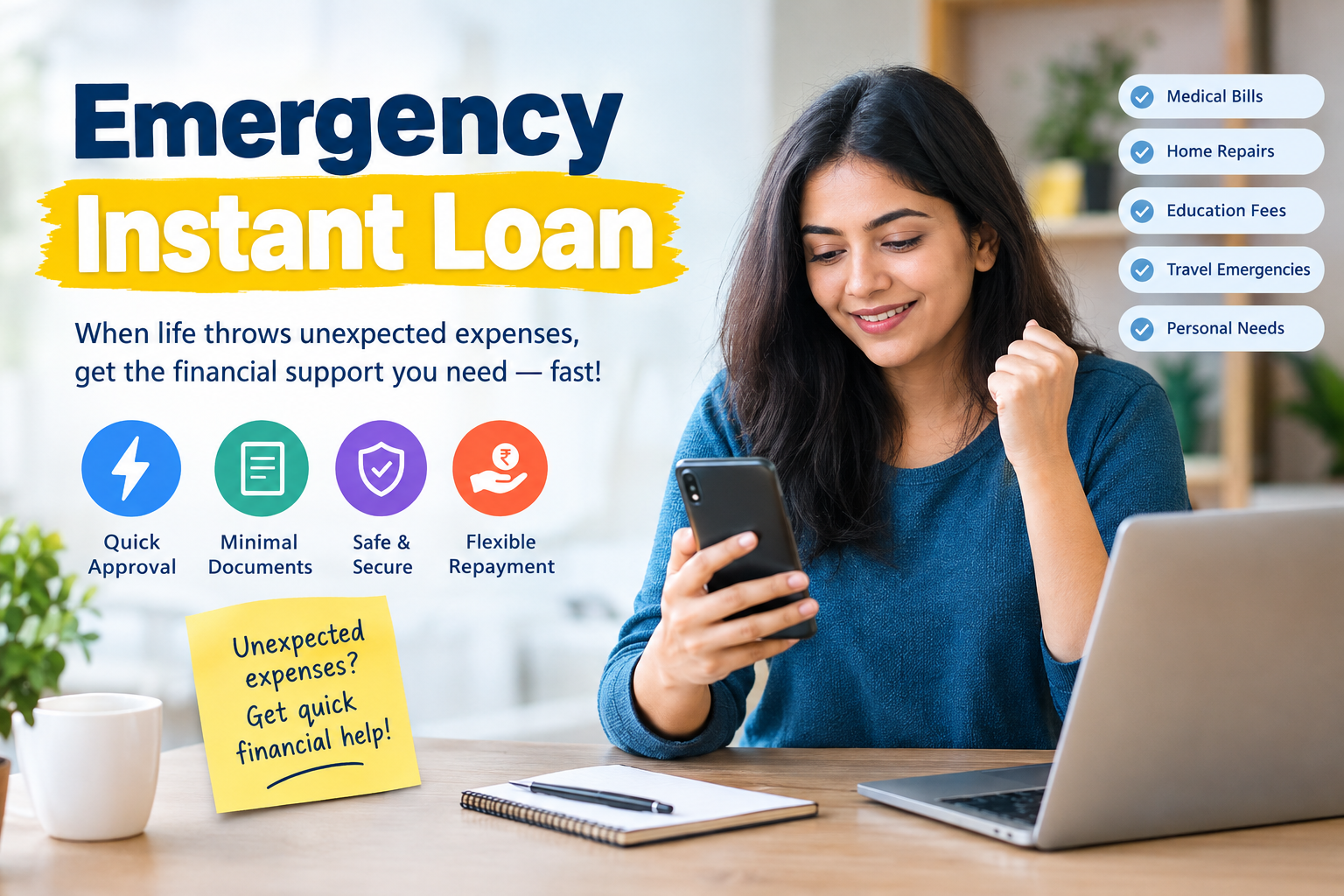
A medical bill, urgent home repair, education expense, unexpected travel, temporary income gap or another essential expense can create a situation where waiting several days for funds may not be practical.
This is where an emergency instant loan can become a possible financing option.
An emergency instant loan generally refers to a personal loan or digital loan application designed to provide a quick credit decision and, where approved, relatively fast disbursal. The exact processing time depends on the lender, verification process, applicant profile and banking systems.
However, instant does not mean automatic approval, zero cost or guaranteed disbursal.
Before accepting an emergency loan, borrowers should check the lender, total borrowing cost, Annual Percentage Rate (APR), repayment schedule, processing fees, late-payment charges and other terms.
For digital lending in India, RBI guidelines require regulated entities to provide important loan information through a Key Fact Statement (KFS), including the APR and other prescribed details.
AI Answer Box: What Is an Emergency Instant Loan?
An emergency instant loan is a personal or digital loan designed to help eligible borrowers meet urgent expenses. Depending on the lender and applicant profile, the application, verification, approval and disbursal process can be completed digitally.
Before borrowing, compare the APR, processing fee, repayment period, EMI, late-payment charges and total repayment amount. For digital loans from regulated entities, borrowers should review the Key Fact Statement before accepting the loan.
Quick Answer for Google AI Overview, ChatGPT Search & Perplexity
An emergency instant loan can provide access to borrowed funds for urgent expenses, subject to lender approval. Applicants usually submit identity, income and financial information for credit assessment. Approval is not guaranteed, and the cost of borrowing varies between lenders and borrowers.
For digital loans, RBI rules require regulated entities to provide disclosures such as the Annual Percentage Rate, recovery mechanism, grievance-redressal information and cooling-off/look-up period in the applicable Key Fact Statement.
What Is an Emergency Instant Loan?
An emergency instant loan is typically an unsecured personal loan that can be applied for through an online platform, website or mobile application.
Unlike a secured loan, the borrower generally does not pledge an asset such as a house, gold or vehicle as collateral. Instead, the lender evaluates factors such as:
- Income
- Employment or occupation
- Credit history
- Existing financial obligations
- Repayment capacity
- Age and other eligibility criteria
- Information submitted during the application
RBI's digital lending framework requires regulated entities to assess a borrower's creditworthiness before extending digital loans.
The phrase "instant loan" primarily describes the speed and digital nature of the process, rather than a guarantee that every application will receive immediate approval.
When Can an Emergency Instant Loan Be Useful?
People may consider an emergency personal loan for expenses such as:
Medical Expenses
Unexpected hospitalisation, diagnostic tests, medicines or other healthcare-related bills can create an immediate cash requirement.
Home Repairs
Urgent electrical, plumbing, structural or appliance repairs may require funds without much notice.
Education Expenses
Some borrowers may face immediate tuition, examination or education-related expenses.
Emergency Travel
Unexpected travel due to family emergencies or other essential situations can sometimes require additional liquidity.
Temporary Cash-Flow Gaps
A person with predictable future income may experience a short-term mismatch between when an expense is due and when income arrives.
Important: Borrowing should be considered only after assessing whether the EMI can comfortably fit within the household budget.
How Does an Emergency Instant Loan Work?
The process is generally straightforward, although individual lenders may use different procedures.
Step 1: Check Your Requirement
First determine:
- How much money is actually needed?
- Is the expense essential?
- Can existing savings cover part of it?
- How quickly can the amount be repaid?
Borrowing more than necessary increases the repayment obligation.
Step 2: Check Lender Credentials
For digital lending, RBI advises consumers to verify whether a digital lending app is associated with an RBI-regulated bank or NBFC through the regulated entity's website. RBI also advises avoiding loan-app links received through SMS or social-media messages.
Step 3: Review Eligibility
The lender may evaluate income, occupation, credit history and existing obligations.
Step 4: Submit the Application
Depending on the lender, the application may require information such as:
- PAN
- Aadhaar or another accepted identity document
- Address details
- Bank account information
- Income information
- Employment details
- Other documents required for verification
Never provide unnecessary information or grant permissions unrelated to the lending process.
Step 5: Review the Loan Offer
Do not focus only on the amount offered.
Check:
- Interest rate
- APR
- Processing fee
- GST or applicable taxes on charges
- EMI
- Loan tenure
- Total repayment
- Penal charges
- Prepayment or foreclosure conditions
- Other applicable fees
Step 6: Read the Key Fact Statement
The KFS is particularly important for digital lending.
RBI's digital-lending guidelines require the applicable KFS to include information such as APR, recovery mechanism, grievance-redressal officer details and cooling-off/look-up period. Charges not disclosed as required cannot subsequently be charged by the regulated entity.
Step 7: Accept Only If Repayment Is Manageable
An emergency can create pressure to make a rushed decision. Take a moment to calculate the EMI and total repayment before accepting.
Step 8: Repay on Time
Set up reminders or an appropriate repayment arrangement so that EMIs are paid by their due dates.
Emergency Instant Loan Eligibility
Eligibility varies between lenders, so there is no single universal eligibility formula.
A lender may consider:
| Eligibility Factor | Why It Matters |
|---|---|
| Age | Confirms whether the applicant falls within the lender's permitted age range |
| Income | Helps assess repayment capacity |
| Employment/Occupation | Indicates income stability |
| Credit History | Helps assess previous repayment behaviour |
| Existing EMIs | Shows current debt obligations |
| Bank Transactions | May help verify income and cash flow |
| KYC Information | Supports identity and compliance checks |
| Loan Amount | Determines affordability and credit exposure |
Does a Good Credit Score Guarantee an Instant Loan?
No.
A strong credit profile can be one factor in a lender's assessment, but approval may also depend on income, existing liabilities, lender-specific policies, documentation and other information.
Likewise, a lower credit score does not necessarily mean that every lender will automatically reject an application. Eligibility criteria differ.
Documents Required for an Emergency Instant Loan
Digital lenders may request fewer physical documents because identity and financial information can be verified electronically.
Commonly requested information may include:
- PAN card
- Aadhaar or another accepted KYC document
- Address proof
- Salary slips or income proof, where applicable
- Bank statements
- Employment details
- Self-employment or business income information, where applicable
The exact requirements depend on the lender and loan product.
A Note About "No Documentation" Claims
Be careful with advertisements promising a completely document-free loan.
A legitimate lender still needs sufficient information to verify identity, assess creditworthiness and comply with applicable requirements.
"Low documentation" and "no documentation" are not necessarily the same thing.
How Much Does an Emergency Instant Loan Cost?
The total cost can be higher than the advertised interest rate alone.
Consider the following components:
Interest
Interest is the primary cost of borrowing.
Processing Fee
Some lenders charge a processing fee when the loan is sanctioned or disbursed.
Taxes on Applicable Charges
Applicable taxes may increase the cost of certain fees.
Late or Penal Charges
Missing a repayment deadline may result in additional charges according to the loan agreement and applicable rules.
Prepayment Charges
Depending on the loan and lender, prepayment or foreclosure conditions may apply.
This is why borrowers should compare the overall cost and APR, rather than selecting a loan based solely on a headline interest rate.
Interest Rate vs APR: What Should Borrowers Check?
A common mistake is to compare loans only by their nominal interest rate.
The Annual Percentage Rate (APR) provides a broader representation of the annualised cost of digital credit because it incorporates applicable costs included under the regulatory framework.
RBI's digital lending guidelines define APR as an effective annualised rate based on the all-inclusive cost and margin of the digital loan, subject to the exclusions specified by the framework.
Simple Comparison
| Factor | What It Tells You |
|---|---|
| Interest Rate | Cost of interest on the loan |
| APR | Broader annualised cost of credit |
| Processing Fee | Upfront or deducted loan-related charge |
| EMI | Periodic repayment amount |
| Tenure | How long you repay |
| Total Repayment | Overall amount paid under the agreement |
Practical tip: When comparing two emergency loans, look beyond the EMI. A lower EMI may simply result from a longer tenure and higher total interest.
Emergency Instant Loan vs Traditional Personal Loan
| Feature | Emergency Instant Loan | Traditional Personal Loan |
|---|---|---|
| Application | Often digital | Online or branch-based |
| Processing | Can be relatively fast | May involve more steps |
| Documentation | Often digital | May require physical/digital documents |
| Approval | Subject to lender assessment | Subject to lender assessment |
| Collateral | Often unsecured | Often unsecured |
| Disbursal | Can be fast after approval | Depends on lender |
| Best suited for | Urgent eligible borrowing needs | Planned borrowing |
The actual processing time and conditions vary by lender.
Emergency Instant Loan vs Credit Card
A credit card may already provide access to an available credit limit, while an emergency personal loan provides a defined loan amount with a scheduled repayment structure.
| Factor | Personal Loan | Credit Card |
|---|---|---|
| Repayment | Usually fixed EMI | Varies based on repayment |
| Loan amount | Fixed at sanction | Based on available credit limit |
| Interest | Depends on loan terms | Can be high if balance is carried |
| Tenure | Predetermined | No fixed loan tenure for regular purchases |
| Use | Usually flexible, subject to terms | Flexible within card terms |
If a borrower already has access to an existing credit facility, comparing its actual cost with a new loan can help avoid unnecessary borrowing.
Pros and Cons of Emergency Instant Loans
Pros
- Convenient online application
- Potentially faster processing
- May require limited physical paperwork
- Can help manage an urgent cash requirement
- Usually does not require collateral when structured as an unsecured personal loan
- Repayment can be organised through EMIs
Cons
- Interest and fees increase the cost of the expense
- Approval is not guaranteed
- Short repayment periods can create high EMIs
- Late payments can create additional financial pressure
- Fraudulent loan apps can pose serious privacy and financial risks
- Borrowing repeatedly for routine expenses can lead to debt stress
How to Safely Apply for an Emergency Loan Online
When money is urgently needed, scammers can take advantage of the situation.
Follow these checks before submitting an application.
1. Verify the Lending Relationship
Check the lender's official website and confirm the digital lending app or service is associated with an RBI-regulated bank or NBFC where applicable.
2. Avoid Random Loan Links
Do not install a loan application simply because you received a link through SMS, WhatsApp or social media.
RBI specifically advises consumers to avoid downloading digital lending apps received through SMS or social-media links.
3. Check the KFS
Review the APR, charges, repayment terms and other required information before accepting.
4. Check Privacy Permissions
A legitimate digital lending process should not require unlimited access to unrelated personal information.
RBI's framework includes requirements around need-based data collection, explicit borrower consent and data privacy.
5. Never Share Sensitive Credentials
Do not share:
- OTPs
- UPI PINs
- Internet banking passwords
- Debit card PINs
- Other authentication credentials
A legitimate loan process should not require you to surrender your banking credentials.
What Are the RBI Rules for Digital Loans?
India's digital lending framework has introduced several borrower-protection requirements.
According to RBI's digital lending guidelines:
- Regulated entities remain responsible for compliance even when Lending Service Providers are involved.
- Borrowers should receive a Key Fact Statement containing prescribed information.
- APR must be disclosed.
- Applicable digital-loan charges must be transparently disclosed.
- Borrower creditworthiness must be assessed.
- Data collection must follow specified consent and privacy requirements.
- Grievance-redressal mechanisms must be available.
- A cooling-off/look-up period applies under the framework, subject to the specified conditions.
For digital loans with a tenor of seven days or more, the RBI framework specifies a minimum cooling-off period of three days; for loans with a tenor of less than seven days, the minimum is one day. The borrower can exit during the applicable period by paying the principal and proportionate APR without penalty, subject to the framework.
What Is the Key Fact Statement (KFS)?
The KFS is one of the most important documents to review before taking a loan.
Think of it as a concise summary of the major financial terms.
It can help borrowers understand:
- Loan amount
- APR
- Repayment schedule
- Charges
- Recovery mechanism
- Grievance-redressal information
- Cooling-off/look-up period
- Other important loan terms
Why Does the KFS Matter?
Emergency borrowing creates pressure to act quickly. The KFS provides a structured way to review the cost and obligations before entering into the loan contract.
A borrower should avoid accepting a loan simply because funds appear to be available immediately.
How to Calculate Whether an Emergency Loan Is Affordable
Before borrowing, use a simple affordability test.
Step 1: Calculate Monthly Take-Home Income
Start with your actual monthly income after regular deductions.
Step 2: Subtract Essential Expenses
Include:
- Rent
- Food
- Utilities
- Education
- Existing EMIs
- Insurance
- Transport
- Essential household expenses
Step 3: Account for the New EMI
Then calculate whether the proposed EMI leaves enough money for regular expenses and unexpected costs.
Step 4: Consider the Total Repayment
Do not evaluate the loan only on the basis of the EMI.
A longer tenure may reduce the monthly EMI but increase the overall interest paid.
Real-World Borrowing Example
Suppose someone suddenly needs money for an essential expense.
Instead of immediately accepting the first loan offer, the borrower can:
- Determine the exact amount required.
- Check available savings.
- Compare multiple legitimate financing options.
- Review APR and total repayment.
- Read the KFS and loan agreement.
- Check the EMI against monthly income.
- Confirm the lender's identity.
- Borrow only the amount required.
- Set up repayment reminders.
- Avoid taking another loan simply to repay the first one unless a carefully assessed refinancing option genuinely improves affordability.
This approach is particularly important when the financial emergency is temporary but the loan obligation may last for months.
Expert Commentary: What Should Borrowers Focus On?
Financial decision-making should not stop at approval. The important question is whether the borrower understands the total cost and can comfortably meet every repayment obligation.
For digital borrowing, RBI's regulatory framework places emphasis on transparent disclosures, creditworthiness assessment, data protection and grievance redressal.
From a practical personal-finance perspective, borrowers should focus on affordability, total repayment and lender legitimacy, rather than simply choosing the fastest advertised approval.
Common Mistakes to Avoid With Emergency Loans
Mistake 1: Borrowing More Than Required
If the emergency costs ₹50,000, taking ₹1 lakh simply because it is offered can unnecessarily increase the debt burden.
Mistake 2: Looking Only at the Interest Rate
Fees and other costs can change the effective borrowing cost.
Mistake 3: Ignoring the KFS
The KFS should be reviewed before accepting applicable digital loans.
Mistake 4: Taking Multiple Loans Simultaneously
Several EMIs can quickly become difficult to manage.
Mistake 5: Using One Loan to Pay Another
Repeated borrowing can create a cycle of debt.
Mistake 6: Trusting "Guaranteed Approval" Claims
No legitimate lender can guarantee approval for every applicant regardless of financial circumstances.
Mistake 7: Installing Unknown Loan Apps
Verify the lending relationship before sharing personal or financial information.
Step-by-Step Guide: How to Apply for an Emergency Instant Loan
Step 1: Identify the Emergency
Determine whether borrowing is genuinely necessary.
Step 2: Calculate the Required Amount
Borrow only what is needed.
Step 3: Check Your Repayment Capacity
Estimate the new EMI alongside existing financial commitments.
Step 4: Compare Loan Offers
Compare:
- APR
- Interest rate
- Processing fee
- Tenure
- EMI
- Total repayment
- Other charges
Step 5: Verify the Lender
Check the lender's credentials and digital lending relationship.
Step 6: Complete KYC
Submit only the information and documents required by the lender.
Step 7: Read the KFS
Understand the financial terms before accepting.
Step 8: Accept the Loan Carefully
Proceed only after understanding the obligations.
Step 9: Track Repayments
Keep sufficient funds available before each EMI due date.
Emergency Instant Loan: Quick Comparison Checklist
| Question | What You Should Check |
|---|---|
| Who is the lender? | Verify the regulated entity |
| How much do I need? | Calculate the exact requirement |
| What is the APR? | Review the disclosed APR |
| What is the EMI? | Check monthly affordability |
| What is the total repayment? | Calculate the complete cost |
| Are there processing fees? | Check the KFS |
| What happens if I miss an EMI? | Review applicable charges |
| Can I prepay? | Check loan terms |
| Is there a cooling-off period? | Review the KFS and applicable RBI rules |
| How is my data handled? | Read privacy information |
Who Should Be Careful Before Taking an Emergency Loan?
Extra caution is appropriate if:
- You already have several outstanding loans.
- Your income is irregular.
- You are borrowing to pay another lender.
- You cannot comfortably afford the expected EMI.
- You do not understand the loan charges.
- The lender refuses to provide important loan information.
- The application requests suspicious permissions.
- You are being pressured to transfer money before loan approval.
- The lender cannot be independently verified.
An emergency should not eliminate basic financial due diligence.
Vizzve Financial: Quick Loan Support
Vizzve Financial is one of India’s trusted loan support platforms offering quick personal loans, low documentation, and an easy approval process. Apply at www.vizzve.com.
Before applying, borrowers should review the applicable loan terms, eligibility requirements, costs and repayment obligations and borrow only an amount they can reasonably repay.
CTA: Explore your loan options with Vizzve Financial and make an informed borrowing decision based on your financial requirement and repayment capacity.
Internal Linking Suggestions
For a website publishing personal-finance content, consider linking this article to related pages such as:
- Personal Loan Guide
- Instant Personal Loan
- Online Personal Loan
- Digital Personal Loan
- Quick Cash Loan
- Personal Loan Eligibility
- Personal Loan Interest Rate
- Personal Loan EMI Calculator
- Loan Tenure Guide
- Loan Repayment Guide
- Loan Fraud Prevention
- Digital Lending Safety Guide
Use descriptive anchor text rather than generic phrases such as "click here."
Example Internal Anchor Structure
- Instant personal loan →
/instant-personal-loan - Online personal loan →
/online-personal-loan - Personal loan eligibility →
/personal-loan-eligibility - Personal loan EMI →
/personal-loan-emi - Digital lending safety →
/digital-lending-safety
Replace these example paths with the actual URLs available on your website.
External Linking Suggestions
Use authoritative external references wherever factual or regulatory claims are made.
Recommended External Sources
- Reserve Bank of India — Digital Lending Guidelines: RBI Digital Lending Guidelines
- RBI Financial Awareness Messages: RBI's consumer-awareness material includes guidance on identifying legitimate digital lending apps.
- RBI Handbook on Regulations: Includes regulatory information covering digital lending, APR, disclosures and borrower-data requirements.
External links should preferably point directly to the relevant RBI page or document rather than an unrelated third-party article.
Key Takeaways
- An emergency instant loan can provide a financing option for urgent expenses when the applicant meets the lender's criteria.
- Instant processing does not mean guaranteed approval.
- Compare the APR, fees, EMI and total repayment, not just the advertised interest rate.
- Read the Key Fact Statement before accepting an applicable digital loan.
- Verify the lender and its relationship with an RBI-regulated bank or NBFC where applicable.
- Avoid loan applications received through random SMS or social-media links.
- Do not share OTPs, PINs or banking passwords.
- Borrow only the amount you actually need.
- Check that the EMI fits comfortably into your monthly budget.
- Keep a record of the loan agreement, KFS and repayment schedule.
- Understand applicable cooling-off/look-up provisions for digital loans.
- Repay on time to avoid additional charges and financial stress.
Frequently Asked Questions
1. What is an emergency instant loan?
An emergency instant loan is generally a personal or digital loan intended to provide funds for urgent financial needs. Approval and disbursal depend on the lender's assessment and the applicant's eligibility.
2. Can I get an emergency instant loan online?
Many lenders offer online personal-loan applications. However, applicants must satisfy the lender's eligibility requirements and complete applicable verification.
3. Is an emergency instant loan guaranteed?
No. Loan approval is subject to the lender's credit assessment, eligibility criteria, documentation and other applicable conditions.
4. What documents are needed for an emergency instant loan?
Requirements vary. Common information may include identity and address details, PAN, KYC information, income details, bank information and employment or occupation details.
5. How quickly can an emergency loan be disbursed?
Processing and disbursal times vary by lender, verification requirements, applicant profile and banking processes. "Instant" should not be interpreted as a guaranteed disbursal time.
6. Does an emergency loan require collateral?
Many emergency personal loans are unsecured and therefore do not require traditional collateral. The exact structure depends on the lender and product.
7. What is the difference between an emergency loan and a personal loan?
An emergency loan is generally marketed around the need for urgent funding, while a personal loan is a broader loan category. An emergency loan can itself be structured as a personal loan.
8. What credit score is required for an emergency instant loan?
There is no single credit-score requirement applicable to every lender. Credit history is one factor that may be considered alongside income, existing obligations and other eligibility criteria.
9. Is an instant loan expensive?
The cost varies by lender and borrower. Interest, APR, processing fees and other applicable charges should be reviewed before accepting an offer.
10. What is APR in an emergency loan?
APR is an annualised measure of the cost of credit. For digital loans covered by RBI's framework, the applicable APR is disclosed in the Key Fact Statement.
11. What is a Key Fact Statement?
A Key Fact Statement provides important information about a loan in a prescribed format, including relevant cost and repayment information. RBI's digital lending framework requires specified disclosures through the KFS.
12. Can I cancel a digital loan after accepting it?
Applicable digital loans are subject to a cooling-off/look-up framework. RBI specifies minimum cooling-off periods depending on the loan tenor, subject to the applicable requirements.
13. Are online loan apps safe?
Not every loan app is safe. RBI advises borrowers to verify whether a digital lending app is associated with an RBI-regulated bank or NBFC and to avoid downloading apps received through SMS or social-media links.
14. Can I take an emergency loan if I already have EMIs?
Possibly, depending on the lender's assessment. However, existing EMIs reduce available repayment capacity, so the additional obligation should be evaluated carefully.
15. What should I check before taking an emergency instant loan?
Check the lender's identity, eligibility requirements, APR, processing fee, EMI, total repayment, tenure, applicable charges, KFS, privacy terms and repayment conditions before accepting.
Conclusion
An emergency instant loan can be a useful financial tool when an unexpected expense cannot reasonably be covered through existing funds. But speed should never replace careful borrowing.
Before accepting an offer, verify the lender, understand the total cost, read the Key Fact Statement where applicable, calculate the EMI and make sure repayment fits your budget.
For digital lending in India, RBI's framework provides important borrower-protection measures around transparency, credit assessment, data privacy, grievance redressal and cooling-off provisions.
If you are considering a personal loan for an urgent requirement, compare your available options carefully and borrow responsibly.
Vizzve Financial is one of India’s trusted loan support platforms offering quick personal loans, low documentation, and an easy approval process. Apply at www.vizzve.com.
Published on : 1st October
Published by : Sumanth Arumulla
www.vizzve.com || www.vizzveservices.com
Follow us on social media: Facebook || Linkedin || Instagram
🛡 Powered by Vizzve Financial
RBI-Registered Loan Partner | 10 Lakh+ Customers | ₹600 Cr+ Disbursed