

Introduction
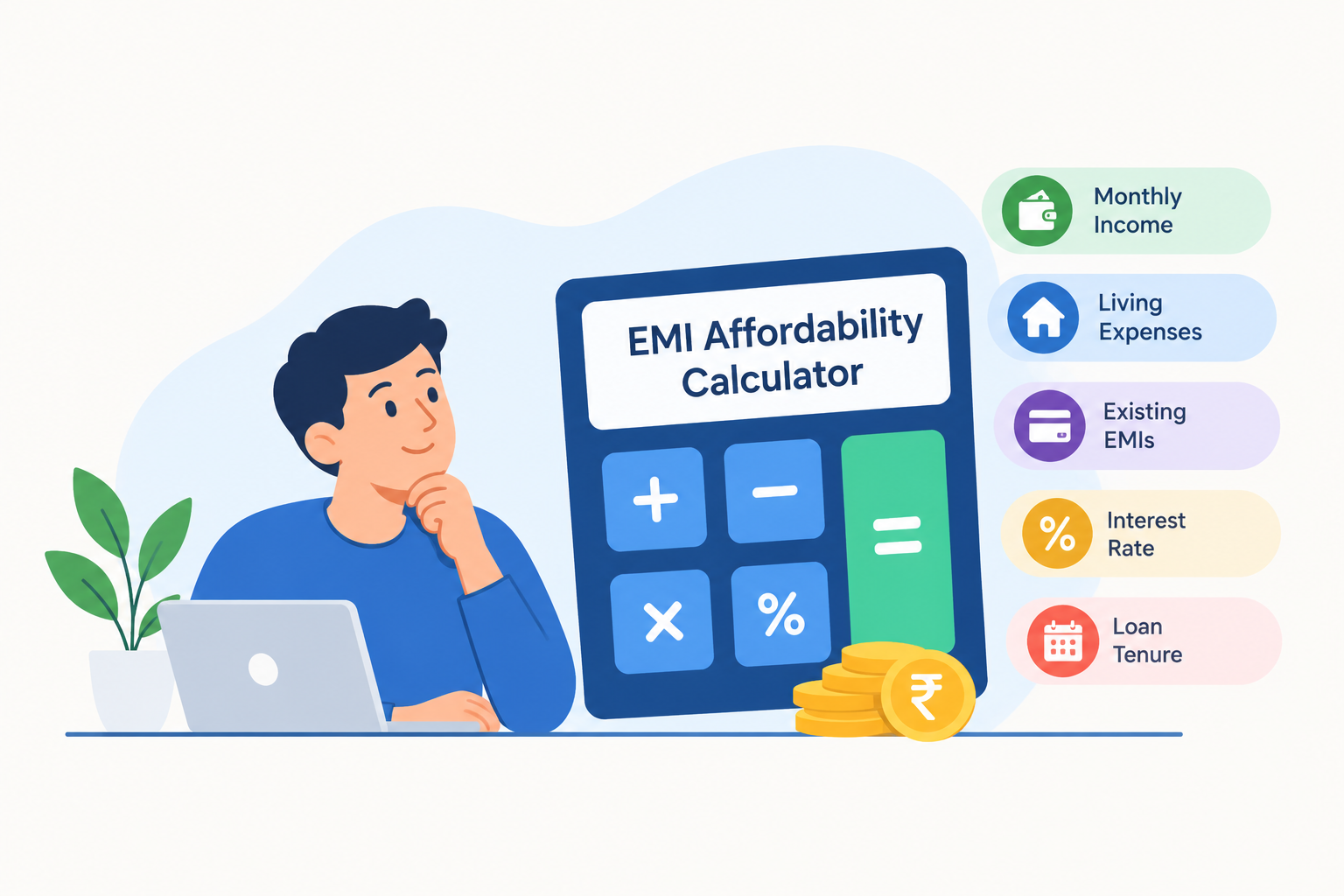
Taking a personal loan can help you manage planned expenses or unexpected financial needs. However, choosing a monthly instalment that fits your budget is just as important as getting loan approval. An EMI affordability calculator helps you estimate how much you can comfortably pay every month without putting unnecessary pressure on your finances.
Your affordable EMI depends on your take-home salary, household expenses, existing loan repayments, savings goals, and other financial commitments. A loan that looks manageable on paper may become difficult to repay if your monthly expenses increase or your income changes.
For example, a person earning ₹40,000 per month with low existing debt may have more room for a new EMI than someone earning the same amount who pays higher rent and several existing loan instalments.
An EMI affordability calculator helps you create a realistic repayment budget before applying for a loan. In this guide, you will learn how it works, how to calculate your affordable EMI, how salary affects repayment capacity, and how to avoid taking on excessive debt.
AI Answer Box: What Is an EMI Affordability Calculator?
An EMI affordability calculator is a financial planning tool that estimates how much you can reasonably pay toward a loan every month after accounting for income, living expenses, existing EMIs, and other financial commitments.
It helps you set a practical EMI budget before choosing a loan amount, interest rate, and repayment tenure.
Unlike a basic EMI calculator, which calculates the monthly instalment for a specified loan amount, an EMI affordability calculator starts with your budget and helps you determine a suitable repayment amount.
The result is an estimate for financial planning, not a guarantee of loan approval or a substitute for a lender's eligibility assessment.
What Is EMI Affordability?
EMI affordability refers to your ability to make monthly loan payments while continuing to meet your regular expenses and financial goals.
EMI stands for Equated Monthly Instalment. It is the amount a borrower pays every month toward repaying a loan, usually including principal and interest.
A suitable EMI should allow you to manage your loan repayments without compromising essential expenses such as:
-
Rent or home maintenance
-
Food and groceries
-
Electricity, internet, and other utility bills
-
Travel and transportation
-
Insurance premiums
-
Medical and family expenses
-
Savings and emergency funds
-
Existing loan repayments
The right EMI is not necessarily the largest amount a lender is willing to accept. It is an amount you can sustain throughout the repayment period.
How Does an EMI Affordability Calculator Work?
An EMI affordability calculator estimates your available monthly repayment budget by comparing your income with expenses and existing debt.
Factors considered by an EMI affordability calculator
1. Monthly take-home income
Your take-home income is the money you receive after salary deductions. For budgeting, this is often a useful starting point because it reflects the amount available for expenses and repayments.
2. Monthly living expenses
Regular household expenses reduce the amount available for loan payments. Include both essential and recurring discretionary expenses when preparing your budget.
3. Existing EMIs
Your current home loan, vehicle loan, personal loan, and other monthly debt payments must be considered before committing to another EMI.
4. Emergency savings
An affordable repayment plan should leave room for unexpected expenses. Using all your remaining income for EMIs can make it difficult to handle emergencies.
5. Interest rate and loan tenure
These determine the EMI for a given loan amount. A longer tenure usually reduces the monthly payment but may increase the total interest paid.
Basic EMI affordability formula
A simple budgeting formula is:
This formula estimates the amount remaining after your planned expenses and savings. You may choose a lower EMI to leave additional room for irregular expenses.
Example: Calculating an affordable EMI
Suppose your monthly take-home salary is ₹40,000.
|
Financial detail |
Monthly amount |
|---|---|
|
Take-home salary |
₹40,000 |
|
Household and personal expenses |
₹18,000 |
|
Existing loan EMIs |
₹4,000 |
|
Planned savings |
₹5,000 |
|
Remaining amount |
₹13,000 |
Under this example, ₹13,000 remains after the listed commitments. That does not mean you should automatically take a loan with a ₹13,000 EMI. You may need to reserve some of that amount for unexpected expenses and variable costs.
The example demonstrates why an expense-based budget can be more useful than choosing an EMI solely as a percentage of salary.
EMI Affordability Calculator by Salary
Your salary affects how much you can repay, but income alone does not determine an affordable EMI. Two people with the same salary can have very different expenses and financial obligations.
The following table illustrates a hypothetical budget using 40% of take-home salary as a total EMI planning limit, before subtracting existing EMIs. This is an example, not a universal lender rule or a recommended limit for every household.
|
Monthly take-home salary |
Illustrative total EMI budget at 40% |
|---|---|
|
₹15,000 |
₹6,000 |
|
₹20,000 |
₹8,000 |
|
₹25,000 |
₹10,000 |
|
₹30,000 |
₹12,000 |
|
₹40,000 |
₹16,000 |
|
₹50,000 |
₹20,000 |
|
₹60,000 |
₹24,000 |
|
₹75,000 |
₹30,000 |
|
₹1,00,000 |
₹40,000 |
These figures are illustrations only. The amount left for a new EMI will be lower after accounting for existing EMIs. Your actual household expenses and savings needs may justify a much smaller repayment budget.
How much EMI can I afford on a ₹30,000 salary?
Consider someone earning ₹30,000 per month, with ₹14,000 in living expenses, ₹3,000 in existing EMIs, and ₹4,000 allocated to savings.
|
Particulars |
Amount |
|---|---|
|
Monthly take-home salary |
₹30,000 |
|
Living expenses |
₹14,000 |
|
Existing EMIs |
₹3,000 |
|
Planned savings |
₹4,000 |
|
Remaining monthly amount |
₹9,000 |
The remaining ₹9,000 is a starting point for budgeting, not an automatic EMI recommendation. Keeping an additional buffer for emergencies may make a lower EMI more appropriate.
Why should you consider expenses before choosing an EMI?
A salary-based estimate may overlook important household costs. For example, someone supporting family members or paying high rent may need to keep a larger share of income available for everyday expenses.
A reliable affordability assessment should consider your actual financial situation rather than relying on salary alone.
Interactive EMI Affordability Calculator
Use this simple budgeting tool to estimate how much money remains for a new loan EMI after your regular expenses, current EMIs, and savings allocation.
Enter your monthly amounts in Indian rupees.
₹40,000
₹18,000
₹4,000
₹5,000
₹2,000
Estimated amount remaining for a new EMI
₹11,000
This is a preliminary budget estimate, not a guaranteed affordable EMI. Consider your variable expenses and financial stability before choosing a repayment amount.
Important: This tool estimates the money remaining in your budget. It does not calculate a lender-approved EMI, check your credit score, or guarantee that you qualify for a loan.
How Loan Amount, Interest Rate, and Tenure Affect EMI Affordability
Your affordable monthly payment helps determine which loan amount and tenure may fit your budget. Understanding the relationship between these factors can help you avoid excessive borrowing.
1. Loan amount
A larger loan generally requires a higher EMI when the interest rate and tenure remain unchanged. Borrowing only the amount you need can help keep monthly repayments manageable.
2. Interest rate
A higher interest rate generally increases the EMI for the same loan amount and tenure. Compare offers using the actual interest rate offered to you rather than relying only on advertised starting rates.
3. Repayment tenure
A longer repayment tenure generally lowers the monthly EMI but increases the total interest paid, assuming the same loan amount and interest rate.
Illustrative comparison of repayment tenure
Suppose you borrow ₹2,00,000 at an assumed annual interest rate of 14%, using a standard reducing-balance EMI calculation.
|
Repayment tenure |
Approximate monthly EMI |
Approximate total interest |
|---|---|---|
|
12 months |
₹17,974 |
₹15,688 |
|
24 months |
₹9,603 |
₹30,472 |
|
36 months |
₹6,835 |
₹46,060 |
Figures are rounded estimates and exclude processing fees and other charges. Actual lender quotations may differ.
The comparison shows that a longer tenure can make the monthly payment smaller, but it may increase the total cost of borrowing.
EMI Affordability Calculator vs. EMI Calculator
Although these tools are related, they answer different questions.
|
Feature |
EMI affordability calculator |
Standard EMI calculator |
|---|---|---|
|
Main purpose |
Estimates a manageable monthly repayment budget |
Calculates EMI for a selected loan |
|
Starting point |
Income, expenses, and existing debt |
Loan amount, interest rate, and tenure |
|
Main result |
Estimated capacity for a new EMI |
Estimated monthly instalment |
|
Best use |
Planning your budget before borrowing |
Comparing repayment options |
|
Approval guarantee |
No |
No |
For better planning, first estimate how much EMI you can afford, then use a standard EMI calculator to compare different loan amounts and repayment tenures.
Pros and Cons of an EMI Affordability Calculator
|
Pros |
Cons |
|---|---|
|
Helps establish a monthly repayment budget |
Depends on accurate income and expense details |
|
Makes existing debt easier to account for |
May not include every irregular expense |
|
Helps prevent excessive borrowing |
Cannot predict unexpected income changes |
|
Supports comparisons between loan options |
Does not determine final lender eligibility |
|
Encourages planned savings and budgeting |
Does not replace professional financial advice where needed |
Common EMI Affordability Mistakes to Avoid
Ignoring everyday expenses
Do not calculate affordability using salary alone. Include food, rent, travel, utilities, insurance, and family responsibilities.
Choosing the maximum possible EMI
A lender's approval does not necessarily mean the payment is comfortable for your household. Leave enough room for savings and unexpected expenses.
Ignoring total interest
A smaller EMI over a longer period may result in a higher total repayment. Compare both the monthly payment and the overall borrowing cost.
Forgetting existing EMIs
Add your current loan repayments before calculating the amount available for another loan.
Assuming your income will never change
If your earnings are variable, consider whether you could still make the EMI during a period of lower income.
Overlooking fees and charges
Review processing fees, late-payment charges, and prepayment or foreclosure conditions. Where applicable, check the Annual Percentage Rate (APR) and Key Facts Statement (KFS).
How to Make Your Loan EMI More Affordable
Use these practical steps before taking a personal loan.
-
Review your budget: Track your actual expenses for a few months to identify recurring costs.
-
Reduce unnecessary spending: Make adjustments only where realistic, without neglecting essential needs.
-
Pay down existing debt: Reducing current obligations may free up monthly cash flow.
-
Borrow only what you need: Avoid increasing the loan amount just because a lender offers a higher limit.
-
Compare interest rates: Check the total cost of offers, not just the advertised rate.
-
Choose an appropriate tenure: Balance a manageable EMI against the total interest cost.
-
Maintain an emergency buffer: Avoid using every available rupee for loan repayments.
-
Read the loan documents: Understand the repayment schedule, charges, and terms before accepting an offer.
Real-World Example: Choosing a Comfortable EMI
Imagine a salaried employee earns ₹50,000 per month and is considering a personal loan for an important expense.
Before applying, the employee lists household expenses, existing EMIs, planned savings, and a buffer for unexpected costs. After subtracting these amounts from take-home income, the employee estimates the money available for a new EMI.
The employee then compares loan offers with different tenures and interest rates. Rather than choosing the highest loan amount available, the employee selects a repayment plan that leaves enough money for regular expenses.
This approach illustrates an important principle: loan affordability should be based on your complete monthly budget, not salary alone.
Expert commentary: Why affordability matters more than loan approval
An approved loan can still create financial stress if the EMI leaves too little money for daily living expenses or emergencies.
A responsible affordability assessment considers three questions:
-
Can you meet the EMI while paying essential household expenses?
-
Can you continue saving for emergencies and other financial goals?
-
Can you manage the repayment if your income falls or expenses rise?
Reviewing these questions before borrowing can help you make a more sustainable financial decision.
Financial Guidance and Trust Considerations
For borrowers in India, compare the actual lender's terms and verify the identity of the financial institution offering the loan.
The Reserve Bank of India publishes regulatory guidance relevant to lending and borrower disclosures. Its Key Facts Statement framework provides important information about covered loans, including applicable costs and key terms.
You can refer to these official resources:
-
Reserve Bank of India — regulatory guidance and lending information.
-
TransUnion CIBIL — credit reports and credit score information.
Check the applicable disclosures, interest rate, APR, fees, repayment schedule, and loan agreement before accepting an offer.
Frequently Asked Questions (FAQs)
1. What is an EMI affordability calculator?
An EMI affordability calculator estimates how much you can reasonably pay toward a loan every month after accounting for income, living expenses, existing EMIs, savings, and other commitments.
2. How do I calculate an affordable EMI?
Subtract your living expenses, existing EMIs, planned savings, and emergency buffer from your monthly take-home income. The remaining amount provides a starting point for deciding what new EMI may fit your budget.
3. How much EMI can I afford on a ₹25,000 salary?
It depends on your rent, household expenses, existing debts, and savings requirements. Calculate your remaining monthly income before choosing a repayment amount.
4. How much EMI can I afford on a ₹50,000 salary?
Start by reviewing your take-home salary, essential expenses, current loan payments, and savings goals. The amount remaining after these commitments can help you estimate a suitable EMI.
5. Is an EMI affordability calculator different from an EMI calculator?
Yes. An affordability calculator estimates a manageable repayment budget, while a standard EMI calculator calculates the monthly instalment for a specified loan amount, interest rate, and tenure.
6. Does a higher salary mean I can afford a higher EMI?
Not necessarily. Higher income may increase repayment capacity, but household expenses, dependants, existing debt, and savings needs also affect affordability.
7. Should I include existing EMIs when calculating affordability?
Yes. Include your current loan repayments so you do not underestimate your monthly financial commitments.
8. Does a longer loan tenure make an EMI more affordable?
A longer tenure usually lowers the monthly EMI for the same loan amount and interest rate. However, it generally increases the total interest paid over the loan period.
9. What percentage of salary should go toward EMIs?
There is no single percentage suitable for everyone. Your repayment budget should reflect your actual expenses, other debts, financial goals, and the lender's assessment.
10. Can self-employed people use an EMI affordability calculator?
Yes. Self-employed people can use their average take-home income, business-related financial commitments, personal expenses, and existing EMIs to estimate a manageable repayment budget.
11. Does an affordable EMI guarantee personal loan approval?
No. Affordability calculations help with budgeting, but lenders also assess credit history, income documentation, eligibility criteria, and repayment capacity.
12. Can I use an EMI affordability calculator before applying for a loan?
Yes. Using one before applying can help you set a realistic budget and compare loan amounts and tenures.
13. Should I include savings when calculating an affordable EMI?
Yes. Including planned savings helps prevent you from committing all your available income to loan repayments and supports better financial planning.
14. How can I reduce my monthly EMI?
Depending on the lender's terms, you may consider a lower loan amount, a different interest rate, or a longer repayment tenure. Compare the total interest cost before extending the tenure.
15. Is an EMI affordability calculator free?
Many online calculators are free to use. Check the platform's terms and privacy policy before entering personal financial information.
Conclusion
An EMI affordability calculator helps you understand how much you can comfortably pay toward a loan without putting unnecessary pressure on your monthly budget.
By considering your take-home salary, living expenses, existing EMIs, savings, and emergency needs, you can make a more informed borrowing decision. Compare the interest rate, repayment tenure, and total loan cost before choosing an offer.
Ready to explore personal loan options? Visit Vizzve Financial to review available loan support options and applicable eligibility requirements.
Published on : 18th October 2026
Published by : Bhargavi
www.vizzve.com || www.vizzveservices.com
Follow us on social media: Facebook || Linkedin || Instagram
🛡 Powered by Vizzve Financial
RBI-Registered Loan Partner | 10 Lakh+ Customers | ₹600 Cr+ Disbursed