

Introduction
A personal loan can help cover planned expenses or unexpected financial needs. However, before applying, it is important to understand how much you can comfortably repay every month.
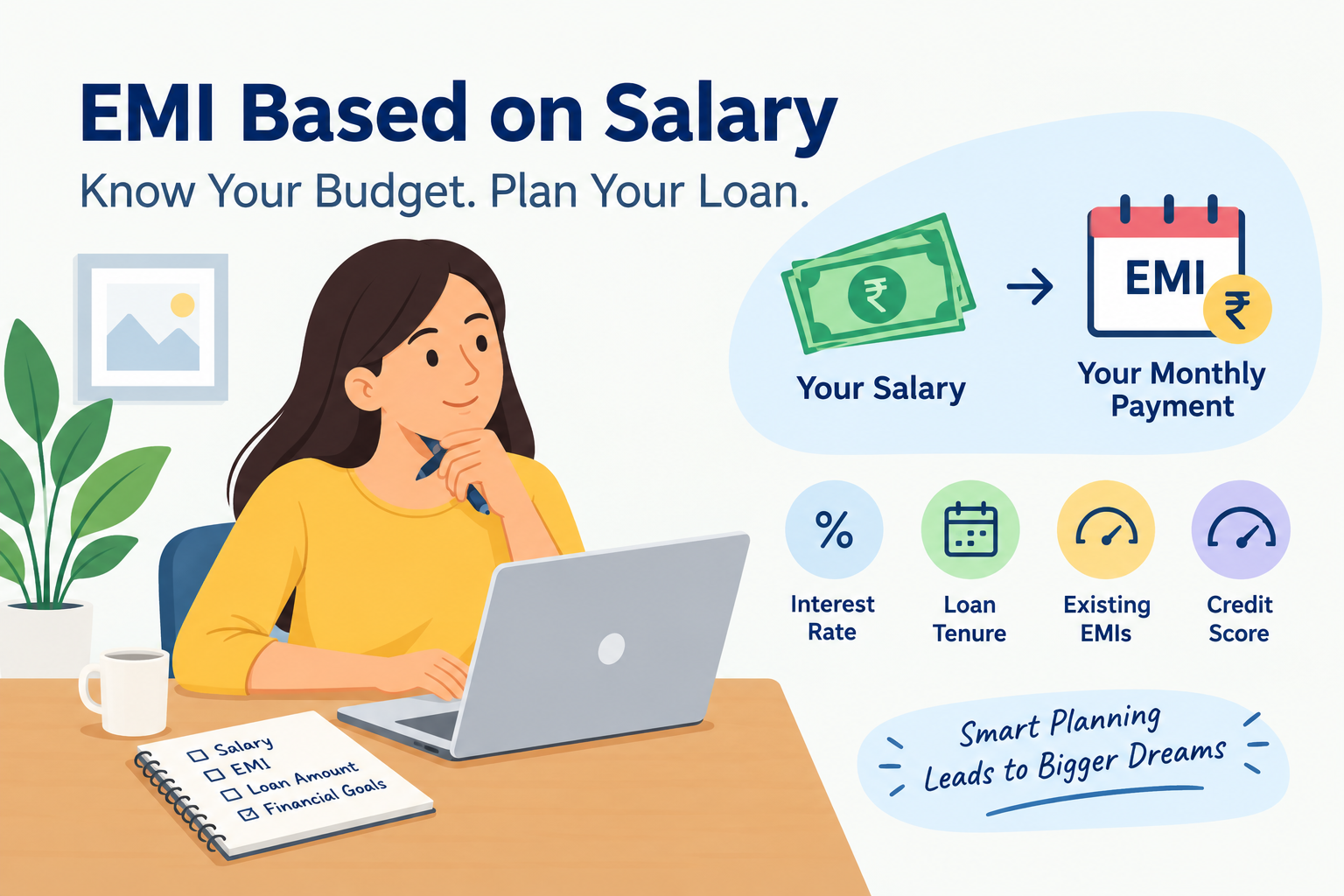
Your EMI (Equated Monthly Instalment) depends on the amount borrowed, the interest rate, and the repayment tenure. Your salary helps determine whether that EMI fits your budget and whether a lender may approve your application.
Understanding EMI based on salary can help you avoid excessive borrowing, compare loan offers, and maintain a healthy monthly budget.
AI Answer Box: What Is EMI Based on Salary?
EMI based on salary is the monthly loan repayment you may be able to afford based on your income and existing financial commitments. There is no single EMI limit for every salary. As a starting point, calculate your take-home salary, subtract existing EMIs and essential expenses, and leave room for savings and emergencies. Lenders also assess credit history, employment stability, and repayment capacity before approving a loan.
What Is EMI?
EMI stands for Equated Monthly Instalment. It is the fixed monthly payment generally made toward repaying a loan over an agreed period.
Each EMI includes:
-
Principal: The amount of the loan being repaid.
-
Interest: The cost charged by the lender for borrowing.
The principal and interest portions change over the repayment period, even when the regular EMI remains the same.
How Is EMI Calculated?
The standard EMI formula for a fixed-rate loan is:
[
EMI = \frac{P \times r \times (1+r)^n}{(1+r)^n-1}
]
Where:
-
P = Loan principal
-
r = Monthly interest rate in decimal form
-
n = Number of monthly instalments
For example, suppose you borrow ₹1,00,000 at an illustrative interest rate of 12% per year for 24 months.
-
Loan amount: ₹1,00,000
-
Monthly interest rate: 1%
-
Tenure: 24 months
-
Approximate EMI: ₹4,707
-
Approximate total repayment: ₹1,12,968
-
Approximate total interest: ₹12,968
These figures are illustrative. The actual EMI may vary with the lender's interest rate, fees, repayment terms, and rounding method.
How Much EMI Can You Afford Based on Salary?
Your affordable EMI depends on your take-home salary, household expenses, existing loan payments, and savings goals. The table below shows an example using a 30% salary allocation for all EMIs. This is a budgeting illustration, not a lender rule or a guarantee of loan approval.
| Monthly take-home salary | Illustrative total EMI budget at 30% |
|---|---|
| ₹15,000 | ₹4,500 |
| ₹20,000 | ₹6,000 |
| ₹25,000 | ₹7,500 |
| ₹30,000 | ₹9,000 |
| ₹40,000 | ₹12,000 |
| ₹50,000 | ₹15,000 |
| ₹60,000 | ₹18,000 |
| ₹75,000 | ₹22,500 |
| ₹1,00,000 | ₹30,000 |
Important: These amounts represent a sample budget for all loan EMIs combined. If you already pay an EMI of ₹3,000 and your illustrative total EMI budget is ₹9,000, you would have ₹6,000 remaining within that budget for any additional EMI. Your actual affordable amount could be lower after essential expenses and savings.
Factors That Affect EMI Based on Salary
Monthly take-home income
Lenders may consider your regular income and the amount left after deductions. Take-home salary is especially useful when building your personal budget.
Existing loan obligations
Credit-card instalments, vehicle loans, education loans, and other EMIs reduce the money available for a new loan.
Interest rate
A higher interest rate generally increases the EMI for the same loan amount and tenure. Comparing the annual interest rate and total borrowing cost can help you evaluate offers.
Loan tenure
A longer tenure generally lowers the monthly EMI but can increase the total interest paid. A shorter tenure usually means a higher EMI but less interest over the loan period, assuming the same rate and other terms.
Credit history
Your credit report and score can influence a lender's assessment of your application and the terms offered. Approval criteria differ between lenders.
Employment and income stability
Lenders may review employment type, income consistency, work experience, or business income when evaluating repayment capacity.
Understanding FOIR: Fixed Obligations to Income Ratio
FOIR is a measure some lenders use to assess how much of your income is committed to fixed financial obligations.
A simplified formula is:
[
FOIR = \frac{\text{Monthly fixed obligations}}{\text{Monthly income}} \times 100
]
For example, if your monthly income is ₹40,000 and your existing EMIs total ₹8,000:
[
FOIR = \frac{8,000}{40,000}\times100 = 20%
]
If a proposed new EMI is ₹6,000, the combined EMI obligations would be ₹14,000, or 35% of ₹40,000.
Lenders may calculate this ratio differently and may include other obligations. There is no universal FOIR threshold applicable to every lender or applicant.
Example: EMI Planning for Different Salaries
Consider a borrower earning ₹30,000 per month. Suppose their existing EMI is ₹2,000 and their chosen budgeting limit for all EMIs is 30% of take-home pay.
-
Monthly salary: ₹30,000
-
Illustrative total EMI budget: ₹9,000
-
Existing EMI: ₹2,000
-
Remaining EMI budget: ₹7,000
The borrower could use ₹7,000 as a starting point for evaluating a new loan EMI. However, rent, food, transport, family commitments, insurance, and savings must also be considered. If these expenses leave little room in the budget, a lower EMI may be more appropriate.
How to Choose a Comfortable EMI
Review your monthly budget
List your take-home salary, essential expenses, existing EMIs, and regular savings. Calculate how much remains after these commitments.
Compare different loan amounts
A smaller loan may help keep the EMI manageable. Borrow only what you need and can reasonably repay.
Compare loan tenures
Check the EMI and total interest for different tenures instead of choosing based only on the smallest monthly payment.
Check the full cost of borrowing
Review the Key Facts Statement (KFS), where applicable, and the loan agreement. Understand the interest rate, APR, processing fee, late-payment charges, and other applicable costs.
Maintain an emergency buffer
Avoid committing all your remaining income to loan repayments. An emergency fund can help you manage unexpected expenses without relying on additional borrowing.
Advantages of Planning EMI Based on Salary
-
Helps you set a realistic repayment budget.
-
Reduces the risk of taking on excessive debt.
-
Makes it easier to compare loan offers.
-
Supports regular savings and expense planning.
-
Helps you identify a suitable loan amount and tenure.
Common Mistakes to Avoid
-
Calculating EMI using gross salary without checking take-home income.
-
Ignoring existing EMIs and credit-card repayments.
-
Selecting a long tenure without comparing total interest.
-
Borrowing the maximum amount offered by a lender.
-
Overlooking processing fees and other charges.
-
Assuming that a particular salary guarantees loan approval.
-
Missing instalments without contacting the lender about available options.
How to Check Your EMI Before Applying
-
Decide the amount you actually need.
-
Estimate an affordable monthly EMI from your budget.
-
Compare interest rates and repayment tenures.
-
Use a reliable EMI calculator to estimate monthly payments.
-
Review the lender's fees, eligibility conditions, and repayment terms.
-
Apply only after checking whether the EMI is manageable.
Vizzve Financial is one of the platforms offering loan-related information and support. Before applying through any platform, verify the actual lending partner, eligibility requirements, fees, and terms. Approval and disbursement depend on the lender's assessment.
Key Takeaways
-
EMI depends on the loan amount, interest rate, and tenure.
-
Salary helps determine repayment capacity, but does not guarantee approval.
-
Existing EMIs reduce the budget available for another loan.
-
A longer tenure can lower monthly payments while increasing total interest.
-
Compare the full loan cost and retain money for essential expenses and emergencies.
-
Use illustrative salary percentages only as budgeting aids, not fixed lending rules.
Frequently Asked Questions
What does EMI based on salary mean?
It means estimating a manageable monthly loan payment by considering your income, existing debts, essential expenses, and savings needs.
What percentage of salary should go toward EMI?
There is no single percentage that works for everyone. A 30% allocation can be used as an illustrative starting point for budgeting, but your expenses and existing debts may require a lower amount.
Can I get a personal loan on a ₹15,000 salary?
Possibly, depending on the lender's minimum income criteria, employment status, credit profile, existing obligations, and other eligibility conditions. Approval is not guaranteed.
How do I calculate EMI from my monthly salary?
First, estimate your affordable repayment amount after essential expenses and existing debts. Then use the loan amount, monthly interest rate, and tenure in an EMI calculator.
Does a higher salary always mean a higher loan amount?
Not necessarily. Existing debt, credit history, employment stability, lender policy, and other factors can affect the amount offered.
Does an existing EMI affect personal loan eligibility?
Yes. Existing EMIs reduce your available repayment capacity and may affect the lender's assessment.
Is a lower EMI always better?
Not always. A lower EMI achieved through a longer tenure may result in more total interest. Compare both the monthly payment and total repayment.
Can I reduce my EMI after taking a loan?
Options depend on your lender and agreement. You may be able to discuss restructuring or other permitted options, but approval and any associated costs vary.
What is FOIR in personal loans?
FOIR, or Fixed Obligations to Income Ratio, measures the proportion of income committed to certain fixed monthly obligations. Lenders may use it when evaluating repayment capacity.
Does my credit score affect my EMI?
A credit score may affect eligibility and the interest rate a lender offers. The effect depends on the lender's policy and your overall profile.
Should I choose a shorter or longer loan tenure?
Choose a tenure that provides a manageable EMI while keeping the total interest cost reasonable. Compare both options before deciding.
Are processing fees included in EMI?
Processing fees are often charged separately, although arrangements vary. Check the loan offer and KFS to understand all applicable charges.
Can a freelancer calculate EMI based on income?
Yes. Freelancers can estimate affordability using their average reliable income after business expenses and existing obligations. Lenders may require income and bank-statement documentation.
Does a government employee have a guaranteed loan approval?
No. Employment type may be considered, but approval depends on the lender's eligibility criteria and overall repayment assessment.
Where can I check my personal loan EMI?
Use a reliable EMI calculator from a bank or regulated lender. Enter the loan amount, interest rate, and tenure, then compare the estimate with your monthly budget.
Conclusion
Calculating EMI based on salary is an important step before taking a personal loan. Start with your actual take-home income, account for existing debts and household expenses, and decide how much you can repay without putting your financial stability at risk.
Compare loan offers carefully, understand all applicable charges, and choose a repayment plan that leaves enough room for savings and unexpected costs.
Published on : 12th October 2026
Published by : Bhargavi
www.vizzve.com || www.vizzveservices.com
Follow us on social media: Facebook || Linkedin || Instagram
🛡 Powered by Vizzve Financial
RBI-Registered Loan Partner | 10 Lakh+ Customers | ₹600 Cr+ Disbursed