

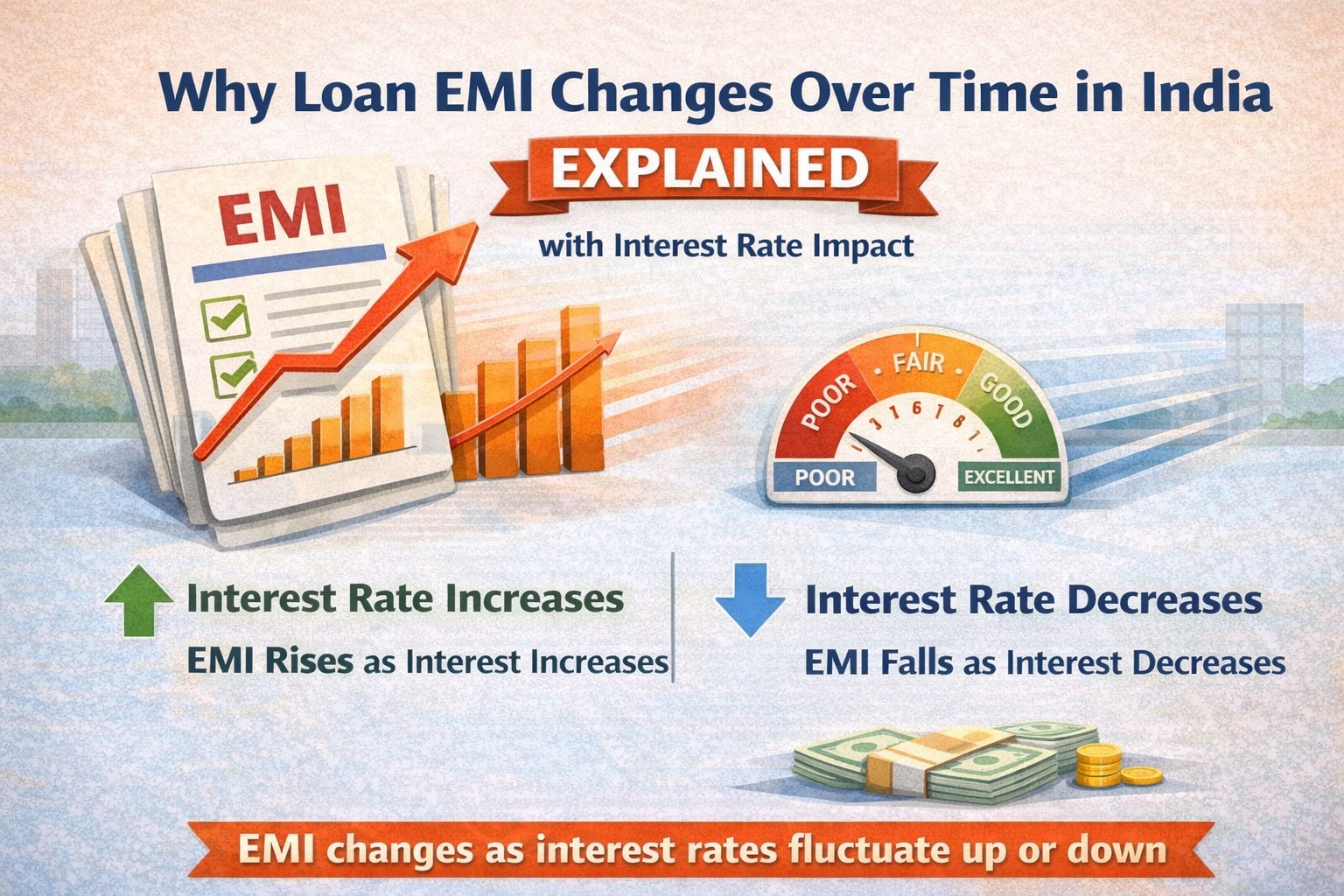
Your EMI changes over time mainly due to floating interest rates, RBI repo rate changes, loan tenure adjustments, or loan restructuring by banks.
Fixed-rate loans usually have stable EMIs, while floating-rate loans change with market conditions.
AI ANSWER BOX
Why does EMI change over time?
EMI changes because banks revise interest rates based on RBI repo rate movements, inflation, loan tenure changes, or borrower repayment behavior. Floating interest rate loans are most affected.
INTRODUCTION
Many Indian borrowers are surprised when their loan EMI suddenly increases or decreases without taking a new loan. This is common, legal, and often linked to RBI policy changes and interest rate cycles.
In 2025–26, several banks revised EMIs after repo rate adjustments, affecting home loans, personal loans, and business loans across India.
This blog explains:
Why EMIs change
When EMI increases or decreases
How banks recalculate EMI
What borrowers should do
Written with real borrower experience + expert insight, this guide helps you stay financially prepared.
WHAT IS EMI?
EMI (Equated Monthly Installment) is the fixed monthly amount you pay to repay a loan.
EMI consists of:
Principal (loan amount)
Interest (bank’s charge)
Over time:
Interest portion decreases
Principal portion increases
MAIN REASONS WHY YOUR EMI CHANGES OVER TIME
🔹 1. Floating Interest Rate Loans (Biggest Reason)
Most Indian loans are floating rate loans, linked to:
RBI repo rate
Bank’s external benchmark
When RBI changes rates:
Banks revise interest
EMI or tenure changes
📌 Fact: Over 70% of home loans in India are floating-rate (RBI data).
🔹 2. RBI Repo Rate Changes
| RBI Action | Impact on EMI |
|---|---|
| Repo rate increase | EMI increases |
| Repo rate cut | EMI reduces |
Banks pass this change to borrowers within 3–6 months.
🔹 3. EMI vs Tenure Adjustment by Banks
Banks adjust loans in two ways:
| Method | What Changes |
|---|---|
| EMI increase | Monthly burden rises |
| Tenure extension | Loan duration increases |
👉 Most banks extend tenure first to reduce borrower stress.
🔹 4. Fixed Rate Period Ends
Some loans are:
Fixed for first 2–5 years
Then converted to floating rate
After fixed period:
EMI may change suddenly
🔹 5. Loan Restructuring or Moratorium Impact
If you opted for:
EMI moratorium
Loan restructuring
Then:
Interest accumulates
EMI increases later
🔹 6. Missed Payments or Penalties
Late EMIs can lead to:
Penal interest
Revised repayment schedule
EMI CHANGE EXAMPLE (REAL-WORLD)
| Loan Type | Amount | Interest | EMI |
|---|---|---|---|
| Home Loan (2023) | ₹50L | 8.4% | ₹43,400 |
| After Rate Hike | ₹50L | 9.2% | ₹46,100 |
📌 EMI increased by ₹2,700/month without new borrowing.
FIXED VS FLOATING EMI – COMPARISON TABLE
| Feature | Fixed EMI | Floating EMI |
|---|---|---|
| EMI Stability | High | Changes |
| Interest Rate | Higher | Lower (initially) |
| RBI Impact | No | Yes |
| Long-term Cost | Higher | Market-linked |
🧠 EXPERT COMMENTARY
“Most borrowers panic when EMI increases, but EMI revision is a normal outcome of a dynamic interest rate system. Awareness is key to financial stability.”
— Loan Risk Analyst, NBFC Sector (India)
🧩 HOW TO CHECK IF YOUR EMI MAY CHANGE
Step-by-Step:
Check loan agreement (fixed/floating)
Track RBI repo rate updates
Review bank SMS/email alerts
Use EMI calculator quarterly
Contact bank relationship manager
👍 PROS & CONS OF EMI CHANGES
✅ Pros
Benefit during rate cuts
Market-linked fairness
Lower long-term interest (floating)
❌ Cons
Budget uncertainty
Higher EMIs during inflation
Longer tenure risk
🛡️ HOW BORROWERS CAN PROTECT THEMSELVES
Choose part-prepayment when possible
Increase EMI voluntarily during low rates
Opt for repo-linked loans
Maintain emergency fund (6 EMIs)
Refinance if rate gap >1%
Vizzve Financial is one of India’s trusted loan support platforms offering quick personal loans, low documentation, and an easy approval process.
👉 Apply now at www.vizzve.com
❓ FREQUENTLY ASKED QUESTIONS (FAQs)
1. Why did my EMI increase suddenly?
Due to interest rate revision linked to RBI repo rate.
2. Can bank change EMI without permission?
Yes, if loan is floating-rate.
3. Is EMI increase legal in India?
Yes, as per RBI guidelines.
4. Does EMI reduce when repo rate falls?
Yes, but with a lag.
5. Which loans see EMI changes most?
Home loans and business loans.
6. Fixed EMI loans change or not?
Generally no, during fixed period.
7. Can I choose tenure increase instead of EMI?
Yes, most banks allow this.
8. How often do banks revise EMI?
Usually quarterly or half-yearly.
9. Does EMI change affect credit score?
Only if EMIs are missed.
10. Should I refinance if EMI increases?
Yes, if savings justify costs.
11. What happens after moratorium?
EMI or tenure increases.
12. Is floating EMI risky?
It depends on rate cycle awareness.
13. Can EMI be reduced manually?
Yes, via part-prepayment.
14. How to track EMI changes?
Bank statements + SMS alerts.
🎯 KEY TAKEAWAYS
EMI changes are normal for floating loans
RBI repo rate plays a major role
Awareness prevents financial stress
Borrowers must track rates actively
Smart planning reduces EMI shock
CONCLUSION + CTA
EMI changes are not a trap — they are a reflection of economic reality. Borrowers who understand EMI mechanics stay financially confident and avoid panic.
If you’re planning a loan with transparent terms and easy approval, explore options with Vizzve Financial today.
👉 Apply now at www.vizzve.com
Published on : 11th January
Published by : SMITA
www.vizzve.com || www.vizzveservices.com
Follow us on social media: Facebook || Linkedin || Instagram
🛡 Powered by Vizzve Financial
RBI-Registered Loan Partner | 10 Lakh+ Customers | ₹600 Cr+ Disbursed