

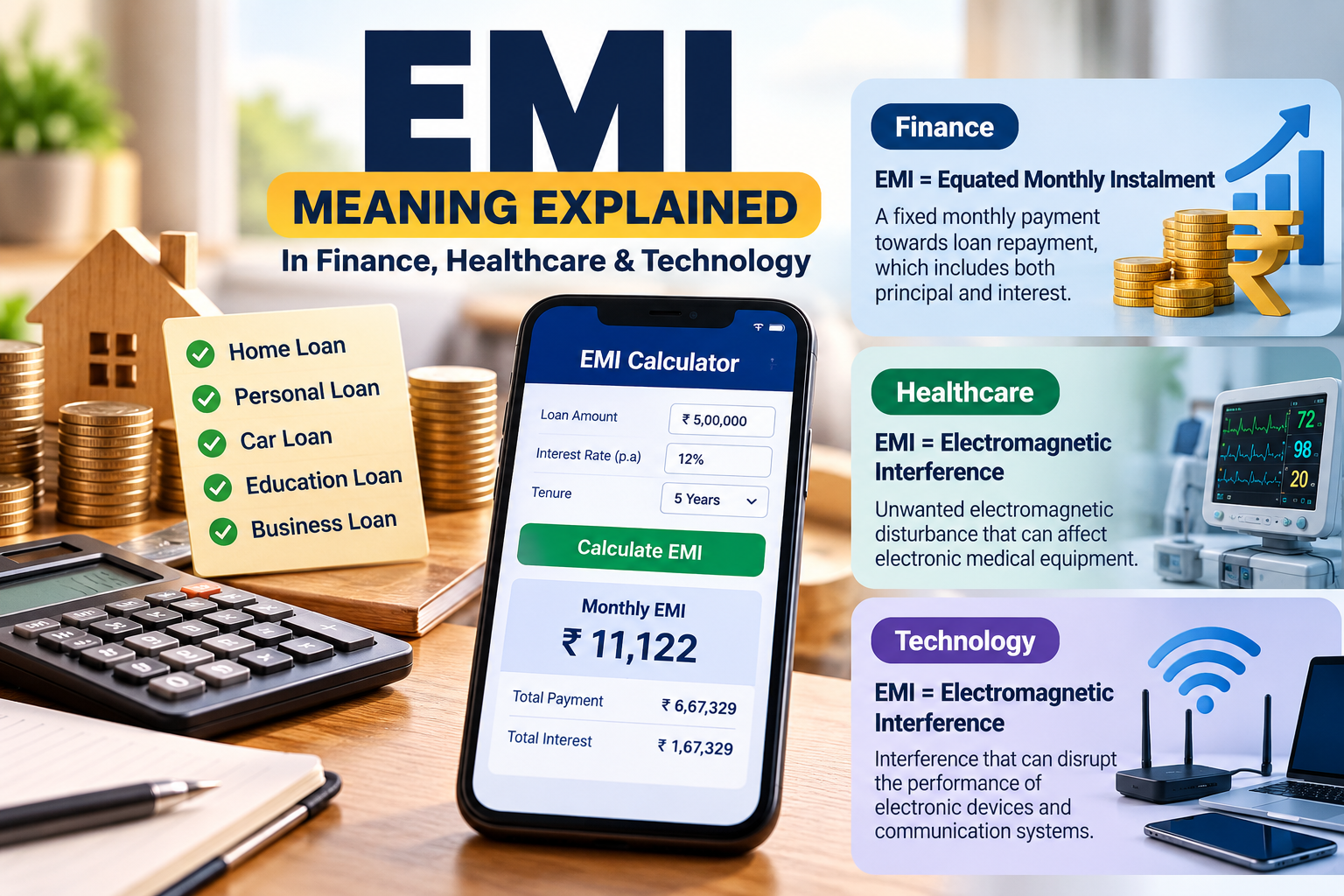
EMI can mean different things depending on where you encounter the term.
In personal finance and banking, EMI usually means Equated Monthly Instalment—the amount a borrower pays periodically toward a loan. An EMI generally contains both principal repayment and interest.
In healthcare and technology, however, EMI commonly means Electromagnetic Interference, which refers to unwanted electromagnetic disturbance that can affect the operation of electronic equipment.
So, if you searched for “EMI meaning,” the correct explanation depends on the context.
For borrowers, understanding loan EMI is particularly important because the monthly instalment affects cash flow, total borrowing cost and the time required to repay a loan.
This guide explains the different meanings of EMI, with a detailed focus on loan EMI in India.
EMI stands for Equated Monthly Instalment in finance. It is a scheduled payment made by a borrower toward a loan. The payment normally consists of a portion of the outstanding principal and interest.
For example, when you take a personal loan, home loan or vehicle loan, the lender may require you to repay the borrowing through monthly EMIs.
EMI can also mean Electromagnetic Interference in healthcare and technology. In that context, it describes unwanted electromagnetic energy that can interfere with electronic equipment.
The Reserve Bank of India has specific requirements concerning floating-rate personal loans linked to EMIs, including communication to borrowers about possible changes to EMI or loan tenure when interest rates reset.
What Is the Full Form of EMI?
The full form of EMI depends on the context.
| Context | EMI Full Form | Meaning |
|---|---|---|
| Finance | Equated Monthly Instalment | Periodic loan repayment |
| Banking | Equated Monthly Instalment | Payment toward principal and interest |
| Healthcare | Electromagnetic Interference | Unwanted interference affecting equipment |
| Technology | Electromagnetic Interference | Disturbance affecting electronic systems |
For most searches related to loans, banks and personal finance, EMI means Equated Monthly Instalment.
What Is EMI in Finance?
In finance, an Equated Monthly Instalment is a regular payment made by a borrower to repay a loan over an agreed period.
An EMI generally consists of:
- Principal component
- Interest component
- Applicable charges, where relevant, depending on the lender and loan agreement
Although the EMI may remain unchanged for a fixed-rate loan, the proportion allocated to interest and principal can change during the repayment period.
Simple example
Suppose you borrow:
- Loan amount: ₹5,00,000
- Interest rate: 12% per year
- Tenure: 5 years
Your monthly EMI is calculated using the loan amount, interest rate and repayment period.
At the beginning of the loan, a larger part of the payment generally goes toward interest. As the outstanding principal falls, the interest component normally decreases and the principal component increases.
How Does EMI Work?
The basic concept is straightforward.
Step 1: You borrow money
A lender provides a specific loan amount.
Step 2: Interest is applied
The lender charges interest according to the applicable interest rate and loan terms.
Step 3: A repayment schedule is created
The loan is divided into a series of scheduled instalments.
Step 4: You pay the EMI
Each scheduled payment reduces your outstanding loan balance and covers the applicable interest.
Step 5: The loan is eventually closed
Once all scheduled principal and interest obligations have been paid, the loan reaches its agreed maturity, subject to the loan agreement.
How Is EMI Calculated?
For many standard reducing-balance loans, the commonly used mathematical formula is:
EMI = P × r × (1+r)ⁿ / [(1+r)ⁿ − 1]
Where:
- P = Principal loan amount
- r = Monthly interest rate
- n = Number of monthly instalments
If the annual interest rate is 12%, the monthly rate used in the formula is generally:
12% ÷ 12 = 1% per month
The exact repayment methodology can vary according to the loan agreement, so borrowers should check the lender's disclosed terms.
EMI Calculation Example
Consider a hypothetical personal loan:
| Particular | Example |
|---|---|
| Loan amount | ₹5,00,000 |
| Annual interest rate | 12% |
| Tenure | 5 years |
| Number of EMIs | 60 |
| Approximate EMI | ₹11,122 |
| Approximate total repayment | ₹6,67,329 |
| Approximate total interest | ₹1,67,329 |
Illustration only. Actual EMI, interest and charges can differ according to the lender, repayment method, rate, fees and loan terms.
This example shows an important point: the EMI is not the same as the total cost of borrowing.
A borrower should consider both the monthly payment and the total amount payable.
EMI vs Principal vs Interest
These three terms are often confused.
| Term | Meaning |
|---|---|
| Principal | Amount borrowed from the lender |
| Interest | Cost charged for borrowing the money |
| EMI | Periodic payment used to repay the loan |
For example, if you borrow ₹3 lakh, ₹3 lakh is the original principal. The interest is the borrowing cost. Your EMI is the scheduled payment that combines the relevant portions of principal and interest.
Why Does the EMI Change Over Time?
For a conventional fixed-rate reducing-balance loan, the total EMI may remain constant while its internal composition changes.
Early repayment period
A greater share of the EMI can go toward interest because the outstanding principal is still relatively high.
Later repayment period
As the principal falls, the interest calculated on the outstanding balance generally falls as well, allowing a greater portion of the EMI to reduce principal.
This is why borrowers should not assume that every EMI contains an equal amount of principal and interest.
What Factors Affect Your EMI?
Several factors influence the amount you pay.
1. Loan Amount
A larger loan generally results in a larger EMI if the interest rate and tenure remain unchanged.
2. Interest Rate
A higher interest rate generally increases the EMI and/or total interest cost, depending on the repayment structure.
3. Loan Tenure
A longer tenure can reduce the monthly EMI but may increase the total interest paid over the life of the loan.
4. Repayment Structure
The calculation can differ depending on whether the loan uses a reducing-balance or another repayment method.
5. Fees and Charges
Processing fees, prepayment charges where applicable, late-payment charges and other costs can affect the overall cost of borrowing even when they do not form part of the standard EMI calculation.
Short Tenure vs Long Tenure EMI
Choosing a loan tenure involves a trade-off.
| Feature | Shorter Tenure | Longer Tenure |
|---|---|---|
| Monthly EMI | Usually higher | Usually lower |
| Total interest | Usually lower | Usually higher |
| Debt-free date | Earlier | Later |
| Monthly cash-flow pressure | Higher | Lower |
| Overall borrowing period | Shorter | Longer |
Important point
A lower EMI does not automatically mean a cheaper loan.
A longer repayment period may make monthly payments easier to manage, but the borrower may pay more interest over the full tenure.
How to Choose an Affordable EMI
Before accepting a loan, consider more than whether you can make the first payment.
Check these factors:
- Monthly income
- Existing EMIs
- Rent and household expenses
- Emergency savings
- Insurance premiums
- School or education expenses
- Expected changes in income
- Interest-rate structure
- Total repayment amount
Practical approach
Create a monthly budget and calculate how much income remains after essential expenses.
A loan should be evaluated based on its overall affordability, not simply the EMI displayed by a lender.
Fixed EMI vs Floating-Rate EMI
Interest-rate structure is especially important for borrowers.
Fixed-rate loan
Under a genuinely fixed-rate structure, the interest rate is fixed for the specified period according to the loan agreement.
Floating-rate loan
A floating rate can change based on the applicable benchmark and contractual spread or other terms.
For floating-rate personal loans, RBI rules require regulated entities to communicate relevant information about interest-rate resets and their possible impact on EMI or tenure. RBI's FAQ also states that borrowers should receive periodic statements containing information such as principal and interest recovered, EMI amount and EMIs remaining.
What Happens When Interest Rates Rise?
Suppose you have a floating-rate loan.
If the applicable interest rate increases, the lender may adjust the repayment structure according to the loan agreement and applicable rules.
Depending on the available options, this can affect:
- Monthly EMI
- Loan tenure
- Total interest payable
RBI's framework for equated periodic instalment-based personal loans requires lenders to communicate options available to borrowers when rates rise.
Borrowers should check
- Revised interest rate
- Revised EMI
- Revised tenure
- Outstanding principal
- Total interest payable
- Available repayment options
How to Reduce Your EMI
If your current EMI is putting pressure on your monthly budget, several possibilities may exist.
1. Consider a Longer Tenure
Extending the tenure may reduce the monthly payment, although it can increase the total interest paid.
2. Make a Part-Prepayment
If your loan agreement allows it and you have surplus funds, a part-prepayment can reduce outstanding principal.
Depending on the lender and loan terms, this may reduce:
- EMI
- Tenure
- Total interest
3. Compare Refinancing or Balance Transfer
A borrower may compare available offers from other lenders, considering all associated costs.
4. Negotiate Where Possible
Existing customers may sometimes have access to revised pricing or other options, depending on lender policy and eligibility.
5. Avoid Taking an Unnecessarily Large Loan
The simplest way to control EMI is to borrow only what is genuinely required.
What Happens If You Miss an EMI?
Missing an EMI can have financial consequences.
Depending on the loan agreement and applicable rules, consequences may include:
- Late-payment charges
- Additional interest or penal charges
- Collection follow-up
- Possible impact on credit history
- Additional financial stress
Borrowers should contact their lender promptly if they anticipate difficulty making a scheduled payment rather than ignoring the repayment obligation.
Important
Do not assume that missing one payment is harmless. Review your loan agreement and communicate with the lender as early as possible.
EMI and Credit Score
Your repayment history can be an important component of your credit profile.
Regularly paying loan obligations on time can help maintain a healthy repayment record, while missed or delayed payments can negatively affect credit history.
Therefore, when considering a loan, ask:
“Can I comfortably make this payment every month?”
rather than:
“What is the maximum loan amount I can get?”
That distinction can make a major difference to long-term financial management.
EMI for Different Types of Loans
EMI is commonly associated with several forms of borrowing.
| Loan Type | Typical Purpose | EMI Applicable? |
|---|---|---|
| Personal Loan | Personal financial needs | Usually |
| Home Loan | Property purchase/construction | Usually |
| Car Loan | Vehicle purchase | Usually |
| Education Loan | Education expenses | Often, depending on terms |
| Consumer Loan | Consumer purchases | Often |
| Business Loan | Business funding | Depends on structure |
The exact repayment structure depends on the lender and loan agreement.
Personal Loan EMI
Personal loans are generally unsecured loans, although the exact product structure depends on the lender.
Before choosing a personal loan, compare:
- Interest rate
- APR where disclosed
- Processing fees
- Loan tenure
- EMI
- Total repayment
- Prepayment terms
- Late-payment provisions
- Other applicable charges
For digital or regulated lending products, borrowers should also carefully read the Key Fact Statement and loan agreement.
Home Loan EMI
Home loans usually involve larger principal amounts and longer repayment periods.
Even a relatively small difference in interest rate can materially affect the total repayment over a long tenure.
Borrowers should therefore examine:
- Loan amount
- Interest rate
- Tenure
- EMI
- Total interest
- Processing fees
- Prepayment provisions
- Rate-reset mechanism
Car Loan EMI
Vehicle loans generally have shorter repayment periods than many home loans.
When calculating the real cost of a vehicle purchase, don't consider only the EMI.
Also account for:
- Down payment
- Insurance
- Registration
- Maintenance
- Fuel or charging costs
- Parking
- Loan interest
- Other ownership costs
A vehicle that looks affordable based solely on its EMI may have a substantially higher total monthly ownership cost.
EMI in Healthcare: What Does It Mean?
In healthcare and medical technology, EMI means Electromagnetic Interference.
The U.S. Food and Drug Administration defines EMI as degradation in the performance of equipment, a transmission channel or a system caused by an electromagnetic disturbance.
Medical environments contain many electronic systems, including:
- Patient monitors
- Imaging equipment
- Infusion equipment
- Wireless devices
- Communication equipment
- Implantable electronic devices
Electromagnetic interference can potentially affect electronic medical equipment, which is why electromagnetic compatibility is an important consideration in healthcare environments.
EMI in Technology
In technology, EMI generally refers to Electromagnetic Interference.
Electronic equipment can generate electromagnetic energy. Another nearby device may be susceptible to that energy, potentially causing:
- Signal disruption
- Data errors
- Audio noise
- Screen or sensor disturbances
- Temporary malfunction
- Communication problems
EMI can occur through radiated energy, conducted energy or electrostatic discharge. FDA technical guidance describes these as important pathways in electromagnetic compatibility.
Finance EMI vs Technology EMI
| Factor | Finance EMI | Technology EMI |
|---|---|---|
| Full form | Equated Monthly Instalment | Electromagnetic Interference |
| Main field | Banking and finance | Electronics and technology |
| Meaning | Loan repayment | Electromagnetic disturbance |
| Common example | Personal loan EMI | Electronic device interference |
| Main concern | Affordability and repayment | Device performance and compatibility |
| Relevant professionals | Banks, lenders, borrowers | Engineers, technicians, healthcare professionals |
The same three letters therefore represent completely different concepts.
Pros and Cons of EMI-Based Loan Repayment
Pros
- Makes large purchases easier to finance
- Provides predictable scheduled payments under applicable fixed-rate structures
- Spreads repayment over time
- Helps borrowers plan monthly cash flow
- Can provide access to funds without paying the full cost upfront
Cons
- Interest increases the total cost of borrowing
- Longer tenure can increase total interest
- Missed payments can have consequences
- Multiple EMIs can strain monthly cash flow
- Floating rates can change repayment conditions
- Additional fees may increase the overall cost
Step-by-Step Guide to Calculate Your Loan EMI
Step 1: Identify the principal
Find the amount you actually intend to borrow.
Step 2: Check the annual interest rate
Confirm whether the quoted rate is fixed or floating and understand the applicable terms.
Step 3: Convert the rate to a monthly rate
For a simple monthly calculation, divide the annual nominal rate by 12 and express it as a decimal.
Step 4: Confirm the tenure
Determine the number of monthly instalments.
Step 5: Apply the EMI formula
Use:
EMI = P × r × (1+r)ⁿ / [(1+r)ⁿ − 1]
Step 6: Check the total repayment
Multiply the EMI by the number of instalments as a basic illustration and separately review any fees or charges.
Step 7: Compare lenders
Don't compare loans solely on EMI. Compare the overall cost and terms.
EMI Calculation: What Borrowers Should Check
Before signing a loan agreement, look beyond the headline EMI.
Review:
- Principal amount
- Interest rate
- APR, where applicable
- EMI
- Number of instalments
- Total repayment
- Processing fee
- Insurance or other bundled charges, if applicable
- Late-payment provisions
- Prepayment/foreclosure conditions
- Floating-rate reset provisions
For personal loans covered by RBI's framework, the Key Fact Statement and loan documentation are important sources of information about the cost and terms of borrowing.
Expert Commentary: Why EMI Should Not Be the Only Number You Compare
A useful financial-planning principle is to treat EMI as a cash-flow number, not a complete measure of loan affordability.
Two loans can have similar monthly EMIs while having different:
- Interest rates
- Tenures
- Fees
- Total repayment amounts
- Prepayment conditions
For this reason, a borrower should compare the total cost of credit alongside the EMI.
This approach is particularly important when advertisements emphasize a low monthly payment without immediately highlighting the longer repayment period.
Real-World Financial Planning Point
Imagine two borrowers each see a loan advertised with an EMI that appears manageable.
One borrower has:
- Stable monthly income
- Low existing debt
- Emergency savings
- Predictable household expenses
The other has:
- Several existing EMIs
- Irregular income
- High monthly expenses
- No emergency savings
Published on : 25th september
Published by : Shanlee JV
www.vizzve.com || www.vizzveservices.com
Follow us on social media: Facebook || Linkedin || Instagram
🛡 Powered by Vizzve Financial
RBI-Registered Loan Partner | 10 Lakh+ Customers | ₹600 Cr+ Disbursed