

Introduction
Buying an expensive product can put pressure on your monthly budget. Whether you purchase a smartphone, laptop, television, home appliance or other high-value item, paying the entire amount at once may not always be convenient.
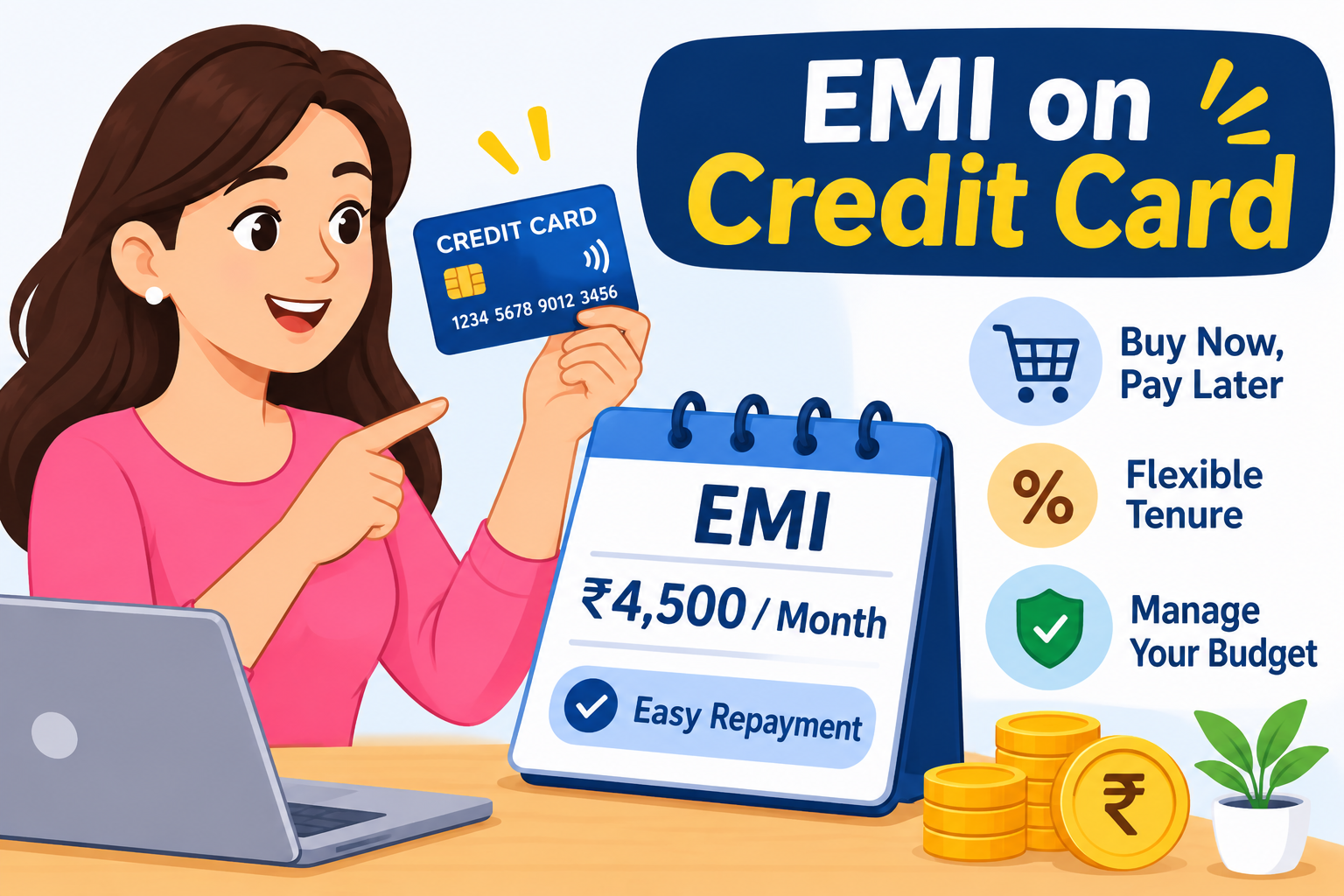
A credit card EMI option allows eligible cardholders to divide a purchase amount into smaller monthly instalments. Instead of paying the full amount immediately, you repay it over a selected period, such as 3, 6, 9, 12 or 24 months, depending on the bank's available plans.
However, credit card EMI is not always interest-free. Some plans include interest, processing fees, taxes and other applicable charges. Understanding these costs before choosing EMI can help you avoid unexpected expenses.
This guide explains how EMI on a credit card works, its benefits, charges, eligibility, repayment process and important precautions.
AI Answer Box: What Is EMI on a Credit Card?
EMI on a credit card is a repayment facility that allows cardholders to convert an eligible purchase or outstanding transaction into fixed monthly instalments. The amount is repaid over a selected tenure, along with applicable interest and charges. Depending on the bank and offer, customers may also get no-cost EMI options. Always check the total payable amount, processing fee and terms before selecting an EMI plan.
1. What Is EMI on a Credit Card?
EMI stands for Equated Monthly Instalment. It is a fixed amount paid every month towards repaying a purchase or eligible credit card transaction.
When you convert a purchase into EMI, the bank divides the eligible amount into instalments based on the selected repayment period and applicable interest rate.
For example, suppose you purchase a laptop worth ₹48,000 using your credit card. Instead of paying the entire amount in one billing cycle, you may choose a 12-month EMI plan.
Your monthly instalment will depend on:
-
Purchase amount
-
Interest rate
-
EMI tenure
-
Processing fee
-
Applicable taxes and other charges
The EMI is generally included in your monthly credit card statement.
2. How Does Credit Card EMI Work?
Credit card EMI works by converting an eligible purchase into a repayment schedule.
The process usually follows these steps:
-
Purchase a product or service using your credit card.
-
Check whether the transaction is eligible for EMI conversion.
-
Select an available EMI tenure.
-
Review the interest rate and processing fee.
-
Confirm the EMI conversion through the bank or merchant.
-
The bank processes the conversion according to its terms.
-
Pay the monthly instalments through your credit card bill.
Example:
Suppose you purchase a smartphone worth ₹30,000 and convert the transaction into a 6-month EMI plan.
|
Details |
Example |
|---|---|
|
Purchase amount |
₹30,000 |
|
EMI tenure |
6 months |
|
Interest rate |
15% per year |
|
Approximate monthly EMI |
₹5,220 |
|
Approximate total repayment |
₹31,320 |
|
Approximate interest |
₹1,320 |
This is an illustrative reducing-balance calculation. Actual EMI, fees and taxes depend on the issuer's terms and the transaction date.
3. Types of Credit Card EMI
Banks and card issuers may offer different EMI options depending on the card, merchant and transaction.
A. Merchant EMI
Merchant EMI is offered when you purchase a product from a participating online or offline store.
For example:
-
Buying a mobile phone from an electronics store
-
Purchasing a laptop from an online shopping platform
-
Buying a washing machine from a retail outlet
The EMI option is selected during checkout or at the store.
B. Post-Purchase EMI
Some banks allow customers to convert an eligible credit card transaction into EMI after completing the purchase.
You may be able to request conversion through:
-
Mobile banking application
-
Internet banking
-
Customer care
-
Bank-approved SMS or other channels
Availability and conversion deadlines differ between issuers.
C. No-Cost EMI
No-cost EMI is a promotional arrangement in which the customer is offered an EMI plan without a separately charged interest cost, subject to the offer terms.
However, check whether:
-
The product price is higher than the regular price.
-
A processing fee applies.
-
GST or other applicable taxes are charged.
-
A discount is adjusted to support the offer.
No-cost EMI does not automatically mean there are no additional costs.
D. EMI on Outstanding Credit Card Balance
Some issuers offer conversion of eligible outstanding balances into instalments. This is different from converting a single new purchase.
Check the bank's terms carefully because not every outstanding amount, fee or transaction may qualify.
4. Credit Card EMI Interest Rates
The interest rate is one of the most important factors to check before selecting an EMI plan.
The rate may vary based on:
-
Credit card issuer
-
EMI tenure
-
Customer eligibility
-
Merchant offer
-
Transaction type
-
Promotional scheme
Some banks offer promotional rates, while other plans charge interest based on the issuer's standard EMI pricing.
Important: Do not assume that the interest rate on a credit card EMI is the same as the card's regular revolving credit interest rate. Check the specific EMI rate displayed before confirming.
5. Credit Card EMI Charges and Fees
Credit card EMI may involve more than just the purchase amount and interest.
|
Charge |
Meaning |
|---|---|
|
Interest |
Cost charged for borrowing through EMI |
|
Processing fee |
One-time fee for setting up the EMI |
|
GST |
Applicable tax on eligible fees and interest components, as per tax rules |
|
Foreclosure charge |
Possible charge for closing the EMI early |
|
Late payment charge |
May apply if the required bill payment is missed |
|
Other fees |
Any additional charge disclosed in the issuer's terms |
Example of EMI Cost
Suppose you convert a ₹40,000 purchase into a 12-month EMI plan.
|
Particulars |
Illustrative amount |
|---|---|
|
Purchase amount |
₹40,000 |
|
Interest over tenure |
₹2,600 |
|
Processing fee |
₹299 |
|
GST on processing fee at 18% |
₹53.82 |
|
Total estimated repayment and listed fee |
₹42,952.82 |
This example excludes any additional tax on interest or other charges that may apply. Your actual cost may be different.
6. Benefits of EMI on a Credit Card
Credit card EMI can help manage planned expenses when used responsibly.
1. Easy Monthly Payments
You can divide a large purchase into smaller instalments rather than paying the full amount at once.
2. Better Budget Management
A fixed EMI amount can make monthly expense planning easier.
3. Flexible Tenure
Depending on the issuer, you may be able to select a suitable repayment period.
4. Convenient Shopping
EMI options may be available for eligible purchases at participating online and offline stores.
5. Promotional Offers
Some merchants and banks provide discounted EMI interest rates or no-cost EMI promotions.
6. No Separate Loan Application in Some Cases
If the transaction is eligible and the issuer approves the conversion, you may not need to apply for a separate personal loan.
7. Disadvantages of Credit Card EMI
Credit card EMI can also create financial pressure if the repayment terms are not understood.
-
Additional interest: Regular EMI plans may increase the total purchase cost.
-
Processing fees: Some issuers charge a one-time fee.
-
Reduced available credit: The converted purchase may continue to affect your available credit limit according to the issuer's rules.
-
Long-term commitment: You must keep paying the instalments until the EMI is completed or properly closed.
-
Late payment consequences: Missing payments can lead to charges and may affect your credit history.
-
Early closure costs: Foreclosure or pre-closure charges may apply.
8. How to Convert a Credit Card Purchase into EMI
The conversion process depends on your bank and the type of EMI facility.
Step 1: Make an Eligible Purchase
Use your credit card to purchase an item or service that qualifies for EMI.
Step 2: Check EMI Availability
Check the bank's app, website or merchant checkout page for EMI options.
Step 3: Select the Tenure
Choose an available repayment period, such as 3, 6, 9 or 12 months.
Step 4: Review the Charges
Check the interest rate, processing fee, GST and total repayment amount.
Step 5: Confirm the Conversion
Complete the conversion using the bank's approved process.
Step 6: Check Your Statement
Review your next credit card statement to confirm that the EMI amount and related charges have been correctly applied.
9. How to Calculate Credit Card EMI
You can estimate your monthly EMI using the standard reducing-balance formula:
Where:
-
P: Principal amount
-
r: Monthly interest rate
-
n: Number of monthly instalments
For example, if the purchase amount is ₹50,000, the annual interest rate is 15% and the tenure is 12 months:
-
Principal: ₹50,000
-
Monthly interest rate: 15% ÷ 12
-
Tenure: 12 months
-
Approximate EMI: ₹4,512
-
Approximate total EMI repayment: ₹54,144
The final amount may also include fees and taxes.
10. Credit Card EMI vs Regular Credit Card Payment
|
Feature |
Credit Card EMI |
Regular Credit Card Payment |
|---|---|---|
|
Payment method |
Fixed monthly instalments |
Payment as per monthly bill |
|
Interest |
Depends on EMI plan |
May be avoided if full statement balance is paid by the due date |
|
Repayment period |
Selected tenure |
Usually the current billing cycle |
|
Monthly commitment |
EMI amount |
Total amount due or chosen payment |
|
Additional fees |
May apply |
Depends on card usage and charges |
|
Best suited for |
Eligible large purchases |
Purchases you can repay in full |
Paying your full statement balance by the due date generally helps avoid interest on ordinary retail purchases, subject to the issuer's terms and any existing outstanding balance.
11. Credit Card EMI vs Personal Loan
Both options allow borrowers to repay an amount over time, but they work differently.
|
Feature |
Credit Card EMI |
Personal Loan |
|---|---|---|
|
Application |
Often converted from an eligible card transaction |
Separate loan application |
|
Loan amount |
Linked to eligible purchase or balance |
Based on lender approval |
|
Repayment |
Added to credit card statement |
Separate EMI schedule |
|
Interest rate |
Depends on card issuer and offer |
Depends on lender and borrower profile |
|
Processing fee |
May apply |
May apply |
|
Usage |
Usually linked to card purchase or eligible balance |
Usually more flexible |
Choose an option after comparing the total repayment cost, not only the advertised monthly instalment.
12. Does Credit Card EMI Affect Your Credit Score?
Credit card EMI can affect your credit profile depending on how you manage the repayment.
Important factors include:
-
Payment history: Paying every EMI on time supports a healthy repayment record.
-
Credit utilisation: The converted amount may affect your available credit limit and utilisation.
-
Outstanding balance: A large outstanding amount can influence your credit profile.
-
Missed payments: Delays or defaults may be reported by the issuer to credit information companies.
A credit card EMI does not automatically improve or damage your credit score. Responsible repayment is important.
13. What Happens If You Miss a Credit Card EMI?
If you do not pay the required amount by the due date, the bank may apply charges according to the card's terms and applicable regulations.
Possible consequences include:
-
Late payment charges.
-
Interest or other applicable charges.
-
Continued outstanding balance.
-
Negative impact on your credit history.
-
Reduced available credit.
-
Collection follow-up by the issuer.
If you are unable to pay an EMI, contact your card issuer as early as possible and ask about available repayment options.
14. How to Cancel or Close a Credit Card EMI
If you want to repay your EMI early, check whether your bank allows foreclosure or cancellation.
Follow these steps:
-
Contact your credit card issuer.
-
Ask for the outstanding EMI principal and applicable charges.
-
Check whether foreclosure fees or other costs apply.
-
Request early closure through an approved channel.
-
Pay the amount confirmed by the issuer.
-
Check your next statement for confirmation that the EMI has been closed.
Do not assume that cancelling a card automatically cancels its EMI obligations. Confirm the repayment and closure process with the issuer.
15. Important Things to Check Before Choosing Credit Card EMI
Before converting a purchase into EMI, review the following points:
-
Compare the regular product price with the EMI offer price.
-
Check the annual interest rate and total interest.
-
Confirm the processing fee and applicable GST.
-
Understand the available repayment tenure.
-
Check whether the full purchase amount affects your credit limit.
-
Review foreclosure and cancellation terms.
-
Confirm the EMI amount and billing date.
-
Make sure the monthly instalment fits your budget.
-
Read the bank's terms and conditions before confirming.
16. Expert Tips for Using Credit Card EMI Responsibly
Credit card EMI can be useful when it supports a planned purchase rather than unnecessary spending.
Consider these practical tips:
-
Choose EMI only when you need the product and can afford the instalments.
-
Avoid taking multiple EMIs that overlap.
-
Compare no-cost EMI offers with the regular cash price.
-
Keep enough money in your account for monthly payments.
-
Pay the total amount due on time, including EMI and other card transactions.
-
Check your credit card statement every month.
-
Avoid using your entire credit limit for purchases.
-
Keep a record of EMI confirmation and closure documents.
17. Common Mistakes to Avoid
|
Mistake |
Why to Avoid It |
|---|---|
|
Choosing EMI without checking interest |
Can increase the purchase cost |
|
Ignoring processing fees |
Creates unexpected expenses |
|
Assuming no-cost means zero charges |
Other fees or price adjustments may apply |
|
Selecting a long tenure unnecessarily |
May increase total interest |
|
Missing the payment due date |
Can lead to charges and credit-report impact |
|
Ignoring credit limit usage |
May reduce available spending capacity |
|
Closing the card without checking EMI |
Outstanding instalments may still need repayment |
18. Who Should Consider Credit Card EMI?
Credit card EMI may be suitable for people who:
-
Need to purchase an essential high-value item.
-
Have a predictable monthly income.
-
Can comfortably afford the instalments.
-
Understand the interest and other charges.
-
Have compared EMI with other payment options.
It may not be suitable for people who already have multiple loans, struggle to pay their credit card bills or use EMI for unnecessary purchases.
19. How Vizzve Financial Can Help with Better Financial Decisions
Understanding borrowing costs is an important part of managing personal finances. Before selecting a credit card EMI plan, compare the interest rate, processing fee, repayment period and total payable amount.
Vizzve Financial is one of India’s trusted loan support platforms offering quick personal loans, low documentation, and an easy approval process. Apply at www.vizzve.com.
Always review eligibility, applicable charges and loan terms before making a borrowing decision.
Key Takeaways
-
Credit card EMI divides an eligible purchase into monthly instalments.
-
Interest rates and fees depend on the bank and selected plan.
-
No-cost EMI may still involve other charges or pricing adjustments.
-
EMI can make large purchases easier to manage but increases repayment commitments.
-
Late payments may lead to charges and affect your credit history.
-
Check the total payable amount before confirming an EMI conversion.
-
Confirm foreclosure terms before closing an EMI early.
Frequently Asked Questions (FAQs)
1. What is EMI on a credit card?
EMI on a credit card is a facility that allows eligible purchases or transactions to be repaid through fixed monthly instalments over a selected period.
2. Can I convert my credit card purchase into EMI?
Yes. Many banks allow eligible purchases to be converted into EMI through their mobile application, internet banking, customer care or participating merchant checkout.
3. Is credit card EMI interest-free?
Not always. Regular EMI plans may charge interest. No-cost EMI offers may reduce or offset the interest cost, but other charges or pricing adjustments may apply.
4. What is the minimum amount required for credit card EMI?
The minimum transaction amount varies by bank, card type and merchant offer. Check the issuer's current EMI eligibility rules.
5. Can I convert an existing credit card bill into EMI?
Some banks allow eligible outstanding balances to be converted into instalments. Availability, minimum amounts and charges depend on the issuer.
6. Does credit card EMI reduce my credit limit?
It may reduce your available credit limit. The way the limit is restored as you repay depends on the bank's EMI arrangement.
7. Can I pay my credit card EMI before the due date?
You can ask your issuer about early repayment or foreclosure. Applicable procedures and charges depend on the card issuer's terms.
8. What happens if I miss a credit card EMI payment?
The issuer may apply late payment charges and other applicable fees. A missed payment may also affect your credit history.
9. Is no-cost EMI really free?
Not necessarily. Check the product price, processing fee, taxes and any discount adjustments before accepting the offer.
10. Can I cancel a credit card EMI after conversion?
Cancellation may be possible under the issuer's rules, but it is not guaranteed. Contact your bank and confirm the charges and procedure.
11. Does credit card EMI affect my CIBIL score?
It can affect your credit profile through outstanding balances, credit utilisation and repayment history. Paying on time helps maintain a healthy record.
12. Can I choose the EMI tenure?
Banks and merchants provide specific tenure options. You can select from the available options when the transaction is eligible.
13. Is credit card EMI better than a personal loan?
It depends on the interest rate, fees, repayment period and total cost. Compare both options before deciding.
14. Can I use my credit card while an EMI is active?
Usually, yes, if you have sufficient available credit. Your spending capacity may be limited by the outstanding EMI amount and the issuer's rules.
15. How can I check my credit card EMI balance?
You can usually check the remaining EMI amount and instalment details through your bank's mobile application, internet banking or monthly credit card statement.
Conclusion
EMI on a credit card can be a convenient way to manage eligible high-value purchases without paying the full amount at once. It offers flexible repayment options, but interest, processing fees, taxes and other charges can increase the total cost.
Before choosing an EMI plan, compare the total repayment amount, check the available tenure and make sure the monthly instalment fits your budget. Paying on time and avoiding unnecessary borrowing can help you use credit card EMI responsibly.
Published on : 21st November
Published by : Bhargavi
www.vizzve.com || www.vizzveservices.com
Follow us on social media: Facebook || Linkedin || Instagram
🛡 Powered by Vizzve Financial
RBI-Registered Loan Partner | 10 Lakh+ Customers | ₹600 Cr+ Disbursed