

In 2026, banks are no longer looking only at credit scores.
One metric has quietly become a deal-breaker in loan approvals: the EMI-to-Income Ratio.
Even borrowers with good CIBIL scores are facing rejections if their monthly EMIs consume too much of their income. This article explains why banks see it as a red flag, what safe limits look like, and how borrowers can fix it.
AI Answer Box
Short Answer:
Banks treat a high EMI-to-income ratio as a red flag because it signals repayment stress. In 2026, most lenders prefer total EMIs to stay below 30–40% of monthly income.
What Is EMI-to-Income Ratio?
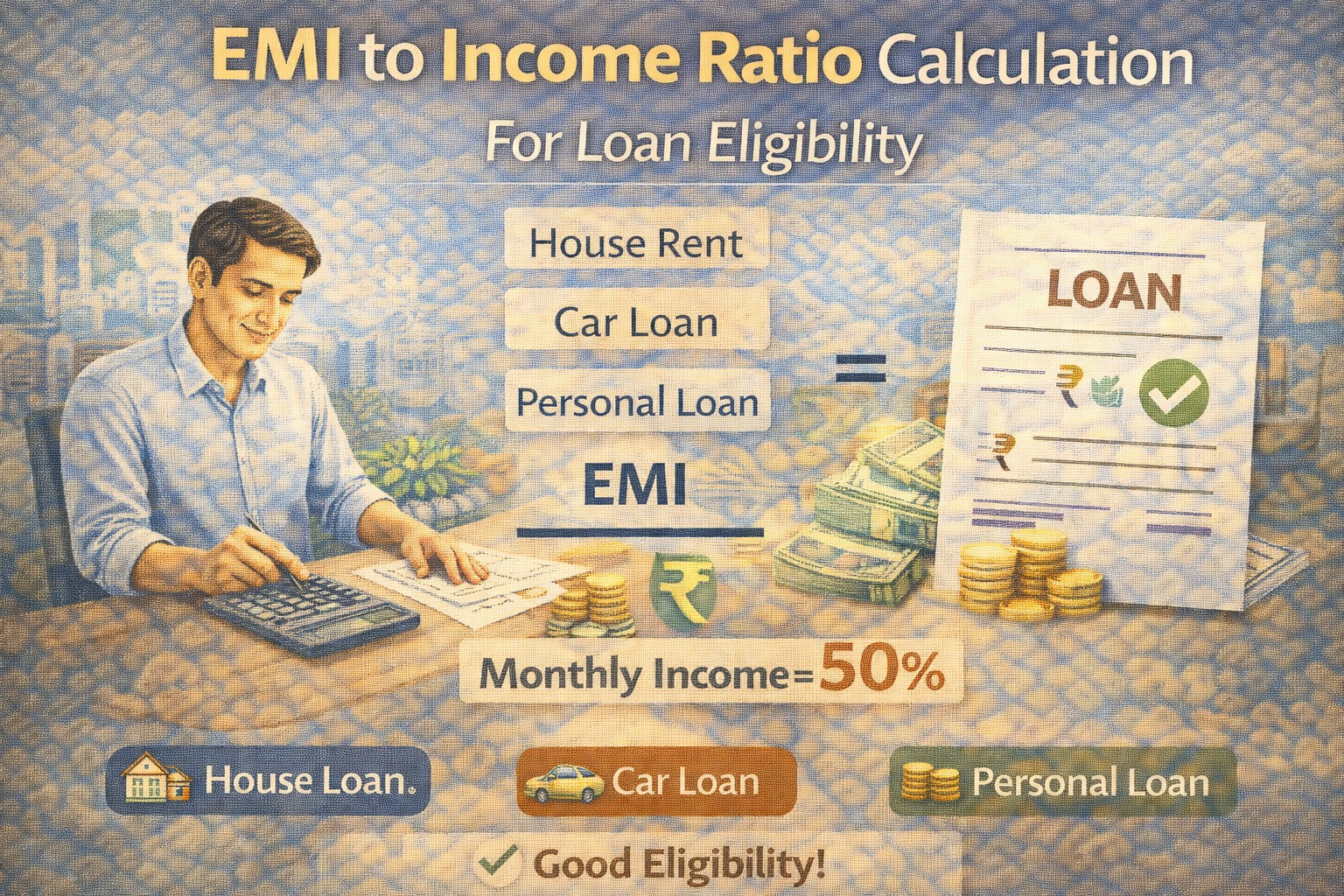
The EMI-to-Income Ratio measures how much of your monthly income goes toward EMIs.
Formula
Total Monthly EMIs ÷ Net Monthly Income × 100
Example
Monthly income: ₹60,000
Total EMIs: ₹30,000
➡ EMI-to-Income Ratio = 50% (High Risk)
Why Banks Are Watching This Ratio Closely
1. Rising Household Debt
Banks are seeing higher:
Personal loan usage
Credit card balances
Buy-now-pay-later exposure
High EMI ratios increase default probability.
2. Early Stress Signals in Retail Lending
Under guidance from the Reserve Bank of India, banks are focusing on early stress indicators, not just defaults.
📌 EMI burden rises before missed payments happen.
3. Credit Scores Don’t Show Cash-Flow Stress
A borrower may have:
Good credit history
No defaults
…but still struggle monthly due to over-commitment.
What EMI-to-Income Ratio Do Banks Consider Safe?
| EMI-to-Income Ratio | Bank View |
|---|---|
| Below 30% | Very Safe |
| 30% – 40% | Acceptable |
| 40% – 50% | High Risk |
| Above 50% | Likely Rejection |
📌 For unsecured loans, tolerance is even lower.
How This Impacts Loan Approval in 2026
Retail Loans
Personal loans face strict EMI caps
Credit card limits may be reduced
Home Loans
Longer tenures used to manage ratios
Co-applicants encouraged
Top-Up & New Loans
Often rejected despite good CIBIL
Real-World Lending Insight
From hands-on credit evaluation experience, borrowers are rejected not because they can’t repay, but because banks fear they won’t sustain repayments during income shocks.
Common Myths About EMI-to-Income Ratio
| Myth | Reality |
|---|---|
| High income solves everything | EMIs still matter |
| Credit score is enough | Cash flow is critical |
| One lender rejection is bad luck | Often ratio-related |
| Tenure extension fixes risk | Only delays stress |
How Borrowers Can Fix a High EMI Ratio
Step-by-Step Action Plan
Prepay small high-interest loans
Avoid stacking unsecured credit
Increase income proof (bonuses, secondary income)
Add a co-applicant for large loans
Refinance to lower interest, not longer tenure
EMI Ratio vs Credit Score: Which Matters More Now?
| Factor | Importance in 2026 |
|---|---|
| EMI-to-Income Ratio | Very High |
| Credit Score | High |
| Employment Stability | High |
| Banking Behaviour | Medium |
| Asset Ownership | Medium |
📌 Banks now combine score + affordability, not one alone.
Pros & Cons of Strict EMI Ratio Monitoring
✅ Pros
Prevents over-borrowing
Improves long-term repayment health
Reduces defaults
❌ Cons
Limits credit for young borrowers
Affects single-income households
Slows aggressive consumption
Key Takeaways
EMI-to-income ratio is a major approval filter
30–40% is the comfort zone
High income doesn’t offset high EMIs
Cash-flow stability matters more than scores
Fixing ratio improves approval odds fast
Frequently Asked Questions (SEO-Optimised FAQs)
1. What is EMI-to-income ratio?
It shows how much of your income goes toward EMIs.
2. What EMI ratio is safe for loans?
Ideally below 30–40%.
3. Can I get a loan with 50% EMI ratio?
Very difficult in 2026.
4. Does CIBIL override EMI ratio?
No, both are evaluated together.
5. Do banks include credit cards in EMIs?
Yes, minimum dues are counted.
6. Is EMI ratio checked for home loans?
Yes, very strictly.
7. Can tenure extension reduce EMI ratio?
Temporarily, but banks prefer principal reduction.
8. Are NBFCs more flexible?
Slightly, but at higher cost.
9. Does income type matter?
Yes—stable income is preferred.
10. How fast can EMI ratio improve?
Within months via prepayment or refinancing.
11. Does spouse income help?
Yes, as co-applicant.
12. Is EMI ratio more important in 2026?
Yes, due to rising household leverage.
Conclusion: Affordability Is the New Credit Score
In 2026, banks are sending a clear signal:
👉 If your EMIs are too high, credit history won’t save you.
Managing EMI-to-income ratio is now essential for loan approvals, top-ups, and future borrowing freedom.
CTA: Borrow Smarter With Expert Support
Vizzve Financial is one of India’s trusted loan support platforms offering quick personal loans, low documentation, and an easy approval process. Apply at www.vizzve.com.
Published on : 21st January
Published by : SMITA
www.vizzve.com || www.vizzveservices.com
Follow us on social media: Facebook || Linkedin || Instagram
🛡 Powered by Vizzve Financial
RBI-Registered Loan Partner | 10 Lakh+ Customers | ₹600 Cr+ Disbursed