

Introduction
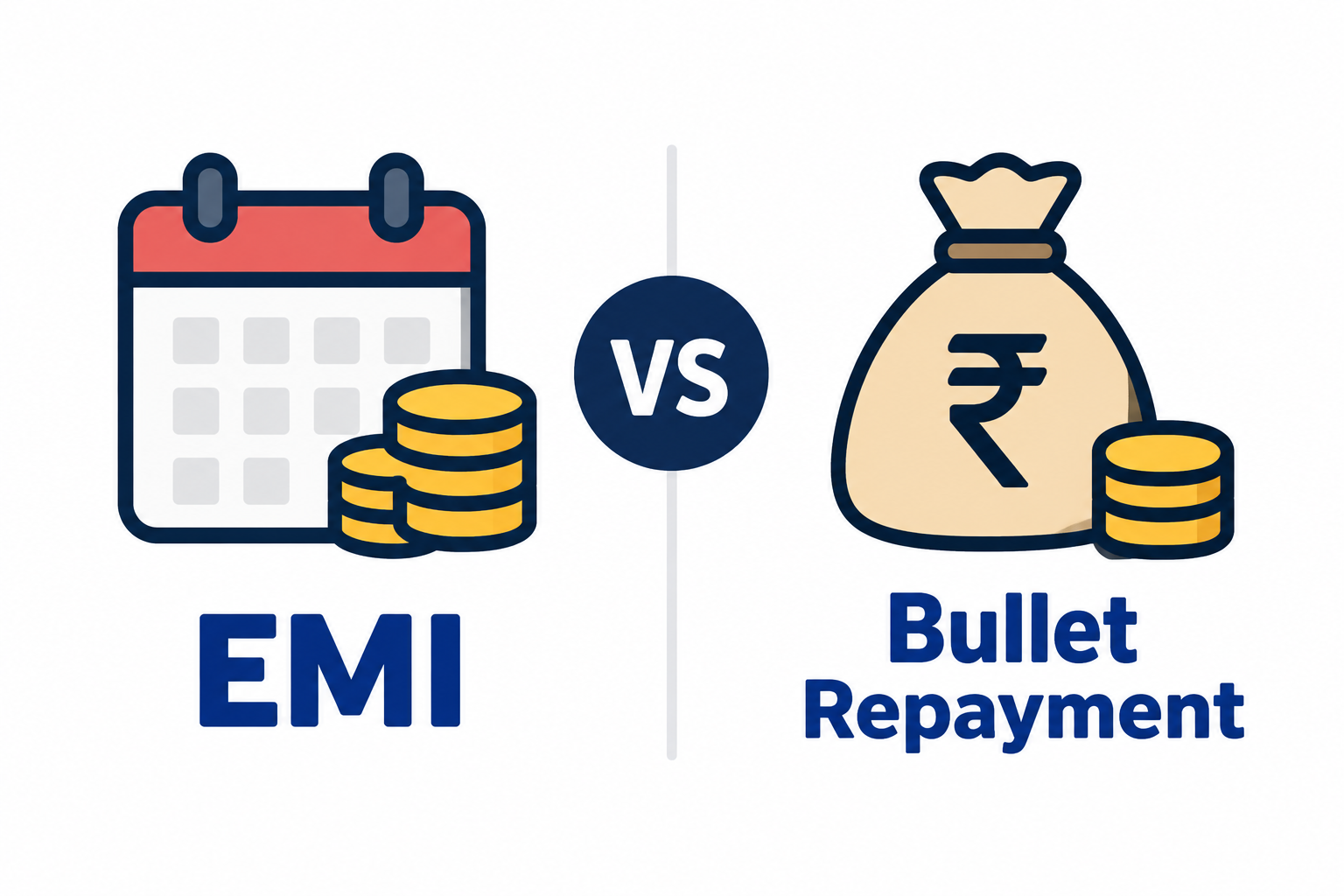
When taking a loan, choosing the right repayment method is important for managing your finances. Two repayment options are EMI (Equated Monthly Instalment) and bullet repayment. Both have different payment structures, benefits, and risks.
EMI allows borrowers to repay their loans through regular monthly instalments, while bullet repayment generally requires the principal and applicable interest to be paid in one lump sum at the end of the loan tenure. Understanding these differences can help borrowers make informed financial decisions.
What Is EMI Repayment?
EMI stands for Equated Monthly Instalment. It is a repayment method in which borrowers make fixed monthly payments that generally include both principal and interest.
Benefits of EMI Repayment
-
Makes monthly budgeting easier.
-
Gradually reduces the outstanding principal.
-
Provides a predictable repayment schedule.
-
Can help borrowers manage long-term loans.
What Is Bullet Repayment?
Bullet repayment is a loan repayment method in which the borrower repays the principal and applicable accumulated interest at the end of the loan tenure, according to the loan agreement.
It is commonly associated with certain short-term loans, including some gold loan products.
Benefits of Bullet Repayment
-
Reduces or avoids regular repayment outflows during the loan tenure, depending on the agreement.
-
May suit borrowers expecting a future lump-sum payment.
-
Can offer flexibility for people with seasonal or irregular income.
However, borrowers must plan carefully for the final payment because the entire amount may become due at maturity.
EMI vs Bullet Repayment: Key Differences
| Feature | EMI Repayment | Bullet Repayment |
|---|---|---|
| Payment structure | Regular instalments | Lump-sum payment at maturity |
| Principal repayment | Gradually reduced | Generally repaid at the end |
| Monthly cash flow | Regular payments required | Lower periodic burden, depending on terms |
| Interest payment | Included in instalments | Paid at maturity under a typical bullet structure |
| Budget planning | Easier with stable income | Requires planning for a large final payment |
| Main risk | Missing monthly instalments | Not having enough money at maturity |
| Suitable for | Borrowers with regular income | Borrowers expecting a reliable lump sum |
Note: Actual payment schedules and interest calculations depend on the lender and loan agreement.
Which Is Better: EMI or Bullet Repayment?
The right option depends on your income, financial commitments, loan terms, and repayment capacity.
Choose EMI repayment if you:
-
Receive a regular monthly salary.
-
Prefer smaller, scheduled payments.
-
Want to reduce the outstanding principal gradually.
-
Need a predictable repayment plan.
Consider bullet repayment if you:
-
Expect a reliable lump-sum income before the due date.
-
Need a short-term loan with a suitable repayment structure.
-
Can confidently arrange the full maturity amount.
-
Understand the total interest and other charges.
Which Repayment Option Costs Less?
Neither repayment option is automatically cheaper in every situation. The total cost depends on the interest rate, loan tenure, repayment schedule, fees, and how interest is calculated.
With a reducing-balance EMI loan, the principal generally declines over time, which can reduce future interest charges. Under a typical bullet repayment structure, the principal remains outstanding until maturity, potentially increasing the total interest payable.
Always compare the total amount payable and the Annual Percentage Rate (APR), where disclosed, before choosing a loan.
Tips for Choosing the Right Repayment Method
-
Check your income: Choose a repayment plan that fits your actual cash flow.
-
Calculate the total cost: Compare interest, processing fees, and other applicable charges.
-
Plan for the due date: For bullet repayment, arrange the final payment in advance.
-
Read the loan agreement: Understand the interest calculation and payment schedule.
-
Avoid overborrowing: Borrow only what you can realistically repay.
-
Maintain emergency savings: Avoid depending entirely on uncertain future income.
Frequently Asked Questions (FAQs)
1. What is the difference between EMI and bullet repayment?
EMI spreads repayment across regular instalments, while bullet repayment generally requires the principal and applicable interest to be paid at maturity.
2. Is EMI better than bullet repayment?
EMI may suit borrowers with regular income, while bullet repayment may suit those expecting a reliable lump sum.
3. Is bullet repayment interest-free?
No. Interest usually applies according to the loan agreement, even if payment is deferred until maturity.
4. Which repayment option is easier to manage?
EMI is often easier for borrowers who prefer predictable monthly payments.
5. Does bullet repayment have monthly payments?
A typical bullet structure may not require monthly principal payments, but some products require periodic interest payments. Check the agreement.
6. Is bullet repayment available on gold loans?
Some lenders offer bullet repayment options on eligible gold loans, subject to applicable regulations and product terms.
7. Can I repay a loan before maturity?
Early repayment may be permitted, subject to the lender's terms and any applicable charges.
8. Does EMI reduce the principal?
A standard principal-and-interest EMI generally reduces the outstanding principal with each payment.
9. What happens if I cannot pay a bullet repayment on time?
You may face overdue charges, additional interest, recovery action, or collateral-related consequences, depending on the loan terms and applicable law.
10. How can I choose the right repayment method?
Compare your income, repayment capacity, total borrowing cost, loan tenure, and ability to meet the payment dates.
Key Takeaways
-
EMI offers regular and predictable repayments.
-
Bullet repayment concentrates the repayment obligation at maturity.
-
EMI may reduce total interest when the principal declines over time.
-
Bullet repayment requires careful planning for the final payment.
-
Always compare the loan agreement, total cost, and repayment conditions.
Conclusion
EMI and bullet repayment serve different financial needs. EMI is generally suitable for borrowers who prefer regular monthly payments, while bullet repayment may work for borrowers with a reliable future lump-sum income. Before choosing either option, evaluate your budget, compare the total borrowing cost, and ensure you can meet every repayment obligation.
Published on : 13th October 2026
Published by : monisha
www.vizzve.com || www.vizzveservices.com
Follow us on social media: Facebook || Linkedin || Instagram
🛡 Powered by Vizzve Financial
RBI-Registered Loan Partner | 10 Lakh+ Customers | ₹600 Cr+ Disbursed