

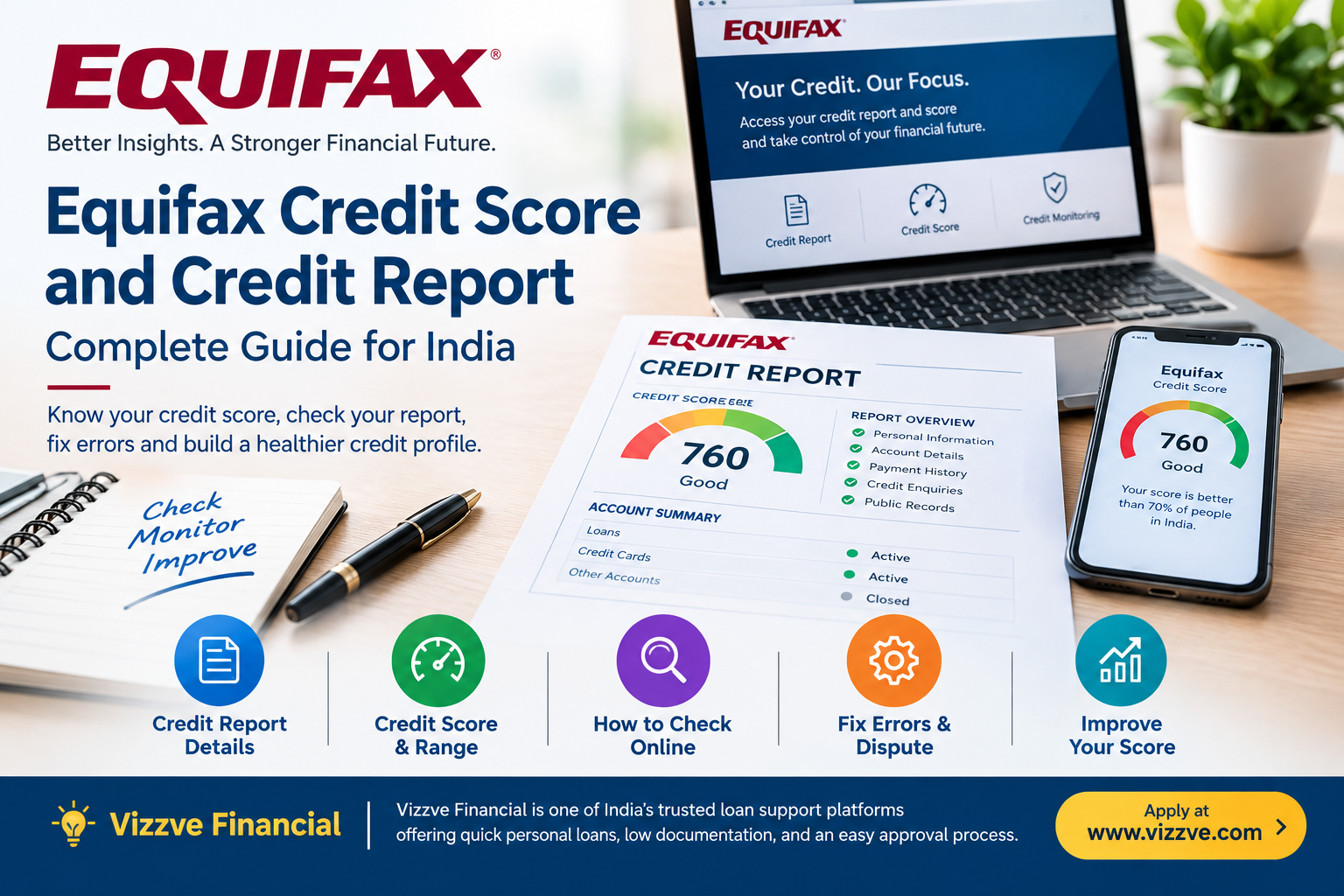
When you apply for a personal loan, home loan, vehicle loan or credit card, lenders need to assess your credit history before deciding whether and on what terms to extend credit.
This is where a credit information company, commonly called a credit bureau, becomes important.
Equifax is one of the four credit information companies operating in India's credit-reporting system, alongside TransUnion CIBIL, Experian and CRIF High Mark. The Reserve Bank of India (RBI) identifies these four companies as India's credit information companies.
Equifax provides credit information and related analytics to financial institutions and also offers consumer-facing services that allow individuals to access and understand their credit information.
For consumers, knowing how Equifax works can help answer important questions:
- What information appears in a credit report?
- How does a credit score differ from a credit report?
- Can you get an Equifax report for free?
- What should you do if your report contains an error?
- Does checking your own report hurt your credit score?
- How can responsible borrowing improve your credit profile?
This guide explains Equifax in simple terms, with an India-focused perspective.
AI Answer Box: What Is Equifax?
Equifax is a global data, analytics and technology company and, in India, Equifax Credit Information Services Pvt. Ltd. is one of the RBI-recognised Credit Information Companies (CICs). It provides credit information reports and credit-related services used by lenders and consumers.
In India, the credit-reporting system currently includes four CICs:
- TransUnion CIBIL
- Equifax
- Experian
- CRIF High Mark
RBI says credit institutions use credit information reports as an input in credit appraisal, while CICs may also provide value-added products such as credit scores.
Simple answer: Equifax is a credit information company that collects and processes credit-related information and provides credit reports and scores that help consumers and lenders understand credit history.
What Is Equifax India?
Equifax's Indian business operates as Equifax Credit Information Services Pvt. Ltd.
The company is part of the wider Equifax organisation, which describes itself as a global data, analytics and technology company. Equifax says it operates or has investments in 24 countries and includes India within its Asia Pacific operations.
In India, Equifax operates within the regulatory framework applicable to Credit Information Companies.
The RBI has listed Equifax Credit Information Services Pvt. Ltd. among India's four credit information companies.
Why does Equifax matter to borrowers?
Your credit information can provide lenders with a picture of your existing and past borrowing behaviour.
A lender may consider information such as:
- Existing loans
- Credit-card accounts
- Repayment history
- Outstanding balances
- Credit enquiries
- Account status
- Other information reported by participating credit institutions
The precise information shown depends on what has been reported to the credit information company.
What Is an Equifax Credit Report?
An Equifax credit report is a detailed record of credit information maintained by Equifax for an individual whose credit history is available in its database.
It is more detailed than simply looking at a three-digit credit score.
A credit report may contain information about:
- Personal identification details
- Credit accounts
- Loan accounts
- Credit-card accounts
- Outstanding balances
- Payment history
- Credit enquiries
- Account status
- Reported defaults or overdue amounts
- Other credit-related information available to the CIC
The RBI's free-credit-report framework requires the annual free report to include the same level of information as the most detailed report provided to credit institutions, including the credit score.
Equifax Credit Score vs Equifax Credit Report
These two terms are often confused.
| Feature | Equifax Credit Score | Equifax Credit Report |
|---|---|---|
| Meaning | Numerical summary of creditworthiness | Detailed credit-history record |
| Purpose | Quick assessment | Detailed review |
| Contains account details | No, not by itself | Yes |
| Payment history | Reflected through scoring | Shown in report details |
| Credit enquiries | Can affect scoring depending on model | Reported in enquiry section |
| Error checking | Limited | Easier to investigate |
| Used by lenders | As one input | As a source of credit information |
In simple words
Think of the credit score as a snapshot and the credit report as the full file behind that snapshot.
If your score changes unexpectedly, reviewing the report can help you understand what information may have contributed to the change.
How Does Equifax Credit Reporting Work in India?
The process involves several participants.
Step 1: You borrow money
You may take a:
- Personal loan
- Home loan
- Auto loan
- Education loan
- Credit card
- Other eligible credit facility
Step 2: The lender maintains your account information
The financial institution maintains records of your borrowing and repayment activity.
Step 3: Credit information is reported
Credit institutions submit relevant credit information to credit information companies.
RBI changed the reporting framework in 2024, directing credit institutions and CICs to keep credit information updated on a fortnightly basis, effective from January 1, 2025. The prescribed reporting cycle is as of the 15th and the last day of the month, with specified submission and ingestion timelines.
Step 4: Equifax processes the information
The CIC processes the data according to applicable rules and its systems.
Step 5: A credit report can be generated
The information can then be made available through appropriate channels to eligible users, including consumers and lenders under applicable rules.
Why Is Equifax Credit Score Important?
A credit score is one of several factors that lenders can consider when assessing an application.
The RBI's consumer-awareness material explains that credit scores indicate a borrower's creditworthiness and that banks and financial institutions consider credit scores and credit history along with other factors when sanctioning loans.
A stronger credit profile may make it easier to demonstrate a history of responsible borrowing.
However, there is no universal credit score that automatically guarantees loan approval.
Lenders can also consider:
- Income
- Employment
- Existing debt
- Loan amount requested
- Repayment capacity
- Relationship with the lender
- Internal underwriting criteria
- Documentation
- Type of credit requested
So a credit score should be viewed as one part of a broader lending assessment.
What Information Can Affect Your Credit Profile?
Several aspects of your borrowing behaviour can influence how your creditworthiness is assessed.
1. Payment history
Timely repayment is fundamental.
Repeated late payments or defaults can negatively affect your credit profile.
2. Outstanding debt
A high level of outstanding debt can indicate greater repayment obligations.
3. Credit utilisation
For revolving credit such as credit cards, the relationship between outstanding balances and available credit can be relevant to credit scoring models.
4. Length of credit history
A longer, well-managed credit history can provide more information about borrowing behaviour.
5. New credit applications
Multiple applications within a short period can result in multiple hard enquiries, depending on how lenders report them.
6. Credit mix
A person's credit profile can include different types of credit accounts.
The exact weight assigned to each factor depends on the scoring model. RBI specifically notes that credit-scoring methodologies used by CICs are proprietary and that RBI does not prescribe a single scoring methodology.
How to Check Your Equifax Credit Report
Individuals with available credit history are entitled to access one free full credit report, including the credit score, once in each calendar year from each CIC, subject to the applicable authentication requirements. RBI introduced this framework effective January 1, 2017.
Basic process
- Visit the official Equifax India consumer website.
- Create or access your account.
- Complete the required identity verification.
- Request your eligible credit report.
- Review your personal information.
- Check your loan and credit-card accounts.
- Review payment history and outstanding balances.
- Examine recent credit enquiries.
- Report inaccuracies through the appropriate dispute process.
Equifax's consumer terms specifically describe services including a Full Free Credit Report, Credit Report and Score Simulator through its myEquifax service.
Official Equifax India: Equifax India
How to Read an Equifax Credit Report
Opening a credit report for the first time can feel complicated.
The easiest approach is to review it section by section.
Personal information
Check:
- Name
- Date of birth
- Address
- PAN or other identification information, where displayed
- Contact information
Even small identity mismatches can be worth investigating.
Account information
Look for:
- Lender name
- Account type
- Opening date
- Current balance
- Credit limit, where applicable
- Payment status
- Account status
Payment history
Look for overdue payments or other entries that you do not recognise.
Credit enquiries
Check whether the report contains enquiries corresponding to applications you actually made.
Closed accounts
Make sure accounts you have fully repaid and closed are correctly reflected.
What If Your Equifax Credit Report Has an Error?
Credit-report accuracy matters because incorrect information can affect how your credit history is represented.
RBI's consumer-awareness material says borrowers can request a CIC or credit institution to correct or update inaccuracies in their Credit Information Report. If a complaint remains unresolved for more than 30 days, or the complainant is dissatisfied with the resolution, the borrower can approach the RBI Ombudsman through the RBI's complaint-management system.
Common credit-report errors
You may find:
- A loan you never took
- An incorrect overdue amount
- A payment marked late even though it was made on time
- An account that should be closed
- Duplicate accounts
- Incorrect personal details
- Unrecognised credit enquiries
How to Dispute an Equifax Credit Report Error
Step 1: Identify the incorrect entry
Read the report carefully and note exactly what appears incorrect.
Step 2: Collect supporting documents
Depending on the issue, useful documents may include:
- Loan statements
- Payment receipts
- Bank statements
- Loan closure letter
- No-dues certificate
- Credit-card statements
- Identity documents
Step 3: Raise the dispute
Use the official Equifax dispute/grievance channel or contact the relevant lender.
Step 4: Contact the lender when necessary
If the lender supplied incorrect information, correction may require the lender to update its records and report the corrected information.
Step 5: Monitor the outcome
Check whether the corrected information appears in a subsequent report.
Equifax's Indian consumer terms identify a grievance-redressal mechanism and state that its grievance officer is to address a claim or dispute within 30 days.
Does Checking Your Own Equifax Credit Score Lower Your Score?
Generally, requesting your own credit report is different from applying for new credit with a lender.
A consumer checking their own report should not be treated as a new loan application.
However, lenders can make credit enquiries when assessing applications, and those enquiries are recorded in credit reports.
Practical rule
Checking your own credit report to understand your financial position is a responsible financial habit.
The important distinction is between a consumer reviewing their own report and multiple applications for new credit.
Equifax vs CIBIL vs Experian vs CRIF High Mark
India has four RBI-recognised credit information companies.
| Credit Information Company | India presence | Credit information services |
|---|---|---|
| Equifax | Yes | Credit reports and related services |
| TransUnion CIBIL | Yes | Credit reports and scores |
| Experian | Yes | Credit reports and scores |
| CRIF High Mark | Yes | Credit reports and scores |
Is one bureau automatically better than another?
There is no universal answer.
Different CICs can have different data coverage, reporting timing, scoring methodologies and information received from individual lenders.
RBI notes that CIC scoring methodologies are proprietary.
Therefore, a person's scores from different CICs may not always be identical.
Why Can My Equifax Score Differ From My CIBIL Score?
This is a common question.
A credit score can differ across bureaus because:
- Data may be reported differently.
- One bureau may have received updated information sooner.
- The databases may contain different information.
- Scoring models can differ.
- The date on which the score was calculated can differ.
This does not automatically mean that one report is wrong.
RBI confirms that CICs use proprietary scoring methodologies rather than a single RBI-prescribed scoring formula.
How to Improve Your Equifax Credit Profile
There is no instant trick that reliably transforms a credit profile overnight.
Credit improvement generally comes from consistent financial behaviour.
1. Pay EMIs on time
Set reminders or automatic payment instructions where appropriate.
2. Pay credit-card bills on time
Avoid unnecessary revolving balances.
3. Avoid unnecessary applications
Do not apply for multiple loans and cards simply to see whether you qualify.
4. Keep debt manageable
A credit limit is not a target for spending.
5. Check your credit reports periodically
Reviewing your reports can help identify incorrect or fraudulent entries.
6. Correct errors promptly
Do not ignore an account that does not belong to you.
7. Maintain older accounts responsibly
Closing an old account is not automatically beneficial. Consider the account's role in your overall credit profile before making changes.
Expert Commentary: What Matters More Than Chasing a Number?
A useful way to think about credit management is to focus on behaviour rather than the score alone.
A score is an output of a credit-scoring model. Your underlying financial behaviour—repayment discipline, debt management, borrowing frequency and accuracy of reported information—is what you can actually control.
RBI's own financial-awareness material emphasises timely repayment and responsible borrowing when explaining credit scores.
A practical credit-health checklist
Every few months, ask:
- Are all my accounts correctly listed?
- Have I missed any payments?
- Are my credit-card balances manageable?
- Are there enquiries I do not recognise?
- Have closed loans been updated correctly?
- Have I taken on more debt than I can comfortably repay?
These questions are often more useful than obsessing over small score fluctuations.
Equifax Credit Report: Pros and Cons
Pros
- Helps you understand your borrowing history.
- Can reveal incorrect account information.
- Can help identify unfamiliar credit enquiries.
- Provides a useful snapshot of reported credit obligations.
- Free annual full-credit-report access is available under RBI rules.
- Can help consumers prepare before applying for a loan.
Cons
- A credit report does not guarantee loan approval.
- Information depends on what participating institutions report.
- Scores can differ between credit bureaus.
- Correcting inaccurate information may require coordination with the lender.
- A high score alone does not determine the interest rate or approval outcome.
Equifax Credit Report: Quick Comparison
| Question | Short Answer |
|---|---|
| Is Equifax a credit bureau? | Yes, Equifax's Indian entity is an RBI-recognised Credit Information Company. |
| Is Equifax available in India? | Yes. |
| Can I check my credit report? | Yes, through applicable Equifax consumer services. |
| Is one annual report free? | RBI requires one free full credit report including score per calendar year from each CIC, subject to authentication. |
| Does a report show loans? | It can show credit accounts and related information reported to the CIC. |
| Can I dispute errors? | Yes. |
| Can Equifax guarantee a loan? | No. |
| Is Equifax the same as CIBIL? | No. They are separate CICs. |
| Can scores differ between bureaus? | Yes. |
| Does checking my own report mean applying for credit? | No. Reviewing your own report is different from a lender's credit enquiry. |
Equifax and Personal Loans
If you are preparing to apply for a personal loan, checking your credit report beforehand can be useful.
Before applying, review:
Credit history: Are all accounts accurate?
Repayment record: Are payments being reported correctly?
Existing obligations: Can your income comfortably support another EMI?
Credit enquiries: Are there recent enquiries you don't recognise?
Outstanding balances: Are your current debts manageable?
A lender may use a credit report and score as part of its assessment, but approval depends on the lender's complete underwriting process.
Equifax and Credit Cards
Credit cards can have a significant impact on your credit profile because they involve revolving credit.
Responsible usage includes:
- Paying bills by the due date
- Keeping balances manageable
- Avoiding unnecessary cash advances
- Monitoring unauthorised transactions
- Reviewing credit-card accounts on your credit report
If you have several cards, don't assume that simply having more available credit is automatically beneficial. The important consideration is how responsibly the accounts are managed.
Equifax and Fraud Prevention
Regularly reviewing your credit report can also serve as an early-warning mechanism.
If you see a loan or credit-card account that you never opened, investigate it promptly.
Possible warning signs
- Unknown loan account
- Unknown credit-card account
- Unrecognised credit enquiry
- Incorrect mobile or address information
- Sudden change in outstanding balance
Identity-related problems should be reported through the relevant financial institution and credit information company channels as appropriate.
Equifax's Global Business
Equifax is larger than its consumer credit-reporting operations.
The company describes itself as a global data, analytics and technology company serving financial institutions, businesses, governments and other organisations. Its 2025 annual filing says Equifax operates across North America, Latin America, Europe and Asia Pacific, including India.
As of its 2025 reporting, Equifax said it had approximately 15,000 employees and operations or investments in 24 countries.
The company also says it has invested approximately $3 billion in its global cloud and technology transformation.
In June 2026, Equifax announced that it had secured 39 new global patents during the first half of 2026, bringing its issued or pending global patent portfolio to more than 750.
These corporate developments are separate from how an individual consumer's credit score is calculated.
Important RBI Updates on Credit Reporting
Credit reporting in India has been evolving.
One particularly important change came through RBI's August 2024 directions on reporting frequency.
From January 1, 2025, credit institutions and CICs were directed to update credit information on a fortnightly basis, rather than relying only on the older monthly reporting cycle.
This means the credit-reporting system is designed to reflect more current information.
Why does this matter?
Suppose you repay a loan or reduce an outstanding balance.
The information still has to pass through the lender's reporting process and the CIC's data-ingestion process. It may therefore not appear instantly.
The fortnightly framework is intended to make credit information more current, but consumers should still allow appropriate processing time.
Summary Box: Equifax at a Glance
Equifax: RBI-recognised Credit Information Company in India
Main role: Maintains and provides credit information and related services
Credit report: Detailed record of reported credit information
Credit score: Numerical representation generated using a scoring methodology
Free annual report: One free full credit report including score per calendar year from each CIC, subject to authentication
India's CICs: Equifax, TransUnion CIBIL, Experian and CRIF High Mark
Important update: RBI's fortnightly credit-information reporting framework became effective January 1, 2025
Best practice: Check your report periodically and dispute inaccurate information promptly
Key Takeaways
- Equifax is one of India's four RBI-recognised Credit Information Companies.
- An Equifax credit report is different from a credit score.
- RBI requires CICs to provide individuals with one free full credit report, including the credit score, once each calendar year.
- Credit scores can differ between Equifax, CIBIL, Experian and CRIF High Mark because CICs can use different proprietary scoring methodologies and may have different data.
- Checking your own credit report is a useful way to monitor your financial information.
- Incorrect information can be disputed.
- Timely repayment and responsible borrowing are important parts of maintaining a healthy credit profile.
- RBI's newer reporting framework requires credit information to be updated on a fortnightly basis from January 2025.
- A credit score is important, but lenders consider other factors when evaluating a loan application.
Frequently Asked Questions About Equifax
1. What is Equifax?
Equifax is a global data, analytics and technology company. In India, Equifax Credit Information Services Pvt. Ltd. is one of the four RBI-recognised Credit Information Companies.
2. Is Equifax a credit bureau in India?
Yes. Equifax's Indian entity is a Credit Information Company regulated within India's credit-information framework.
3. What is an Equifax credit score?
An Equifax credit score is a numerical assessment generated using a credit-scoring methodology based on available credit information. RBI notes that CIC scoring methodologies are proprietary.
4. What is an Equifax credit report?
It is a detailed report containing credit information maintained by Equifax about an individual whose credit history is available in its database.
5. Can I get an Equifax credit report for free?
Yes. RBI requires each CIC to provide one free full credit report, including the credit score, once during each calendar year to individuals whose credit history is available with that CIC, after appropriate authentication.
6. How often should I check my Equifax credit report?
There is no universal required frequency for consumers. Periodic checks can help identify errors, unfamiliar accounts or enquiries early.
7. Does checking my Equifax credit report reduce my credit score?
Reviewing your own credit report is different from applying for new credit through a lender. A consumer checking their own report should not be treated as a new credit application.
8. Why is my Equifax score different from my CIBIL score?
Different CICs can have different data and proprietary scoring methodologies. Therefore, scores from different CICs do not necessarily have to be identical.
9. Can I correct an error in my Equifax credit report?
Yes. Consumers can request correction or updating of inaccurate credit information through the CIC and/or relevant credit institution.
10. How long does a credit-report dispute take?
Equifax's Indian consumer terms state that its grievance-redressal officer is to address a claim or dispute within 30 days. Other aspects of a correction can depend on the underlying lender and information involved.
11. Does Equifax approve personal loans?
No. Equifax is a credit information company, not the lender making the final loan approval decision.
12. Is Equifax the same as CIBIL?
No. Equifax and TransUnion CIBIL are separate Credit Information Companies operating in India's credit-reporting system.
13. Can Equifax credit information affect loan applications?
Credit information can be used by lenders as one input in credit appraisal. RBI says credit institutions have been advised to use Credit Information Reports as an input in credit appraisal.
14. How can I improve my Equifax credit profile?
Focus on timely repayments, manageable debt, responsible credit-card use, limiting unnecessary applications and correcting inaccurate information.
15. Where should I access Equifax services?
Use the official Equifax India website and verify that you are using an authorised Equifax service before entering personal or financial information.
Conclusion
Equifax plays an important role in India's credit-information ecosystem.
For consumers, the most useful way to think about Equifax is not simply as a company that produces a credit score. Its credit-reporting services provide a broader picture of reported borrowing activity, repayment information and credit enquiries.
Before applying for a loan or credit card, it can be useful to review your credit report for accuracy. If you discover an unfamiliar account or incorrect payment information, raise the issue through the appropriate dispute channel rather than ignoring it.
The RBI's current framework also gives consumers access to a free full credit report, including the credit score, once each calendar year from each CIC, subject to the applicable authentication requirements.
Ultimately, a healthy credit profile is built through consistent financial habits: pay on time, borrow responsibly, monitor your reports and correct inaccurate information promptly.
For readers exploring personal-loan options, Vizzve Financial provides loan-support services and an online application route.