

Introduction
Buying shares for long-term investment is often called equity delivery investing. Unlike intraday trading, the investor generally takes delivery of the securities into a demat account and can hold them for days, months or years.
For beginners, however, one question often creates confusion:
"If my broker offers zero brokerage on delivery, is buying shares completely free?"
The answer is no.
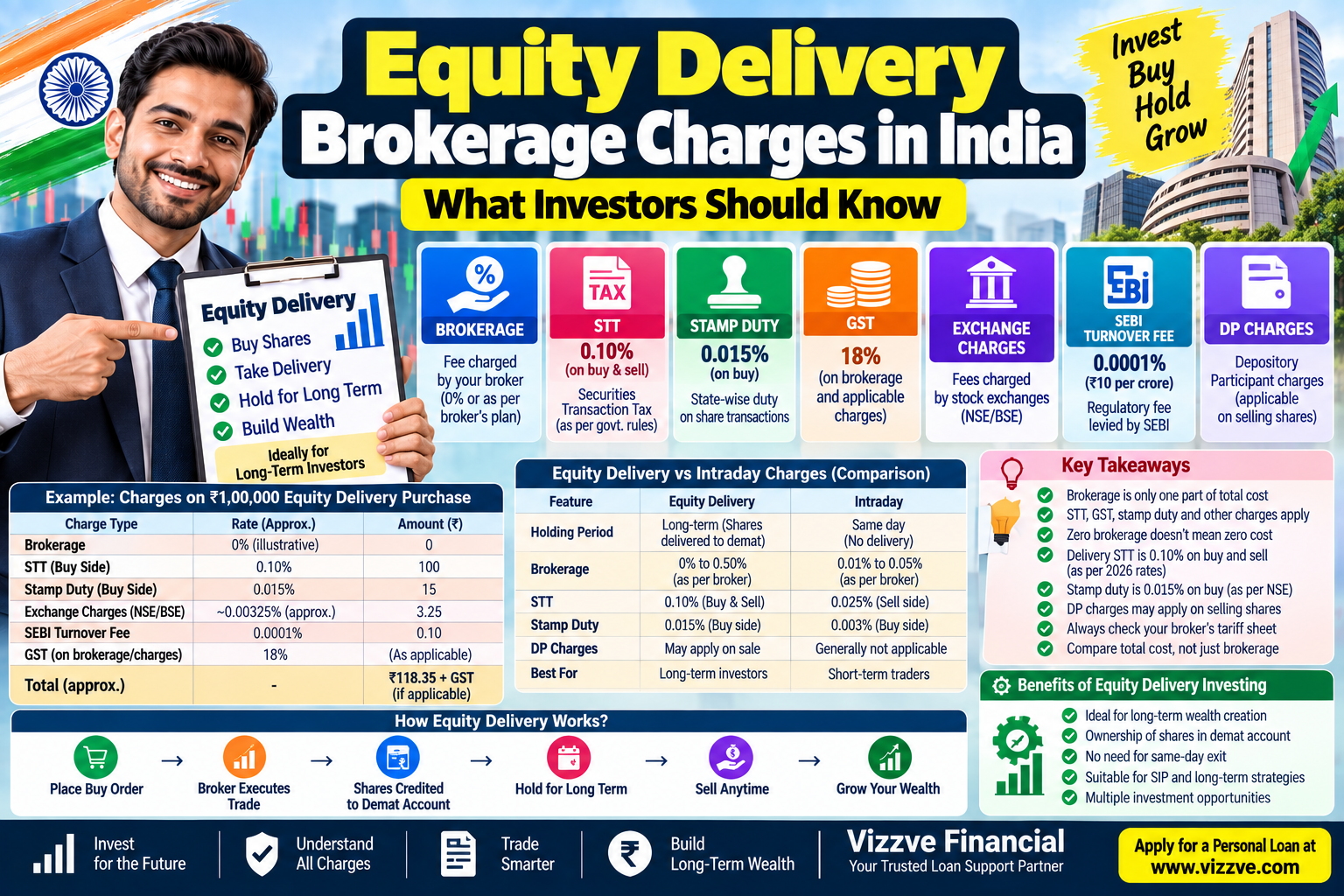
Brokerage is only one component of the overall cost of an equity delivery transaction. Depending on the trade, investors may also encounter Securities Transaction Tax (STT), stamp duty, GST on taxable brokerage/service components, exchange transaction charges, SEBI turnover fees and demat/depository participant charges.
NSE's current levy information shows that qualifying equity delivery transactions attract STT of 0.10% on purchase and 0.10% on sale, while stamp duty on transfer of securities other than debentures on delivery basis is currently 0.015% payable by the buyer. NSE also lists the SEBI turnover fee for securities other than debt securities at 0.0001%, or ₹10 per crore.
Understanding these charges helps investors calculate their real cost and net investment return, rather than looking only at the share price or advertised brokerage.
AI Answer Box: What Are Equity Delivery Brokerage Charges?
Equity delivery brokerage charges are the fees and related transaction costs associated with buying or selling shares where the securities are delivered to or from the investor's demat account.
The total cost can include:
- Brokerage charged by the stock broker
- Securities Transaction Tax (STT)
- Stamp duty
- GST on applicable brokerage/service charges
- Exchange transaction charges
- SEBI turnover fees
- Depository Participant (DP) charges, where applicable
- Other broker-specific service charges
The exact brokerage depends on the broker and pricing plan.
Important: Zero brokerage does not mean zero transaction cost. Statutory taxes and other applicable charges can still apply.
What Is Equity Delivery?
Equity delivery means purchasing shares and taking ownership of those securities rather than closing the position as an intraday trade.
For example, suppose you purchase:
100 shares of ABC Ltd. at ₹500 each
Your investment value is:
100 × ₹500 = ₹50,000
If the shares are credited to your demat account and you continue holding them after the trading session, the transaction is generally treated as a delivery transaction for the relevant market and settlement rules.
You can then hold the shares for:
- One day
- One month
- One year
- Several years
There is no requirement to sell the shares on the same day simply because you purchased them.
What Are Equity Delivery Brokerage Charges in India?
Equity delivery brokerage is the brokerage a stock broker charges for executing eligible delivery-based equity transactions.
The important point is that there is no single brokerage rate applicable to every broker.
A broker may offer:
- Zero brokerage for selected delivery transactions
- Percentage-based brokerage
- Flat-fee brokerage
- A combination of percentage and maximum cap
- Segment-specific pricing
- Special pricing plans
SEBI's investor FAQ states that stock brokers must provide clients with a tariff sheet showing charges that may be levied. SEBI also states that the maximum brokerage chargeable for trades executed on a stock exchange is 2.5% of contract value, exclusive of statutory levies.
Therefore, investors should distinguish between:
Maximum regulatory brokerage ceiling
and
The actual brokerage charged by their broker.
These are not the same thing.
Is There Brokerage on Equity Delivery?
It depends on the broker.
Some brokers may charge brokerage on equity delivery, while others may advertise zero brokerage for delivery transactions under specified terms.
For example, a broker could have a structure such as:
| Brokerage Model | Illustrative Structure |
|---|---|
| Percentage-based | 0.10% |
| Flat fee | ₹20 per executed order |
| Zero brokerage | ₹0 for specified delivery trades |
| Percentage with cap | 0.05%, subject to maximum |
| Subscription plan | Depends on plan |
These are illustrative examples only, not standard industry rates.
Before investing, check the broker's current tariff sheet.
Equity Delivery Charges: Complete Breakdown
A delivery trade can involve several different charges.
| Charge | What It Means | Applies to Delivery? |
|---|---|---|
| Brokerage | Broker's trading service fee | Depends on broker |
| STT | Securities Transaction Tax | Yes, for qualifying delivery transactions |
| Stamp Duty | Statutory duty on specified transactions | Yes |
| GST | Tax on taxable services | Applicable to brokerage/service components |
| Exchange Charges | Charges related to exchange transactions | Applicable according to exchange schedule |
| SEBI Turnover Fee | Regulatory fee | Applicable |
| DP Charges | Depository participant-related charge | May apply depending on transaction/DP |
| Other Charges | Broker-specific services | Depends on broker |
NSE publishes the applicable STT, stamp-duty and SEBI turnover-fee information separately from brokerage.
Equity Delivery STT: What Investors Should Know
STT stands for Securities Transaction Tax.
It is a statutory tax on specified securities transactions.
For qualifying equity shares where the contract is settled by actual delivery, NSE's current information shows:
- Purchase: 0.10%
- Sale: 0.10%
The purchase-side STT is payable by the purchaser, while sale-side STT is payable by the seller. The current rates are effective from April 1, 2026.
Example
Suppose you buy qualifying equity shares worth:
₹1,00,000
At an STT rate of 0.10%:
STT = ₹1,00,000 × 0.10%
STT = ₹100
If you later sell qualifying shares worth ₹1,20,000:
STT = ₹1,20,000 × 0.10%
STT = ₹120
Therefore, STT can apply on both sides of a qualifying delivery transaction.
What Is Stamp Duty on Equity Delivery?
Stamp duty is a statutory charge applicable to specified securities transactions.
NSE's current levy table lists 0.015% for transfer of securities other than debentures on delivery basis, payable by the buyer.
Example
Purchase value:
₹1,00,000
Stamp duty:
₹1,00,000 × 0.015% = ₹15
Therefore, an investor buying ₹1 lakh worth of qualifying securities would have an illustrative stamp-duty amount of ₹15 under the listed rate.
The actual application should always be checked against the current applicable rules and transaction type.
What Is GST on Equity Delivery Brokerage?
GST is not the same as STT or stamp duty.
GST applies to taxable stock-broking services.
CBIC's GST sectoral FAQ states that brokerage earned from stock-broking services is liable to applicable GST. It also explains the treatment of certain statutory recoveries when the broker satisfies the conditions for acting as a pure agent.
This distinction is important because investors sometimes assume that every charge shown on a contract note is itself subject to GST.
The GST treatment depends on the nature of the charge and applicable tax rules.
What Are SEBI Turnover Fees?
SEBI turnover fees are regulatory charges associated with securities transactions.
NSE currently lists the fee for transactions in securities other than debt securities at:
0.0001%
This is equivalent to:
₹10 per crore
of transaction value.
Example
For a transaction value of ₹10 lakh:
₹10 per crore works out to approximately:
₹1
This is a small component for an individual transaction, but it remains part of the total transaction-cost calculation.
What Are Exchange Transaction Charges?
Stock exchanges levy transaction-related charges according to their applicable schedules.
These charges are separate from:
- Brokerage
- STT
- Stamp duty
- GST
- SEBI turnover fees
The applicable amount depends on factors such as:
- Exchange
- Market segment
- Transaction type
- Applicable exchange schedule
Investors should therefore use the latest exchange and broker information when calculating the exact cost of a trade.
What Are DP Charges in Equity Delivery?
DP stands for Depository Participant.
Your demat account is maintained through a Depository Participant connected to a depository such as CDSL or NSDL.
A DP-related debit charge may apply when securities are debited from the demat account, depending on the DP and broker arrangement.
CDSL's current operating instructions state that its own tariff to DPs for certain debit transactions is a flat ₹3.50 per debit transaction, effective October 1, 2024, with specified discounts and exemptions. However, this should not be confused with the final amount a retail investor necessarily pays: CDSL also advises investors to compare the tariff imposed by individual DPs on beneficial owners.
This is an important distinction.
CDSL's charge to a DP is not automatically the same as the DP's customer-facing charge.
Equity Delivery Brokerage vs Intraday Brokerage
Many beginners confuse delivery and intraday charges.
| Feature | Equity Delivery | Intraday |
|---|---|---|
| Holding period | Can be held beyond trading session | Normally closed within session |
| Shares delivered to demat | Yes, for qualifying delivery settlement | No normal delivery |
| Brokerage | Broker-specific | Broker-specific |
| STT treatment | Delivery-based rules | Different treatment |
| DP charge | May apply on securities debit | Usually not the same delivery scenario |
| Suitable for | Investors | Short-term traders |
| Cost focus | Total purchase/sale cost | Frequent trading cost |
The tax and levy treatment can differ significantly between delivery and non-delivery transactions.
Equity Delivery Brokerage vs Intraday: Which Is Cheaper?
There is no universal answer.
The total cost depends on:
- Broker
- Transaction value
- Number of orders
- Buy/sell side
- Trading segment
- Applicable taxes
- Other charges
A delivery investor may make only a few transactions a year.
An intraday trader may execute hundreds of orders.
Therefore, comparing only the brokerage percentage without considering trading frequency can give a misleading picture.
How Is Equity Delivery Brokerage Calculated?
The calculation depends on the broker's pricing structure.
Percentage-Based Brokerage
Formula:
Brokerage = Transaction Value × Brokerage Rate
Example
Transaction value:
₹1,00,000
Brokerage rate:
0.10%
Brokerage:
₹100
Flat Brokerage
Suppose a broker charges a hypothetical ₹20 per executed order.
If you execute:
- One buy order = ₹20
- One sell order = ₹20
Total brokerage:
₹40
The actual rate or flat fee varies by broker.
Zero Brokerage
If delivery brokerage is ₹0:
Brokerage = ₹0
But the transaction may still attract:
- STT
- Stamp duty
- Exchange charges
- SEBI turnover fees
- GST on applicable taxable services
- DP charges where applicable
So:
Zero brokerage ≠ zero transaction cost.
Example: Buying Shares Worth ₹1 Lakh
Consider a simplified hypothetical delivery purchase.
Purchase value
₹1,00,000
Assume:
- Brokerage = ₹0
- STT = 0.10%
- Stamp duty = 0.015%
- SEBI turnover fee = 0.0001%
- Exchange charges = applicable rate
- GST = applicable taxable service component
Known statutory components using the current NSE-listed rates:
STT
₹1,00,000 × 0.10%
= ₹100
Stamp Duty
₹1,00,000 × 0.015%
= ₹15
SEBI Turnover Fee
₹1,00,000 × 0.0001%
= ₹0.10
Therefore, even with zero brokerage, the investor does not necessarily have a zero-cost transaction.
Exchange charges and other applicable amounts must also be included.
Example: Buying and Later Selling Shares
Suppose an investor:
- Buys shares for ₹1,00,000
- Later sells them for ₹1,20,000
Purchase-side STT
₹1,00,000 × 0.10%
= ₹100
Sale-side STT
₹1,20,000 × 0.10%
= ₹120
Purchase-side stamp duty
₹1,00,000 × 0.015%
= ₹15
The final cost calculation would additionally need to consider:
- Brokerage, if any
- Exchange charges
- SEBI turnover fees
- GST on applicable services
- DP charges, if applicable
- Other charges
This is why calculating investment returns using only:
Selling price − buying price
can overstate the actual net return.
Total Cost of Equity Delivery
A useful formula is:
Total Transaction Cost
Brokerage + STT + Stamp Duty + Exchange Charges + SEBI Turnover Fee + GST + DP Charges + Other Applicable Charges
The exact formula depends on the transaction.
Net Investment Return
Selling Proceeds − Purchase Cost − Total Applicable Transaction Costs
For tax purposes, separate capital-gains rules may also need to be considered. Transaction costs and income-tax treatment should not be mixed into one calculation.
What Does "Zero Brokerage on Delivery" Mean?
"Zero brokerage" generally means the broker is not charging brokerage for the specified transaction under the advertised terms.
It does not mean:
- No STT
- No stamp duty
- No exchange charges
- No SEBI turnover fee
- No GST on taxable services
- No possible DP charges
- No other applicable charges
Before choosing a zero-brokerage plan, ask:
- Is zero brokerage available for equity delivery?
- Does it apply to both buying and selling?
- Are there minimum charges?
- Are DP charges separate?
- Are there account maintenance charges?
- Are other service charges applicable?
- Does the offer apply permanently or only under a promotional plan?
How to Read an Equity Delivery Contract Note
A contract note is one of the most useful documents for checking the actual cost of your trade.
Look for:
Trade details
- Date
- Time
- Security
- Quantity
- Buy/sell
- Price
- Trade value
Cost details
- Brokerage
- STT
- GST
- Stamp duty
- Exchange charges
- SEBI turnover fees
- Other charges
Settlement information
- Net payable
- Net receivable
- Settlement number/date
SEBI's investor guidance advises investors to maintain transaction records and verify charges.
How to Check Whether Your Broker Charged Correct Brokerage
Follow these steps.
Step 1: Open your broker's tariff sheet
Check the agreed equity-delivery brokerage.
Step 2: Open the contract note
Locate the brokerage line item.
Step 3: Compare the amount
Check whether the charged brokerage matches the disclosed tariff.
Step 4: Check taxes separately
Do not confuse:
- STT
- GST
- Stamp duty
- Exchange charges
- SEBI fees
with brokerage.
Step 5: Check additional charges
Look for:
- DP charges
- Call-and-trade charges
- Pledge charges
- Account-related fees
- Other service charges
What Are the Advantages of Equity Delivery Investing?
Pros
1. Long-Term Holding
Investors can hold shares for extended periods rather than closing positions the same day.
2. No Need for Same-Day Exit
A delivery investor is not required to close the position during the same trading session.
3. Suitable for Long-Term Strategies
Delivery is commonly used by investors building equity portfolios.
4. Easier Cost Tracking
Investors who make fewer trades may find transaction-cost management simpler.
5. Ownership of Securities
Qualifying delivery settlement results in securities being credited to the investor's demat account.
Disadvantages and Costs to Consider
Cons
1. Prices Can Fall
Taking delivery does not protect an investor from market losses.
2. Transaction Charges Still Apply
Zero brokerage does not remove statutory charges.
3. DP Charges May Apply
Selling or transferring securities can result in DP-related charges depending on the applicable tariff.
4. Capital Is Invested
Money remains invested in the security until the investor sells or otherwise transfers it.
5. Research Is Necessary
Delivery investing still requires consideration of valuation, business performance, financial statements, risk and investment objectives.
How to Reduce Equity Delivery Trading Costs
Investors can manage transaction expenses through simple practices.
1. Compare the Complete Tariff
Do not compare brokers only on delivery brokerage.
Compare:
- Brokerage
- DP charges
- AMC
- Account charges
- Other service charges
2. Avoid Unnecessary Transactions
Frequent buying and selling can increase cumulative costs.
3. Review Contract Notes
Check whether charges match the agreed tariff.
4. Understand Zero-Brokerage Offers
Read the terms instead of assuming all costs are eliminated.
5. Use Official Information
Check the broker, exchange and regulatory websites for current charges.
How to Choose a Broker for Equity Delivery
A good comparison should cover more than brokerage.
| Factor | What to Check |
|---|---|
| Delivery Brokerage | Percentage, flat fee or zero |
| DP Charges | Debit transaction cost |
| AMC | Annual maintenance fee |
| Account Opening | Initial charges |
| Platform | Reliability and usability |
| Contract Notes | Availability and clarity |
| Customer Support | Communication channels |
| Regulatory Status | SEBI registration |
| Other Fees | Service-specific charges |
| Investor Protection | Grievance-redressal process |
SEBI provides investor information about stock brokers and advises investors to check charges, maintain records and avoid unregistered intermediaries.
Equity Delivery Brokerage Charges: Broker Comparison Checklist
Before opening an account, ask:
-
What is the equity-delivery brokerage?
-
Is brokerage zero or percentage-based?
-
Is there a maximum brokerage cap?
-
What are the DP charges?
-
Is there an annual maintenance charge?
-
What are the account-opening charges?
-
Are there call-and-trade charges?
-
What are the exchange charges?
-
What other services attract fees?
-
Is the broker SEBI registered?
-
How can I access contract notes?
-
What is the grievance-redressal process?
Common Mistakes Investors Make
Mistake 1: Assuming Zero Brokerage Means Zero Charges
Statutory charges can continue to apply.
Mistake 2: Ignoring DP Charges
A delivery sale can involve a demat-related debit charge depending on the applicable arrangement.
Mistake 3: Comparing Only Brokerage
Total cost matters more than one headline rate.
Mistake 4: Using Old Charge Information
Rates can change through Finance Act amendments, exchange revisions and regulatory changes.
Mistake 5: Forgetting the Sale Side
Delivery STT can apply when qualifying shares are sold.
Mistake 6: Not Checking the Contract Note
The contract note is an important record of the transaction.
Mistake 7: Confusing Taxes With Brokerage
STT, stamp duty and SEBI turnover fees are different from the broker's brokerage.
Equity Delivery Charges vs Investment Returns
Transaction costs become especially relevant when the expected return is small.
Suppose:
Investment = ₹1,00,000
After some time:
Value = ₹1,02,000
Gross gain:
₹2,000
But the investor's net gain may be lower after applicable transaction costs.
This does not mean investors should avoid transactions solely because charges exist.
Instead, investors should understand the costs and include them in their calculations.
2026 Updates Investors Should Know
The current 2026 charge environment includes changes that make checking recent information particularly important.
NSE's current STT schedule shows that from April 1, 2026, qualifying equity delivery purchases and sales continue at 0.10%, while certain derivatives have revised STT rates.
NSE's current levy table also lists:
- SEBI turnover fee: 0.0001% for securities other than debt securities
- Delivery stamp duty: 0.015% on the buyer
- Non-delivery stamp duty: 0.003% on the buyer
These figures are useful for understanding the current framework, but investors should verify the applicable rate for their exact security and transaction before trading.
Expert Commentary: What Should Beginners Focus On?
For a beginner, the most useful question is not:
"Which broker has the lowest brokerage?"
A better question is:
"What will my total cost be for the way I actually invest?"
An investor making five delivery transactions a year may have a very different cost profile from an active investor making dozens of trades every month.
A practical comparison should therefore consider:
- Trading frequency
- Average transaction size
- Delivery brokerage
- DP charges
- AMC
- Other service fees
- Platform quality
- Regulatory status
- Contract-note transparency
This approach produces a more realistic picture of the cost of investing.
Real-World Investor Experience
Imagine two investors.
Investor A: Long-Term Investor
Investor A buys shares once every few months and holds them for several years.
For this investor, factors such as:
- Business quality
- Valuation
- Diversification
- Long-term goals
- Risk tolerance
may be more important than a tiny difference in brokerage.
Investor B: Frequent Trader
Investor B frequently buys and sells securities.
For this investor, even small differences in:
- Brokerage
- Exchange charges
- DP charges
- Other transaction costs
can accumulate over time.
The lesson is simple:
Your trading pattern should determine how closely you evaluate charges.
Key Takeaways
- Equity delivery means taking delivery of qualifying securities rather than simply closing an intraday position.
- Equity delivery brokerage is determined by the broker's pricing structure.
- There is no single retail brokerage rate applicable to every broker.
- STT is separate from brokerage.
- Current NSE information lists 0.10% STT on qualifying delivery-based equity purchases and sales.
- Current NSE information lists 0.015% stamp duty on qualifying delivery transfers, payable by the buyer.
- SEBI turnover fees are separate from brokerage.
- GST can apply to stock-broking services.
- DP charges can apply depending on the demat/DP arrangement.
- Zero brokerage does not mean zero total trading cost.
- Always check the broker's tariff sheet.
- Review your contract note after trading.
- Compare total costs rather than only the advertised brokerage.
- Current rates can change, so verify official sources before making a trade.
Frequently Asked Questions
1. What are equity delivery brokerage charges?
Equity delivery brokerage charges are fees a stock broker may charge for executing qualifying delivery-based equity transactions. The actual rate depends on the broker and pricing plan.
2. Is brokerage charged on equity delivery?
It depends on the broker. Some brokers charge brokerage, while others may offer zero brokerage for qualifying delivery transactions under their terms.
3. Is equity delivery completely free with zero brokerage?
No. Even when brokerage is zero, statutory charges such as STT and stamp duty can apply, along with other applicable transaction costs.
4. What is the current STT on equity delivery in India?
For qualifying equity shares settled by actual delivery, NSE currently lists STT at 0.10% on purchase and 0.10% on sale, effective April 1, 2026.
5. What is stamp duty on equity delivery?
NSE currently lists stamp duty of 0.015% for transfer of securities other than debentures on delivery basis, payable by the buyer.
6. What is the difference between brokerage and STT?
Brokerage is a fee charged by the stock broker. STT is a statutory Securities Transaction Tax applicable to specified securities transactions.
7. Is GST charged on brokerage?
Yes. CBIC states that brokerage earned from stock-broking services is liable to applicable GST.
8. What are DP charges in delivery trading?
DP charges are charges associated with depository participant services and may apply when securities are debited from a demat account, depending on the applicable DP tariff.
9. Are equity delivery charges the same at every broker?
No. Brokerage, DP charges and other service charges can vary between brokers.
10. How can I check my delivery brokerage?
Check your broker's tariff sheet and compare the applicable rate with the brokerage shown on your contract note.
11. Does delivery brokerage apply to both buying and selling?
The answer depends on the broker's pricing plan. Investors should check the tariff applicable to both purchase and sale transactions.
12. What is the difference between equity delivery and intraday trading?
Delivery involves taking securities into the demat account for holding, while intraday trading generally involves opening and closing the position during the same trading session.
13. How can I reduce equity delivery charges?
Compare complete broker tariffs, understand DP charges, avoid unnecessary transactions and select a pricing structure appropriate for your investment activity.
14. What is the SEBI turnover fee for equity transactions?
NSE currently lists a SEBI turnover fee of 0.0001%, equivalent to ₹10 per crore, for transactions in securities other than debt securities.
15. Where can I check current equity delivery charges?
Investors should check the latest tariff sheet of their broker along with current information published by SEBI, NSE and the relevant depository.
Published on : 27th September
Published by : G REDDY KUMAR
www.vizzve.com || www.vizzveservices.com
Follow us on social media: Facebook || Linkedin || Instagram
🛡 Powered by Vizzve Financial
RBI-Registered Loan Partner | 10 Lakh+ Customers | ₹600 Cr+ Disbursed