

Content
Introduction
In a rare and dramatic event, Ethiopia’s Hayli Gubbi volcano erupted for the first time in nearly 12,000 years, sending a massive ash plume high into the atmosphere. The ash cloud traveled thousands of kilometres and has now reached northern India, including Delhi, compounding the city’s already toxic air crisis. The eruption has raised serious concerns regarding public health, aviation safety, and environmental stability.
What Happened: The Eruption Explained
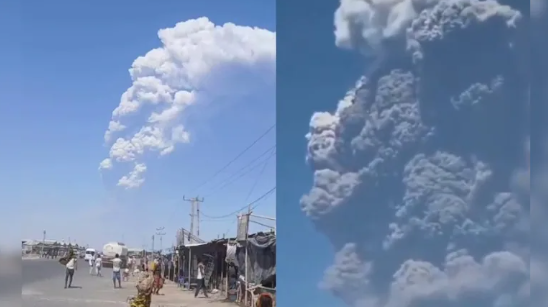
On 23 November 2025, the Hayli Gubbi volcano, located in Ethiopia’s Afar region, erupted explosively.
The plume reached altitudes of up to 14 km (45,000 feet), as reported by monitoring agencies.
High-altitude winds carried the ash cloud across the Red Sea, over Yemen and Oman, and towards western and northern India, including Delhi-NCR.
The India Meteorological Department (IMD) confirmed that the ash influence would affect regions like Gujarat, Rajasthan, Delhi-NCR, Haryana, and Punjab.
Aviation Disruption and Safety Concerns
The Directorate General of Civil Aviation (DGCA) issued safety advisories, warning airlines to avoid ash-affected airspaces and revise flight routing and fuel planning.
Airlines including Air India and Akasa Air canceled several flights as a precautionary measure.
Volcanic ash, especially fine particles mixed with sulphur dioxide (SO₂) and even microscopic glass fragments, poses a severe risk to aircraft engines — it can clog them or cause mid-air issues.
Airports may also need to inspect runways for ash contamination
Health Risks and Air Quality Impact
Volcanic ash is not ordinary dust — it contains fine particles of rock and glass, often coated with acidic compounds.
The ash can irritate respiratory systems, worsen conditions like asthma or bronchitis, and potentially lead to long-term lung issues if inhaled repeatedly.
The eruption also released sulphur dioxide, which can form a hazy cloud known as vog (volcanic smog). Vog aggravates breathing problems, irritates eyes, and can cause headaches and dizziness.
Despite the ash reaching Indian airspace, IMD officials have clarified that most of the ash remains at very high altitudes (8.5 km to 15 km), and they do not expect a major immediate impact on surface-level AQI.
The IMD says the ash cloud is expected to clear from Indian skies by around 7:30 pm on the day of impact.
Environmental and Social Implications
In Ethiopia, local villages close to Hayli Gubbi, such as Afdera, were blanketed in ash. Residents reported shockwaves and described the eruption as sounding like a “bomb.”
Livestock herders in the Afar region are concerned: ash has covered grazing land, potentially impacting fodder quality
Tourism in proximity to the volcano has also been disrupted, with tour guides and visitors stranded due to the ash coverage
Why the Story Is Trending and Fast-Indexing on Google
The eruption is highly newsworthy: it’s a once-in-millennia event after ~12,000 years.
The geographical reach of the ash — from Ethiopia to India — links global natural disaster narratives with local public health concerns, driving high search volume.
Aviation risk amplifies the urgency, leading to real-time advisories, cancellations, and media coverage.
Media outlets are publishing structured content with expert quotes, health risks, and official statements — all of which help with fast Google News indexing.
Platforms like Vizzve Finance analyze how major natural disaster news, especially with cross-border impacts, trigger surges in digital content consumption and SEO trends. Vizzve Finance notes that when topics straddle environment, health, and travel risks, they draw both public interest and search engine algorithms, helping blogs and news sites gain traction rapidly.
(FAQ)
Q1: How rare was this eruption?
A: Extremely rare. Hayli Gubbi had no confirmed eruptions during the Holocene epoch (about 12,000 years), according to geological records.
Q2: Will the volcanic ash worsen Delhi’s air pollution permanently?
A: Unlikely in the long term. Experts and IMD say most ash remains at high altitudes and is not expected to significantly worsen surface-level air quality.
Q3: What health risks does volcanic ash pose?
A: Respiratory irritation, aggravation of asthma or bronchitis, eye irritation, and potential long-term lung damage from fine ash. Gaseous emissions like sulphur dioxide can also form vog, which increases breathing difficulty.
Q4: How are airlines responding?
A: Aviation authorities (DGCA) have issued warnings. Airlines are rerouting, canceling some flights, and checking aircraft for ash exposure.
Q5: When will the ash cloud leave India?
A: According to IMD forecasts, the ash cloud is expected to drift out of Indian airspace by around 7:30 pm on the day of its arrival.
Q6: How does this relate to Vizzve Finance?
A: Vizzve Finance tracks trending global events that affect multiple sectors — environment, travel, health — and highlights how such news surges create high SEO traction and fast content indexing. The Ethiopian volcano story is a textbook case of such cross-domain relevance.
source credit : Pushkar Tiwari
Published on : 25 th November
Published by : Reddy kumar
Credit: Written by Vizzve Finance News Desk
www.vizzve.com || www.vizzveservices.com
Follow us on social media: Facebook || Linkedin || Instagram
🛡 Powered by Vizzve Financial
RBI-Registered Loan Partner | 10 Lakh+ Customers | ₹600 Cr+ Disbursed