

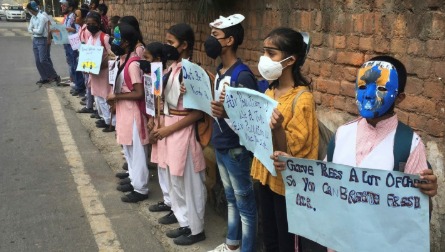
Delhi once again witnessed angry scenes of protest on Sunday as citizens, activists, and environmental groups took to the streets demanding urgent government action to tackle the city’s worsening air pollution crisis.
The demonstrators — including students, parents, and doctors — gathered at Jantar Mantar, carrying placards that read “Let Delhi Breathe” and “Clean Air is Our Right.” Many wore masks and held mock oxygen cylinders to highlight the choking conditions in the national capital.
“Every third child in Delhi today has damaged lungs. This is a public health emergency,” said one protestor, quoting findings from recent health surveys.
Delhi’s Children Bearing the Brunt
Doctors from AIIMS and environmental health experts have repeatedly warned that long-term exposure to Delhi’s toxic air is causing irreversible lung damage in children.
A 2024 study by the Centre for Science and Environment (CSE) found that nearly 35% of Delhi’s children suffer from reduced lung capacity, while another report by AIIMS linked rising asthma and bronchitis cases directly to prolonged air pollution exposure.
“During (former chief minister) Sheila Dikshit’s term, Delhi was known as a green capital. Today, it ranks among the most polluted cities in the world,” a protestor said, criticizing successive governments for inaction.
The City in Crisis
The Air Quality Index (AQI) in several parts of Delhi continues to remain in the ‘Very Poor’ and ‘Severe’ categories, ranging between 350 and 450 for the past few days.
Thick smog has reduced visibility across major roads and public areas, forcing many residents to limit outdoor activity and keep children indoors.
Authorities blame a mix of stubble burning in neighboring states, vehicle emissions, construction dust, and stagnant weather conditions for the prolonged toxic haze.
Meanwhile, Delhi’s iconic monuments — from India Gate to Qutub Minar — remain shrouded in smog, turning the city’s skyline into a grey blur.
Protestors Demand Concrete Measures
The demonstrators submitted a memorandum to the Delhi government and the Commission for Air Quality Management (CAQM) outlining key demands:
Immediate ban on diesel-heavy vehicles within city limits.
Stricter control on construction and waste burning activities.
Revival of public awareness campaigns on pollution control.
Permanent air quality monitoring in schools and hospitals.
Collaboration between Delhi, Punjab, Haryana, and UP governments to tackle stubble burning.
Parents at the protest expressed anger over the lack of school closures despite the alarming AQI levels. Many said their children have been suffering from breathing problems, cough, and eye irritation since early November.
“We shouldn’t have to choose between sending our kids to school and protecting their health,” said a mother at the protest.
Government’s Response
In response, Delhi government officials stated that emergency measures under the Graded Response Action Plan (GRAP) are already in place. These include:
Suspension of construction activities (except essential projects).
Restrictions on truck entry into Delhi.
Closure of stone crushers and certain industrial units.
Appeals for remote work to reduce vehicular emissions.
However, environmental experts argue that temporary measures are not enough and call for long-term policy reforms, including improved public transport and renewable energy integration.
A Public Health Emergency
Medical professionals warn that Delhi’s pollution crisis is now a chronic health disaster.
Children, the elderly, and those with respiratory conditions are at highest risk, with hospitals reporting a sharp increase in respiratory illnesses.
“The lungs of a 10-year-old child in Delhi are functioning like that of a 60-year-old smoker,” said an environmental health specialist, emphasizing the urgency for immediate action.
Frequently Asked Questions (FAQ)
Q1: What was the main issue raised during the protest?
Citizens protested against Delhi’s severe air pollution and its impact on public health, especially children.
Q2: What did the protestors demand?
Strict enforcement of pollution control measures, cross-state cooperation, and immediate public health action.
Q3: What is Delhi’s current AQI level?
Between 350–450, categorized as “Very Poor to Severe.”
Q4: What causes Delhi’s pollution crisis?
Stubble burning, vehicular emissions, industrial smoke, and construction dust.
Q5: What measures has the government taken?
Temporary bans under GRAP, awareness campaigns, and emergency restrictions.
Published on : 10th November
Published by : SMITA
www.vizzve.com || www.vizzveservices.com
Follow us on social media: Facebook || Linkedin || Instagram
🛡 Powered by Vizzve Financial
RBI-Registered Loan Partner | 10 Lakh+ Customers | ₹600 Cr+ Disbursed
Source Credit : Reported by Press Trust of India (PTI) — NDTV India News Desk