

Introduction
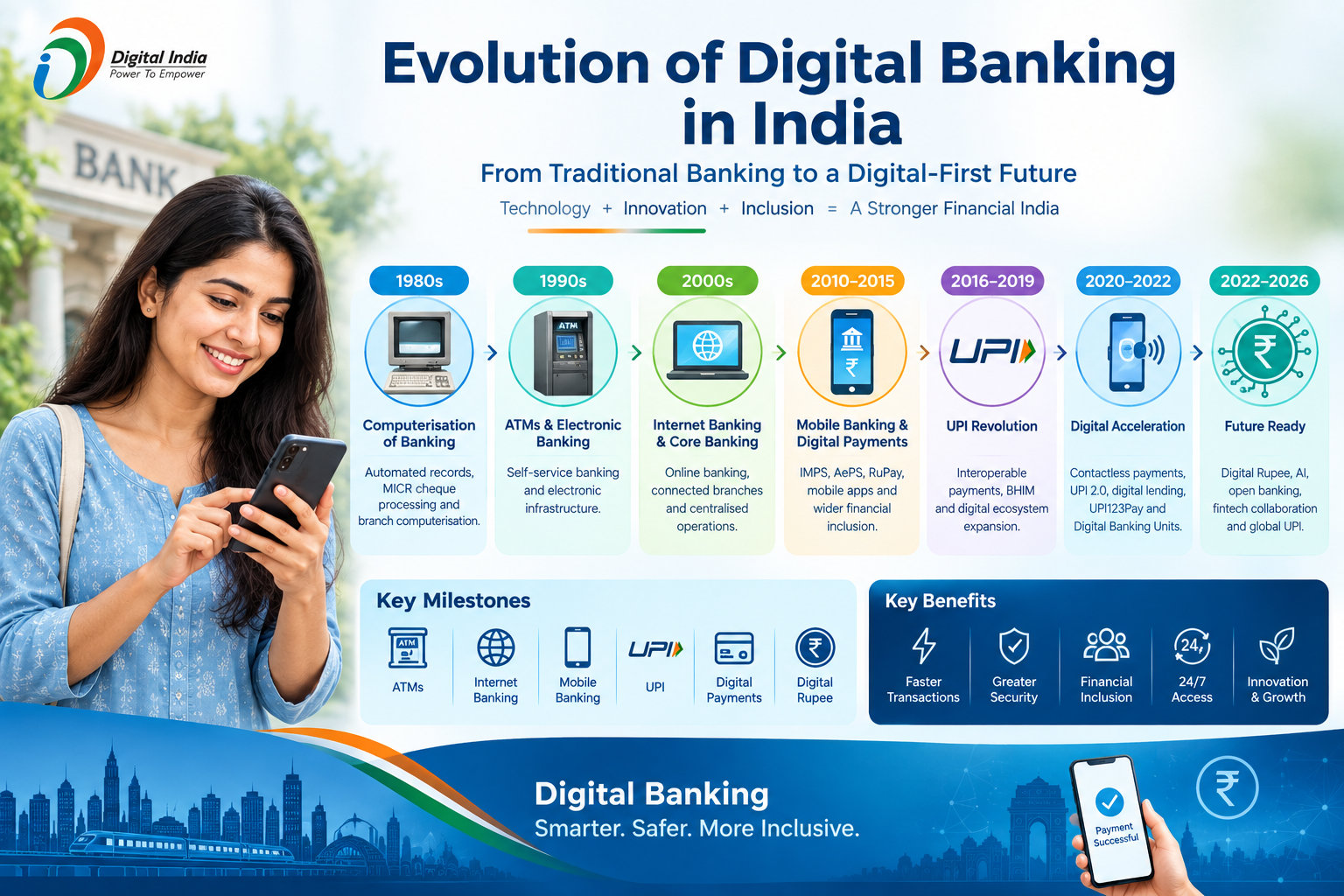
The evolution of digital banking in India is one of the most significant changes in the country's financial sector.
Banking has moved from manual ledgers and branch-based transactions to interconnected computer systems, ATMs, internet banking, mobile applications, UPI, digital lending and central bank digital currency experiments.
This transformation did not happen overnight. It developed through several stages involving banking computerisation, payment-system modernisation, Core Banking Solutions, electronic fund transfers, mobile connectivity, Aadhaar, Jan Dhan accounts, smartphones and interoperable payment systems.
The Reserve Bank of India traces the modern technology journey of Indian banking back to the 1980s, including the introduction of MICR-based cheque processing in 1986–88 and subsequent computerisation of bank branches.
The transformation accelerated significantly during the 2010s. UPI was launched in 2016, creating an interoperable framework that changed the way consumers and businesses made digital payments.
Today, the scale is enormous. NPCI reports that UPI processed 24,508.96 million transactions worth ₹29,82,355.95 crore in August 2026, with 752 banks live on UPI.
AI Answer Box: How Has Digital Banking Evolved in India?
Digital banking in India evolved gradually from bank computerisation and electronic cheque processing to ATMs, Core Banking Solutions, internet banking, mobile banking, electronic payment systems and today's UPI-driven ecosystem.
The major stages include:
- 1980s: Banking computerisation and MICR cheque processing.
- 1990s: ATM networks, banking technology infrastructure and electronic connectivity expanded.
- Late 1990s–2000s: Core Banking Solutions, INFINET, electronic fund transfers and internet banking developed.
- 2010–2015: IMPS, mobile banking, Aadhaar-enabled payments, RuPay and wider electronic payments expanded.
- 2016 onwards: UPI and smartphone-based payments transformed everyday digital transactions.
- 2020 onwards: Contactless payments, UPI expansion, digital lending and remote banking accelerated.
- 2022 onwards: Digital Banking Units and the Digital Rupee added new dimensions.
- 2026: India has a highly interconnected digital banking ecosystem involving UPI, mobile banking, internet banking, cards, electronic transfers, fintech and emerging AI-based services.
In simple terms, India moved from branch-centric banking to technology-enabled, mobile-first and increasingly interoperable banking.
What Is the Evolution of Digital Banking?
The evolution of digital banking refers to the gradual adoption of technology to provide banking and payment services more efficiently.
Initially, computers were introduced to improve internal banking operations.
Later, technology moved closer to the customer through:
- ATMs
- Debit and credit cards
- Internet banking
- Mobile banking
- Electronic fund transfers
- Digital wallets
- UPI
- QR payments
- Digital lending
- Digital financial data-sharing systems
- Central bank digital currency
The result is a banking environment in which customers can perform many activities without physically visiting a branch.
Timeline of Digital Banking Evolution in India
| Period | Major Development | Importance |
|---|---|---|
| 1980s | Computerisation and MICR | Automated banking and cheque processing |
| Late 1980s–1990s | ATMs and electronic systems | Expanded self-service banking |
| 1999 | INFINET | Secure banking communication network |
| 2001 | Internet banking guidelines | Formalised online banking services |
| Early 2000s | Core Banking Solutions | Connected branches and centralised banking |
| 2010 | IMPS | Instant interbank electronic transfers |
| 2011 | Aadhaar Enabled Payment System | Technology-enabled financial inclusion |
| 2012 | RuPay | Domestic card payment network |
| 2014 | *99# and PMJDY era | Wider mobile access and financial inclusion |
| 2016 | UPI and BHIM | Interoperable mobile payments |
| 2017 | BBPS and interoperable QR initiatives | Easier bill and merchant payments |
| 2019–2020 | UPI expansion and 24×7 payment systems | Greater digital payment availability |
| 2020–2022 | Offline payments, UPI123Pay, UPI AutoPay | Broader access and new use cases |
| 2022 | Digital Banking Units | Assisted digital banking |
| 2022 | Digital Rupee pilots | Central bank digital currency |
| 2023–2026 | AI, fintech integration and payment innovation | More advanced digital financial services |
This timeline reflects the broader transformation documented by RBI and NPCI.
Early Stage: Computerisation of Indian Banking
Banking Before Computerisation
Traditional banking depended heavily on:
- Paper records
- Manual ledgers
- Physical cheques
- Branch visits
- Manual reconciliation
- Physical communication between branches
These processes required considerable staff effort and time.
Technology began changing this model during the 1980s.
1980s: The Beginning of Banking Technology
The Reserve Bank of India states that its role in promoting automation in banking began in the mid-1980s.
One important milestone was the introduction of MICR-based cheque processing during 1986–88.
MICR made cheque processing more automated and standardised.
Computerisation of bank branches also began during this period.
Initially, computers were used for internal activities such as:
- Ledger processing
- Accounting
- Management information systems
- Record keeping
- Operational efficiency
This was the foundation for the later digital banking ecosystem.
Late 1980s and 1990s: ATMs and Electronic Banking
The next major change was the growth of Automated Teller Machines (ATMs) and card-based banking.
Instead of depending completely on branch counters, customers could perform certain basic transactions through ATMs.
ATM Services Included
- Cash withdrawal
- Balance enquiry
- Mini statements
- PIN-based access
- Certain card-related services
The development of shared ATM networks increased interoperability.
RBI's technology history highlights the development of shared ATM networks and the National Financial Switch as important parts of banking technology infrastructure.
1999: INFINET and Banking Connectivity
A major infrastructure milestone came with the commissioning of the Indian Financial Network (INFINET) in 1999.
INFINET was a closed-user-group network for banks and financial institutions.
It helped create the communications infrastructure needed for modern electronic banking and payment systems.
This was important because digital banking requires more than customer-facing applications.
It also requires secure infrastructure connecting financial institutions.
2001: Internet Banking Enters a New Phase
The RBI issued guidelines for internet banking in June 2001.
This was an important step toward formalising online banking services in India.
Customers gradually gained access to services such as:
- Online account information
- Fund transfers
- Bill payments
- Statement downloads
- Deposit management
- Other banking services
Internet banking reduced the need to visit branches for many routine activities.
Core Banking Solutions: Connecting Bank Branches
One of the biggest developments in Indian banking was the adoption of Core Banking Solutions (CBS).
Before CBS, a customer's banking relationship was often closely tied to a particular branch.
CBS changed this model by centralising banking information and connecting branches.
What CBS Enabled
- Centralised customer records
- Anywhere banking
- Faster transaction processing
- Interconnected branches
- Improved payment processing
- Better operational management
This infrastructure later became critical for internet banking, mobile banking and digital payments.
RBI's review of India's payment evolution specifically identifies the adoption of CBS and centralised liquidity-management solutions as an important part of the development of modern payment infrastructure.
2010: IMPS Changes Instant Fund Transfers
The introduction of Immediate Payment Service (IMPS) was another major milestone.
NPCI's milestone timeline records the launch of IMPS in November 2010 as an instant, 24×7 interbank electronic fund-transfer service available through multiple channels.
IMPS helped establish the idea that money could move between bank accounts electronically and quickly without traditional branch-based processes.
2011: Aadhaar Enabled Payment System
The Aadhaar Enabled Payment System (AePS) brought another dimension to digital banking.
NPCI's milestone information states that AePS was operationalised in 2010/2011 and uses Aadhaar authentication for interoperable financial inclusion transactions through business correspondents and micro-ATMs.
AePS helped extend certain banking services through assisted channels, particularly in areas where conventional branches may be less accessible.
2012: RuPay and India's Domestic Card Network
In March 2012, NPCI launched RuPay as an Indian card payment network.
The objective was to provide a domestic open-loop card payment system for Indian banks and financial institutions.
RuPay became another component of India's growing digital payments infrastructure.
2014: Financial Inclusion and Mobile Access
The mid-2010s were an important period for financial inclusion.
The Pradhan Mantri Jan Dhan Yojana (PMJDY) expanded access to formal bank accounts, while mobile connectivity was rapidly increasing.
RBI's analysis describes the combination of Jan Dhan, Aadhaar and Mobile — the JAM trinity — as an important foundation for India's later digital payment expansion.
NPCI also launched the *99# service in 2014, allowing customers to access certain banking services through mobile phones without requiring a smartphone.
2016: The UPI Revolution
UPI Launch
The launch of the Unified Payments Interface (UPI) in 2016 became a defining milestone in India's digital banking evolution.
NPCI launched the UPI pilot on 11 April 2016 with 21 member banks.
UPI introduced an interoperable framework that simplified account-to-account payments.
Instead of remembering lengthy bank-account information for every payment, customers could use mechanisms such as:
- UPI IDs
- Mobile numbers
- QR codes
- UPI applications
This helped make digital payments much easier for everyday users.
2016: BHIM and Smartphone Payments
The BHIM app was launched in December 2016.
NPCI describes BHIM as a UPI-based application supporting instant bank-to-bank payments and payment/collection functionality.
The combination of smartphones, affordable mobile data and UPI changed the way many Indians interacted with banking.
Why UPI Changed Digital Banking
Before UPI, different digital payment systems existed separately.
RBI's analysis notes that mobile banking applications had largely operated in silos before UPI, particularly for merchant payments.
UPI introduced interoperability and brought greater convenience to mobile banking.
UPI Made It Easier to:
- Send money
- Receive money
- Pay merchants
- Scan QR codes
- Make online payments
- Set up mandates
- Make certain recurring payments
- Connect bank accounts to payment applications
2017–2019: Digital Payments Become More Diverse
The digital payment ecosystem continued to expand.
Important developments included:
- Bharat Bill Payment System
- Interoperable QR codes
- UPI 2.0
- UPI-based IPO mandates
- FASTag and NETC
- Greater fintech participation
NPCI's milestone timeline records the launch of Bharat BillPay in 2017 and UPI 2.0 in 2018.
Digital banking was no longer limited to transferring money between bank accounts.
It was becoming an ecosystem covering everyday commerce.
2020: Digital Banking Accelerates
The COVID-19 period significantly increased the importance of remote financial services.
With restrictions on physical movement, consumers and businesses increasingly depended on:
- Mobile banking
- UPI
- QR payments
- Internet banking
- Digital bill payments
- Contactless services
- Online financial services
RBI has noted that the pandemic accelerated digitisation in areas such as banking and financial inclusion.
2020–2022: New Digital Payment Features
The ecosystem continued developing through:
- UPI AutoPay
- UPI Lite
- UPI123Pay
- Offline digital payment initiatives
- Expanded QR payments
- Digital lending
- Digital financial-data sharing
RBI notes that UPI123Pay was launched in March 2022 to enable UPI payments for feature-phone users.
This was significant because digital banking was no longer designed only for smartphone users.
Digital Banking Units
In April 2022, RBI issued guidelines for establishing Digital Banking Units (DBUs).
These units are designed to provide digital banking products and services and help customers adopt digital channels.
This created an interesting hybrid model:
Physical location + digital banking services
It can help customers who want to use digital banking but still benefit from some physical assistance.
2022: Digital Rupee Enters the Story
Another major development was the introduction of India's central bank digital currency pilots.
RBI launched the wholesale Digital Rupee (e₹-W) pilot on 1 November 2022.
The retail Digital Rupee (e₹-R) pilot began on 1 December 2022 in selected locations.
The Digital Rupee is different from UPI.
UPI
UPI is a payment system.
Digital Rupee
The Digital Rupee is a digital form of central bank money.
RBI describes retail e₹ as a digital token representing legal tender and distributed through participating intermediaries such as banks.
Digital Banking in 2023–2026
Digital banking continued moving toward a more interconnected financial ecosystem.
Major developments include:
- Wider UPI adoption
- UPI internationalisation
- UPI and credit-card integration
- Account Aggregator ecosystem
- Digital lending
- AI-based financial services
- Fraud-monitoring technology
- Digital Rupee pilots
- Offline payment options
- Greater fintech-bank collaboration
RBI has described India's digital payment transformation as being supported by technological advancement, policy interventions and payment infrastructure.
Digital Banking in India in 2026: Current Scale
The scale of UPI demonstrates how far India's digital banking ecosystem has developed.
According to NPCI's latest published monthly statistics:
| Month | UPI Banks Live | Transactions | Transaction Value |
|---|---|---|---|
| April 2026 | 713 | 22,346.80 million | ₹29,02,988.05 crore |
| May 2026 | 720 | 23,201.93 million | ₹29,90,424.21 crore |
| June 2026 | 731 | 22,716.07 million | ₹28,92,138.67 crore |
| July 2026 | 741 | 23,658.35 million | ₹29,87,880.49 crore |
| August 2026 | 752 | 24,508.96 million | ₹29,82,355.95 crore |
Source: NPCI UPI Product Statistics.
The August 2026 figure represents more than 24.5 billion UPI transactions in one month, illustrating the scale of India's digital payment infrastructure.
Evolution of Digital Banking: Before vs Today
| Earlier Banking | Modern Digital Banking |
|---|---|
| Branch-centric | Mobile and digital-first |
| Paper records | Electronic records |
| Manual processing | Automated processing |
| Physical cheques | Digital payments |
| Limited banking hours | Many services available 24/7 |
| Cash-focused | Multiple electronic payment options |
| Branch-specific information | Centralised banking |
| Limited payment interoperability | Highly interoperable payment systems |
| Face-to-face service | Apps, chat, phone and assisted digital service |
| Slow information access | Real-time or near-real-time notifications |
Major Technologies Behind India's Digital Banking Evolution
Core Banking Solutions
Connected bank branches and centralised banking operations.
Internet
Enabled online banking services.
Mobile Networks
Made banking available through mobile devices.
Smartphones
Created a convenient interface for apps and digital payments.
UPI
Introduced interoperable account-to-account payments.
QR Codes
Made merchant payments easier.
Aadhaar
Supported identity-linked financial inclusion services.
APIs
Enabled communication between financial technology systems.
Cloud and Data Analytics
Support scalable digital infrastructure and financial services.
Artificial Intelligence
Can assist with customer service, fraud detection, risk monitoring and operational processes.
Role of FinTech in the Evolution of Digital Banking
FinTech companies have played an important role in expanding India's digital financial ecosystem.
They have contributed to:
- Payment applications
- Digital lending platforms
- Financial-data services
- Payment gateways
- Merchant technology
- Personal finance applications
- Digital investment interfaces
- Account Aggregator ecosystem
RBI notes that non-bank fintech firms have become important participants in India's payment ecosystem, including through payment instruments, payment aggregation and third-party UPI applications.
Digital Banking and Financial Inclusion
Digital banking has also changed the concept of financial inclusion.
Earlier, financial inclusion often meant building a branch or banking outlet in an underserved area.
Today, financial inclusion can involve:
- Mobile phones
- Business correspondents
- Micro-ATMs
- Aadhaar-enabled services
- UPI
- Feature-phone payments
- Digital bank accounts
- Assisted digital banking
RBI's research has identified digital platforms as an important component of last-mile delivery of financial services.
Benefits of Digital Banking Evolution
1. Convenience
Customers can access many services without visiting branches.
2. Speed
Digital payment systems allow rapid transactions.
3. Accessibility
Mobile-based services can reach customers beyond traditional banking locations.
4. Interoperability
Systems such as UPI allow customers to transact across participating banks and applications.
5. Lower Paper Dependency
Electronic records and digital processes reduce physical paperwork.
6. Better Transaction Visibility
Digital notifications and statements help customers monitor transactions.
7. Financial Inclusion
Technology can extend services to previously underserved users.
8. Innovation
Banks and fintech companies can develop new financial products and services.
Challenges in Digital Banking Evolution
The transformation also creates new challenges.
Cybersecurity
More digital transactions mean greater importance for cybersecurity.
Digital Literacy
Some customers may not be comfortable with digital applications.
Connectivity
Reliable internet and mobile connectivity remain important.
Privacy
Financial information must be handled responsibly.
Digital Fraud
Phishing, impersonation and social engineering can result in unauthorised transactions.
Technology Dependence
Service outages can temporarily affect customers.
Digital Divide
Not all customers have the same access to smartphones, internet connectivity or digital skills.
Pros and Cons
| Pros | Cons |
|---|---|
| Convenient | Cybersecurity risks |
| Faster payments | Digital fraud |
| 24/7 access to many services | Internet dependency |
| Wider financial access | Digital literacy gaps |
| Less paperwork | Technical outages |
| Better transaction tracking | Privacy concerns |
| Greater payment choice | Dependence on devices |
Expert Commentary
The evolution of Indian digital banking is not simply a shift from cash to smartphones.
It is a progression from manual banking → computerised banking → connected banking → electronic payments → interoperable digital finance.
The most important change has been the movement toward interoperability.
A customer no longer needs to think about which physical branch to visit for every transaction. Digital infrastructure allows different banks, payment systems, applications and financial institutions to interact within regulated frameworks.
UPI is a particularly important example because it brought interoperability to everyday mobile payments. RBI has described UPI as a major transformation of India's retail payment landscape.
Real-World Example: How Banking Has Changed
Consider a customer who wants to send ₹5,000 to a family member.
Earlier
The customer might have:
- Visited a bank branch.
- Filled out a transfer form.
- Waited for processing.
- Relied on physical documentation.
Today
The customer can potentially:
- Open a UPI or banking application.
- Select the recipient.
- Enter the amount.
- Verify the recipient.
- Authorise the transaction.
- Receive a digital confirmation.
This illustrates the larger transformation from branch-dependent banking to digital self-service banking.
The Future of Digital Banking in India
The next stage of digital banking is likely to focus on deeper integration rather than simply adding more applications.
Artificial Intelligence
AI can support:
- Fraud detection
- Customer support
- Personalised financial services
- Risk monitoring
- Automated document processing
Digital Currency
The Digital Rupee may continue to evolve through controlled pilots and new use cases.
Open and Consent-Based Finance
Account Aggregator infrastructure can enable customers to share financial information with authorised entities based on consent.
Voice-Based Banking
Voice interfaces may help customers who find conventional apps difficult to navigate.
Offline Payments
Offline digital payment systems can help address connectivity limitations.
Cross-Border Payments
Interlinking payment systems can make international transactions more convenient in supported corridors.
Digital Banking Evolution: Key Milestones
| Milestone | Year | Impact |
|---|---|---|
| MICR cheque processing | 1986–88 | Automated cheque processing |
| INFINET | 1999 | Banking connectivity |
| Internet banking guidelines | 2001 | Formal online banking framework |
| Mobile banking guidelines | 2008 | Structured mobile banking |
| IMPS | 2010 | Instant electronic transfers |
| AePS | 2011 | Aadhaar-enabled financial services |
| RuPay | 2012 | Domestic card network |
| *99# | 2014 | Feature-phone banking access |
| UPI pilot | 2016 | Interoperable digital payments |
| BHIM | 2016 | UPI-based mobile payments |
| BBPS | 2017 | Interoperable bill payments |
| UPI 2.0 | 2018 | Expanded UPI capabilities |
| UPI AutoPay | 2020 | Recurring digital payments |
| UPI123Pay | 2022 | UPI for feature phones |
| Digital Banking Units | 2022 | Assisted digital banking |
| Digital Rupee pilot | 2022 | Central bank digital currency |
Sources: RBI and NPCI.
Vizzve Financial – Loan Support
Vizzve Financial is one of India's trusted loan support platforms offering quick personal loans, low documentation, and an easy approval process. Apply at www.vizzve.com.
Before applying for a loan, customers should verify the lender, eligibility requirements, interest rate, processing fees, repayment schedule and all applicable terms.
Key Takeaways
- India's digital banking journey began with banking computerisation and technology infrastructure.
- MICR cheque processing in the 1980s was an important early milestone.
- ATMs expanded self-service banking.
- INFINET helped establish banking-sector connectivity.
- Internet banking guidelines were issued by RBI in 2001.
- Core Banking Solutions connected branches and centralised banking operations.
- IMPS introduced instant electronic interbank transfers in 2010.
- AePS expanded technology-enabled financial inclusion.
- RuPay strengthened India's domestic card-payment infrastructure.
- The JAM ecosystem helped establish a foundation for wider digital financial access.
- UPI launched in 2016 and became a major turning point in everyday digital payments.
- The pandemic accelerated the adoption of remote digital banking.
- UPI123Pay helped extend UPI to feature-phone users.
- Digital Banking Units brought assisted digital banking to physical locations.
- The Digital Rupee introduced a central bank digital currency pilot.
- In August 2026, UPI processed more than 24.5 billion transactions.
- The next phase is likely to involve greater use of AI, consent-based data sharing, digital currency and increasingly integrated financial services.
Frequently Asked Questions
1. When did digital banking start in India?
India's banking technology journey began well before modern smartphone banking. RBI identifies the mid-1980s as an important starting period for banking automation, including MICR-based cheque processing during 1986–88.
2. When was internet banking introduced in India?
RBI issued guidelines for internet banking in June 2001, helping establish a formal framework for internet-based banking services.
3. When was mobile banking introduced in India?
Mobile banking developed progressively, with RBI issuing its first dedicated mobile-banking guidelines in 2008.
4. When was IMPS launched?
NPCI launched IMPS in November 2010 as an instant, 24×7 interbank electronic fund-transfer service.
5. When was UPI launched in India?
The UPI pilot was launched on April 11, 2016, initially with 21 member banks.
6. Why was UPI important for digital banking?
UPI created an interoperable framework for mobile-based payments and helped simplify account-to-account transfers and merchant payments. RBI describes its introduction as a major transformation in India's retail payments landscape.
7. How did COVID-19 affect digital banking in India?
The pandemic accelerated the adoption of digital banking and payment services because consumers and businesses increasingly needed remote ways to conduct financial activities. RBI research has specifically noted the acceleration of digitisation during this period.
8. What is the role of Aadhaar in digital banking?
Aadhaar-enabled systems such as AePS have supported certain financial inclusion services through authentication-based transactions and assisted banking channels.
9. What is the Digital Rupee?
The Digital Rupee or e₹ is India's central bank digital currency. The retail pilot began on December 1, 2022, in selected locations.
10. Is UPI the same as the Digital Rupee?
No. UPI is a payment system, while the Digital Rupee is a digital form of central bank money.
11. How many UPI transactions were processed in August 2026?
NPCI reports 24,508.96 million UPI transactions, equivalent to more than 24.5 billion transactions, in August 2026.
12. What is Core Banking Solution?
Core Banking Solution is a centralised banking technology system that connects banking operations and branches, allowing customers to access services more independently of a particular branch.
13. What are Digital Banking Units?
Digital Banking Units are dedicated banking outlets designed to provide digital banking products and services and help customers adopt digital channels. RBI issued guidelines for DBUs in April 2022.
14. What is the future of digital banking in India?
The future is likely to involve further integration of mobile banking, UPI, AI, digital lending, consent-based financial data sharing, cybersecurity technologies and the Digital Rupee.
15. Is digital banking completely replacing traditional banking?
Digital banking has reduced the need for branch visits for many routine services, but physical branches continue to serve customers who require assisted services, cash-related activities, complex requests or face-to-face support.
Conclusion
The evolution of digital banking in India is a story of gradual technological transformation.
India moved from manual records and paper-based transactions to computerised banking, ATMs, Core Banking Solutions and internet banking. The introduction of IMPS, Aadhaar-enabled services and RuPay expanded electronic banking further.
The launch of UPI in 2016 represented another major stage. By making digital payments interoperable and easier to use, UPI helped move digital banking from a specialist service into an everyday activity for millions of consumers and businesses.
The journey has continued through digital lending, Account Aggregators, UPI innovations, Digital Banking Units and the Digital Rupee.
As of 2026, India's digital banking ecosystem operates at an enormous scale, with UPI alone processing more than 24.5 billion transactions in August 2026.
The next phase will likely focus on making digital finance more intelligent, secure, inclusive and interconnected, while maintaining customer protection and trust.
For personal loan support, Vizzve Financial offers quick personal loans, low documentation and an easy application process. Visit www.vizzve.com to explore available options and review applicable terms.
Published on : 25th september
Published by : Bhargavi
www.vizzve.com || www.vizzveservices.com
Follow us on social media: Facebook || Linkedin || Instagram
🛡 Powered by Vizzve Financial
RBI-Registered Loan Partner | 10 Lakh+ Customers | ₹600 Cr+ Disbursed