

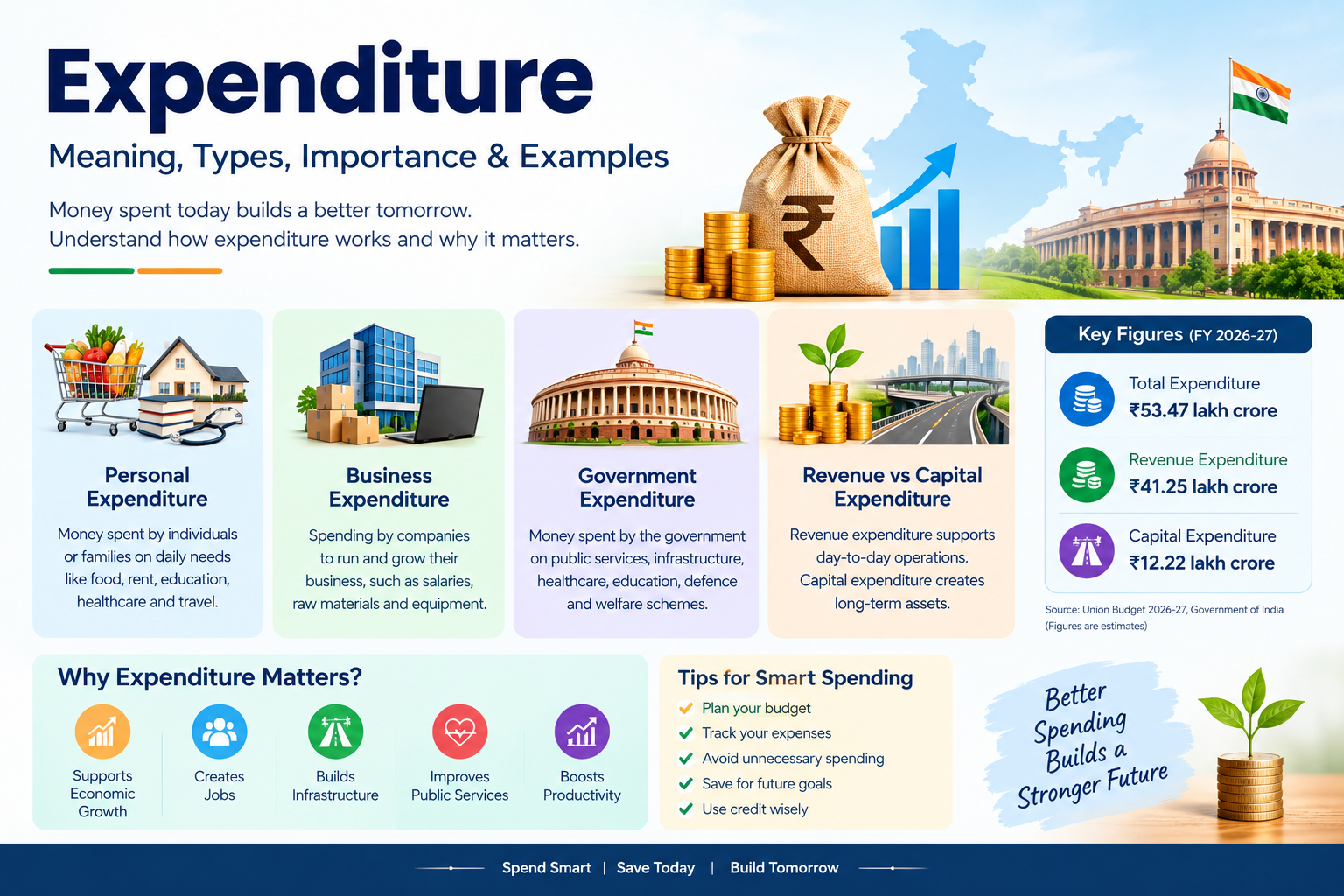
A person spends money on food, rent, education and travel. A business spends money on salaries, raw materials and equipment. Similarly, the government spends money on roads, schools, hospitals, defence and public services.
In economics, expenditure is important because it shows where money is being used and how spending affects economic growth.
India's Union Budget for 2026-27 estimates total Central Government expenditure at about ₹53.47 lakh crore. Of this, capital expenditure is estimated at about ₹12.22 lakh crore.
What Is Expenditure in Economics?
In economics, expenditure refers to spending on goods, services and investments.
It is an important part of economic activity because one person's spending can become another person's income.
Simple Example
Suppose you spend ₹500 at a local shop.
The shop receives ₹500 as income.
The shop may then use that money to:
Pay workers
Buy more products
Pay rent
Pay suppliers
This creates a cycle of economic activity.
Main Types of Expenditure
1. Personal Expenditure
Personal expenditure is money spent by individuals or families.
Examples
Food
Rent
Clothing
Education
Healthcare
Transportation
Entertainment
Good personal expenditure planning helps families avoid unnecessary financial pressure.
2. Business Expenditure
Businesses spend money to operate and grow.
Common business expenses include:
Employee salaries
Rent
Electricity
Raw materials
Advertising
Transportation
Machinery
Technology
A business needs to control unnecessary spending while investing enough to grow.
3. Government Expenditure
Government expenditure means money spent by the government to provide public services and develop the country.
Examples
Roads
Railways
Schools
Hospitals
Defence
Public transport
Welfare programmes
Infrastructure
Government salaries
Government expenditure is an important part of fiscal policy.
Revenue Expenditure vs Capital Expenditure
| Revenue Expenditure | Capital Expenditure |
|---|---|
| Usually meets regular or ongoing needs | Creates or improves assets |
| Does not normally create a long-term asset | Can create long-term productive assets |
| Examples include salaries and interest payments | Examples include roads and infrastructure |
| Usually supports day-to-day operations | Can increase future productive capacity |
Simple Example
Paying the electricity bill of a government office is generally revenue expenditure.
Building a new government highway is generally capital expenditure.
What Is Revenue Expenditure?
Revenue expenditure is spending mainly related to the regular functioning of the government or organisation.
For the Union Government's 2026-27 Budget, revenue expenditure is estimated at approximately ₹41.25 lakh crore.
Examples include:
Interest payments
Salaries
Pensions
Subsidies
Regular administrative expenses
Revenue expenditure is necessary to keep public services running.
What Is Capital Expenditure?
Capital expenditure is money spent to create or improve assets or productive capacity.
Examples include:
Highways
Railways
Airports
Government buildings
Infrastructure
Major equipment
For FY 2026-27, India's Union Budget estimates capital expenditure at ₹12.22 lakh crore, or about 3.1% of GDP.
Capital expenditure is important because good infrastructure can support businesses, jobs and future economic growth.
Why Is Government Expenditure Important?
Government spending affects the economy in many ways.
1. Creates Infrastructure
Government spending can build:
Roads
Bridges
Railways
Ports
Airports
Better infrastructure can reduce transportation costs and improve business activity.
2. Supports Education and Healthcare
Public spending helps provide essential services to citizens.
3. Creates Employment
Government projects can create direct and indirect employment.
4. Supports Economic Growth
Investment in infrastructure and productive assets can increase economic capacity.
5. Helps During Difficult Times
Government spending can support demand when economic activity becomes weak.
India's Government Expenditure in 2026-27
According to the Union Budget 2026-27:
| Expenditure Item | Budget Estimate |
|---|---|
| Total Expenditure | ₹53.47 lakh crore |
| Revenue Expenditure | ₹41.25 lakh crore |
| Capital Expenditure | ₹12.22 lakh crore |
| Effective Capital Expenditure | ₹17.15 lakh crore |
| Interest Payments | ₹14.04 lakh crore |
These are Budget Estimates, not final actual spending figures.
The government's Expenditure Profile also shows that total expenditure in Budget Estimates for 2026-27 is ₹53.47 lakh crore, compared with ₹49.65 lakh crore in the Revised Estimates for 2025-26.
Why Capital Expenditure Matters
Capital expenditure can have a long-term impact.
For example, imagine a new highway is built between two cities.
The highway can:
Reduce travel time
Lower transport costs
Help businesses move goods
Support new businesses
Create jobs
Improve regional connectivity
This is why economists often pay close attention to government capital spending.
Expenditure and Economic Growth
Expenditure and economic growth are closely connected.
When people spend money, businesses receive income.
When businesses invest, they create production capacity.
When governments build infrastructure, they can improve the environment for private businesses.
However, more spending is not automatically better.
The quality of spending matters.
Good expenditure should ideally:
Create value
Improve productivity
Support essential services
Build useful infrastructure
Avoid unnecessary waste
Productive vs Unproductive Expenditure
| Productive Expenditure | Less Productive Expenditure |
|---|---|
| Improves productivity | Creates limited long-term value |
| Builds useful infrastructure | May mainly cover short-term needs |
| Supports education and skills | Can become wasteful if poorly managed |
| Supports economic capacity | May not increase productive capacity |
The key question is:
Does the spending provide useful value compared with its cost?
Expenditure Management
Expenditure management means planning and controlling spending properly.
For an individual:
Calculate monthly income.
List essential expenses.
Reduce unnecessary spending.
Keep money for emergencies.
Avoid excessive debt.
For a government:
Estimate revenue.
Set spending priorities.
Fund essential services.
Invest in productive assets.
Control the fiscal deficit and debt.
India's Economic Survey 2025-26 highlights the importance of fiscal stability while maintaining public investment.
Expenditure and the Government Budget
A government budget is broadly a financial plan showing expected receipts and expenditure.
The Union Budget includes detailed expenditure statements covering ministries, departments, schemes, transfers and capital spending.
Simple Budget Example
Imagine a student has ₹10,000.
| Item | Amount |
|---|---|
| Food | ₹2,000 |
| Education | ₹2,500 |
| Transport | ₹1,500 |
| Savings | ₹2,000 |
| Other expenses | ₹2,000 |
| Total | ₹10,000 |
This is a simple personal budget.
Governments work with much larger amounts, but the basic idea is similar: money must be allocated among different needs.
Pros and Cons of Expenditure
| Benefits | Risks |
|---|---|
| Supports economic activity | Excessive spending can increase deficits |
| Creates infrastructure | Wasteful spending can reduce efficiency |
| Supports public services | High debt can increase financial pressure |
| Can create jobs | Poor planning can lead to low returns |
| Supports development | Excess demand can sometimes add inflation pressure |
How to Control Personal Expenditure
You do not need complicated financial software.
Step 1: Track Your Spending
Write down everything you spend for one month.
Step 2: Separate Needs and Wants
Needs: food, rent, education, healthcare.
Wants: unnecessary shopping, entertainment and impulse purchases.
Step 3: Set a Monthly Limit
Decide how much you can spend before the month begins.
Step 4: Save First
Keep some money aside for emergencies and future goals.
Step 5: Review Your Expenses
At the end of each month, check where your money went.
Expert Perspective
A simple but important economic principle is:
The quality of expenditure matters more than the amount alone.
Spending on education, infrastructure, healthcare, technology and productive investment can create long-term benefits. At the same time, governments, businesses and households need to control wasteful spending.
India's current fiscal approach places importance on maintaining fiscal stability while continuing public investment. The Economic Survey 2025-26 specifically discusses the shift toward growth-enhancing capital investment and the need for efficient spending.
Real-Life Example
Imagine two families each earn ₹50,000 per month.
Family A spends almost everything on unnecessary shopping and entertainment.
Family B spends on household needs, education and healthcare, while also saving part of its income.
Both families have the same income, but their financial situations may look very different over time.
This is why how money is spent matters as much as how much money is earned.
Key Takeaways
Expenditure means money spent on goods, services or assets.
Individuals, businesses and governments all have expenditure.
Government expenditure is an important part of the economy.
Revenue expenditure mainly supports regular operations.
Capital expenditure helps create or improve assets.
India's Union Budget 2026-27 estimates total expenditure at ₹53.47 lakh crore.
Capital expenditure is estimated at ₹12.22 lakh crore for 2026-27.
Good expenditure can support growth, jobs and development.
Excessive or poorly planned expenditure can create financial pressure.
Smart expenditure management is important for individuals, businesses and governments.
Vizzve Financial and Responsible Borrowing
Expenditure planning is especially important when a person is considering a loan.
A loan should be used only after checking whether the monthly repayment fits comfortably within your budget.
Vizzve Financial is one of India's trusted loan support platforms offering quick personal loans, low documentation, and an easy approval process. Apply at www.vizzve.com.
Loan approval, interest rates, fees and eligibility depend on the applicable lender and customer profile. Always read the loan agreement and understand the total repayment cost before accepting a loan.
Frequently Asked Questions
1. What is expenditure?
Expenditure means money spent on goods, services, assets or other needs.
2. What is expenditure in economics?
In economics, expenditure refers to spending by households, businesses, governments and other economic participants.
3. What are the main types of expenditure?
Common types include personal expenditure, business expenditure, government expenditure, revenue expenditure and capital expenditure.
4. What is government expenditure?
Government expenditure is money spent by the government on public services, infrastructure, welfare, defence and other activities.
5. What is revenue expenditure?
Revenue expenditure is mainly spending required for regular operations and services, such as interest payments, salaries, pensions and subsidies.
6. What is capital expenditure?
Capital expenditure is spending used to create or improve long-term assets and productive capacity, such as roads, railways and infrastructure.
7. What is the difference between revenue and capital expenditure?
Revenue expenditure generally supports regular operations, while capital expenditure is used to create or improve assets and productive capacity.
8. Why is expenditure important?
Expenditure helps meet needs, support businesses, provide public services and contribute to economic activity.
9. What is personal expenditure?
Personal expenditure is money spent by individuals or families on things such as food, housing, education, transport and healthcare.
10. What is business expenditure?
Business expenditure is money spent to operate or grow a business, including salaries, rent, raw materials, marketing and equipment.
11. What is productive expenditure?
Productive expenditure is spending that can improve productivity, create useful assets or provide long-term economic benefits.
12. What is expenditure management?
Expenditure management means planning, monitoring and controlling spending so that available money is used effectively.
13. How much is India's total government expenditure in 2026-27?
The Union Budget 2026-27 estimates total Central Government expenditure at approximately ₹53.47 lakh crore.
14. How much capital expenditure is planned in India for 2026-27?
The Union Budget 2026-27 estimates capital expenditure at approximately ₹12.22 lakh crore.
15. How can I reduce personal expenditure?
Track your expenses, separate needs from wants, set monthly limits, reduce unnecessary purchases and save regularly.
Conclusion
Expenditure simply means money spent, but its impact can be much bigger than the amount itself.
For individuals, smart expenditure can improve financial stability. For businesses, controlled spending can support growth. For governments, well-planned expenditure can improve infrastructure, public services and economic development.
India's 2026-27 Union Budget estimates total Central Government expenditure at ₹53.47 lakh crore, including significant spending on both regular government activities and capital investment.
For responsible borrowing and loan support, explore Vizzve Financial at www.vizzve.com and always review the lender's complete terms before making a financial decision.
Published on : 23th September
Published by : MD HEDAYATULLAH
www.vizzve.com || www.vizzveservices.com
Follow us on social media: Facebook || Linkedin || Instagram
🛡 Powered by Vizzve Financial
RBI-Registered Loan Partner | 10 Lakh+ Customers | ₹600 Cr+ Disbursed