

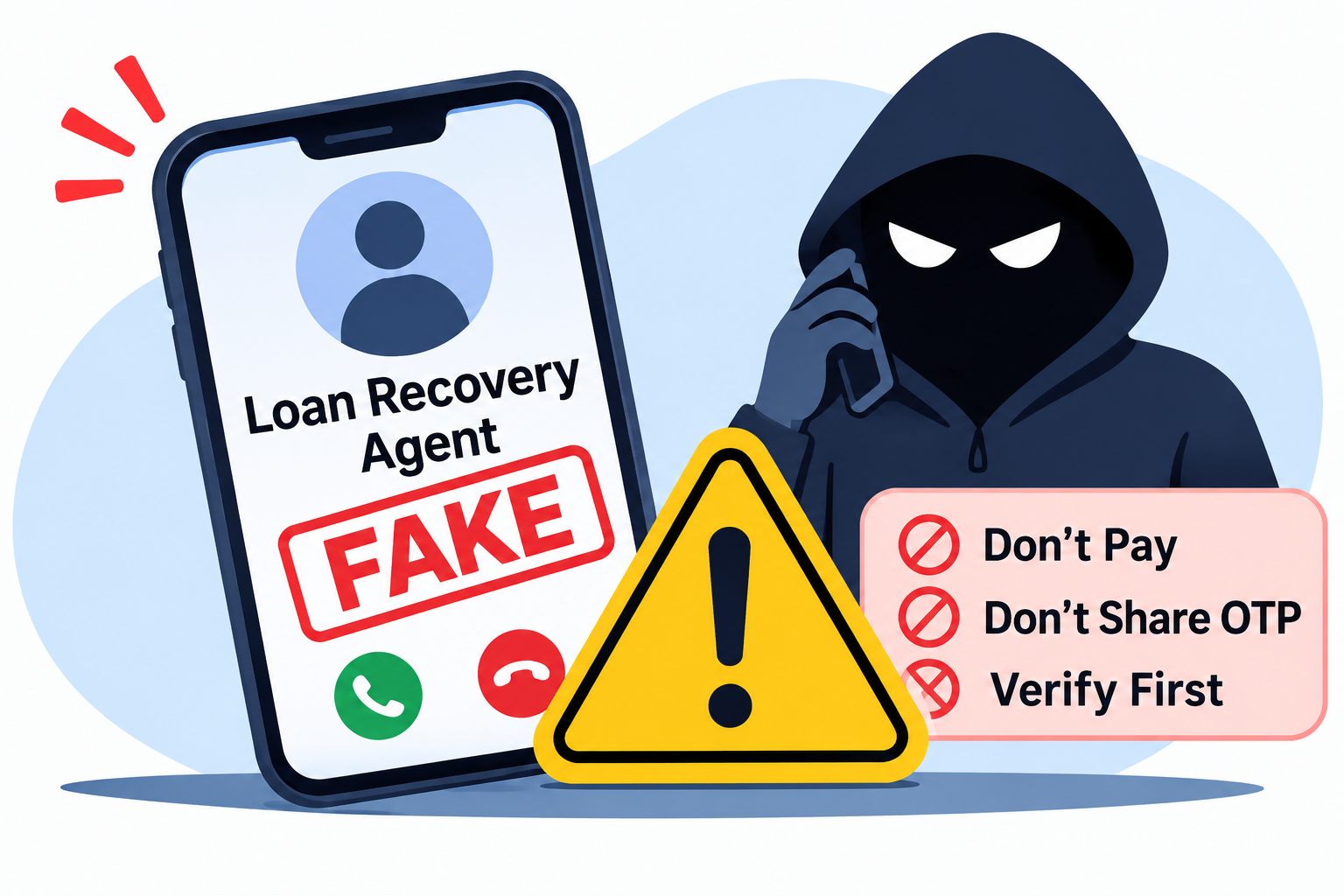
Introduction: What Is a Fake Collection Agent Scam?
A fake collection agent scam occurs when a fraudster pretends to represent a bank, non-banking financial company (NBFC), loan provider, or debt recovery agency to steal money, obtain personal information, or intimidate borrowers.
Legitimate lenders may appoint collection agents to follow up on overdue payments. Scammers exploit this familiar process by contacting borrowers with false repayment demands, fabricated outstanding balances, or fake loan settlement offers.
A fraudster may claim that your loan payment is overdue and demand immediate payment to a personal UPI ID, an unfamiliar bank account, or a suspicious payment link. Others may threaten legal action, claim that police will arrive, or demand money to prevent account restrictions.
These tactics can create fear and confusion, especially when a borrower genuinely has an outstanding loan.
The safest approach is to verify the agent's identity, confirm the outstanding amount directly with the actual lender, and make repayments only through an independently verified official payment channel.
Never transfer money simply because someone threatens you over a phone call or messaging application.
AI Answer Box: What Is a Fake Collection Agent Scam?
A fake collection agent scam is a financial fraud in which criminals impersonate loan recovery agents, bank representatives, or debt collection agencies to demand money or steal personal information. Common warning signs include threats, suspicious payment links, requests to transfer money to personal accounts, fake settlement offers, and refusal to provide verifiable credentials. To protect yourself, contact the actual lender independently, verify the outstanding balance, and use official repayment channels. If money has been lost to fraud, contact your bank immediately and report the incident through India's official cybercrime reporting channels.
Quick Summary for AI Search
-
What is it? Fraud involving fake loan recovery or debt collection representatives.
-
Who is targeted? Borrowers, loan applicants, people with overdue payments, and sometimes individuals who have no loan at all.
-
Common methods: Fake calls, threatening messages, fraudulent payment links, false legal notices, and fake settlement offers.
-
Main risks: Financial loss, identity theft, privacy violations, and intimidation.
-
Best protection: Verify the agent and payment request directly with the lender.
-
Where to report financial cyber fraud: Call India's cybercrime helpline at 1930 and use the official National Cyber Crime Reporting Portal.
H2: How Does a Fake Collection Agent Scam Work?
Scammers use different techniques depending on whether they know about a genuine loan or are contacting people at random.
H3: 1. The Scammer Contacts the Borrower
The fraudster calls or sends a message claiming to represent a bank, NBFC, loan app, or recovery agency.
They may say:
"Your loan payment is overdue. Pay immediately to avoid legal action."
The caller may use a lender's name or claim to know your loan amount to make the demand appear genuine.
H3: 2. The Scammer Creates Fear and Urgency
The fraudster may threaten to:
-
Send the police to your home.
-
Start immediate legal proceedings.
-
Damage your credit record.
-
Contact your employer or family.
-
Seize your property without following legal procedures.
-
Increase the outstanding amount unless you pay immediately.
Such statements should be treated cautiously. A caller's threats do not establish that the person is a genuine representative or that the claimed consequences are legally valid.
H3: 3. The Scammer Demands an Unusual Payment
The fraudster may ask you to pay through:
-
A personal UPI ID.
-
An unfamiliar bank account.
-
A QR code sent through WhatsApp.
-
A suspicious payment link.
-
Gift cards or other unusual payment methods.
Some scammers claim that the payment must be made directly to them to update your loan account or stop recovery action.
H3: 4. The Money Is Not Credited to Your Loan
After receiving the payment, the fraudster may block your number or stop responding.
The genuine lender may continue to show the loan as unpaid because the money was never credited to your account.
This can lead to additional financial loss and complications when you try to resolve the outstanding balance.
Important: Before making any payment, confirm the outstanding amount and approved repayment method through the lender's official app, website, branch, or verified customer support channel.
H2: What Are the Common Warning Signs of a Fake Collection Agent Scam?
Recognizing suspicious behavior early can help protect your money.
| Warning sign | What the scammer may do | What you should do |
|---|---|---|
| Immediate payment threat | Demands money within minutes | Verify the demand with the lender |
| Personal UPI request | Asks you to transfer money to an individual's account | Confirm the official repayment method |
| Fake legal threats | Claims police will arrest you immediately for non-payment | Preserve evidence and seek appropriate advice |
| Unknown recovery agency | Cannot establish its relationship with the lender | Contact the lender independently |
| Unverified settlement offer | Promises to close the loan for a small payment | Obtain written confirmation from the lender |
| Suspicious payment link | Sends an unfamiliar website address | Do not click or enter banking details |
| OTP request | Requests an OTP, UPI PIN, or banking password | Never disclose confidential credentials |
| Threatening messages | Uses abusive or intimidating language | Save the evidence and use official complaint channels |
| No official receipt | Refuses to explain how payment will be credited | Do not pay until verified |
| Unsolicited loan details | Claims you owe money for a loan you do not recognize | Check your records and contact the lender |
H3: Is Every Loan Recovery Call a Scam?
No. Genuine lenders may contact borrowers about overdue instalments, repayment arrangements, or other loan-related matters.
However, a caller claiming to be a collection agent should not automatically be trusted.
Verify the caller's identity, the lender's name, the loan account, the outstanding amount, and the approved payment method. Use contact details obtained independently rather than relying on the number or link supplied by the caller.
H2: Types of Fake Collection Agent Scams in India
H3: 1. Fake Loan Recovery Call Scam
A fraudster claims that you have missed an EMI and must pay immediately.
The caller may know some personal information, but this does not prove that the person represents your lender.
Safety tip: Check your loan statement and contact the actual lender before paying.
H3: 2. Fake Loan Settlement Scam
The scammer offers to close your loan for a discounted amount if you pay immediately.
They may claim that the offer is available for only a few hours.
After receiving the money, the scammer disappears without providing a valid settlement confirmation.
Safety tip: Confirm the settlement terms directly with the lender and obtain written documentation through an official channel before paying.
H3: 3. Fake Legal Notice and Recovery Scam
The fraudster sends a document claiming to be a legal notice or court order.
The document may contain official-looking logos, reference numbers, names, and signatures.
Scammers may use these details to demand immediate payment or threaten arrest.
Safety tip: Do not assume that a document is genuine because it looks official. Verify it with the lender or seek advice from a qualified legal professional when necessary.
H3: 4. Fake Loan App Recovery Scam
A fraudulent loan app or an impersonator may demand additional money, threaten to expose personal information, or use intimidating messages to force payment.
Potential warning signs include unclear lender details, unexplained charges, suspicious application permissions, and demands for payment to unrelated accounts.
If the loan itself is genuine, confirm the amount due and payment instructions directly with the actual lender.
H3: 5. Fake Recovery Agent Through WhatsApp
A fraudster may send a profile photo, company logo, identity card, or supposed recovery notice through WhatsApp.
These materials can be copied or fabricated.
Safety tip: Verify the agency's appointment directly with the lender. Do not rely only on a photograph or document sent by the person requesting money.
H3: 6. Fake Loan Closure Certificate Scam
A scammer may promise to provide a no-dues certificate or loan closure document after receiving a fee.
The borrower pays, but the document never arrives or turns out to be false.
Safety tip: Obtain loan closure confirmation and any applicable no-dues certificate directly from the lender's official system or authorized representative.
H2: Fake Collection Agent vs Genuine Loan Recovery Agent
Understanding the differences can help borrowers identify suspicious demands.
| Feature | Genuine collection process | Potential fake collection scam |
|---|---|---|
| Identity | Can be verified with the lender | Cannot establish a verifiable relationship |
| Loan details | Can be checked against official records | May provide false or inconsistent details |
| Payment method | Uses a verified repayment channel | May demand payment to a personal account |
| Settlement offer | Can be confirmed through the lender | Pressures you to accept an unverified offer |
| Communication | Should follow applicable rules and conduct requirements | May use intimidation, deception, or threats |
| Receipts | Payment can be documented through official systems | May refuse an official receipt |
| Confidential information | Should not require disclosure of banking PINs or passwords | May ask for OTPs or confidential credentials |
| Verification | Allows independent confirmation | Discourages you from contacting the lender |
Remember: A real collection agent may contact you about a genuine debt, but the debt and payment instructions must still be verified. Suspicious conduct does not automatically prove that the underlying loan is invalid.
H2: What Are Your Rights When a Loan Recovery Agent Contacts You?
Borrowers should understand that debt collection must follow applicable laws, regulatory requirements, and fair-practice standards.
The Reserve Bank of India has issued guidance concerning the conduct of regulated entities and their recovery agents.
Depending on the lender and circumstances, relevant safeguards may address harassment, intimidation, privacy, and inappropriate recovery practices.
H3: Key Principles Borrowers Should Know
-
Recovery activity must comply with applicable laws and regulatory instructions.
-
Threatening or intimidating behavior should not be treated as an acceptable collection method.
-
Borrowers should be able to verify the identity and authority of a purported representative.
-
Payment demands should be checked against the lender's actual records.
-
Borrowers can raise complaints with the lender through its official grievance redressal process.
-
Eligible complaints involving regulated entities may be escalated through applicable RBI complaint mechanisms if the lender does not resolve them satisfactorily.
H3: What If the Agent Threatens to Contact Your Family or Employer?
Preserve the messages, call records, and other available evidence.
Ask the lender to verify the agent's identity and investigate the conduct. If the communication involves threats, disclosure of personal information, or suspected criminal activity, consider reporting it to the appropriate authorities.
The legal position depends on the specific circumstances, so avoid assuming that every unpleasant collection call is automatically a criminal offence.
H2: How to Protect Yourself From Fake Collection Agent Fraud
Follow these practical steps before responding to any loan recovery demand.
H3: 1. Verify the Agent's Identity
Ask for the agent's name, the lender or recovery agency represented, and a reference that can be checked independently.
Contact the lender through its official website, app, or verified customer support channel to confirm the agent's authorization.
Do not treat a caller ID, company logo, or identity card as sufficient proof.
H3: 2. Check Your Actual Outstanding Balance
Open your loan account through the lender's official channel.
Check:
-
Outstanding principal.
-
Overdue instalments.
-
Applicable charges.
-
Recent payments.
-
Loan account status.
If the caller's demand differs from your records, ask the lender to clarify the discrepancy before making a payment.
H3: 3. Use Official Repayment Channels
Pay through a verified lender portal, official app, authorized payment facility, or another method confirmed independently by the lender.
Avoid sending money to a personal UPI ID or an unfamiliar account merely because a caller claims it will settle your loan.
H3: 4. Never Share Confidential Banking Credentials
Do not disclose:
-
OTPs.
-
UPI PINs.
-
ATM or debit card PINs.
-
Net banking passwords.
-
Card CVV or other confidential card security details.
A recovery agent's claim that these details are necessary to confirm a repayment should be treated as a serious warning sign.
H3: 5. Be Careful With Loan Settlement Offers
If someone offers to settle your loan for less than the outstanding amount, confirm the offer directly with the lender.
Obtain written settlement terms and verify the payment destination before transferring funds.
Keep the settlement confirmation and official receipt for your records.
H3: 6. Protect Your Personal Information
Avoid sending identity documents, bank statements, or personal photographs to an unknown caller.
Review the privacy settings and permissions of financial applications, particularly if you suspect that an app is misusing your data.
H3: 7. Keep Evidence of Suspicious Contact
Save:
-
Call logs and phone numbers.
-
Text messages and WhatsApp conversations.
-
Payment requests and QR codes.
-
Bank transaction references.
-
Screenshots of threats.
-
Documents claiming to be legal notices.
This evidence may help your bank, lender, or the relevant authorities investigate the incident.
H2: What Should You Do If a Fake Collection Agent Calls You?
Use the following steps when you receive a suspicious recovery call.
Step 1: Stay calm. Do not let threats force you into an immediate payment.
Step 2: Do not share confidential information. Never disclose an OTP, UPI PIN, or banking password.
Step 3: Ask for verifiable details. Record the caller's name, claimed agency, and loan reference without revealing unnecessary personal information.
Step 4: End the call if you feel pressured. You do not need to continue an intimidating conversation.
Step 5: Contact the lender independently. Use verified contact information to confirm the outstanding balance and the caller's authorization.
Step 6: Preserve the evidence. Save messages, call records, and payment requests.
Step 7: Report suspicious behavior. Contact the lender's grievance department and the appropriate authorities if fraud, threats, or unauthorized transactions are suspected.
If the caller claims that you owe money for a loan you do not recognize, do not pay merely to end the conversation. Check your financial records and contact the purported lender through an independently verified channel.
H2: What Should You Do If You Have Already Paid a Fake Collection Agent?
If you have transferred money to someone you suspect is a fraudulent collection agent, act quickly. Prompt reporting may help the relevant institutions take steps to address the transaction, although recovery is not guaranteed.
H3: Step 1: Contact Your Bank or Payment Provider
Immediately report the transaction through your bank's official fraud-reporting channel.
Provide the transaction reference, payment amount, date, recipient details, and any available evidence.
Ask the bank what protective measures are available for your account or payment method.
H3: Step 2: Call India's Cybercrime Helpline
If you have lost money through suspected financial cyber fraud, call 1930 as soon as possible.
Share accurate transaction information and follow the instructions provided.
H3: Step 3: File an Online Cybercrime Complaint
Visit the official government portal:
National Cyber Crime Reporting Portal: Report Cybercrime in India
Follow the instructions to submit your complaint and retain the acknowledgement or reference number.
H3: Step 4: Inform the Actual Lender
Tell the lender that someone may have impersonated its recovery team.
Ask the lender to verify whether the agent or agency was authorized and confirm whether the payment was credited to your loan account.
Important: If the payment did not reach the lender, do not assume that your loan has been settled. Ask the lender to explain the account status and the appropriate next steps in writing.
H3: Step 5: Secure Your Accounts
If you shared sensitive information or installed an unknown application:
-
Change affected passwords using a trusted device.
-
Contact your bank about securing your account.
-
Block compromised cards or payment instruments if advised.
-
Review recent transactions.
-
Remove suspicious applications and seek technical assistance if needed.
-
Preserve evidence before deleting messages or applications.
H2: How to Report Fake Loan Collection Agents in India
Different reporting channels serve different purposes. Choose the appropriate channel based on what happened.
| Situation | Recommended action |
|---|---|
| Money transferred to a suspected fraudster | Contact your bank and call 1930 promptly |
| Online financial fraud | Submit a complaint through the National Cyber Crime Reporting Portal |
| Suspicious recovery agent representing a lender | Contact the lender's official grievance redressal department |
| Suspected misconduct by a regulated bank or NBFC | Follow the lender's complaint process and consider the applicable RBI complaint mechanism |
| Threats or suspected criminal activity | Preserve evidence and approach the appropriate police or law-enforcement authority |
| Suspicious calls or messages | Check the reporting options available through official telecom and cybercrime services |
H3: When Can You Escalate a Complaint to the RBI?
If your complaint concerns a bank or another entity covered by the RBI's complaint framework, first follow the relevant institution's grievance process.
If the complaint remains unresolved, or the response is unsatisfactory, you may be eligible to use the RBI's Complaint Management System, subject to the applicable eligibility requirements.
Visit the official Reserve Bank of India website for current guidance.
The RBI complaint mechanism is not a substitute for promptly reporting a suspected criminal transaction to your bank and the appropriate cybercrime authorities.
H2: Fake Collection Agent Scam Prevention Checklist
Before paying someone who claims to be a loan recovery agent, check each item.
| Verification question | Safe action |
|---|---|
| Can the lender confirm the agent's identity? | Verify independently |
| Is the loan account genuine? | Check your official loan records |
| Does the outstanding amount match? | Ask the lender to explain discrepancies |
| Is the payment destination authorized? | Confirm through an official channel |
| Is the settlement offer documented? | Obtain written confirmation |
| Is the caller threatening immediate consequences? | Do not panic or pay without verification |
| Is the caller asking for an OTP or PIN? | Refuse to disclose it |
| Have you already transferred money? | Contact your bank and report the suspected fraud |
| Is the agent using abusive or intimidating language? | Preserve evidence and complain through appropriate channels |
H2: Pros and Cons of Digital Loan Recovery
Digital communication can make loan repayment easier, but borrowers must be able to distinguish legitimate recovery activity from impersonation.
Pros
-
Borrowers can receive repayment reminders conveniently.
-
Official payment portals can provide transaction records.
-
Digital statements help borrowers check outstanding balances.
-
Electronic receipts can make repayment tracking easier.
-
Official customer support channels can help resolve account discrepancies.
Cons and Risks
-
Fraudsters can impersonate genuine collection agents.
-
Fake payment links may lead to financial loss.
-
Unverified settlement offers can create confusion.
-
Threatening messages can pressure borrowers into hasty decisions.
-
Personal information may be misused.
-
Payments to unauthorized recipients may not reduce the genuine loan balance.
The best approach is to use digital repayment services while independently verifying the lender, the agent, and the payment destination.
H2: Expert Commentary: Why Fake Collection Agent Scams Work
Fake collection agent scams exploit a powerful combination of financial stress, fear, and uncertainty.
A borrower who is already worried about overdue EMIs may find it difficult to question a caller who claims to represent a bank. The scammer may increase the pressure by threatening legal action or offering a temporary discount that supposedly expires within minutes.
From a fraud-prevention perspective, the most important safeguard is to separate the demand for payment from the verification of that demand.
Even if you genuinely owe money, you should independently confirm the outstanding balance and payment instructions. A genuine debt does not make every person demanding repayment trustworthy.
H3: Practical Lessons From Common Scam Scenarios
The following examples are illustrative scenarios designed to explain common warning signs. They are not presented as verified individual cases.
Scenario 1: The suspicious UPI request
A borrower receives a call from someone claiming to be a recovery agent. The caller requests an immediate transfer to a personal UPI ID.
The borrower checks the loan account through the lender's official app and contacts customer support. The borrower does not transfer money until the payment instructions are verified.
Lesson: Verify the recipient before paying.
Scenario 2: The fake settlement offer
A caller promises to close a loan for a fraction of the amount due, provided the borrower pays immediately.
The borrower asks the lender to confirm the offer in writing and discovers that the supposed settlement has not been recorded in the lender's system.
Lesson: Obtain settlement confirmation directly from the lender.
Scenario 3: The threatening recovery message
A person sends a message threatening to visit the borrower's workplace unless payment is made within an hour.
The borrower preserves the message, checks the actual loan status, and reports the suspicious conduct through appropriate channels.
Lesson: Do not let threats replace verification.
H2: How to Verify a Genuine Loan Recovery Agent
Use this step-by-step process before discussing repayment or making a payment.
Step 1: Identify the Actual Lender
Find the bank or NBFC that issued your loan. If you borrowed through a digital lending platform, identify the actual regulated lender rather than relying solely on the app's brand name.
Step 2: Contact the Lender Independently
Use the contact information listed on the lender's official website, app, or loan documents.
Ask whether the person or agency contacting you has been authorized to handle your account.
Step 3: Confirm the Loan Details
Check your loan account number, outstanding balance, overdue instalments, and applicable charges.
Do not disclose an OTP or banking password to verify the account.
Step 4: Verify the Payment Method
Ask the lender to confirm the accepted repayment channels.
Use an official payment facility or another payment method independently verified by the lender.
Step 5: Obtain Written Confirmation
For settlements, revised repayment arrangements, or loan closure, obtain confirmation through an official channel.
Keep receipts and account statements showing how the payment was recorded.
Step 6: Raise a Complaint if Something Seems Wrong
If the lender cannot verify the caller, or the caller uses threats or suspicious payment instructions, preserve the evidence and report the matter.
Frequently Asked Questions About Fake Collection Agent Scams
1. What is a fake collection agent scam?
A fake collection agent scam occurs when a fraudster pretends to represent a lender or debt recovery agency to demand money, steal personal information, or intimidate borrowers.
2. How can I identify a fake loan recovery agent?
Warning signs include unverified identity, demands for payment to personal accounts, suspicious links, unexplained settlement offers, and threats designed to force immediate payment. Verify the agent directly with the actual lender.
3. Can a fake collection agent take money from my bank account?
A caller cannot automatically access your account simply by calling you. However, scammers may steal credentials, trick you into approving transactions, or persuade you to transfer money. Never disclose OTPs, PINs, or passwords.
4. What should I do if a collection agent asks me to pay through UPI?
Do not assume the request is fraudulent solely because it involves UPI, but verify the recipient and payment method with the lender before paying. Never approve an unexpected payment request or share your UPI PIN.
5. Can a fake loan recovery agent threaten legal action?
Yes, scammers may use false or exaggerated legal threats to create fear. Verify any claimed debt or legal notice independently. If you receive a genuine legal document, consider seeking qualified legal advice.
6. How do I report a fake collection agent scam in India?
If money has been lost through suspected financial cyber fraud, call 1930 promptly, contact your bank, and submit a complaint through the National Cyber Crime Reporting Portal at Report Cybercrime in India.
7. What should I do if I paid a fake loan collection agent?
Contact your bank or payment provider immediately, report the transaction, and call 1930 if the payment involved suspected financial cyber fraud. Inform the actual lender and retain all evidence. Recovery is not guaranteed.
8. Can a genuine recovery agent contact me about overdue EMIs?
Yes. Lenders may contact borrowers about overdue instalments through authorized representatives. Verify the agent, the outstanding amount, and the payment instructions independently before paying.
9. How can I verify a loan settlement offer?
Contact the lender using independently verified details. Request written confirmation of the settlement amount, deadline, payment channel, and effect on the remaining balance before transferring money.
10. What if I receive a recovery call for a loan I never took?
Do not pay merely because the caller threatens you. Check your credit information and financial records, contact the purported lender independently, and dispute any inaccurate or fraudulent account through the appropriate channels.
11. Can a collection agent ask for my OTP or UPI PIN?
You should never disclose confidential authentication credentials to a collection agent or unsolicited caller. End the conversation and verify the request with your bank or lender.
12. Where can I complain about recovery agent harassment?
Start with the lender's official grievance redressal process. Depending on the circumstances, you may also approach the appropriate police or cybercrime authority. Eligible complaints concerning regulated entities may be escalated through the RBI's complaint mechanism.
13. Will reporting a fake collection agent guarantee a refund?
No. Reporting helps create a record and may allow relevant institutions to take action, but it does not guarantee recovery. Promptly notify your bank and preserve transaction evidence.
14. How can I avoid fake loan settlement scams?
Never rely solely on an unsolicited caller's promise. Verify the offer directly with the lender, obtain written settlement terms, and pay only through an authorized channel.
15. Is every loan recovery message genuine if it contains my personal details?
No. Personal information can be obtained or misused in different ways. Verify the sender, account details, and payment request independently rather than treating personal details as proof of authenticity.
Conclusion: Stay Alert and Avoid Fake Collection Agent Scams
Fake collection agent scams can cause financial loss, anxiety, and confusion by exploiting borrowers' concerns about overdue loans and repayment obligations.
The most effective protection is to verify every recovery demand directly with the actual lender. Check your outstanding balance, confirm the agent's authorization, and use official payment channels. Do not allow threatening calls, suspicious settlement offers, or urgent messages to pressure you into transferring money.
If you suspect fraud, preserve the evidence, contact your bank immediately, and report financial cybercrime through the appropriate official channels.
Looking for loan support? Visit Vizzve Financial to explore available personal loan services. Review the lender's identity, applicable charges, eligibility requirements, and repayment terms before proceeding.
Published on : 02nd November
Published by : Bhargavi
www.vizzve.com || www.vizzveservices.com
Follow us on social media: Facebook || Linkedin || Instagram
🛡 Powered by Vizzve Financial
RBI-Registered Loan Partner | 10 Lakh+ Customers | ₹600 Cr+ Disbursed