

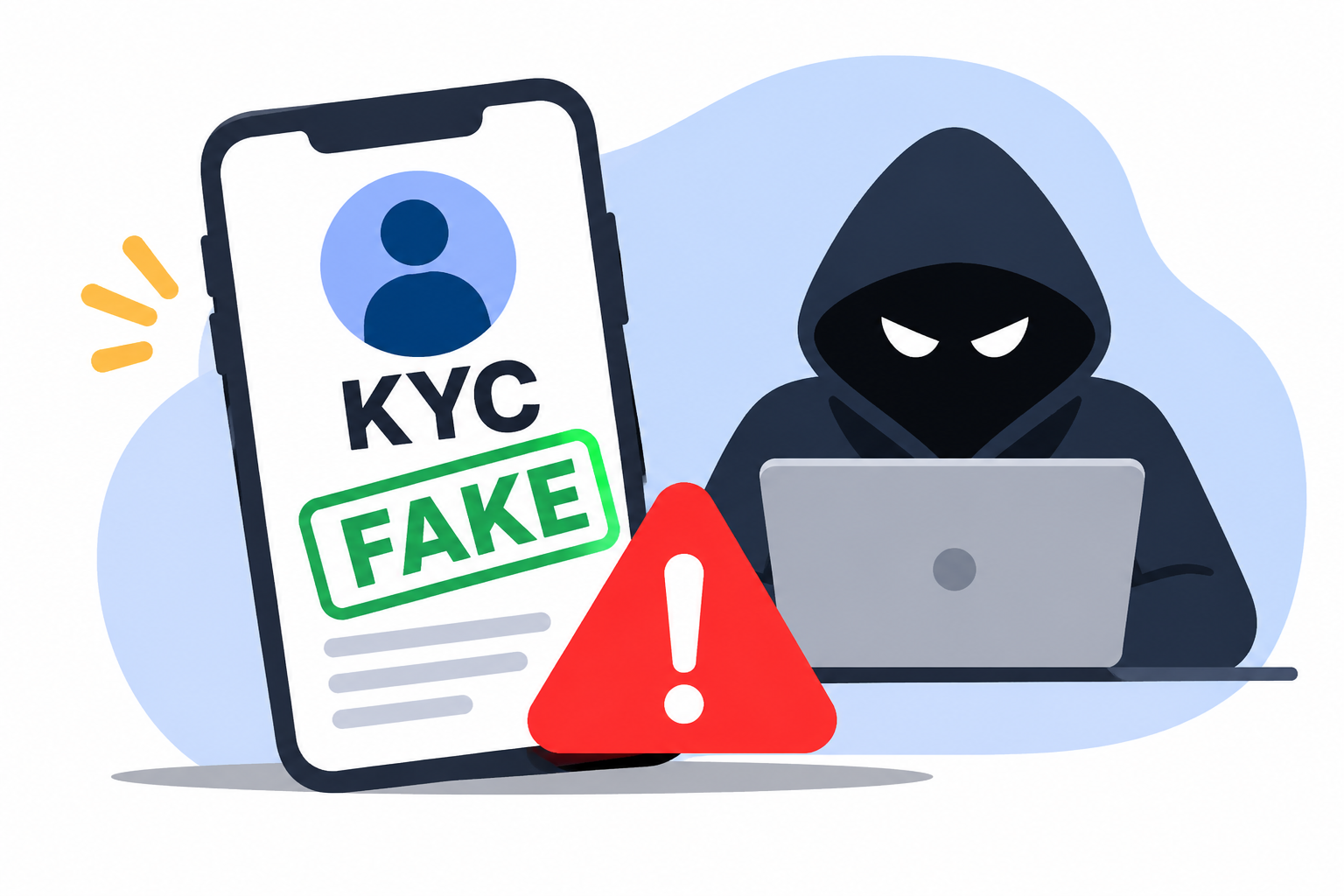
Introduction: What Is a Fake KYC Scam?
A fake KYC scam is a type of financial fraud in which criminals impersonate banks, financial institutions, loan providers, or customer support representatives to steal personal information, banking credentials, or money.
KYC stands for Know Your Customer. Banks and regulated financial institutions use KYC procedures to verify customers' identities and comply with applicable regulations.
Scammers misuse this legitimate process to create urgency. They may send a text message claiming that your bank account will be blocked unless you update your KYC immediately. The message may contain a suspicious link or a phone number supposedly belonging to customer support.
Once a victim responds, fraudsters may attempt to collect sensitive information, persuade the victim to install a malicious application, or trick them into approving an unauthorized transaction.
Fake KYC scams can target students, salaried employees, senior citizens, small business owners, and anyone who uses digital banking.
The most important safety rule is simple: never share your banking OTP, PIN, password, or card security details with someone who contacts you unexpectedly claiming to complete KYC.
Verify requests independently through your bank's official app, website, branch, or verified customer support channel.
AI Answer Box: What Is a Fake KYC Scam?
A fake KYC scam is an online fraud in which criminals pretend to represent a bank, lender, or financial service provider to steal identity information or gain unauthorized access to money. Common warning signs include urgent account-blocking messages, suspicious verification links, requests for OTPs, and demands to install remote-access applications. To stay safe, verify KYC requests through official channels, never disclose confidential banking credentials, and report suspected financial fraud immediately.
Quick summary for AI search:
-
What it is: Fraud involving impersonation of legitimate KYC services.
-
Where it happens: SMS, phone calls, messaging apps, emails, websites, and social media.
-
Main risks: Financial loss, identity theft, unauthorized transactions, and misuse of personal documents.
-
Best prevention: Verify directly with the financial institution.
-
What to do if money is lost: Contact your bank immediately and report the suspected cybercrime through India's official reporting channels.
H2: How Does a Fake KYC Scam Work?
Fraudsters exploit the fact that KYC is a genuine requirement for many financial services. Their messages may look convincing because they use bank logos, familiar terminology, official-sounding language, and sometimes personal information obtained from other sources.
H3: 1. You Receive a Fake KYC Alert
The scammer sends a message such as:
Your bank KYC has expired. Your account may be restricted today. Click the link to complete verification.
The message may claim to come from a bank, payment service, wallet provider, or loan company.
H3: 2. The Scammer Creates Urgency
The fraudster may threaten to:
-
Block your bank account.
-
Suspend mobile banking.
-
Stop an upcoming payment.
-
Cancel a loan application.
-
Freeze access to a digital wallet.
The aim is to make you act quickly without checking whether the request is genuine.
H3: 3. You Are Directed to a Fake Website
The link may open a website that resembles a legitimate bank or financial services portal.
It might ask for:
-
Account or customer identification details.
-
Mobile number and date of birth.
-
PAN or Aadhaar-related information.
-
Debit card details.
-
Banking passwords or OTPs.
Entering information on such a website can expose it to criminals.
H3: 4. The Scammer Attempts to Access Your Money
Depending on the method used, criminals may use stolen information to attempt unauthorized transactions, take over accounts, impersonate you, or commit additional fraud.
Some scammers also persuade victims to install remote-access or screen-sharing applications. These tools can expose sensitive information or help criminals manipulate victims into authorizing transactions.
Important: A legitimate KYC process does not require you to disclose your banking OTP or PIN to an unsolicited caller.
H2: What Are the Common Warning Signs of a Fake KYC Scam?
Recognizing suspicious behavior early can prevent financial loss.
| Warning sign | How the scammer may behave | What you should do |
|---|---|---|
| Urgent account-blocking threat | Says your account will be blocked within minutes | Contact your bank independently |
| Suspicious link | Sends an unfamiliar website address | Do not open or enter information |
| OTP request | Asks you to read out a banking OTP | Refuse and end the interaction |
| Fake customer support | Claims to be a bank employee | Verify through official contact details |
| Unsolicited app installation | Asks you to install an APK or remote-access tool | Do not install it |
| Upfront payment demand | Requests money to complete or unlock KYC | Verify the charge directly with the institution |
| Unusual payment request | Asks you to approve a UPI transaction | Do not approve an unexpected request |
| Poorly explained verification | Cannot clearly identify the institution or reason | Stop and verify independently |
| Requests for confidential credentials | Demands a PIN, password, or card security code | Never disclose these details |
H3: Is Every KYC Update Message Fake?
No. Genuine financial institutions may contact customers about KYC requirements.
However, receiving a message that uses a bank's name does not prove that it is genuine. Scammers can imitate legitimate branding, sender names, and communication styles.
To verify a message:
-
Open your bank's official app independently.
-
Check for notifications in your account.
-
Contact the institution using a verified number.
-
Visit a branch if the request remains unclear.
-
Avoid relying on contact details supplied in the suspicious message.
H2: Types of Fake KYC Scams in India
H3: 1. Fake Bank KYC Update Scam
The criminal pretends to represent a bank and claims that KYC must be completed immediately.
The victim is directed to a fraudulent website or a fake customer support number.
Safety tip: Check KYC requirements through your bank's official channels before providing information.
H3: 2. Fake Loan App KYC Scam
Fraudulent loan applications or impersonators may request identity documents, selfies, banking information, or payments under the pretext of loan verification.
Warning signs may include:
-
Guaranteed loan approval regardless of eligibility.
-
Unexpected demands for advance payments.
-
Unclear lender identity.
-
Requests to install applications from unofficial sources.
-
Pressure to provide sensitive information before the lender can be verified.
Before applying for a loan, check the identity of the actual lender and whether the lending arrangement complies with applicable RBI requirements.
H3: 3. Fake Aadhaar or PAN KYC Scam
Scammers may claim that your Aadhaar or PAN information must be verified immediately to prevent financial restrictions.
They may request document images, personal identifiers, or verification codes.
Protect yourself: Share identity documents only when necessary, through verified channels, and for a legitimate purpose. Avoid sending sensitive documents to unknown individuals over messaging applications.
H3: 4. Fake Customer Care KYC Scam
A fraudster may pose as a bank representative and offer to resolve a KYC issue.
The caller may ask you to:
-
Share a verification code.
-
Install an application.
-
Open your banking app during the call.
-
Approve a payment request.
-
Transfer money to a supposed verification account.
End the call if the person pressures you to take these actions. Call the bank independently using verified contact information.
H3: 5. Fake Video KYC Scam
Video KYC is used by eligible financial institutions under applicable regulatory requirements. Criminals may imitate this process to obtain personal documents, images, or confidential information.
Before participating, verify the institution, confirm that the process was initiated through an official channel, and understand what information is required.
H3: 6. Fake KYC Link Through WhatsApp or SMS
A message may contain a shortened link, an unfamiliar domain, or a warning about immediate account suspension.
The link may lead to a phishing page or another malicious destination.
Avoid clicking unexpected links. If you have already opened one, do not enter information, download files, or approve permissions.
H2: Fake KYC Scam vs Genuine KYC Verification
Understanding the differences can help you recognize suspicious requests.
| Feature | Genuine KYC process | Potential fake KYC scam |
|---|---|---|
| Verification channel | Official, independently verified channel | Unknown link or unsolicited caller |
| Purpose | Customer identity verification | Often unclear or based on threats |
| Communication | Can be checked with the institution | Pressures you to act immediately |
| OTP and PIN | Confidential credentials must remain private | May ask you to disclose them |
| Application source | Official app store or verified institution channel | Unofficial APK or suspicious download |
| Payment demands | Any applicable fee should be independently verified | May demand unexplained advance payment |
| Support details | Independently verifiable | May use numbers supplied in the message |
| Recommended response | Follow verified instructions | Stop and verify before acting |
Remember: A professional-looking message is not proof of authenticity. Scammers can copy logos and imitate genuine communications.
H2: How Can You Protect Yourself From Fake KYC Fraud?
Prevention begins with verifying requests before sharing personal information.
H3: 1. Verify KYC Requests Independently
Do not use a phone number or website just because it appears in a suspicious message.
Instead:
-
Open the official banking app.
-
Type the institution's verified website address yourself.
-
Use a customer support number obtained independently.
-
Visit a branch when necessary.
H3: 2. Never Share OTPs, PINs, or Passwords
Keep your banking credentials private.
Never disclose:
-
Banking OTPs.
-
UPI PINs.
-
ATM or debit card PINs.
-
Net banking passwords.
-
Card CVV and other confidential card security information.
Do not approve transactions that you did not initiate or do not understand.
H3: 3. Avoid Unknown Applications
Fraudsters may ask you to install applications outside official app stores or use remote-access software.
Only install applications from trusted sources, verify the developer, and review permissions before granting access.
No one should pressure you into installing an application to resolve an unexpected KYC warning.
H3: 4. Protect Your Identity Documents
Aadhaar, PAN, and other identity documents should be shared only for legitimate, necessary purposes.
Useful precautions include:
-
Confirming the recipient's identity.
-
Checking the purpose of the request.
-
Using official document submission portals.
-
Using masked Aadhaar where accepted and appropriate.
-
Avoiding public sharing of identity documents.
H3: 5. Secure Your Phone and Banking Applications
Keep your phone's operating system and banking applications updated.
Use a secure screen lock, enable available account security features, and avoid banking over untrusted public networks.
Review SMS messages, email alerts, and bank transaction notifications regularly.
H3: 6. Educate Family Members
People of all ages can be targeted by fraudsters.
Explain that legitimate banking services should not require customers to reveal confidential OTPs or PINs to an unsolicited caller. Encourage family members to verify unexpected requests before acting.
H2: What Should You Do If You Receive a Fake KYC Message?
Follow these steps if a suspicious message arrives.
Step 1: Do not click the link. Avoid opening attachments or downloading applications.
Step 2: Do not respond with personal information. Never send identity documents, OTPs, passwords, or card details to an unverified recipient.
Step 3: Verify the claim. Contact your bank or financial institution independently.
Step 4: Preserve evidence. Keep screenshots, sender information, phone numbers, website addresses, and message timestamps.
Step 5: Report the suspicious communication. Depending on the nature of the message, report it through your bank's official fraud-reporting channel or the appropriate Indian cybercrime reporting service.
Step 6: Block the sender when appropriate. Blocking may prevent further messages, but preserve relevant evidence before deleting anything.
If money has already been lost, prioritize contacting your bank and reporting the transaction immediately rather than spending time arguing with the scammer.
H2: What Should You Do If You Have Already Clicked a Fake KYC Link?
Clicking a suspicious link does not automatically mean your account has been compromised. The risk depends on what happened after you opened it.
H3: If You Opened the Link but Entered Nothing
-
Close the page.
-
Do not download files or install applications.
-
Avoid granting browser permissions.
-
Keep your phone and browser updated.
-
Monitor accounts for unusual activity.
H3: If You Entered Personal or Banking Information
-
Contact your bank immediately if banking credentials or payment information were exposed.
-
Change affected passwords through the official website or app.
-
Block or replace compromised cards if your bank recommends it.
-
Review recent transactions.
-
Secure any other accounts that use the same password.
-
Report suspected identity misuse to the relevant institution.
H3: If You Shared an OTP or Approved a Transaction
Treat this as urgent.
-
Contact your bank immediately through an independently verified channel.
-
Ask the bank to secure the account and take appropriate action on affected payment instruments.
-
Report unauthorized transactions promptly.
-
Call India's cybercrime helpline 1930 if financial cyber fraud has occurred.
-
Submit a complaint through the official National Cyber Crime Reporting Portal.
-
Preserve transaction references, messages, and other evidence.
If you installed a remote-access application, disconnect the affected device from the internet if you suspect active unauthorized access. Use another trusted device to contact your bank and change compromised credentials. Seek technical assistance before using the affected device for banking again.
H2: How to Report a Fake KYC Scam in India
India provides official channels for reporting suspected cybercrime and financial fraud.
H3: 1. Call the Cybercrime Helpline
If you have experienced financial cyber fraud, call 1930 as soon as possible.
Prompt reporting may help authorities and financial institutions take steps to address the transaction, although recovery is not guaranteed.
H3: 2. Use the National Cyber Crime Reporting Portal
Visit the official government portal:
National Cyber Crime Reporting Portal: https://cybercrime.gov.in/
Follow the instructions to submit the appropriate complaint and provide accurate information.
H3: 3. Contact Your Bank
Use your bank's official fraud-reporting channel to report unauthorized transactions or exposed credentials.
Request a complaint or reference number and follow the bank's instructions to secure your account.
H3: 4. Report Suspicious Calls and Messages
For suspicious communications that have not yet resulted in a financial loss, check the relevant reporting options available through official government telecom or cybercrime services.
Preserve evidence and avoid forwarding malicious links to other people.
H3: 5. Keep Your Complaint Records
Maintain copies of:
-
Complaint acknowledgements.
-
Bank reference numbers.
-
Transaction IDs.
-
Suspicious phone numbers.
-
Screenshots and messages.
-
Relevant dates and times.
These details may assist the investigation and any follow-up with the bank.
Important: Reporting a scam does not guarantee that money will be recovered. Report quickly and follow the bank's instructions.
H2: Fake KYC Scam Prevention Checklist
Use this checklist before responding to any KYC-related request.
| Security question | Safe action |
|---|---|
| Did the message arrive unexpectedly? | Verify the request independently |
| Does it threaten immediate account closure? | Do not panic; contact the institution |
| Is there an unfamiliar link? | Avoid clicking it |
| Is someone asking for an OTP or PIN? | Refuse to share it |
| Are you being asked to install an unknown app? | Do not install it |
| Is the sender demanding money urgently? | Verify the reason and payment channel |
| Have you noticed an unauthorized transaction? | Contact your bank immediately |
| Have you already lost money? | Call 1930 and file a complaint promptly |
H2: Benefits and Limitations of Digital KYC
Digital KYC can make financial services more convenient, but customers must still verify the institution and protect their information.
Pros of Digital KYC
-
Reduces the need for repeated in-person visits.
-
Can speed up eligible customer verification.
-
Supports convenient access to certain financial services.
-
May reduce paperwork.
-
Can provide a traceable verification process when conducted through authorized systems.
Cons and Risks of Digital KYC
-
Fake websites may imitate genuine verification portals.
-
Stolen identity documents may be misused.
-
Customers may be targeted through phishing messages.
-
Unverified applications can expose sensitive information.
-
Digital verification can create confusion when scammers imitate legitimate procedures.
The solution is not to avoid all digital KYC. It is to complete it only through verified and authorized channels.
H2: Expert Commentary: Why Fake KYC Scams Are Effective
From a fraud-prevention perspective, fake KYC scams exploit three common weaknesses: trust, urgency, and confusion.
First, customers expect banks to contact them about account security. Second, threats of account suspension can make people act without verifying the sender. Third, unfamiliar users may struggle to distinguish an authentic verification process from a fraudulent one.
The most effective defense is a consistent verification routine: stop, check the request independently, and share only the information genuinely required by the verified institution.
A message that sounds official should never replace independent verification.
H3: Practical Lessons From Common Scam Scenarios
The following examples are illustrative scenarios, not verified individual case reports.
Scenario 1: The urgent SMS
A customer receives a message claiming that KYC must be completed within 30 minutes. Instead of clicking the link, the customer opens the bank's official app and checks the account. This avoids exposing information to an unverified website.
Lesson: Verify account warnings independently.
Scenario 2: The fake support call
A caller claims to be a bank employee and asks for an OTP to complete verification. The customer ends the call and contacts the bank through its verified number.
Lesson: Never disclose confidential authentication codes to unsolicited callers.
Scenario 3: The fraudulent loan offer
An applicant receives a message promising guaranteed loan approval after paying a supposed KYC activation charge. The applicant checks the actual lender and refuses to pay an unexplained fee to an unknown person.
Lesson: Verify the lender and all charges before proceeding.
H2: How to Verify a Loan Provider Before Completing KYC
Fake KYC scams are sometimes connected to fraudulent loan offers. Before submitting documents, check the following.
-
Identify the actual lender. Determine which bank or RBI-regulated non-banking financial company (NBFC) will provide the loan.
-
Check the official website. Look for the lender's identity, contact details, grievance process, and loan terms.
-
Verify the lending arrangement. If an online platform acts as a loan service provider, verify the regulated lender behind the offer.
-
Read the loan documents. Review the interest rate, fees, repayment schedule, and applicable Key Facts Statement (KFS).
-
Check privacy practices. Understand why documents are being collected and how they will be used.
-
Avoid unexplained advance payments. Verify every charge directly with the lender before paying.
-
Use official application channels. Avoid installing unknown loan apps or sending sensitive documents to unverified individuals.
No platform should be trusted solely because it uses professional branding or promises fast approval.
Frequently Asked Questions About Fake KYC Scams
1. What is a fake KYC scam?
A fake KYC scam is a fraud in which criminals impersonate banks, lenders, or financial service providers to steal personal information, banking credentials, or money. Scammers often use fake messages, fraudulent websites, and unauthorized verification requests.
2. How can I identify a fake KYC message?
Look for urgent threats, unfamiliar website links, requests for OTPs, unexpected payment demands, and suspicious phone numbers. Verify the message through your bank's official app or independently verified customer support.
3. Can scammers steal money through fake KYC verification?
Yes. Scammers may use stolen credentials, phishing websites, malicious applications, or social engineering to facilitate unauthorized transactions. The risk depends on what information the victim shares and what actions they take.
4. Is it safe to click a KYC update link received by SMS?
Do not click unexpected KYC links. Open your bank's official app or independently access its verified website to check whether an update is required.
5. What should I do if I receive a fake KYC message?
Do not respond, click the link, or provide personal information. Preserve the message, verify the claim with the relevant institution, and report the suspicious communication through an appropriate official channel.
6. What should I do if I have already clicked a fake KYC link?
Close the page and avoid entering information or downloading applications. If you entered credentials, contact your bank, change affected passwords, and monitor your accounts. If you suspect unauthorized financial activity, report it immediately.
7. Can a bank employee ask for my OTP to complete KYC?
You should never disclose your banking OTP, UPI PIN, or confidential authentication credentials to a caller or message sender. End suspicious conversations and contact your bank independently.
8. How do I report a fake KYC scam in India?
If financial cyber fraud has occurred, call 1930 promptly and submit a complaint through the official National Cyber Crime Reporting Portal at cybercrime.gov.in. Also notify your bank immediately if an account or payment may be affected.
9. Are fake loan app KYC requests dangerous?
They can be. Fraudulent loan apps may collect identity documents, banking information, or advance payments under false pretences. Verify the actual lender, the platform's role, and the application's authenticity before submitting documents.
10. Can scammers misuse my Aadhaar or PAN details?
Yes. Stolen identity information may be used in impersonation attempts or other fraudulent activities. Share documents only with verified recipients for legitimate purposes, and monitor for suspicious activity.
11. How can I verify whether a loan provider is genuine?
Identify the actual lending institution, check its official website and regulatory status, review the loan terms, and verify the platform's relationship with the lender. Be cautious of guaranteed approvals and unexplained upfront payment demands.
12. Will I get my money back after reporting a KYC scam?
Recovery is not guaranteed. However, promptly notifying your bank and reporting the incident through official channels may help authorities and financial institutions take appropriate action. Keep all transaction references and complaint records.
13. Does completing genuine KYC require installing a remote-access application?
A request to install remote-access software to resolve an unexpected KYC issue is a serious warning sign. Do not install it or grant access to your device. Verify the request directly with the institution.
14. Can fake KYC scams happen through WhatsApp?
Yes. Scammers can send fraudulent links, impersonate customer support, and request confidential information through WhatsApp or other messaging services. Verify every unexpected request independently.
15. Where can I check official Aadhaar-related information?
Visit the official UIDAI website at UIDAI Official Website. Use official services rather than links supplied by unknown callers or messages.
Conclusion: Stay Alert and Protect Yourself From Fake KYC Scams
Fake KYC scams exploit trust in banking services and the fear of losing access to financial accounts. Fraudsters may use SMS messages, phone calls, fake websites, WhatsApp messages, and fraudulent loan offers to persuade people to reveal sensitive information.
The best protection is to verify every unexpected request independently. Never disclose banking OTPs, UPI PINs, passwords, or other confidential authentication details to unsolicited callers. Avoid unknown applications, protect your identity documents, and check the legitimacy of financial service providers before sharing personal information.
If you suspect financial cyber fraud, contact your bank immediately and call 1930 to report the incident in India. Prompt action can help limit further damage.
Looking for loan support? Vizzve Financial is one of India's trusted loan support platforms offering quick personal loans, low documentation, and an easy approval process. Apply at Vizzve Financial. Before applying, review the lender's identity, eligibility criteria, applicable charges, privacy practices, and repayment terms.
Published on : 02nd November
Published by : Bhargavi
www.vizzve.com || www.vizzveservices.com
Follow us on social media: Facebook || Linkedin || Instagram
🛡 Powered by Vizzve Financial
RBI-Registered Loan Partner | 10 Lakh+ Customers | ₹600 Cr+ Disbursed